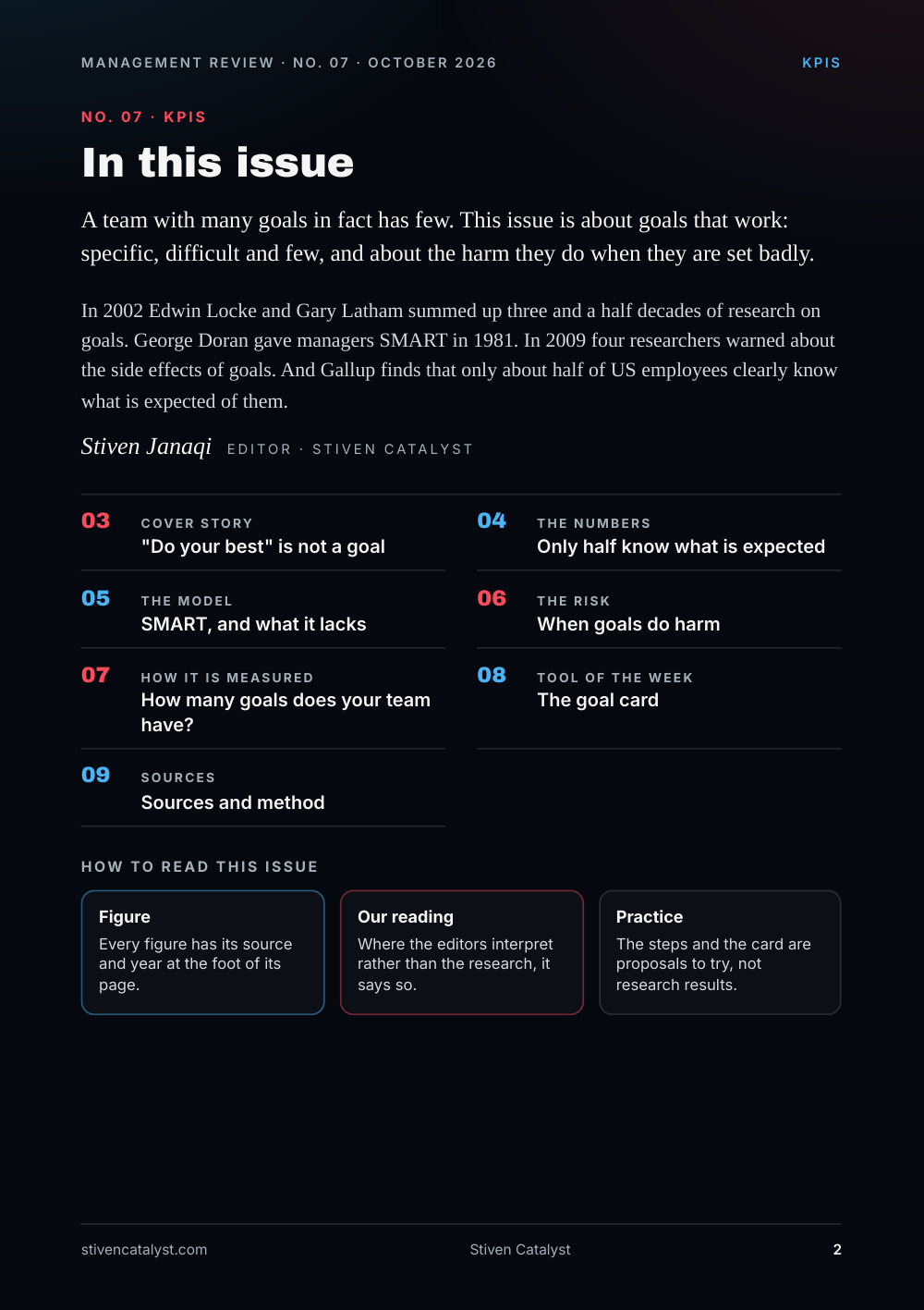
In this issue
A team with many goals in fact has few. This issue is about goals that work: specific, difficult and few, and about the harm they do when they are set badly.
In 2002 Edwin Locke and Gary Latham summed up three and a half decades of research on goals. George Doran gave managers SMART in 1981. In 2009 four researchers warned about the side effects of goals. And Gallup finds that only about half of US employees clearly know what is expected of them.
Stiven Janaqi, Editor
Cover story
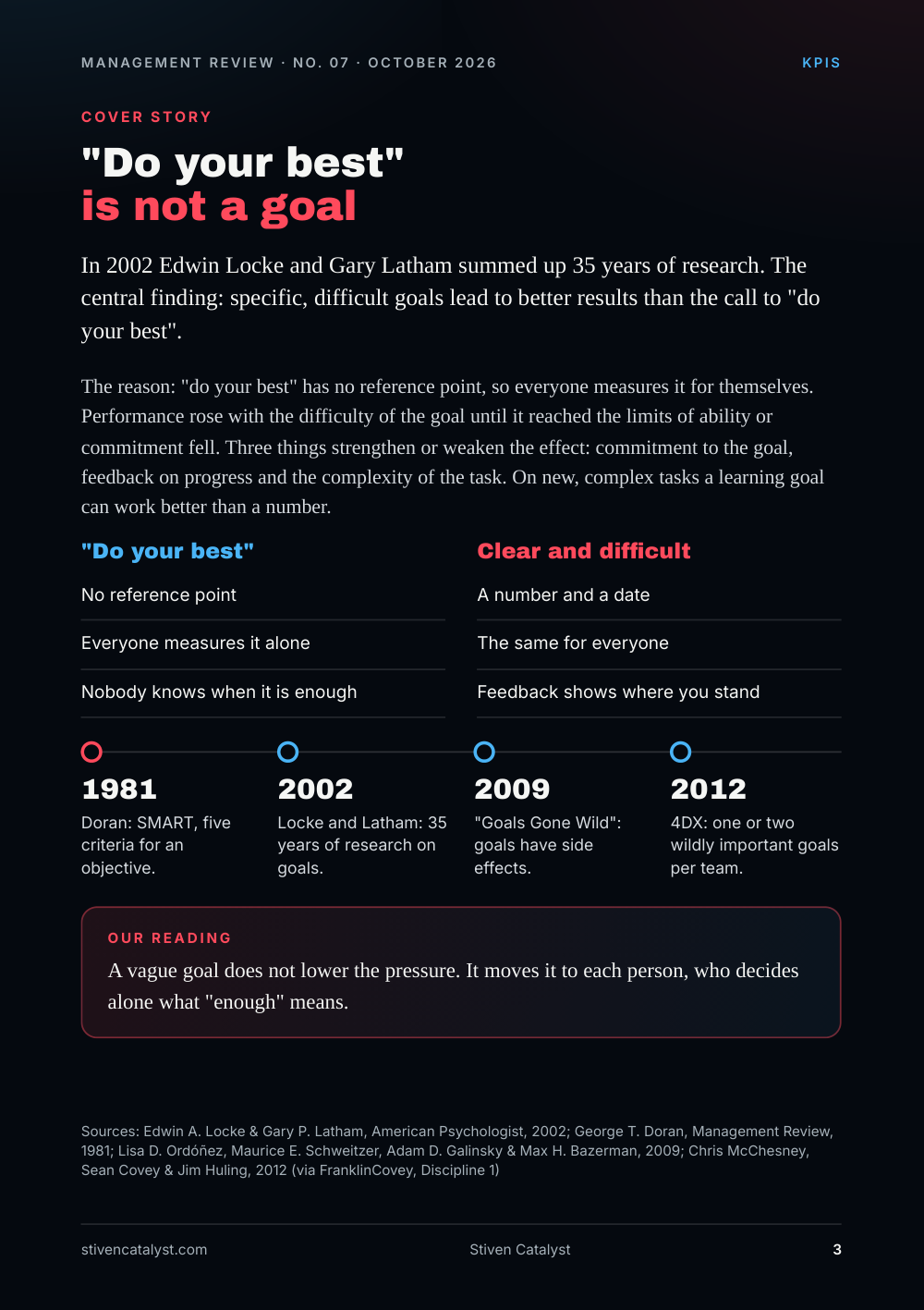
"Do your best" is not a goal
In 2002 Edwin Locke and Gary Latham summed up 35 years of research. The central finding: specific, difficult goals lead to better results than the call to "do your best".
The reason: "do your best" has no reference point, so everyone measures it for themselves. Performance rose with the difficulty of the goal until it reached the limits of ability or commitment fell. Three things strengthen or weaken the effect: commitment to the goal, feedback on progress and the complexity of the task. On new, complex tasks a learning goal can work better than a number.
"Do your best"
- No reference point
- Everyone measures it alone
- Nobody knows when it is enough
Clear and difficult
- A number and a date
- The same for everyone
- Feedback shows where you stand
- 1981 Doran: SMART, five criteria for an objective.
- 2002 Locke and Latham: 35 years of research on goals.
- 2009 "Goals Gone Wild": goals have side effects.
- 2012 4DX: one or two wildly important goals per team.
Our reading
A vague goal does not lower the pressure. It moves it to each person, who decides alone what "enough" means.
Sources: Edwin A. Locke & Gary P. Latham, American Psychologist, 2002; George T. Doran, Management Review, 1981; Lisa D. Ordóñez, Maurice E. Schweitzer, Adam D. Galinsky & Max H. Bazerman, 2009; Chris McChesney, Sean Covey & Jim Huling, 2012 (via FranklinCovey, Discipline 1)
The numbers
Only half know what is expected
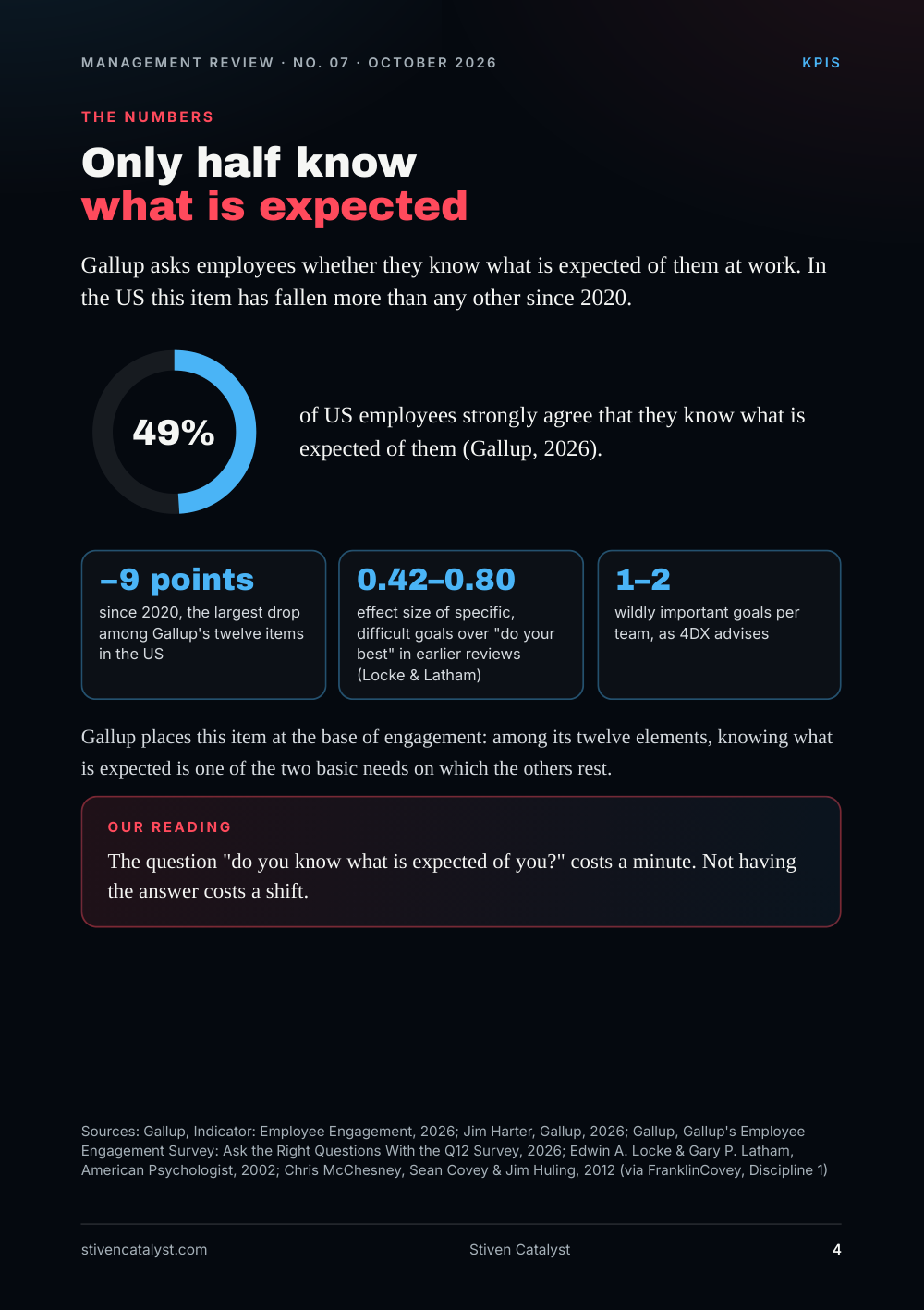
Gallup asks employees whether they know what is expected of them at work. In the US this item has fallen more than any other since 2020.
49% of US employees strongly agree that they know what is expected of them (Gallup, 2026).
- −9 points since 2020, the largest drop among Gallup's twelve items in the US
- 0.42–0.80 effect size of specific, difficult goals over "do your best" in earlier reviews (Locke & Latham)
- 1–2 wildly important goals per team, as 4DX advises
Gallup places this item at the base of engagement: among its twelve elements, knowing what is expected is one of the two basic needs on which the others rest.
Our reading
The question "do you know what is expected of you?" costs a minute. Not having the answer costs a shift.
Sources: Gallup, Indicator: Employee Engagement, 2026; Jim Harter, Gallup, 2026; Gallup, Gallup's Employee Engagement Survey: Ask the Right Questions With the Q12 Survey, 2026; Edwin A. Locke & Gary P. Latham, American Psychologist, 2002; Chris McChesney, Sean Covey & Jim Huling, 2012 (via FranklinCovey, Discipline 1)
The model
SMAR T, and what it lacks
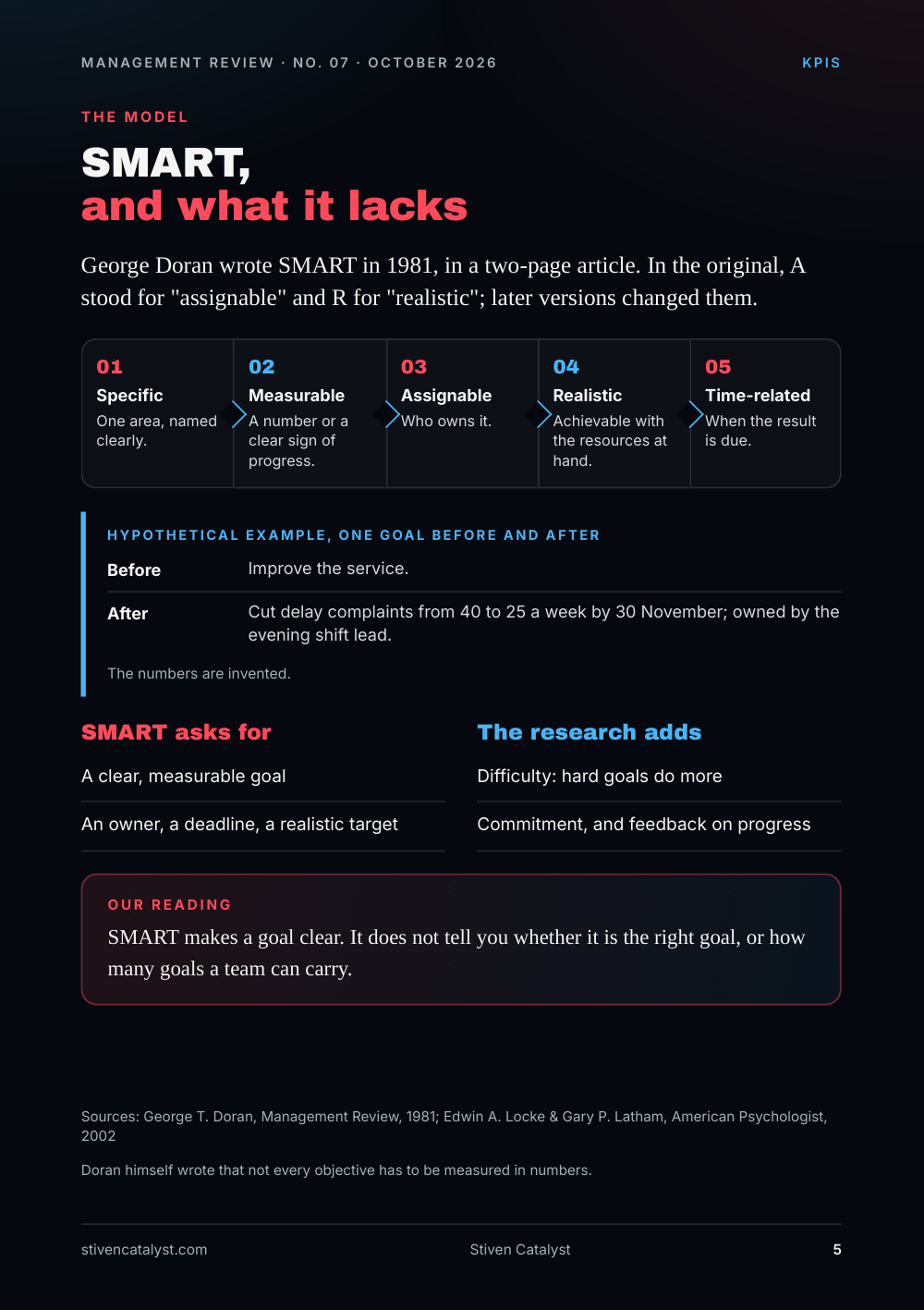
George Doran wrote SMART in 1981, in a two-page article. In the original, A stood for "assignable" and R for "realistic"; later versions changed them.
- Specific. One area, named clearly.
- Measurable. A number or a clear sign of progress.
- Assignable. Who owns it.
- Realistic. Achievable with the resources at hand.
- Time-related. When the result is due.
Hypothe tical example, one goal before and af ter
- Before: Improve the service.
- A
f ter: Cut delay complaints from 40 to 25 a week by 30 November; owned by the evening shift lead.
The numbers are invented.
SMAR T asks for
- A clear, measurable goal
- An owner, a deadline, a realistic target
The research adds
- Difficulty: hard goals do more
- Commitment, and feedback on progress
Our reading
SMART makes a goal clear. It does not tell you whether it is the right goal, or how many goals a team can carry.
Doran himself wrote that not every objective has to be measured in numbers.
Sources: George T. Doran, Management Review, 1981; Edwin A. Locke & Gary P. Latham, American Psychologist, 2002
The risk
When goals do harm
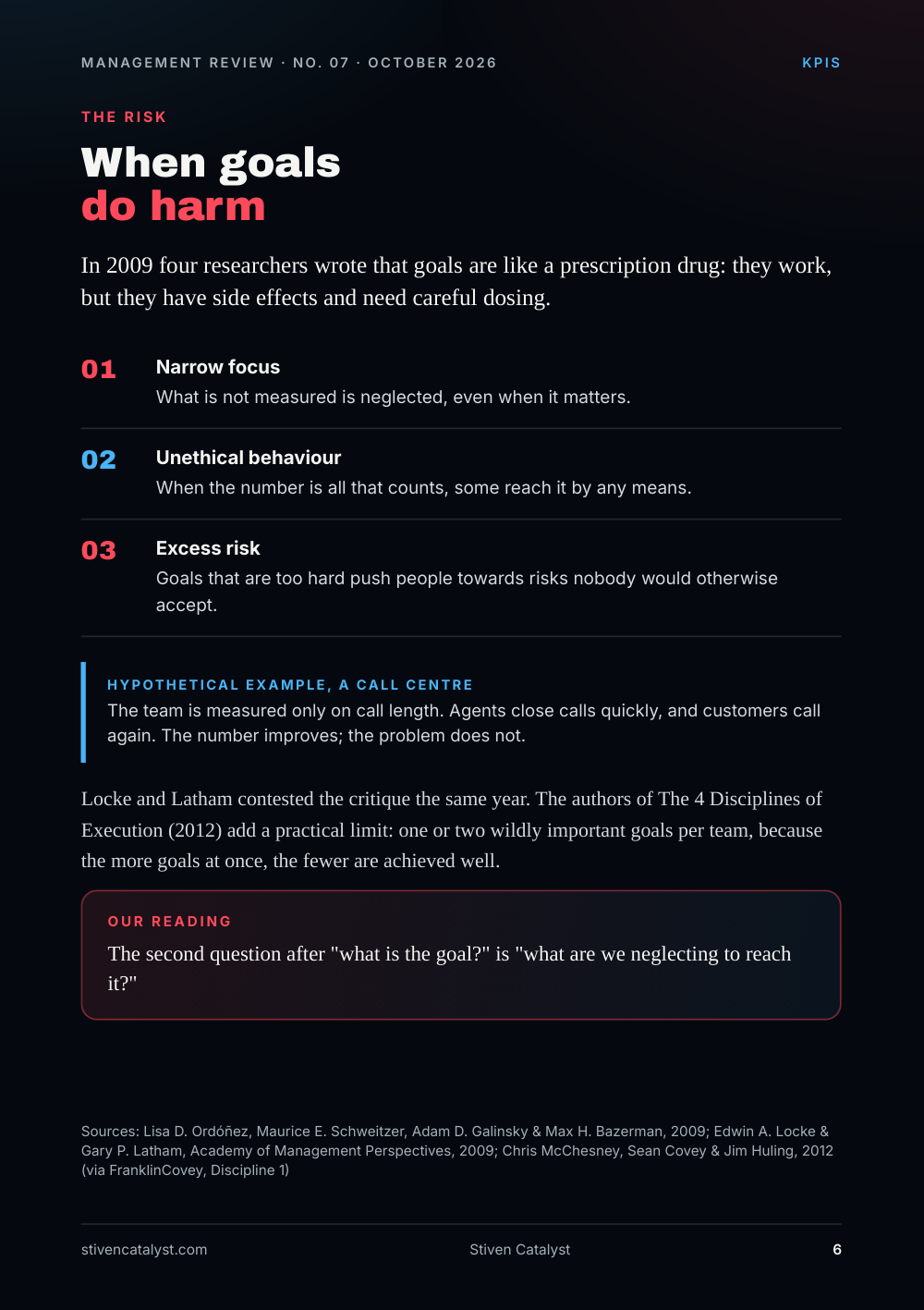
In 2009 four researchers wrote that goals are like a prescription drug: they work, but they have side effects and need careful dosing.
- Narrow focus. What is not measured is neglected, even when it matters.
- Un
e thical behaviour. When the number is all that counts, some reach it by any means. - Excess risk. Goals that are too hard push people towards risks nobody would otherwise accept.
Hypoth
Locke and Latham contested the critique the same year. The authors of The 4 Disciplines of Execution (2012) add a practical limit: one or two wildly important goals per team, because the more goals at once, the fewer are achieved well.
Our reading
The second question after "what is the goal?" is "what are we neglecting to reach it?"
Sources: Lisa D. Ordóñez, Maurice E. Schweitzer, Adam D. Galinsky & Max H. Bazerman, 2009; Edwin A. Locke & Gary P. Latham, Academy of Management Perspectives, 2009; Chris McChesney, Sean Covey & Jim Huling, 2012 (via FranklinCovey, Discipline 1)
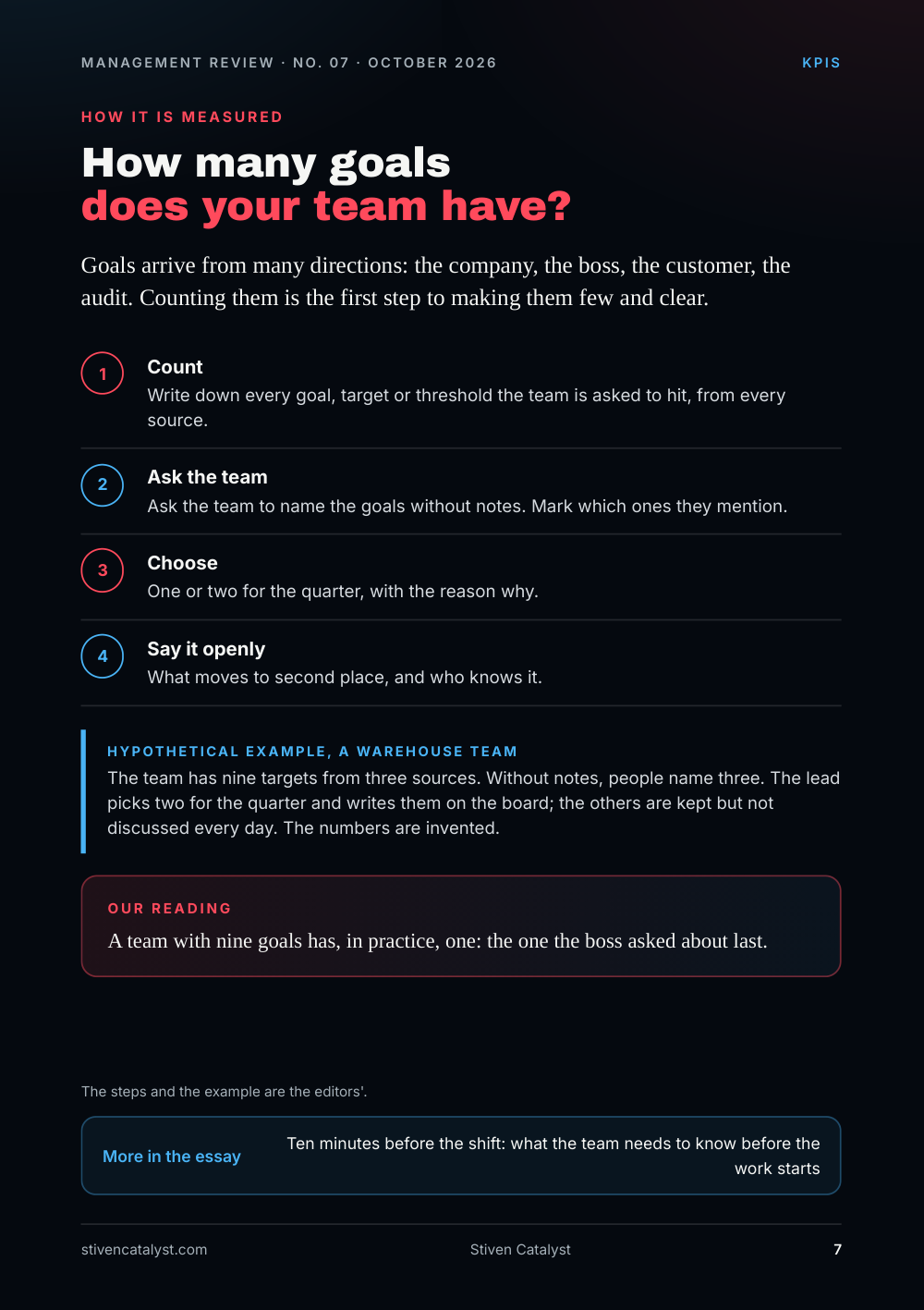
How it is measured
How many goals does your team have?
Goals arrive from many directions: the company, the boss, the customer, the audit. Counting them is the first step to making them few and clear.
- Count. Write down every goal, target or threshold the team is asked to hit, from every source.
- Ask the team. Ask the team to name the goals without notes. Mark which ones they mention.
- Choose. One or two for the quarter, with the reason why.
- Say it openly. What moves to second place, and who knows it.
Hypoth
Our reading
A team with nine goals has, in practice, one: the one the boss asked about last.
The steps and the example are the editors'.
More in the essay: Ten minutes before the shift: what the team needs to know before the work starts
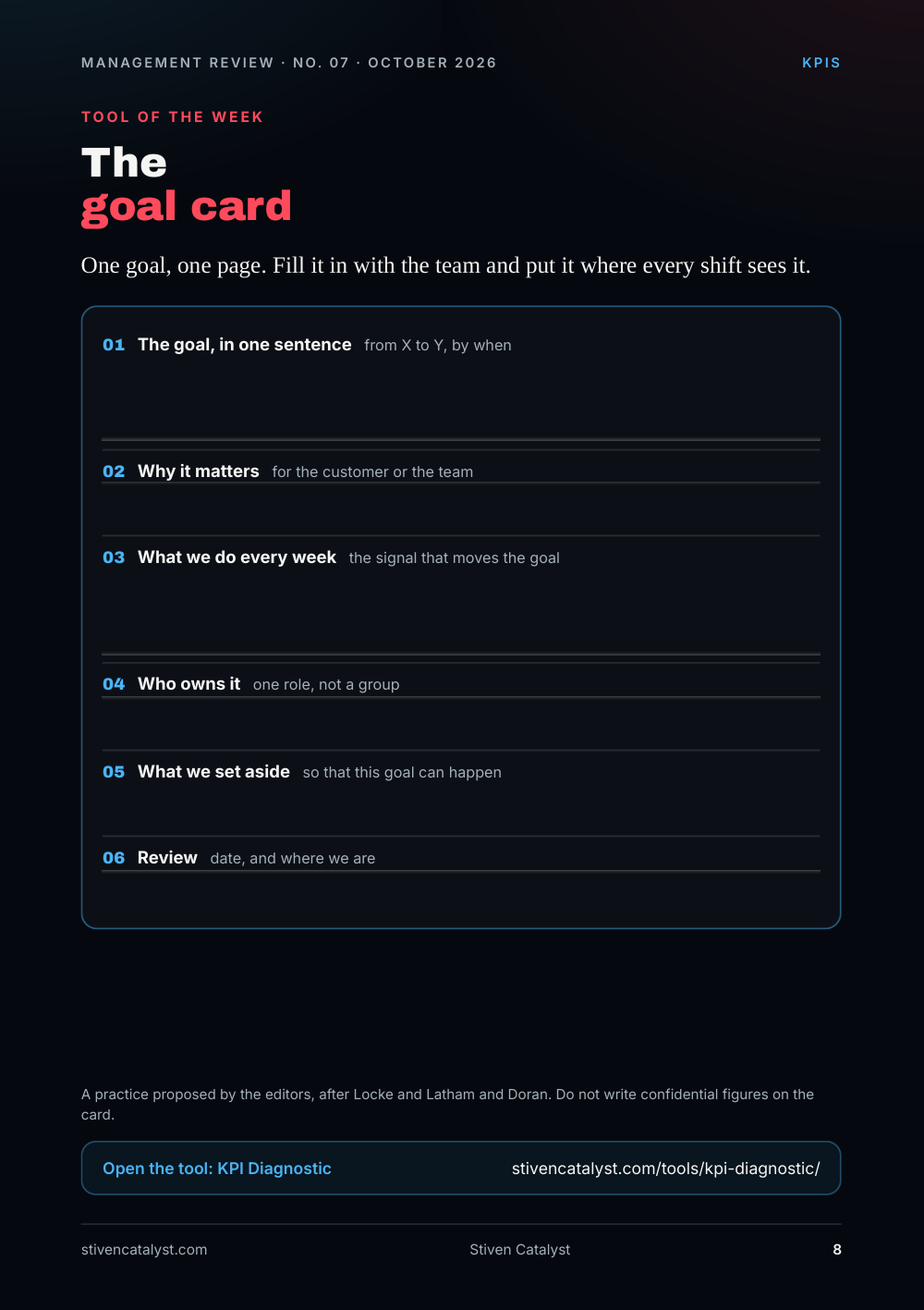
Tool of the week
The goal card
One goal, one page. Fill it in with the team and put it where every shift sees it.
- The goal, in one sentence from X to Y, by when
- Why it ma
t ters for the customer or the team - What we do every week the signal that moves the goal
- Who owns it one role, not a group
- What we s
e t aside so that this goal can happen - Review date, and where we are
A practice proposed by the editors, after Locke and Latham and Doran. Do not write confidential figures on the card.
Open the tool: KPI Diagnostic
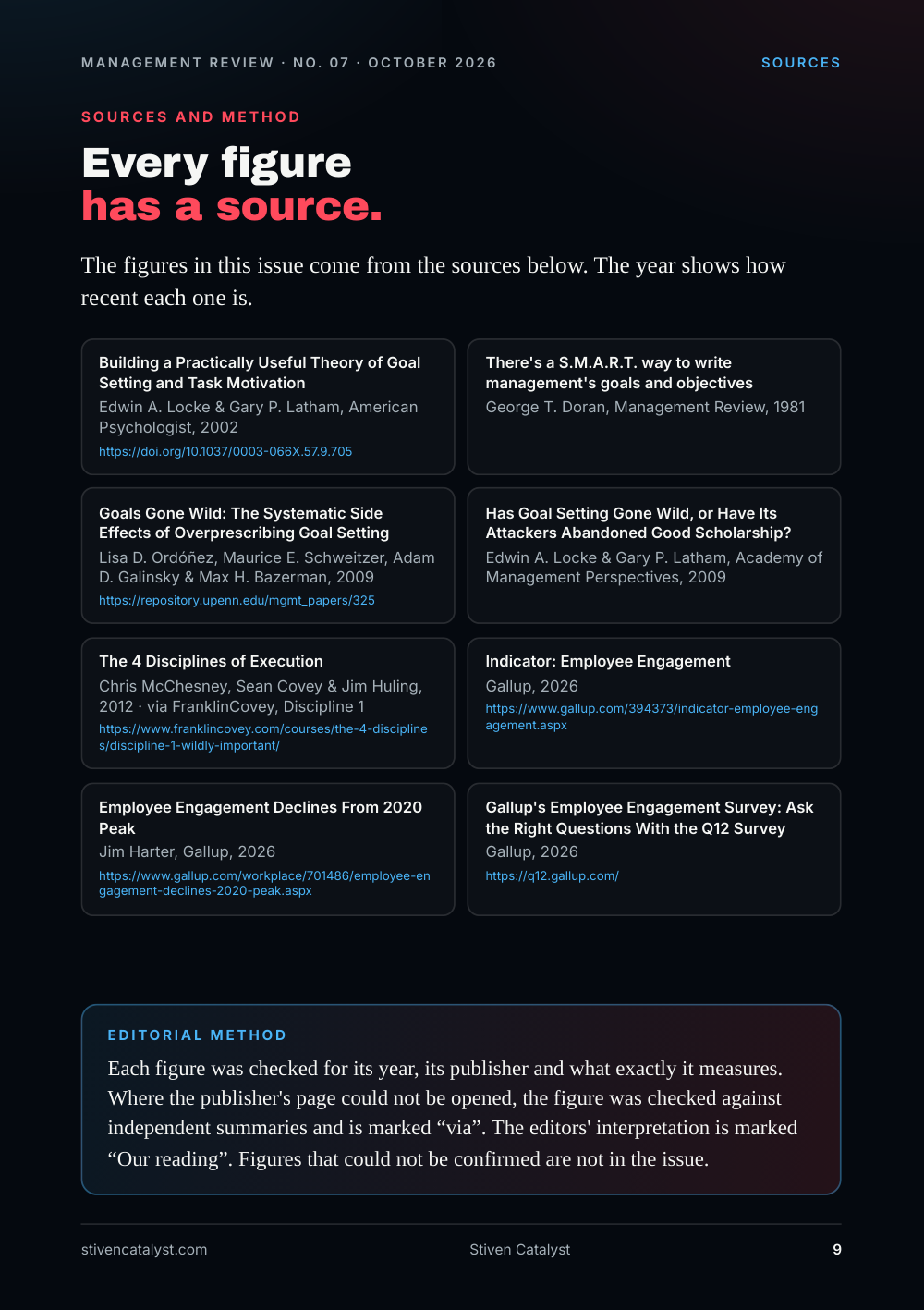
Sources and method
Every figure has a source.
The figures in this issue come from the sources below. The year shows how recent each one is.
- Edwin A. Locke & Gary P. Latham, American Psychologist, “Building a Practically Useful Theory of Goal Setting and Task Motivation”, 2002. https://doi.org/10.1037/0003-066X.57.9.705
- George T. Doran, Management Review, “There's a S.M.A.R.T. way to write management's goals and objectives”, 1981.
- Lisa D. Ordóñez, Maurice E. Schweitzer, Adam D. Galinsky & Max H. Bazerman, “Goals Gone Wild: The Systematic Side Effects of Overprescribing Goal Setting”, 2009. https://repository.upenn.edu/mgmt_papers/325
- Edwin A. Locke & Gary P. Latham, Academy of Management Perspectives, “Has Goal Setting Gone Wild, or Have Its Attackers Abandoned Good Scholarship?”, 2009.
- Chris McChesney, Sean Covey & Jim Huling, “The 4 Disciplines of Execution”, 2012 (via FranklinCovey, Discipline 1). https://www.franklincovey.com/courses/the-4-disciplines/discipline-1-wildly-important/
- Gallup, “Indicator: Employee Engagement”, 2026. https://www.gallup.com/394373/indicator-employee-engagement.aspx
- Jim Harter, Gallup, “Employee Engagement Declines From 2020 Peak”, 2026. https://www.gallup.com/workplace/701486/employee-engagement-declines-2020-peak.aspx
- Gallup, “Gallup's Employee Engagement Survey: Ask the Right Questions With the Q12 Survey”, 2026. https://q12.gallup.com/
Edit orial me thod
Each figure was checked for its year, its publisher and what exactly it measures. Where the publisher's page could not be opened, the figure was checked against independent summaries and is marked “via”. The editors' interpretation is marked “Our reading”. Figures that could not be confirmed are not in the issue.