In 2024 only 22% of US employees strongly agreed that they get the right amount of recognition for their work; in Europe about one in three workers feel their efforts go unnoticed. The recognition people remember most often comes from their manager. Gallup and Workhuman describe five pillars of recognition that works. In field experiments a thank-you card and a symbolic award raised performance, while an attendance award lowered the efficiency of those who already came reliably. Gallup estimates what a business could gain if twice as many people heard praise each week.
Management Review · First series · October 2026 · No. 34
Recognition that works
How few feel recognised enough, who gives the recognition people remember, the five pillars of Gallup and Workhuman, what field experiments show, what recognition is worth, and a card for recognition that lands.
- No.
- 34
- Pages
- 10
- Sources
- 8
- Topics
- People
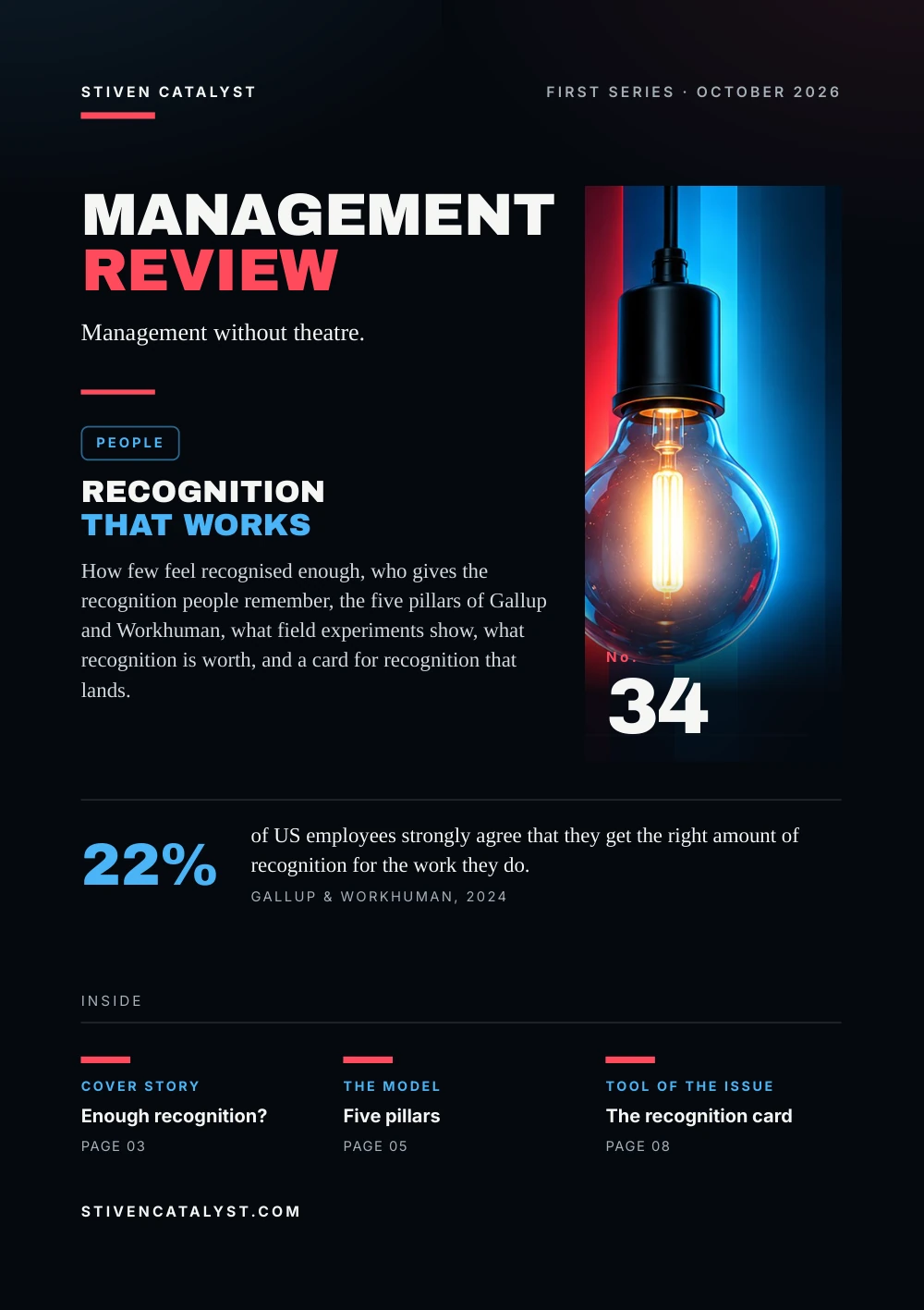
Stiven CatalystFirst series · October 2026
ManagementReview
Management without theatre.
People
Recognitionthat works
How few feel recognised enough, who gives the recognition people remember, the five pillars of Gallup and Workhuman, what field experiments show, what recognition is worth, and a card for recognition that lands.

No.34
22%
of US employees strongly agree that they get the right amount of recognition for the work they do.Gallup & Workhuman, 2024
stivencatalyst.com
No. 34 · People
In this issue
Recognition costs little and most managers give it, yet it often misses. This issue looks at how much of it people get, from whom, what makes it work, and when an award does more harm than good.
- 03Cover storyEnough recognition?
- 04The numbersWho people remember
- 05The modelFive pillars of recognition
- 06What the research saysA card helps, an award can harm
- 07How it is measuredWhat recognition is worth
- 08Tool of the issueThe recognition card
- 09SourcesSources and method
How to read this issue
Figure
Every figure has its source and year at the foot of its page.
Our reading
Where the editors interpret rather than the research, it says so.
Practice
The steps and the card are proposals to try, not research results.
Cover story
Enoughrecognition?
In spring 2024 Gallup and Workhuman asked employed adults in the United States about recognition at work. Only 22% strongly agreed that they get the right amount, the same share as in 2022.
strongly agree that they get the right amount of recognition for the work they do.
55%receive no recognition at all, or recognition that meets none of the five pillars on page 5
11%say someone at their workplace has ever asked how they like to be recognised
13%strongly agree they know how others at work like to be recognised
Our reading
Most of the 55% do hear a thank you. What is missing is recognition that fits the person and the work.
Source: Gallup & Workhuman, 2024
A US panel and self-reports; most results come from 4,439 people asked in April 2024. That the 22% is unchanged since 2022 is Gallup's statement in an article on the report.
The numbers
Who peopleremember
Gallup asked employees in a workplace survey to recall who gave them their most meaningful and memorable recognition. The answers, as Gallup published them in 2016:
Who gave the most memorable recognition (Gallup, 2016)
Day to day the picture is different. In 2024, 46% of US employees said a peer recognises them at least a few times a month, and 38% said the same of a manager. In EU-OSHA's 2025 telephone survey of over 28,000 workers in Europe, about one in three felt their efforts go unnoticed.
Our reading
Peers give recognition more often; the manager's is the one people remember most often. A team needs both.
Sources: Gallup, 2016; Gallup & Workhuman, 2024; EU-OSHA, 2025
Gallup gives no sample or year for the question on memorable recognition; the six answers add up to 100%. Self-reports; for Albania we have no comparable figure.
The model
Five pillarsof recognition
Gallup and Workhuman describe five pillars of strategic recognition. In their words, recognition has the most impact when it is fulfilling, authentic, personalised, equitable and embedded in the culture.
Fulfilling
the amount and the form fit the accomplishment
Authentic
it feels genuine, not like a box to tick
Personalised
it comes the way the person wants to be recognised
Equitable
it is about achievement, without favourites
Embedded
it is part of the values and of everyday work
In their 2024 report, employees whose recognition met even one pillar were 2.9 times as likely to be engaged as those whose recognition met none; with four or more, 9.0 times. Following 3,447 employees from 2022 to 2024, they found that the well-recognised, whose recognition met at least four pillars, were 45% less likely to have left two years later.
Our reading
The pillars describe how recognition is received, not how often it is given. Whether it worked is decided by the person who gets it.
Sources: Gallup & Workhuman, 2024; Gallup & Workhuman, 2023
Correlations from a US panel, studied with Workhuman, a firm that sells recognition software. The 45% comes from following the same people over time, but it is still not proof of cause.
More in the essayLeading people without losing the person
What the research says
A card helps,an award can harm
Surveys show correlations. Field experiments and a meta-analysis have tested recognition and rewards more directly, with effects in both directions.
≈ 12%better performance when students could win a purely symbolic award (Kosfeld & Neckermann, 2011)
−8%efficiency at daily tasks for workers with good attendance, after a laundry plant brought in an attendance award (Gubler et al., 2016)
d = 0.33effect of positive feedback on intrinsic motivation (Deci et al., 1999)
Christiane Bradler and colleagues hired over 300 people for a three-hour data-entry job and, after two hours, handed some an unannounced thank-you card. Performance rose, most when only the best got one, and mostly among those without one. The laundry award, a $75 gift card drawn among workers with perfect attendance, was also gamed. In Deci's meta-analysis of 128 studies, tangible and expected rewards lowered intrinsic motivation.
Our reading
Words and symbols can work. A prize tied to one measure can teach people to chase the measure, and those who already did well to feel overlooked.
Sources: Michael Kosfeld & Susanne Neckermann, American Economic Journal: Microeconomics, 2011; Christiane Bradler, Robert Dur, Susanne Neckermann & Arjan Non, Management Science, 2016 (via ZEW Discussion Paper No. 13-017, 2013); Timothy Gubler, Ian Larkin & Lamar Pierce, Organization Science, 2016 (via ScienceDaily, 2016); Edward L. Deci, Richard Koestner & Richard M. Ryan, Psychological Bulletin, 1999
Short tasks, students, one plant: the experiments show that recognition can matter, not how much it will in your team. The −8% applies to workers whose attendance was above average before the award.
How it is measured
What recognitionis wor th
Gallup estimated what the median business in its database could gain if twice as many employees strongly agreed that they had received recognition or praise for good work in the last seven days: one in two instead of one in four.
Estimated change if recognition doubled, median business
The estimate rests on Gallup's meta-analysis of 456 studies in 276 organisations, covering 2.7 million employees. Gallup warns that the three effects influence each other and cannot be added up. In a team, recognition can be counted without a survey:
Three things to count
- how many people were asked how they like to be recognised
- who was recognised this month, and who was not
- what for: results, help to colleagues, safety, learning
Source: Gallup & Workhuman, 2023
An estimate from correlations, made with a firm that sells recognition software. Gallup's survey item may not be reused without its consent. The list is the editors'.
Tool of the issue
The recognitioncard
One card, one person, once a week. Shift Pulse shows by day or week where a number improved; the card asks who made it happen and how to thank them. Once a month, look back at who was recognised.
01Whothe person or the team, role and shift
02What exactlywhat they did, in one sentence, with the date
03Why it matteredfor the customer, the team, safety or a goal
04How they like itasked? in private or before the team, spoken or written
05Fairness checkwho else contributed; who has not been recognised for a while
06Saidwhen, by whom, how it was received
Sources: Gallup & Workhuman, 2024; Timothy Gubler, Ian Larkin & Lamar Pierce, Organization Science, 2016 (via ScienceDaily, 2016)
A practice proposed by the editors, after the five pillars of Gallup and Workhuman and the experiments on page 6. It does not replace fair pay or promotion.
Open the tool: Shift Pulsestivencatalyst.com/tools/shift-pulse/
Sources and method
Every figurehas a source.
The figures in this issue come from the sources below. The year shows how recent each one is.
- The Human-Centered Workplace: Building Organizational Cultures That ThriveGallup & Workhuman, 2024https://www.gallup.com/file/analytics/650567/Gallup-Workhuman_Human-Centered-Workplace-Report.pdf
- Employee Recognition: Low Cost, High ImpactGallup, 2016https://www.gallup.com/workplace/236441/employee-recognition-low-cost-high-impact.aspx
- OSH Pulse 2025: Occupational safety and health in the era of climate and digital changeEU-OSHA, 2025https://osha.europa.eu/en/publications/osh-pulse-2025-occupational-safety-and-health-era-climate-and-digital-change
- From Praise to Profits: The Business Case for Recognition at WorkGallup & Workhuman, 2023https://www.gallup.com/file/analytics/472787/Gallup-Workhuman_ROI-Report.pdf
- Getting More Work for Nothing? Symbolic Awards and Worker PerformanceMichael Kosfeld & Susanne Neckermann, American Economic Journal: Microeconomics, 2011https://www.aeaweb.org/articles?id=10.1257/mic.3.3.86
- Employee Recognition and Performance: A Field ExperimentChristiane Bradler, Robert Dur, Susanne Neckermann & Arjan Non, Management Science, 2016 · via ZEW Discussion Paper No. 13-017, 2013https://doi.org/10.1287/mnsc.2015.2291
- Motivational Spillovers from Awards: Crowding Out in a Multitasking EnvironmentTimothy Gubler, Ian Larkin & Lamar Pierce, Organization Science, 2016 · via ScienceDaily, 2016https://doi.org/10.1287/orsc.2016.1047
- A Meta-Analytic Review of Experiments Examining the Effects of Extrinsic Rewards on Intrinsic MotivationEdward L. Deci, Richard Koestner & Richard M. Ryan, Psychological Bulletin, 1999https://doi.org/10.1037/0033-2909.125.6.627
Editorial method
Each figure was checked for its year, its publisher and what exactly it measures. Where the publisher's page could not be opened, the figure was checked against independent summaries and is marked “via”. The editors' interpretation is marked “Our reading”. Figures that could not be confirmed are not in the issue.
ManagementReview
Management without theatre.
Every issue, one management question, checked against the best research.
All issues
stivencatalyst.com/magazine/management-review.html
Management Review · No. 34 · October 2026 · Stiven Catalyst
Click or swipe a page to turn it. The arrow keys work too.
Management Review · No. 34
The figures of the issue
The charts of the printed pages, with their sources.
22% strongly agree that they get the right amount of recognition for the work they do.
Source: Gallup & Workhuman, 2024
Source: Gallup, 2016
Source: Gallup & Workhuman, 2023
The whole text Read the issue as text For reading on a small screen, searching or a screen reader. The same words, without the page design.
In this issue
Recognition costs little and most managers give it, yet it often misses. This issue looks at how much of it people get, from whom, what makes it work, and when an award does more harm than good.
In 2024 only 22% of US employees strongly agreed that they get the right amount of recognition for their work; in Europe about one in three workers feel their efforts go unnoticed. The recognition people remember most often comes from their manager. Gallup and Workhuman describe five pillars of recognition that works. In field experiments a thank-you card and a symbolic award raised performance, while an attendance award lowered the efficiency of those who already came reliably. Gallup estimates what a business could gain if twice as many people heard praise each week.
Stiven Janaqi, Editor
Cover story
Enough recognition?
In spring 2024 Gallup and Workhuman asked employed adults in the United States about recognition at work. Only 22% strongly agreed that they get the right amount, the same share as in 2022.
22% strongly agree that they get the right amount of recognition for the work they do.
- 55% receive no recognition at all, or recognition that meets none of the five pillars on page 5
- 11% say someone at their workplace has ever asked how they like to be recognised
- 13% strongly agree they know how others at work like to be recognised
Our reading
Most of the 55% do hear a thank you. What is missing is recognition that fits the person and the work.
A US panel and self-reports; most results come from 4,439 people asked in April 2024. That the 22% is unchanged since 2022 is Gallup's statement in an article on the report.
Source: Gallup & Workhuman, 2024
The numbers
Who people remember
Gallup asked employees in a workplace survey to recall who gave them their most meaningful and memorable recognition. The answers, as Gallup published them in 2016:
Who gave the most memorable recognition (Gallup, 2016): Manager 28%, Senior leader or CEO 24%, Manager's manager 12%, Customer 10%, Peers 9%, Other 17%.
Day to day the picture is different. In 2024, 46% of US employees said a peer recognises them at least a few times a month, and 38% said the same of a manager. In EU-OSHA's 2025 telephone survey of over 28,000 workers in Europe, about one in three felt their efforts go unnoticed.
Our reading
Peers give recognition more often; the manager's is the one people remember most often. A team needs both.
Gallup gives no sample or year for the question on memorable recognition; the six answers add up to 100%. Self-reports; for Albania we have no comparable figure.
Sources: Gallup, 2016; Gallup & Workhuman, 2024; EU-OSHA, 2025
The model
Five pillars of recognition
Gallup and Workhuman describe five pillars of strategic recognition. In their words, recognition has the most impact when it is fulfilling, authentic, personalised, equitable and embedded in the culture.
- Fulfilling. the amount and the form fit the accomplishment
- Authentic. it feels genuine, not like a box to tick
- Personalised. it comes the way the person wants to be recognised
- Equitable. it is about achievement, without favourites
- Embedded. it is part of the values and of everyday work
In their 2024 report, employees whose recognition met even one pillar were 2.9 times as likely to be engaged as those whose recognition met none; with four or more, 9.0 times. Following 3,447 employees from 2022 to 2024, they found that the well-recognised, whose recognition met at least four pillars, were 45% less likely to have left two years later.
Our reading
The pillars describe how recognition is received, not how often it is given. Whether it worked is decided by the person who gets it.
Correlations from a US panel, studied with Workhuman, a firm that sells recognition software. The 45% comes from following the same people over time, but it is still not proof of cause.
Sources: Gallup & Workhuman, 2024; Gallup & Workhuman, 2023
More in the essay: Leading people without losing the person
What the research says
A card helps, an award can harm
Surveys show correlations. Field experiments and a meta-analysis have tested recognition and rewards more directly, with effects in both directions.
- ≈ 12% better performance when students could win a purely symbolic award (Kosfeld & Neckermann, 2011)
- −8% efficiency at daily tasks for workers with good attendance, after a laundry plant brought in an attendance award (Gubler et al., 2016)
- d = 0.33 effect of positive feedback on intrinsic motivation (Deci et al., 1999)
Christiane Bradler and colleagues hired over 300 people for a three-hour data-entry job and, after two hours, handed some an unannounced thank-you card. Performance rose, most when only the best got one, and mostly among those without one. The laundry award, a $75 gift card drawn among workers with perfect attendance, was also gamed. In Deci's meta-analysis of 128 studies, tangible and expected rewards lowered intrinsic motivation.
Our reading
Words and symbols can work. A prize tied to one measure can teach people to chase the measure, and those who already did well to feel overlooked.
Short tasks, students, one plant: the experiments show that recognition can matter, not how much it will in your team. The −8% applies to workers whose attendance was above average before the award.
Sources: Michael Kosfeld & Susanne Neckermann, American Economic Journal: Microeconomics, 2011; Christiane Bradler, Robert Dur, Susanne Neckermann & Arjan Non, Management Science, 2016 (via ZEW Discussion Paper No. 13-017, 2013); Timothy Gubler, Ian Larkin & Lamar Pierce, Organization Science, 2016 (via ScienceDaily, 2016); Edward L. Deci, Richard Koestner & Richard M. Ryan, Psychological Bulletin, 1999
How it is measured
What recognition is wor th
Gallup estimated what the median business in its database could gain if twice as many employees strongly agreed that they had received recognition or praise for good work in the last seven days: one in two instead of one in four.
Estimated change if recognition doubled, median business: Productivity +9%, Safety incidents −22%, Absenteeism −22%.
The estimate rests on Gallup's meta-analysis of 456 studies in 276 organisations, covering 2.7 million employees. Gallup warns that the three effects influence each other and cannot be added up. In a team, recognition can be counted without a survey:
Three things t o count
- how many people were asked how they like to be recognised
- who was recognised this month, and who was not
- what for: results, help to colleagues, safety, learning
An estimate from correlations, made with a firm that sells recognition software. Gallup's survey item may not be reused without its consent. The list is the editors'.
Source: Gallup & Workhuman, 2023
Tool of the issue
The recognition card
One card, one person, once a week. Shift Pulse shows by day or week where a number improved; the card asks who made it happen and how to thank them. Once a month, look back at who was recognised.
- Who the person or the team, role and shift
- What exactly what they did, in one sentence, with the date
- Why it ma
t tered for the customer, the team, safety or a goal - How th
e y like it asked? in private or before the team, spoken or written - Fairness check who else contributed; who has not been recognised for a while
- Said when, by whom, how it was received
A practice proposed by the editors, after the five pillars of Gallup and Workhuman and the experiments on page 6. It does not replace fair pay or promotion.
Sources: Gallup & Workhuman, 2024; Timothy Gubler, Ian Larkin & Lamar Pierce, Organization Science, 2016 (via ScienceDaily, 2016)
Open the tool: Shift Pulse
Sources and method
Every figure has a source.
The figures in this issue come from the sources below. The year shows how recent each one is.
- Gallup & Workhuman, “The Human-Centered Workplace: Building Organizational Cultures That Thrive”, 2024. https://www.gallup.com/file/analytics/650567/Gallup-Workhuman_Human-Centered-Workplace-Report.pdf
- Gallup, “Employee Recognition: Low Cost, High Impact”, 2016. https://www.gallup.com/workplace/236441/employee-recognition-low-cost-high-impact.aspx
- EU-OSHA, “OSH Pulse 2025: Occupational safety and health in the era of climate and digital change”, 2025. https://osha.europa.eu/en/publications/osh-pulse-2025-occupational-safety-and-health-era-climate-and-digital-change
- Gallup & Workhuman, “From Praise to Profits: The Business Case for Recognition at Work”, 2023. https://www.gallup.com/file/analytics/472787/Gallup-Workhuman_ROI-Report.pdf
- Michael Kosfeld & Susanne Neckermann, American Economic Journal: Microeconomics, “Getting More Work for Nothing? Symbolic Awards and Worker Performance”, 2011. https://www.aeaweb.org/articles?id=10.1257/mic.3.3.86
- Christiane Bradler, Robert Dur, Susanne Neckermann & Arjan Non, Management Science, “Employee Recognition and Performance: A Field Experiment”, 2016 (via ZEW Discussion Paper No. 13-017, 2013). https://doi.org/10.1287/mnsc.2015.2291
- Timothy Gubler, Ian Larkin & Lamar Pierce, Organization Science, “Motivational Spillovers from Awards: Crowding Out in a Multitasking Environment”, 2016 (via ScienceDaily, 2016). https://doi.org/10.1287/orsc.2016.1047
- Edward L. Deci, Richard Koestner & Richard M. Ryan, Psychological Bulletin, “A Meta-Analytic Review of Experiments Examining the Effects of Extrinsic Rewards on Intrinsic Motivation”, 1999. https://doi.org/10.1037/0033-2909.125.6.627
Edit orial me thod
Each figure was checked for its year, its publisher and what exactly it measures. Where the publisher's page could not be opened, the figure was checked against independent summaries and is marked “via”. The editors' interpretation is marked “Our reading”. Figures that could not be confirmed are not in the issue.
Management Review · Monthly edition