In this issue
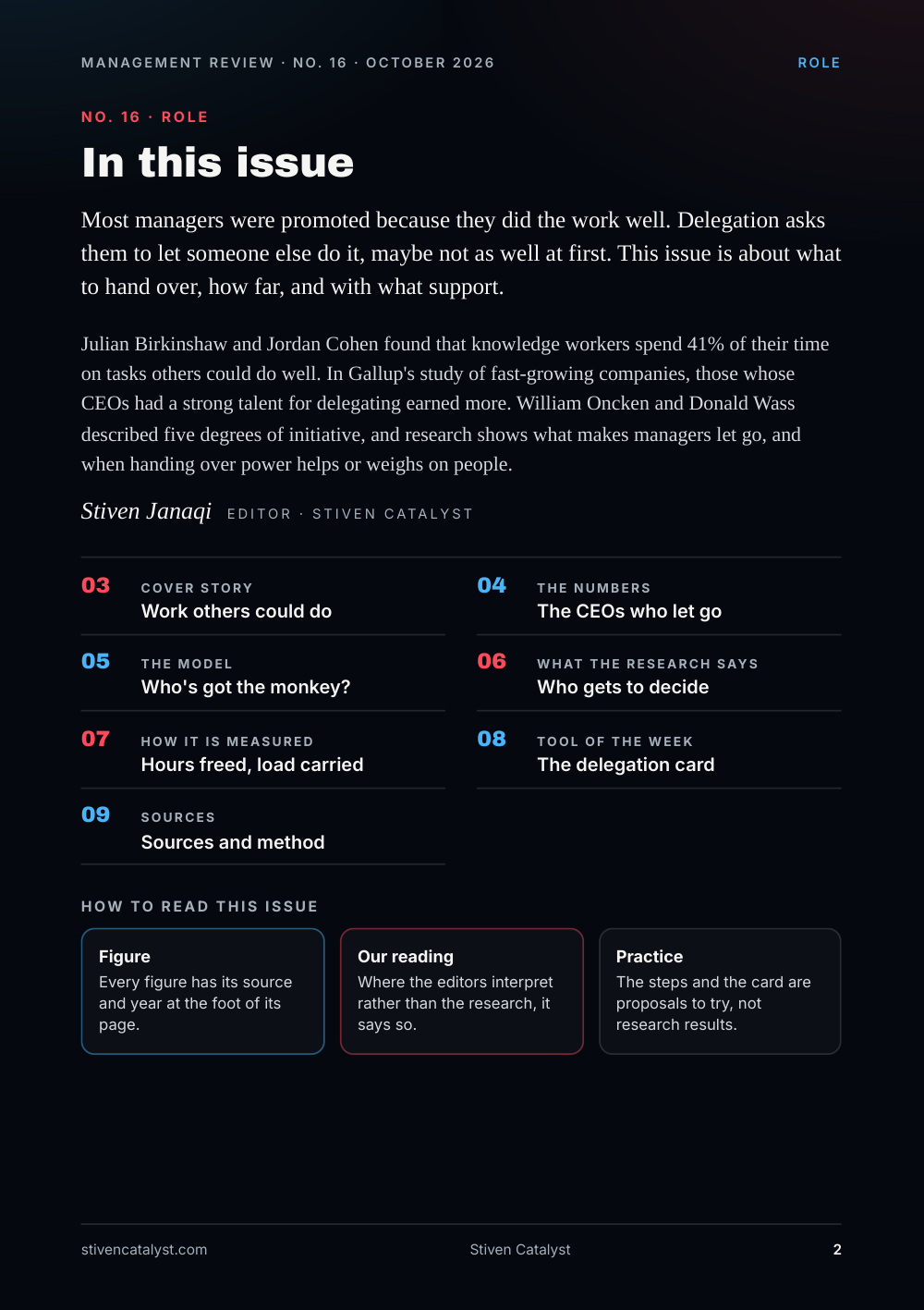
Most managers were promoted because they did the work well. Delegation asks them to let someone else do it, maybe not as well at first. This issue is about what to hand over, how far, and with what support.
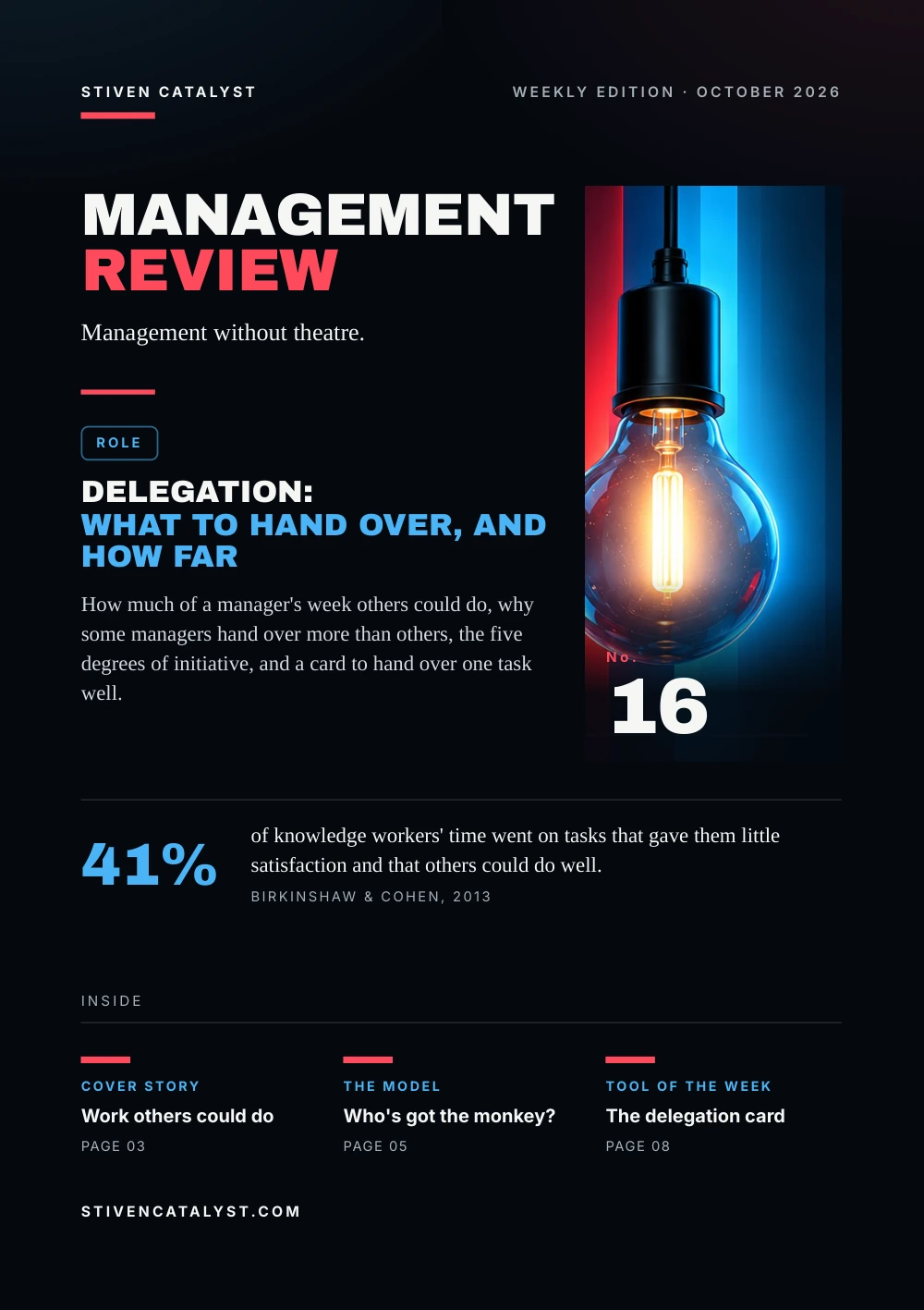
Julian Birkinshaw and Jordan Cohen found that knowledge workers spend 41% of their time on tasks others could do well. In Gallup's study of fast-growing companies, those whose CEOs had a strong talent for delegating earned more. William Oncken and Donald Wass described five degrees of initiative, and research shows what makes managers let go, and when handing over power helps or weighs on people.
Stiven Janaqi, Editor
Cover story
Work others could do
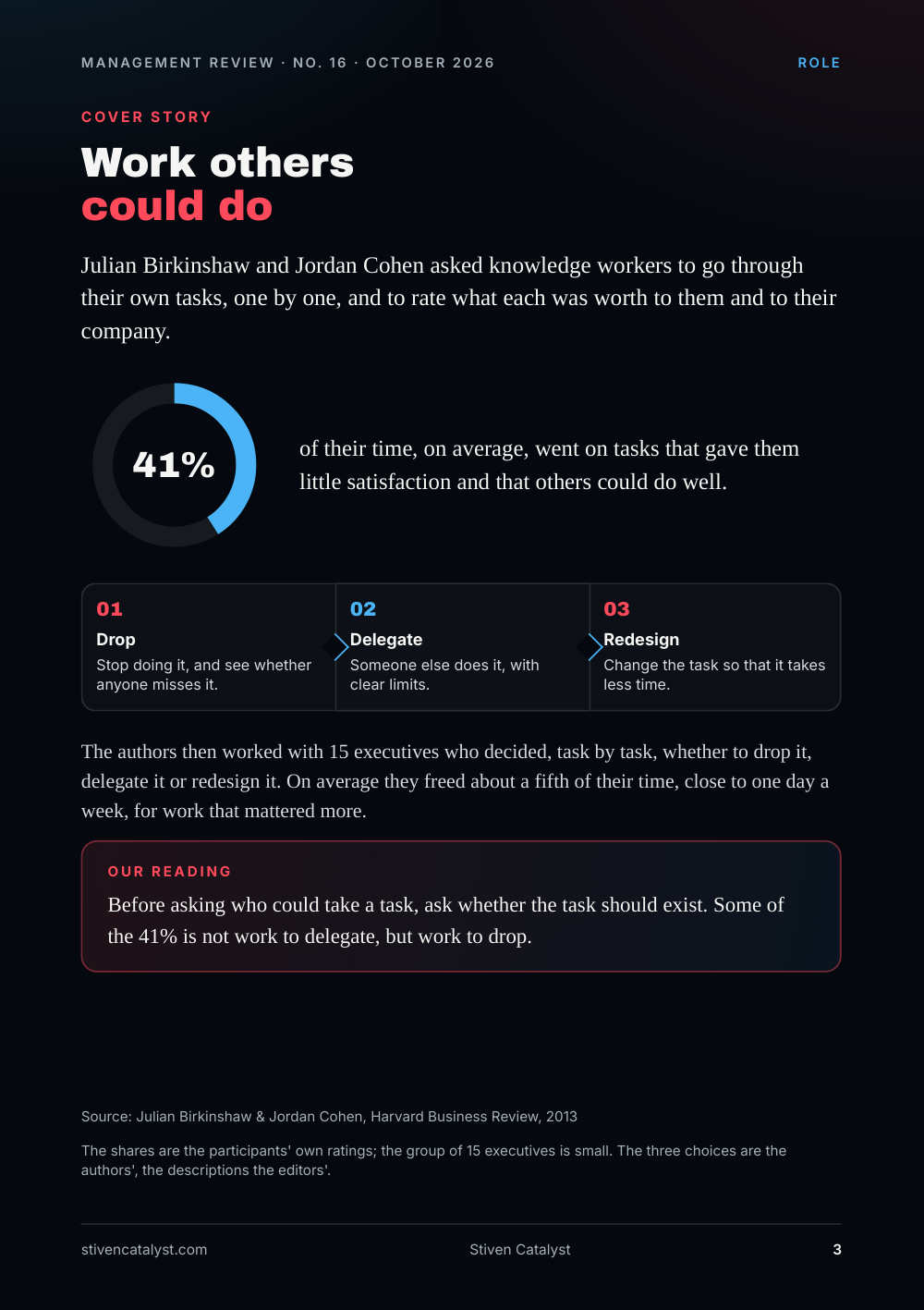
Julian Birkinshaw and Jordan Cohen asked knowledge workers to go through their own tasks, one by one, and to rate what each was worth to them and to their company.
41% of their time, on average, went on tasks that gave them little satisfaction and that others could do well.
- Drop. Stop doing it, and see whether anyone misses it.
- Delegate. Someone else does it, with clear limits.
- Redesign. Change the task so that it takes less time.
The authors then worked with 15 executives who decided, task by task, whether to drop it, delegate it or redesign it. On average they freed about a fifth of their time, close to one day a week, for work that mattered more.
Our reading
Before asking who could take a task, ask whether the task should exist. Some of the 41% is not work to delegate, but work to drop.
The shares are the participants' own ratings; the group of 15 executives is small. The three choices are the authors', the descriptions the editors'.
Source: Julian Birkinshaw & Jordan Cohen, Harvard Business Review, 2013
The numbers
The CEOs who le t go
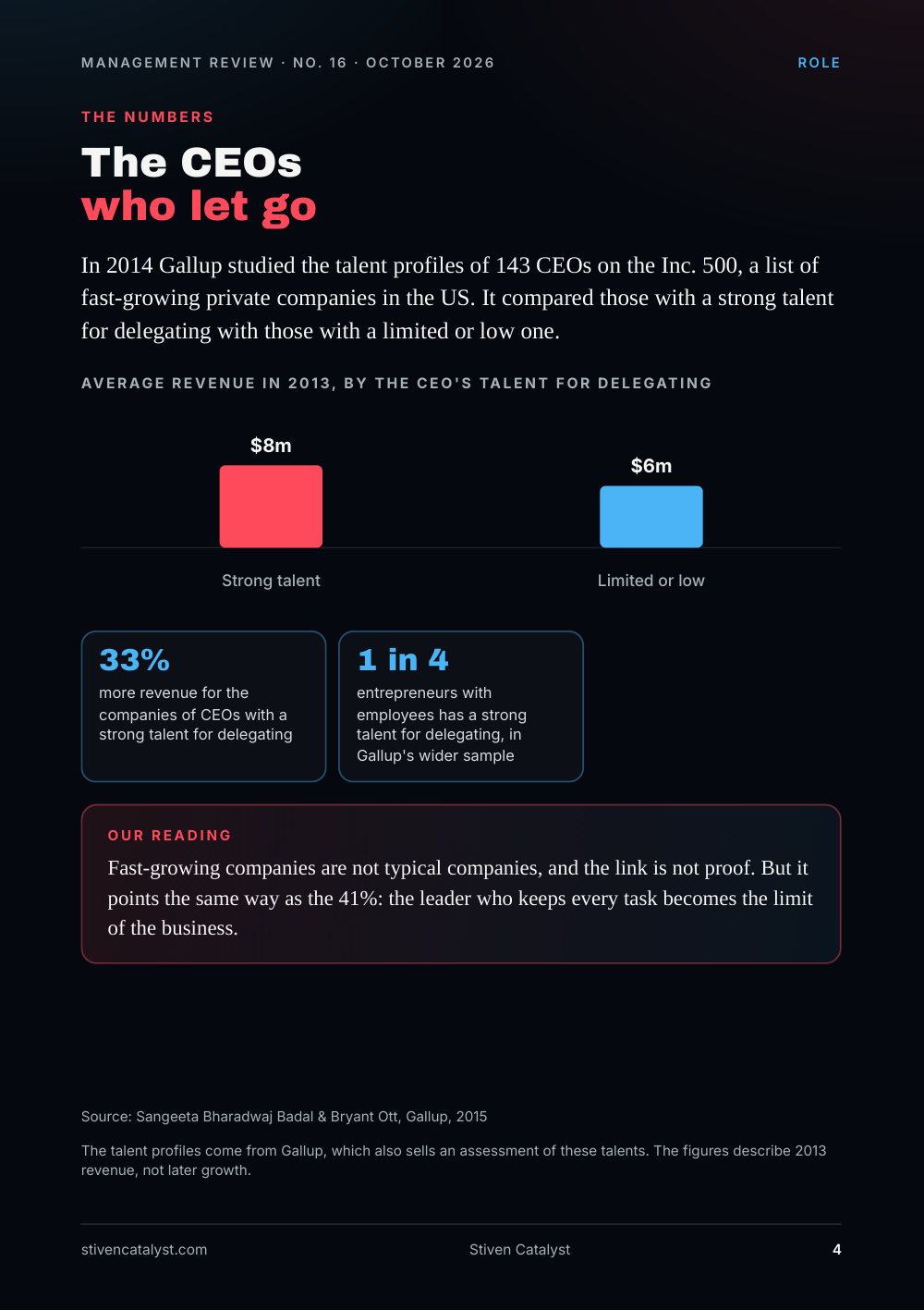
In 2014 Gallup studied the talent profiles of 143 CEOs on the Inc. 500, a list of fast-growing private companies in the US. It compared those with a strong talent for delegating with those with a limited or low one.
Average revenue in 2013, by the CEO's talent for delegating: Strong talent $8m, Limited or low $6m.
- 33% more revenue for the companies of CEOs with a strong talent for delegating
- 1 in 4 entrepreneurs with employees has a strong talent for delegating, in Gallup's wider sample
Our reading
Fast-growing companies are not typical companies, and the link is not proof. But it points the same way as the 41%: the leader who keeps every task becomes the limit of the business.
The talent profiles come from Gallup, which also sells an assessment of these talents. The figures describe 2013 revenue, not later growth.
Source: Sangeeta Bharadwaj Badal & Bryant Ott, Gallup, 2015
The model
Who's got the monke y?
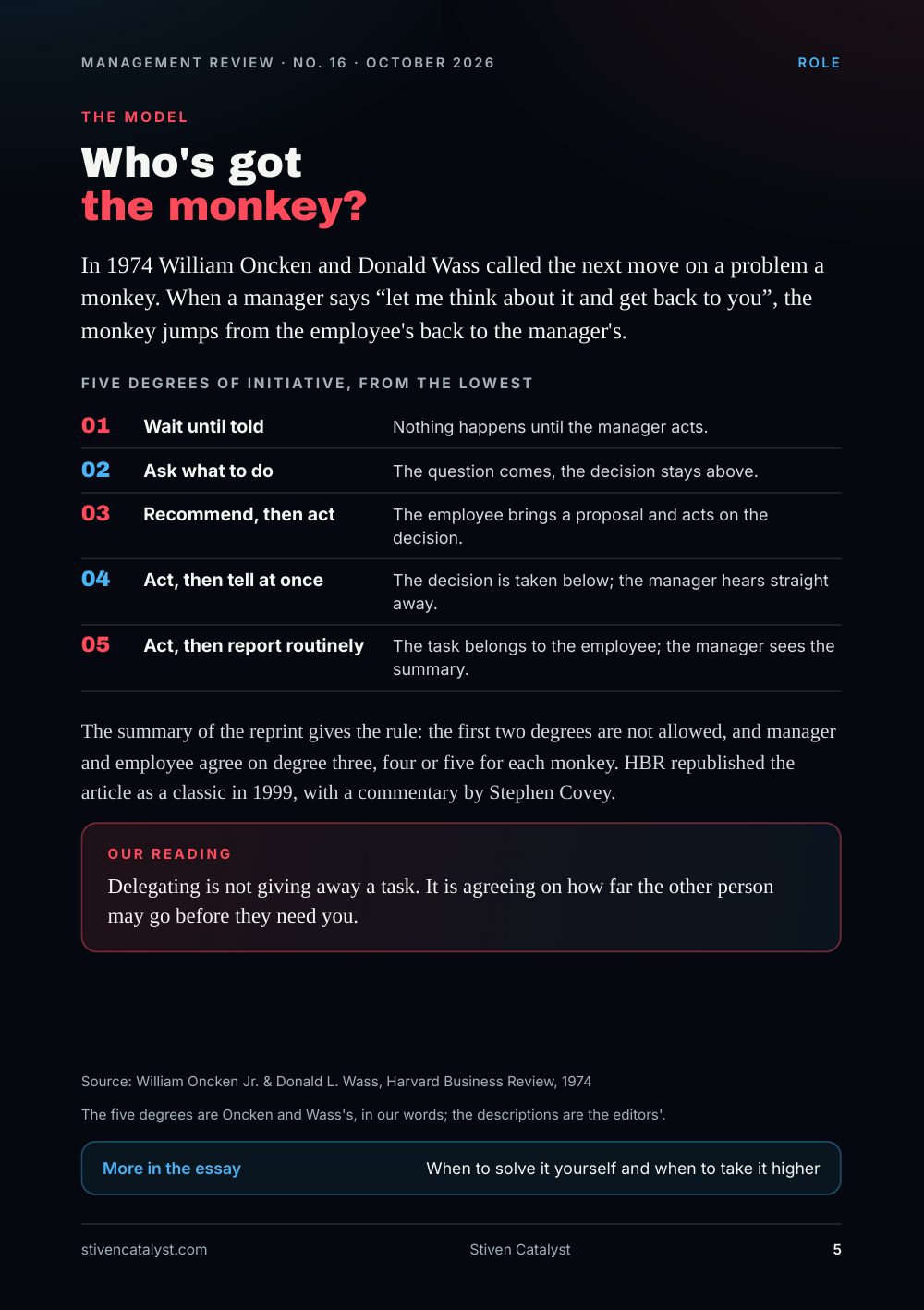
In 1974 William Oncken and Donald Wass called the next move on a problem a monkey. When a manager says “let me think about it and get back to you”, the monkey jumps from the employee's back to the manager's.
Five degrees of initiative, from the lowest
- Wait until
t old. Nothing happens until the manager acts. - Ask what
t o do. The question comes, the decision stays above. - Recommend, then act. The employee brings a proposal and acts on the decision.
- Act, then tell at once. The decision is taken below; the manager hears straight away.
- Act, then repo
r t routinely. The task belongs to the employee; the manager sees the summary.
The summary of the reprint gives the rule: the first two degrees are not allowed, and manager and employee agree on degree three, four or five for each monkey. HBR republished the article as a classic in 1999, with a commentary by Stephen Covey.
Our reading
Delegating is not giving away a task. It is agreeing on how far the other person may go before they need you.
The five degrees are Oncken and Wass's, in our words; the descriptions are the editors'.
Source: William Oncken Jr. & Donald L. Wass, Harvard Business Review, 1974
More in the essay: When to solve it yourself and when to take it higher
What the research says
Who ge ts t o decide
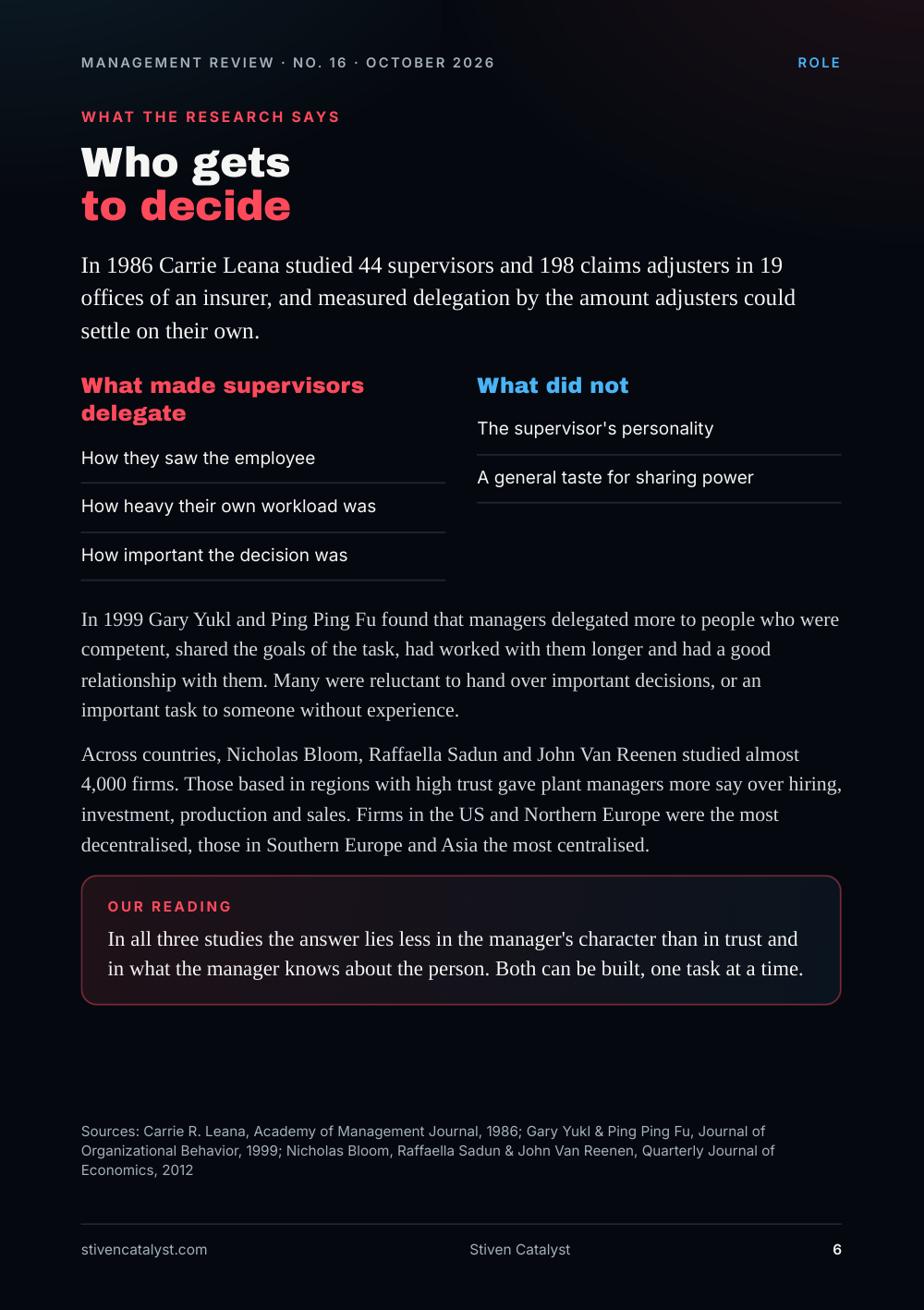
In 1986 Carrie Leana studied 44 supervisors and 198 claims adjusters in 19 offices of an insurer, and measured delegation by the amount adjusters could settle on their own.
What made supervisors delegate
- How they saw the employee
- How heavy their own workload was
- How important the decision was
What did not
- The supervisor's personality
- A general taste for sharing power
In 1999 Gary Yukl and Ping Ping Fu found that managers delegated more to people who were competent, shared the goals of the task, had worked with them longer and had a good relationship with them. Many were reluctant to hand over important decisions, or an important task to someone without experience.
Across countries, Nicholas Bloom, Raffaella Sadun and John Van Reenen studied almost 4,000 firms. Those based in regions with high trust gave plant managers more say over hiring, investment, production and sales. Firms in the US and Northern Europe were the most decentralised, those in Southern Europe and Asia the most centralised.
Our reading
In all three studies the answer lies less in the manager's character than in trust and in what the manager knows about the person. Both can be built, one task at a time.
Sources: Carrie R. Leana, Academy of Management Journal, 1986; Gary Yukl & Ping Ping Fu, Journal of Organizational Behavior, 1999; Nicholas Bloom, Raffaella Sadun & John Van Reenen, Quarterly Journal of Economics, 2012
How it is measured
Hours freed, load carried
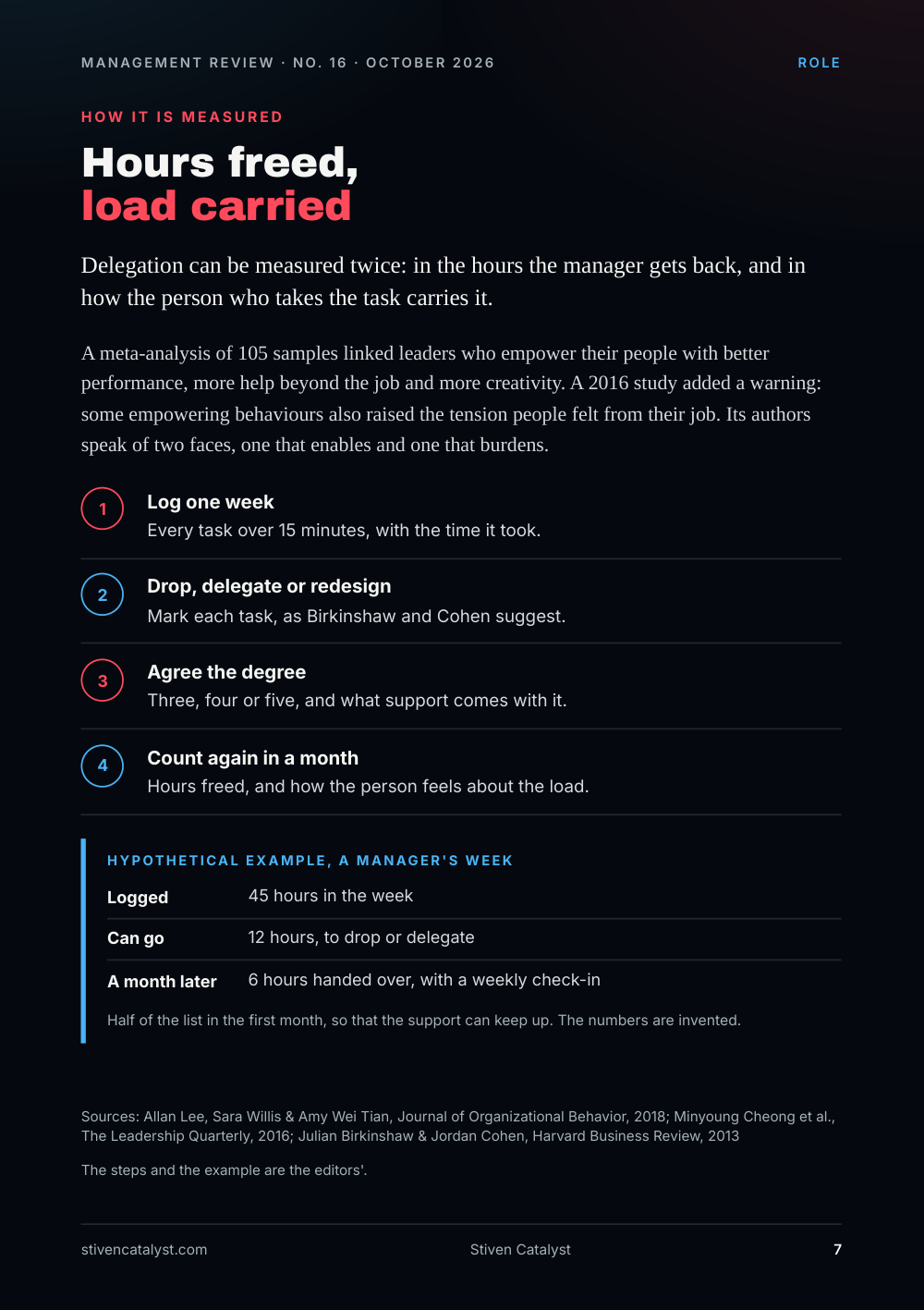
Delegation can be measured twice: in the hours the manager gets back, and in how the person who takes the task carries it.
A meta-analysis of 105 samples linked leaders who empower their people with better performance, more help beyond the job and more creativity. A 2016 study added a warning: some empowering behaviours also raised the tension people felt from their job. Its authors speak of two faces, one that enables and one that burdens.
- Log one week. Every task over 15 minutes, with the time it took.
- Drop, delegate or redesign. Mark each task, as Birkinshaw and Cohen suggest.
- Agree the degree. Three, four or five, and what support comes with it.
- Count again in a month. Hours freed, and how the person feels about the load.
Hypothe tical example, a manager's week
- Logged: 45 hours in the week
- Can go: 12 hours, to drop or delegate
- A month later: 6 hours handed over, with a weekly check-in
Half of the list in the first month, so that the support can keep up. The numbers are invented.
The steps and the example are the editors'.
Sources: Allan Lee, Sara Willis & Amy Wei Tian, Journal of Organizational Behavior, 2018; Minyoung Cheong et al., The Leadership Quarterly, 2016; Julian Birkinshaw & Jordan Cohen, Harvard Business Review, 2013
Tool of the week
The delegation card
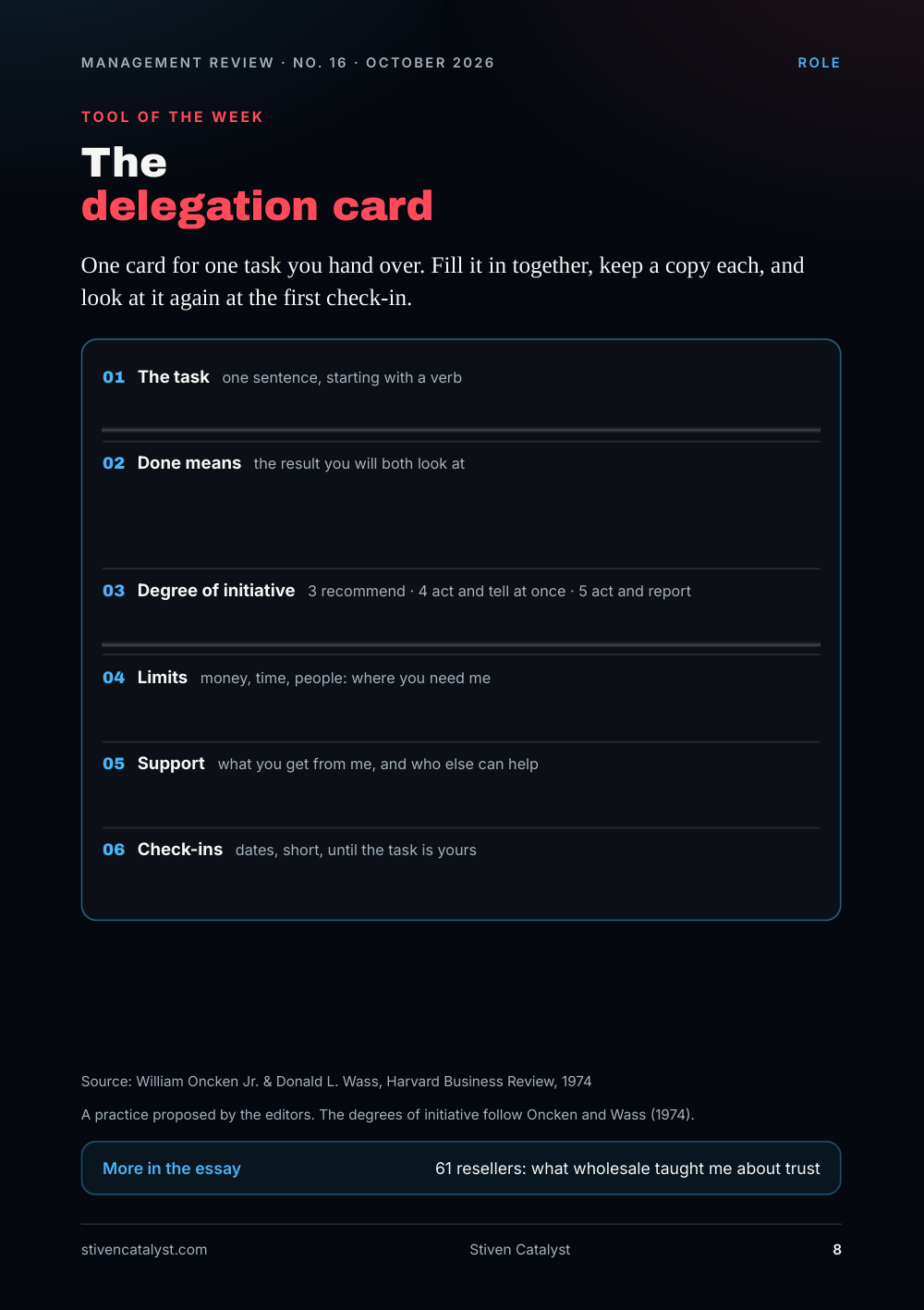
One card for one task you hand over. Fill it in together, keep a copy each, and look at it again at the first check-in.
- The task one sentence, starting with a verb
- Done means the result you will both look at
- Degree of initiative 3 recommend · 4 act and tell at once · 5 act and report
- Limits money, time, people: where you need me
- Suppo
r t what you get from me, and who else can help - Check-ins dates, short, until the task is yours
A practice proposed by the editors. The degrees of initiative follow Oncken and Wass (1974).
Source: William Oncken Jr. & Donald L. Wass, Harvard Business Review, 1974
More in the essay: 61 resellers: what wholesale taught me about trust
Sources and method
Every figure has a source.
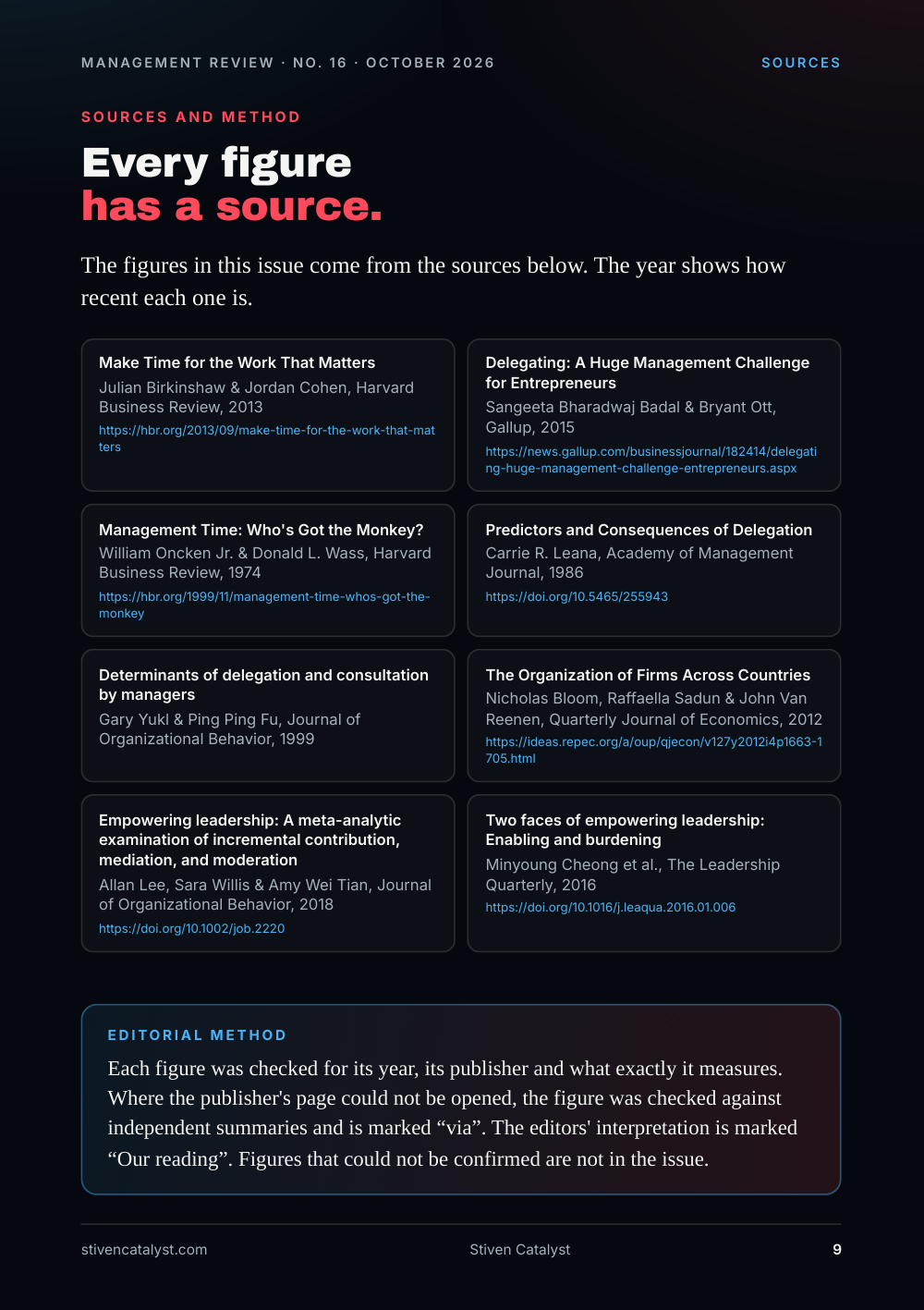
The figures in this issue come from the sources below. The year shows how recent each one is.
- Julian Birkinshaw & Jordan Cohen, Harvard Business Review, “Make Time for the Work That Matters”, 2013. https://hbr.org/2013/09/make-time-for-the-work-that-matters
- Sangeeta Bharadwaj Badal & Bryant Ott, Gallup, “Delegating: A Huge Management Challenge for Entrepreneurs”, 2015. https://news.gallup.com/businessjournal/182414/delegating-huge-management-challenge-entrepreneurs.aspx
- William Oncken Jr. & Donald L. Wass, Harvard Business Review, “Management Time: Who's Got the Monkey?”, 1974. https://hbr.org/1999/11/management-time-whos-got-the-monkey
- Carrie R. Leana, Academy of Management Journal, “Predictors and Consequences of Delegation”, 1986. https://doi.org/10.5465/255943
- Gary Yukl & Ping Ping Fu, Journal of Organizational Behavior, “Determinants of delegation and consultation by managers”, 1999.
- Nicholas Bloom, Raffaella Sadun & John Van Reenen, Quarterly Journal of Economics, “The Organization of Firms Across Countries”, 2012. https://ideas.repec.org/a/oup/qjecon/v127y2012i4p1663-1705.html
- Allan Lee, Sara Willis & Amy Wei Tian, Journal of Organizational Behavior, “Empowering leadership: A meta-analytic examination of incremental contribution, mediation, and moderation”, 2018. https://doi.org/10.1002/job.2220
- Minyoung Cheong et al., The Leadership Quarterly, “Two faces of empowering leadership: Enabling and burdening”, 2016. https://doi.org/10.1016/j.leaqua.2016.01.006
Edit orial me thod
Each figure was checked for its year, its publisher and what exactly it measures. Where the publisher's page could not be opened, the figure was checked against independent summaries and is marked “via”. The editors' interpretation is marked “Our reading”. Figures that could not be confirmed are not in the issue.