Christine Porath and Christine Pearson polled 800 managers and employees in 17 industries: of those treated rudely, 48% cut their effort and 12% left their job. Lynne Andersson and Pearson describe how one rude act can spiral into aggression. In experiments, people treated rudely did worse and helped less, and customers who watched an employee being insulted judged the whole company more harshly. A seven-question scale measures incivility, and a card helps with one incident.
Management Review · Second series · November 2026 · No. 79
The price of incivilit y
Rudeness that is small but not harmless, what it costs those on the receiving end, the spiral it can start, an experiment with dropped pencils, customers who watch, how it is measured, and a card for one incident.
- No.
- 79
- Pages
- 10
- Sources
- 6
- Topics
- People
Stiven CatalystSecond series · November 2026
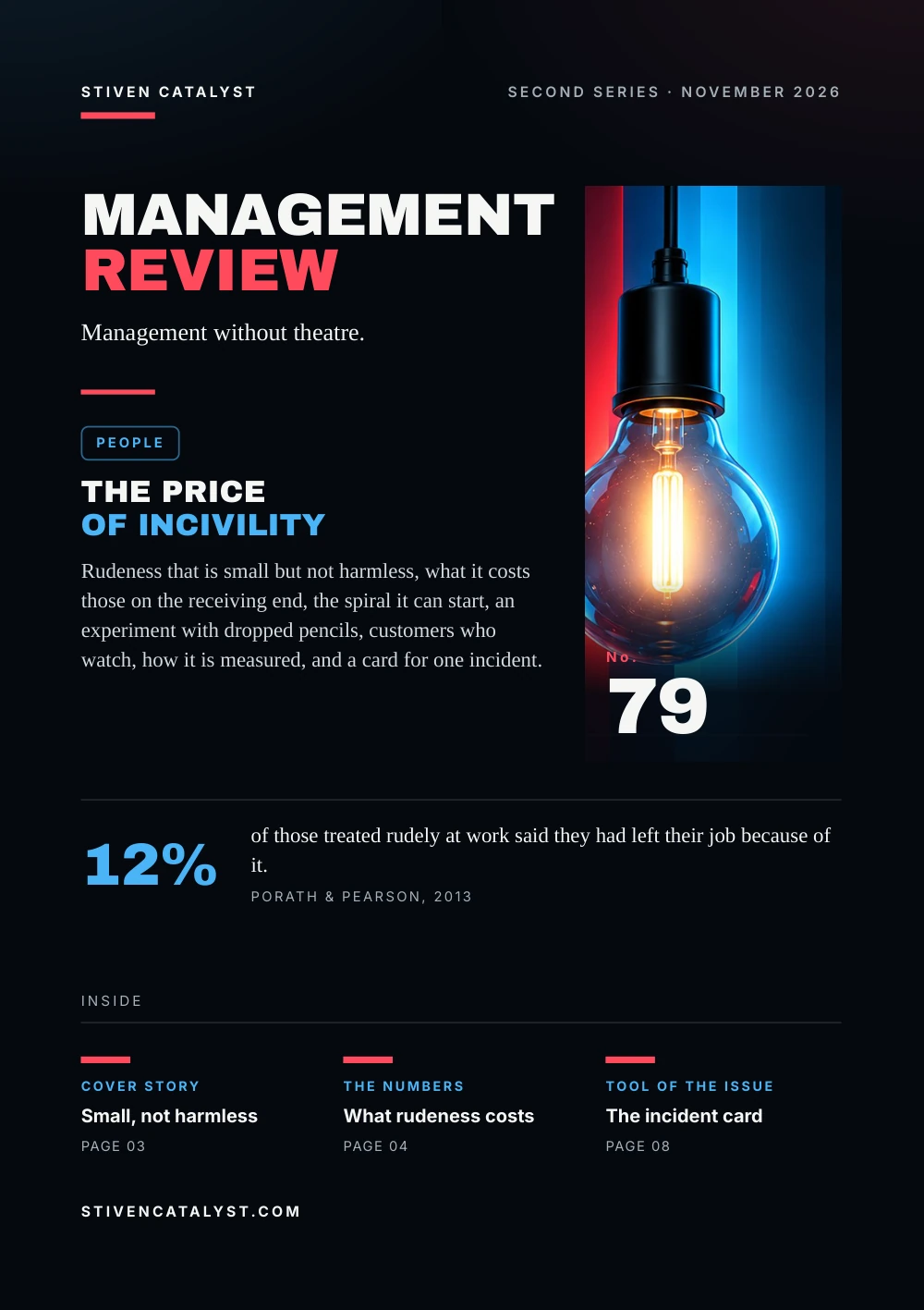
ManagementReview
Management without theatre.
People
The priceof incivility
Rudeness that is small but not harmless, what it costs those on the receiving end, the spiral it can start, an experiment with dropped pencils, customers who watch, how it is measured, and a card for one incident.

No.79
12%
of those treated rudely at work said they had left their job because of it.Porath & Pearson, 2013
stivencatalyst.com
No. 79 · People
In this issue
Most rudeness at work is not shouting or bullying. It is a curt reply, a question ignored, a remark in front of others. Each one looks too small to matter. This issue counts what it costs and asks what a manager can do about it.
- 03Cover storySmall, not harmless
- 04The numbersWhat rudeness costs
- 05The modelThe incivility spiral
- 06What the research saysRudeness in the lab
- 07How it is measuredSeven questions, five years
- 08Tool of the issueThe incident card
- 09SourcesSources and method
How to read this issue
Figure
Every figure has its source and year at the foot of its page.
Our reading
Where the editors interpret rather than the research, it says so.
Practice
The steps and the card are proposals to try, not research results.
Cover story
Small,not harmless
In 1999 Lynne Andersson and Christine Pearson gave everyday rudeness at work a name and a definition. Workplace incivility, they wrote, is
“low-intensity deviant behavior with ambiguous intent to harm the target, in violation of workplace norms for mutual respect.”
98%of the workers in Porath and Pearson's polls had experienced it
1 in 4said in 1998 they were treated rudely at least once a week
1 in 2said the same in 2011
Our reading
Because each act is small, nobody reports it. Because nobody reports it, nobody counts what it costs.
Sources: Lynne M. Andersson & Christine M. Pearson, Academy of Management Review 24(3), 1999; Christine Porath & Christine Pearson, Harvard Business Review 91(1–2), 2013
The unclear intent sets incivility apart from aggression.
The numbers
What rudenesscosts
Porath and Pearson polled 800 managers and employees in 17 industries and asked those who had been treated rudely at work what happened next.
Of those treated rudely, the share who said they…
47% cut their time at work on purpose and 38% the quality of their work. A quarter admitted taking their frustration out on customers, and 12% said they left their job because of the way they were treated.
Our reading
Most of the bill never shows up as a cost: effort held back, hours spent brooding, customers served worse.
Source: Christine Porath & Christine Pearson, Harvard Business Review 91(1–2), 2013
Self-reports: the poll shows what people say they did, not a measured loss. Figures as Porath and Pearson give them in the article (2013).
The model
The incivilit yspiral
Andersson and Pearson describe how incivility can escalate: a rude act draws a reply in kind, and at a tipping point the exchange turns into open aggression. The spiral can be broken at any step.
The spiral (Andersson & Pearson, 1999)
- 01
A rude act
intent unclear
- 02
A reply in kind
tit for tat
- 03
Tipping point
one side feels its face is threatened
- 04
Aggression
intent to harm is now clear
01
Experienced
incivility a person suffers
02
Witnessed
incivility seen done to others
03
Instigated
incivility a person commits
Our reading
The cheapest moment to stop a spiral is the first remark. By the tipping point it is a conflict (see No. 38).
Sources: Lynne M. Andersson & Christine M. Pearson, Academy of Management Review 24(3), 1999; Pauline Schilpzand, Irene E. De Pater & Amir Erez, Journal of Organizational Behavior 37(S1), 2016
Ways out named by the authors: ignoring the act, not retaliating, forgiving. Witnesses can start secondary spirals. The three perspectives organise the review by Schilpzand, De Pater and Erez (2016).
More in the essayLeading people without losing the person
What the research says
Rudenessin the lab
Christine Porath and Amir Erez ran three experiments. In the first, 98 students saw a latecomer turned away; the experimenter then belittled students at their university. Later the experimenter knocked over a jar of pencils.
Helped pick up the pencils, Study 1 (2007)
Rudeness lowered performance on routine and creative tasks, whether it came from the experimenter, a stranger or was only imagined. In four studies by Porath, Debbie MacInnis and Valerie Folkes, customers who saw one employee call another an “idiot” judged the whole company worse, even when the employee had served badly.
Our reading
Rudeness is never private. It costs the attention of the one hit and the trust of whoever is watching.
Sources: Christine L. Porath & Amir Erez, Academy of Management Journal 50(5), 2007; Christine Porath, Debbie MacInnis & Valerie Folkes, Journal of Consumer Research 37(2), 2010
Short laboratory sessions with students: they show a cause, not what happens over years at work. Porath and Erez trace the effect to disrupted thinking.
How it is measured
Seven questions,five years
Lilia Cortina and colleagues built the Workplace Incivility Scale: seven questions on how often superiors or co-workers had treated you in certain ways over five years. Of 1,180 public-sector employees, 71% reported some incivility.
01
Condescension
put you down or talked down to you
02
Not listening
paid little attention to what you said or thought
03
Doubt
doubted your judgment where you are responsible
04
Remarks and exclusion
demeaning remarks, unprofessional address, being left out, unwanted personal talk
Women reported incivility more often than men, but both suffered alike in job satisfaction, withdrawal from work and how much their career mattered to them. Incivility went with greater psychological distress, but broader indices of psychological and physical health were relatively unaffected.
Our reading
What is counted can be discussed. Asked anonymously, the same few questions make the small acts visible over time.
Source: Lilia M. Cortina, Vicki J. Magley, Jill Hunter Williams & Regina Day Langhout, Journal of Occupational Health Psychology 6(1), 2001
The four groups summarise the seven items in our words; the full wording is in Cortina et al. (2001). Self-reports at one point in time.
Tool of the issue
The incidentcard
One card for one rude incident. Write facts, not labels, speak to the person in private and soon, check again two weeks later. If flare-ups keep coming at the same moment, the 5 Whys help find the pressure behind them.
01What happenedwhat was said or done, by whom, who saw it; no labels
02Where in the spirala first act, a reply in kind, or near the tipping point
03The conversationwith whom, when, in private; what changes
04The pressure behind itwhen it recurs: the hour, the handover, the delay
05The team normthe one behaviour agreed, and who models it first
06Review datehas it happened again; what the people who saw it noticed
Sources: Lynne M. Andersson & Christine M. Pearson, Academy of Management Review 24(3), 1999; Christine Porath & Christine Pearson, Harvard Business Review 91(1–2), 2013
A practice proposed by the editors, after the spiral of Andersson and Pearson and the advice Porath and Pearson give leaders: model civility, ask for feedback, set norms with the team. The pressure explains, it does not excuse.
Open the tool: 5 Whysstivencatalyst.com/tools/five-whys/
Sources and method
Every figurehas a source.
The figures in this issue come from the sources below. The year shows how recent each one is.
- Tit for Tat? The Spiraling Effect of Incivility in the WorkplaceLynne M. Andersson & Christine M. Pearson, Academy of Management Review 24(3), 1999https://doi.org/10.5465/amr.1999.2202131
- The Price of IncivilityChristine Porath & Christine Pearson, Harvard Business Review 91(1–2), 2013https://hbr.org/2013/01/the-price-of-incivility
- Workplace incivility: A review of the literature and agenda for future researchPauline Schilpzand, Irene E. De Pater & Amir Erez, Journal of Organizational Behavior 37(S1), 2016https://doi.org/10.1002/job.1976
- Does Rudeness Really Matter? The Effects of Rudeness on Task Performance and HelpfulnessChristine L. Porath & Amir Erez, Academy of Management Journal 50(5), 2007https://doi.org/10.5465/amj.2007.20159919
- Witnessing Incivility among Employees: Effects on Consumer Anger and Negative Inferences about CompaniesChristine Porath, Debbie MacInnis & Valerie Folkes, Journal of Consumer Research 37(2), 2010https://doi.org/10.1086/651565
- Incivility in the Workplace: Incidence and ImpactLilia M. Cortina, Vicki J. Magley, Jill Hunter Williams & Regina Day Langhout, Journal of Occupational Health Psychology 6(1), 2001https://doi.org/10.1037/1076-8998.6.1.64
Editorial method
Each figure was checked for its year, its publisher and what exactly it measures. Where the publisher's page could not be opened, the figure was checked against independent summaries and is marked “via”. The editors' interpretation is marked “Our reading”. Figures that could not be confirmed are not in the issue.
ManagementReview
Management without theatre.
Every issue, one management question, checked against the best research.
All issues
stivencatalyst.com/magazine/management-review.html
Management Review · No. 79 · November 2026 · Stiven Catalyst
Click or swipe a page to turn it. The arrow keys work too.
Management Review · No. 79
The figures of the issue
The charts of the printed pages, with their sources.
Source: Christine Porath & Christine Pearson, Harvard Business Review 91(1–2), 2013
Source: Christine L. Porath & Amir Erez, Academy of Management Journal 50(5), 2007
The whole text Read the issue as text For reading on a small screen, searching or a screen reader. The same words, without the page design.
In this issue
Most rudeness at work is not shouting or bullying. It is a curt reply, a question ignored, a remark in front of others. Each one looks too small to matter. This issue counts what it costs and asks what a manager can do about it.
Christine Porath and Christine Pearson polled 800 managers and employees in 17 industries: of those treated rudely, 48% cut their effort and 12% left their job. Lynne Andersson and Pearson describe how one rude act can spiral into aggression. In experiments, people treated rudely did worse and helped less, and customers who watched an employee being insulted judged the whole company more harshly. A seven-question scale measures incivility, and a card helps with one incident.
Stiven Janaqi, Editor
Cover story
Small, not harmless
In 1999 Lynne Andersson and Christine Pearson gave everyday rudeness at work a name and a definition. Workplace incivility, they wrote, is
low-intensity deviant behavior with ambiguous intent to harm the target, in violation of workplace norms for mutual respect.
- 98% of the workers in Porath and Pearson's polls had experienced it
- 1 in 4 said in 1998 they were treated rudely at least once a week
- 1 in 2 said the same in 2011
Our reading
Because each act is small, nobody reports it. Because nobody reports it, nobody counts what it costs.
The unclear intent sets incivility apart from aggression.
Sources: Lynne M. Andersson & Christine M. Pearson, Academy of Management Review 24(3), 1999; Christine Porath & Christine Pearson, Harvard Business Review 91(1–2), 2013
The numbers
What rudeness costs
Porath and Pearson polled 800 managers and employees in 17 industries and asked those who had been treated rudely at work what happened next.
Of those treated rudely, the share who said they…: lost work time worrying about it 80%, felt their commitment decline 78%, felt their performance decline 66%, lost time avoiding the offender 63%, cut their work effort on purpose 48%.
47% cut their time at work on purpose and 38% the quality of their work. A quarter admitted taking their frustration out on customers, and 12% said they left their job because of the way they were treated.
Our reading
Most of the bill never shows up as a cost: effort held back, hours spent brooding, customers served worse.
Self-reports: the poll shows what people say they did, not a measured loss. Figures as Porath and Pearson give them in the article (2013).
Source: Christine Porath & Christine Pearson, Harvard Business Review 91(1–2), 2013
The model
The incivilit y spiral
Andersson and Pearson describe how incivility can escalate: a rude act draws a reply in kind, and at a tipping point the exchange turns into open aggression. The spiral can be broken at any step.
The spiral (Andersson & Pearson, 1999)
- A rude act. intent unclear
- A reply in kind. tit for tat
- Tipping point. one side feels its face is threatened
- Aggression. intent to harm is now clear
- Experienced. incivility a person suffers
- Witnessed. incivility seen done to others
- Instigated. incivility a person commits
Our reading
The cheapest moment to stop a spiral is the first remark. By the tipping point it is a conflict (see No. 38).
Ways out named by the authors: ignoring the act, not retaliating, forgiving. Witnesses can start secondary spirals. The three perspectives organise the review by Schilpzand, De Pater and Erez (2016).
Sources: Lynne M. Andersson & Christine M. Pearson, Academy of Management Review 24(3), 1999; Pauline Schilpzand, Irene E. De Pater & Amir Erez, Journal of Organizational Behavior 37(S1), 2016
More in the essay: Leading people without losing the person
What the research says
Rudeness in the lab
Christine Porath and Amir Erez ran three experiments. In the first, 98 students saw a latecomer turned away; the experimenter then belittled students at their university. Later the experimenter knocked over a jar of pencils.
Helped pick up the pencils, Study 1 (2007): Neutral 89.8%, After rudeness 35.5%.
Rudeness lowered performance on routine and creative tasks, whether it came from the experimenter, a stranger or was only imagined. In four studies by Porath, Debbie MacInnis and Valerie Folkes, customers who saw one employee call another an “idiot” judged the whole company worse, even when the employee had served badly.
Our reading
Rudeness is never private. It costs the attention of the one hit and the trust of whoever is watching.
Short laboratory sessions with students: they show a cause, not what happens over years at work. Porath and Erez trace the effect to disrupted thinking.
Sources: Christine L. Porath & Amir Erez, Academy of Management Journal 50(5), 2007; Christine Porath, Debbie MacInnis & Valerie Folkes, Journal of Consumer Research 37(2), 2010
How it is measured
Seven questions, five years
Lilia Cortina and colleagues built the Workplace Incivility Scale: seven questions on how often superiors or co-workers had treated you in certain ways over five years. Of 1,180 public-sector employees, 71% reported some incivility.
- Condescension. put you down or talked down to you
- Not listening. paid little attention to what you said or thought
- Doubt. doubted your judgment where you are responsible
- Remarks and exclusion. demeaning remarks, unprofessional address, being left out, unwanted personal talk
Women reported incivility more often than men, but both suffered alike in job satisfaction, withdrawal from work and how much their career mattered to them. Incivility went with greater psychological distress, but broader indices of psychological and physical health were relatively unaffected.
Our reading
What is counted can be discussed. Asked anonymously, the same few questions make the small acts visible over time.
The four groups summarise the seven items in our words; the full wording is in Cortina et al. (2001). Self-reports at one point in time.
Source: Lilia M. Cortina, Vicki J. Magley, Jill Hunter Williams & Regina Day Langhout, Journal of Occupational Health Psychology 6(1), 2001
Tool of the issue
The incident card
One card for one rude incident. Write facts, not labels, speak to the person in private and soon, check again two weeks later. If flare-ups keep coming at the same moment, the 5 Whys help find the pressure behind them.
- What happened what was said or done, by whom, who saw it; no labels
- Where in the spiral a first act, a reply in kind, or near the tipping point
- The conversation with whom, when, in private; what changes
- The pressure behind it when it recurs: the hour, the handover, the delay
- The team norm the one behaviour agreed, and who models it first
- Review date has it happened again; what the people who saw it noticed
A practice proposed by the editors, after the spiral of Andersson and Pearson and the advice Porath and Pearson give leaders: model civility, ask for feedback, set norms with the team. The pressure explains, it does not excuse.
Sources: Lynne M. Andersson & Christine M. Pearson, Academy of Management Review 24(3), 1999; Christine Porath & Christine Pearson, Harvard Business Review 91(1–2), 2013
Open the tool: 5 Whys
Sources and method
Every figure has a source.
The figures in this issue come from the sources below. The year shows how recent each one is.
- Lynne M. Andersson & Christine M. Pearson, Academy of Management Review 24(3), “Tit for Tat? The Spiraling Effect of Incivility in the Workplace”, 1999. https://doi.org/10.5465/amr.1999.2202131
- Christine Porath & Christine Pearson, Harvard Business Review 91(1–2), “The Price of Incivility”, 2013. https://hbr.org/2013/01/the-price-of-incivility
- Pauline Schilpzand, Irene E. De Pater & Amir Erez, Journal of Organizational Behavior 37(S1), “Workplace incivility: A review of the literature and agenda for future research”, 2016. https://doi.org/10.1002/job.1976
- Christine L. Porath & Amir Erez, Academy of Management Journal 50(5), “Does Rudeness Really Matter? The Effects of Rudeness on Task Performance and Helpfulness”, 2007. https://doi.org/10.5465/amj.2007.20159919
- Christine Porath, Debbie MacInnis & Valerie Folkes, Journal of Consumer Research 37(2), “Witnessing Incivility among Employees: Effects on Consumer Anger and Negative Inferences about Companies”, 2010. https://doi.org/10.1086/651565
- Lilia M. Cortina, Vicki J. Magley, Jill Hunter Williams & Regina Day Langhout, Journal of Occupational Health Psychology 6(1), “Incivility in the Workplace: Incidence and Impact”, 2001. https://doi.org/10.1037/1076-8998.6.1.64
Edit orial me thod
Each figure was checked for its year, its publisher and what exactly it measures. Where the publisher's page could not be opened, the figure was checked against independent summaries and is marked “via”. The editors' interpretation is marked “Our reading”. Figures that could not be confirmed are not in the issue.
Management Review · Monthly edition