In a randomised trial at Trip.com, two days at home cut quits by a third without hurting performance reviews. Microsoft found that 85% of leaders struggle to trust that hybrid staff are productive. A meta-analysis of 46 studies shows three paths and a threshold of 2.5 days a week. Data from Microsoft and a Fortune 500 firm show what distance takes away: bridges between groups and feedback for the young. Gallup shows what to measure, and what a team agreement holds.
Management Review · Second series · November 2026 · No. 67
Leading remotely
A randomised trial of two days at home, the gap between how employees and leaders see productivity, three paths in 46 studies, the bridges distance removes, what to measure, and a card for a team agreement.
- No.
- 67
- Pages
- 10
- Sources
- 7
- Topics
- Role
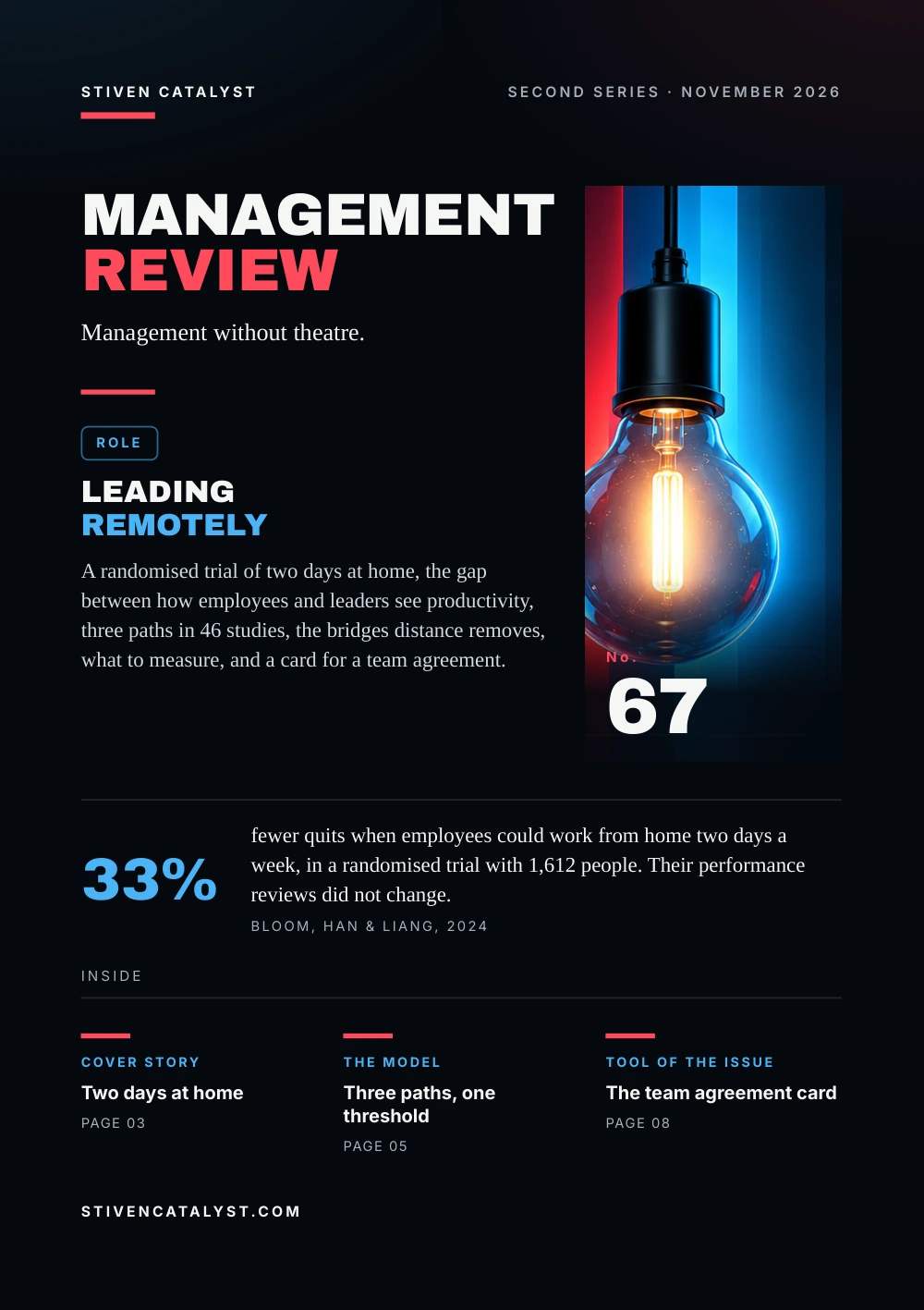
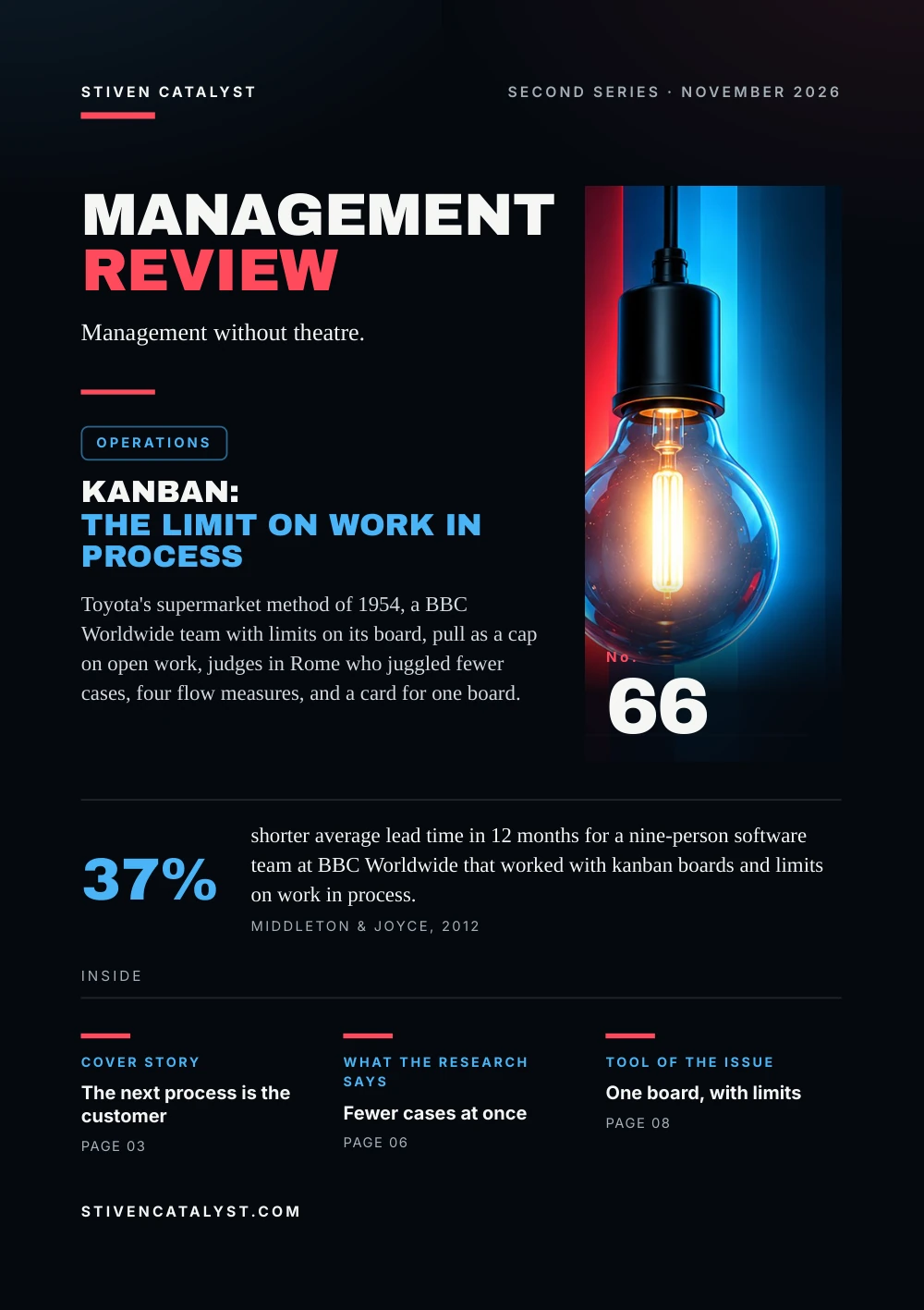
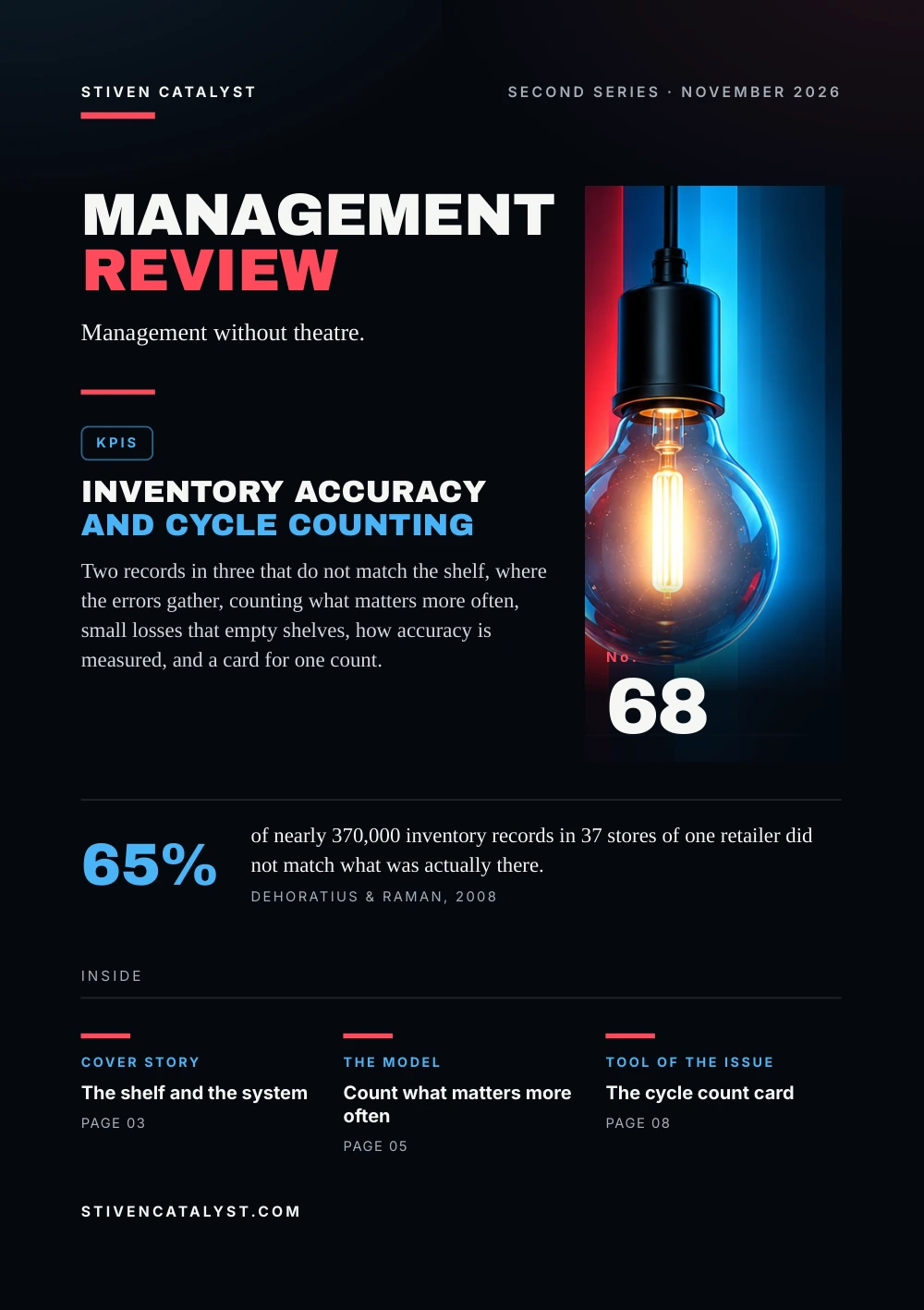
Stiven CatalystSecond series · November 2026
ManagementReview
Management without theatre.
Role
Leadingremotely
A randomised trial of two days at home, the gap between how employees and leaders see productivity, three paths in 46 studies, the bridges distance removes, what to measure, and a card for a team agreement.

No.67
33%
fewer quits when employees could work from home two days a week, in a randomised trial with 1,612 people. Their performance reviews did not change.Bloom, Han & Liang, 2024
stivencatalyst.com
No. 67 · Role
In this issue
More and more teams do not share a room every day. A manager who cannot see the work has to lead it another way: through results, clear priorities and agreements the team makes together. This issue asks what the research shows and what a remote leader can do with it.
- 03Cover storyTwo days at home
- 04The numbersProductivity paranoia
- 05The modelThree paths, one threshold
- 06What the research saysFewer bridges, less feedback
- 07How it is measuredMore than one number
- 08Tool of the issueThe team agreement card
- 09SourcesSources and method
How to read this issue
Figure
Every figure has its source and year at the foot of its page.
Our reading
Where the editors interpret rather than the research, it says so.
Practice
The steps and the card are proposals to try, not research results.
Cover story
Two daysat home
In August 2021 the travel company Trip.com split 1,612 graduates in engineering, marketing and finance by birthday. Those born on an odd day could work from home on Wednesdays and Fridays; the rest came in five days. Nicholas Bloom, Ruobing Han and James Liang followed them.
Quit rate during the trial, August 2021 to January 2022
Performance grades and promotions over the next two years did not differ, nor did the code engineers wrote. The 395 managers expected hybrid work to cut productivity by 2.6%; after the trial, they expected a gain of 1.0%. The company then extended it to all staff.
Our reading
The managers were not convinced by argument, but by six months of their own data.
Source: Nicholas Bloom, Ruobing Han & James Liang, Nature 630, 2024
Co-author James Liang co-founded and chairs Trip.com; the firm did not fund the study. Most took one day at home, usually Friday.
The numbers
Productivit yparanoia
In the summer of 2022 Microsoft surveyed 20,006 knowledge workers in 11 countries, Germany among them. The gap it found it called productivity paranoia: leaders fear that lost productivity comes from people not working.
Knowledge workers in 11 countries, July and August 2022
In the same survey, 81% of employees said it is important that their manager helps them prioritise their workload. Less than a third, 31%, said their manager had ever given clear guidance in one-on-ones.
Our reading
A leader who cannot see the work is tempted to count activity. The team needs priorities more than it needs to be watched.
Source: Microsoft, Work Trend Index Special Report, 2022
Online survey by Edelman Data & Intelligence, 7 July to 2 August 2022, at least 2,000 per country. What people say about their work, not measured output.
The model
Three paths,one threshold
Ravi Gajendran and David Harrison combined 46 field studies with 12,883 employees in 2007. Working away from the office acted through three paths, they found, and its effects were small but mostly good.
01
Autonomy
more control over how and when; the main path to the benefits
02
Work and family
less conflict, and less still with more days away
03
Relationships
slightly better with the manager; with colleagues unchanged, up to 2.5 days a week
Job satisfaction rose, and intent to quit and role stress fell. Performance rated by supervisors or records was higher; self-rated performance was not. Career prospects did not suffer. Beyond 2.5 days a week away, relationships with colleagues worsened. The authors suggest a day when the group is together, and treating remote work as normal, not as a privilege.
Our reading
Distance does not cut the tie to the manager. It thins the ties between colleagues, and someone has to rebuild them on purpose.
Source: Ravi S. Gajendran & David A. Harrison, Journal of Applied Psychology 92(6), 2007
Correlations from field studies up to 2007, mostly not experiments; the effects are small. The three paths are the authors'; the short descriptions are the editors'.
What the research says
Fewer bridges,less feedback
Longqi Yang and colleagues compared 61,182 Microsoft employees in the US in the first half of 2020: those who already worked remotely before the pandemic and those the firm-wide move sent home. Remote work made the network more static and siloed, with fewer bridges between groups.
−25%share of collaboration time with people in other groups, about a quarter below its level before (Microsoft, 2020)
−5%meeting and call hours; email and chat grew instead
+18.3%feedback on code for engineers who sat near their teammates (Fortune 500 firm, 2019–2024)
Natalia Emanuel, Emma Harrington and Amanda Pallais followed software engineers through office closures and later return-to-office mandates. Sitting near teammates raised feedback and code quality, above all for younger and newer engineers; experienced engineers wrote less code.
Our reading
Distance does not stop the planned work. It stops what nobody plans: the quick question, the contact in another team. A remote leader has to plan it.
Sources: Longqi Yang, David Holtz, Sonia Jaffe et al., Nature Human Behaviour 6, 2022 (via Abstract at Nature; figures from the authors' summary at Microsoft Research); Natalia Emanuel, Emma Harrington & Amanda Pallais, NBER Working Paper 31880 (revised 2026), 2023
Microsoft: one firm, during the pandemic; the two figures are from the authors' summary, as the full article was paywalled. Emanuel et al.: a working paper from one firm.
How it is measured
More thanone number
Where people work says little on its own. In Gallup's 2025 global data, employees who worked only remotely were the most engaged, and the least likely to be thriving in their lives.
Employees by place of work, worldwide, 2025
Results
what was agreed and delivered, not hours online
Clarity
in the US it fell twice as fast for hybrid and remote staff (Gallup, 2024)
Connection
lonely the day before: 24% remote and hybrid, 18% on site
Sources: Gallup, State of the Global Workplace 2026; Gallup, Hybrid Work and Productivity: What the Data Show, 2026
Gallup World Poll, 141,444 employed respondents in 2025; on-site figures for jobs that could be done remotely. Choosing these three measures is the editors' reading of the sources.
Tool of the issue
The teamagreement card
In 2024, 48% of hybrid workers told Gallup their team had never discussed a plan for working together. Teams with one were 66% more likely to be engaged and 29% less likely to be burned out. Write it with the team, and review it.
01Channelswhich channel for what: urgent, routine, decisions
02Response timeshow fast in each channel; how to say you are unavailable
03Check-insthe team check-in and each weekly one-to-one: when
04Escalationwhat counts as a problem, whom to tell, by when; who owns it until closed
05Written downdecisions, handovers, open issues with an owner and a time
06Togetherwhich day in person, and what for; the next review date
Sources: Gallup, 2026; Ravi S. Gajendran & David A. Harrison, Journal of Applied Psychology 92(6), 2007
A practice proposed by the editors, after Gallup (the most common practices in teams with a plan: check-ins, availability, unavailability) and Gajendran & Harrison (a day together). Teams with and without a plan were compared: an association, not a cause.
More in the essayLeading 80+ vehicles you cannot see
Open the tool: Shift Handoverstivencatalyst.com/tools/shift-handover/
Sources and method
Every figurehas a source.
The figures in this issue come from the sources below. The year shows how recent each one is.
- Hybrid working from home improves retention without damaging performanceNicholas Bloom, Ruobing Han & James Liang, Nature 630, 2024https://doi.org/10.1038/s41586-024-07500-2
- Hybrid Work Is Just Work. Are We Doing It Wrong?Microsoft, Work Trend Index Special Report, 2022https://www.microsoft.com/en-us/worklab/work-trend-index/hybrid-work-is-just-work
- The good, the bad, and the unknown about telecommuting: Meta-analysis of psychological mediators and individual consequencesRavi S. Gajendran & David A. Harrison, Journal of Applied Psychology 92(6), 2007https://doi.org/10.1037/0021-9010.92.6.1524
- The effects of remote work on collaboration among information workersLongqi Yang, David Holtz, Sonia Jaffe et al., Nature Human Behaviour 6, 2022 · via Abstract at Nature; figures from the authors' summary at Microsoft Researchhttps://doi.org/10.1038/s41562-021-01196-4
- The Power of Proximity to CoworkersNatalia Emanuel, Emma Harrington & Amanda Pallais, NBER Working Paper 31880 (revised 2026), 2023https://www.nber.org/papers/w31880
- State of the Global Workplace 2026Gallup, 2026https://www.gallup.com/workplace/349484/state-of-the-global-workplace.aspx
- Hybrid Work and Productivity: What the Data ShowGallup, 2026https://www.gallup.com/workplace/713093/hybrid-work-productivity.aspx
Editorial method
Each figure was checked for its year, its publisher and what exactly it measures. Where the publisher's page could not be opened, the figure was checked against independent summaries and is marked “via”. The editors' interpretation is marked “Our reading”. Figures that could not be confirmed are not in the issue.
ManagementReview
Management without theatre.
Every issue, one management question, checked against the best research.
All issues
stivencatalyst.com/magazine/management-review.html
Management Review · No. 67 · November 2026 · Stiven Catalyst
Click or swipe a page to turn it. The arrow keys work too.
Management Review · No. 67
The figures of the issue
The charts of the printed pages, with their sources.
Source: Nicholas Bloom, Ruobing Han & James Liang, Nature 630, 2024
Source: Microsoft, Work Trend Index Special Report, 2022
Source: Gallup, 2026
The whole text Read the issue as text For reading on a small screen, searching or a screen reader. The same words, without the page design.
In this issue
More and more teams do not share a room every day. A manager who cannot see the work has to lead it another way: through results, clear priorities and agreements the team makes together. This issue asks what the research shows and what a remote leader can do with it.
In a randomised trial at Trip.com, two days at home cut quits by a third without hurting performance reviews. Microsoft found that 85% of leaders struggle to trust that hybrid staff are productive. A meta-analysis of 46 studies shows three paths and a threshold of 2.5 days a week. Data from Microsoft and a Fortune 500 firm show what distance takes away: bridges between groups and feedback for the young. Gallup shows what to measure, and what a team agreement holds.
Stiven Janaqi, Editor
Cover story
Two days at home
In August 2021 the travel company Trip.com split 1,612 graduates in engineering, marketing and finance by birthday. Those born on an odd day could work from home on Wednesdays and Fridays; the rest came in five days. Nicholas Bloom, Ruobing Han and James Liang followed them.
Quit rate during the trial, August 2021 to January 2022: All employees: Five days in the office 7.2%, Two days at home 4.8%; Non-managers (1,217): Five days in the office 8.6%, Two days at home 5.3%; Managers (395): Five days in the office 3.0%, Two days at home 3.1%.
Performance grades and promotions over the next two years did not differ, nor did the code engineers wrote. The 395 managers expected hybrid work to cut productivity by 2.6%; after the trial, they expected a gain of 1.0%. The company then extended it to all staff.
Our reading
The managers were not convinced by argument, but by six months of their own data.
Co-author James Liang co-founded and chairs Trip.com; the firm did not fund the study. Most took one day at home, usually Friday.
Source: Nicholas Bloom, Ruobing Han & James Liang, Nature 630, 2024
The numbers
Productivit y paranoia
In the summer of 2022 Microsoft surveyed 20,006 knowledge workers in 11 countries, Germany among them. The gap it found it called productivity paranoia: leaders fear that lost productivity comes from people not working.
Knowledge workers in 11 countries, July and August 2022: Employees: I am productive at work 87%, Leaders: hybrid work makes confidence hard 85%, Leaders: full confidence my team is productive 12%.
In the same survey, 81% of employees said it is important that their manager helps them prioritise their workload. Less than a third, 31%, said their manager had ever given clear guidance in one-on-ones.
Our reading
A leader who cannot see the work is tempted to count activity. The team needs priorities more than it needs to be watched.
Online survey by Edelman Data & Intelligence, 7 July to 2 August 2022, at least 2,000 per country. What people say about their work, not measured output.
Source: Microsoft, Work Trend Index Special Report, 2022
The model
Three paths, one threshold
Ravi Gajendran and David Harrison combined 46 field studies with 12,883 employees in 2007. Working away from the office acted through three paths, they found, and its effects were small but mostly good.
- Au
t onomy. more control over how and when; the main path to the benefits - Work and family. less conflict, and less still with more days away
- Relationships. slightly better with the manager; with colleagues unchanged, up to 2.5 days a week
Job satisfaction rose, and intent to quit and role stress fell. Performance rated by supervisors or records was higher; self-rated performance was not. Career prospects did not suffer. Beyond 2.5 days a week away, relationships with colleagues worsened. The authors suggest a day when the group is together, and treating remote work as normal, not as a privilege.
Our reading
Distance does not cut the tie to the manager. It thins the ties between colleagues, and someone has to rebuild them on purpose.
Correlations from field studies up to 2007, mostly not experiments; the effects are small. The three paths are the authors'; the short descriptions are the editors'.
Source: Ravi S. Gajendran & David A. Harrison, Journal of Applied Psychology 92(6), 2007
What the research says
Fewer bridges, less feedback
Longqi Yang and colleagues compared 61,182 Microsoft employees in the US in the first half of 2020: those who already worked remotely before the pandemic and those the firm-wide move sent home. Remote work made the network more static and siloed, with fewer bridges between groups.
- −25% share of collaboration time with people in other groups, about a quarter below its level before (Microsoft, 2020)
- −5% meeting and call hours; email and chat grew instead
- +18.3% feedback on code for engineers who sat near their teammates (Fortune 500 firm, 2019–2024)
Natalia Emanuel, Emma Harrington and Amanda Pallais followed software engineers through office closures and later return-to-office mandates. Sitting near teammates raised feedback and code quality, above all for younger and newer engineers; experienced engineers wrote less code.
Our reading
Distance does not stop the planned work. It stops what nobody plans: the quick question, the contact in another team. A remote leader has to plan it.
Microsoft: one firm, during the pandemic; the two figures are from the authors' summary, as the full article was paywalled. Emanuel et al.: a working paper from one firm.
Sources: Longqi Yang, David Holtz, Sonia Jaffe et al., Nature Human Behaviour 6, 2022 (via Abstract at Nature; figures from the authors' summary at Microsoft Research); Natalia Emanuel, Emma Harrington & Amanda Pallais, NBER Working Paper 31880 (revised 2026), 2023
How it is measured
More than one number
Where people work says little on its own. In Gallup's 2025 global data, employees who worked only remotely were the most engaged, and the least likely to be thriving in their lives.
Employees by place of work, worldwide, 2025: Only remote: Engaged 30%, Thriving 33%; Hybrid: Engaged 25%, Thriving 45%; On site, job could be remote: Engaged 24%, Thriving 45%.
- Results. what was agreed and delivered, not hours online
- Clari
t y. in the US it fell twice as fast for hybrid and remote staff (Gallup, 2024) - Connection. lonely the day before: 24% remote and hybrid, 18% on site
Gallup World Poll, 141,444 employed respondents in 2025; on-site figures for jobs that could be done remotely. Choosing these three measures is the editors' reading of the sources.
Sources: Gallup, State of the Global Workplace 2026; Gallup, Hybrid Work and Productivity: What the Data Show, 2026
Tool of the issue
The team agreement card
In 2024, 48% of hybrid workers told Gallup their team had never discussed a plan for working together. Teams with one were 66% more likely to be engaged and 29% less likely to be burned out. Write it with the team, and review it.
- Channels which channel for what: urgent, routine, decisions
- Response times how fast in each channel; how to say you are unavailable
- Check-ins the team check-in and each weekly one-to-one: when
- Escalation what counts as a problem, whom to tell, by when; who owns it until closed
- Wri
t ten down decisions, handovers, open issues with an owner and a time T oge ther which day in person, and what for; the next review date
A practice proposed by the editors, after Gallup (the most common practices in teams with a plan: check-ins, availability, unavailability) and Gajendran & Harrison (a day together). Teams with and without a plan were compared: an association, not a cause.
Sources: Gallup, 2026; Ravi S. Gajendran & David A. Harrison, Journal of Applied Psychology 92(6), 2007
More in the essay: Leading 80+ vehicles you cannot see
Open the tool: Shift Handover
Sources and method
Every figure has a source.
The figures in this issue come from the sources below. The year shows how recent each one is.
- Nicholas Bloom, Ruobing Han & James Liang, Nature 630, “Hybrid working from home improves retention without damaging performance”, 2024. https://doi.org/10.1038/s41586-024-07500-2
- Microsoft, Work Trend Index Special Report, “Hybrid Work Is Just Work. Are We Doing It Wrong?”, 2022. https://www.microsoft.com/en-us/worklab/work-trend-index/hybrid-work-is-just-work
- Ravi S. Gajendran & David A. Harrison, Journal of Applied Psychology 92(6), “The good, the bad, and the unknown about telecommuting: Meta-analysis of psychological mediators and individual consequences”, 2007. https://doi.org/10.1037/0021-9010.92.6.1524
- Longqi Yang, David Holtz, Sonia Jaffe et al., Nature Human Behaviour 6, “The effects of remote work on collaboration among information workers”, 2022 (via Abstract at Nature; figures from the authors' summary at Microsoft Research). https://doi.org/10.1038/s41562-021-01196-4
- Natalia Emanuel, Emma Harrington & Amanda Pallais, NBER Working Paper 31880 (revised 2026), “The Power of Proximity to Coworkers”, 2023. https://www.nber.org/papers/w31880
- Gallup, “State of the Global Workplace 2026”, 2026. https://www.gallup.com/workplace/349484/state-of-the-global-workplace.aspx
- Gallup, “Hybrid Work and Productivity: What the Data Show”, 2026. https://www.gallup.com/workplace/713093/hybrid-work-productivity.aspx
Edit orial me thod
Each figure was checked for its year, its publisher and what exactly it measures. Where the publisher's page could not be opened, the figure was checked against independent summaries and is marked “via”. The editors' interpretation is marked “Our reading”. Figures that could not be confirmed are not in the issue.
Management Review · Monthly edition