In this issue
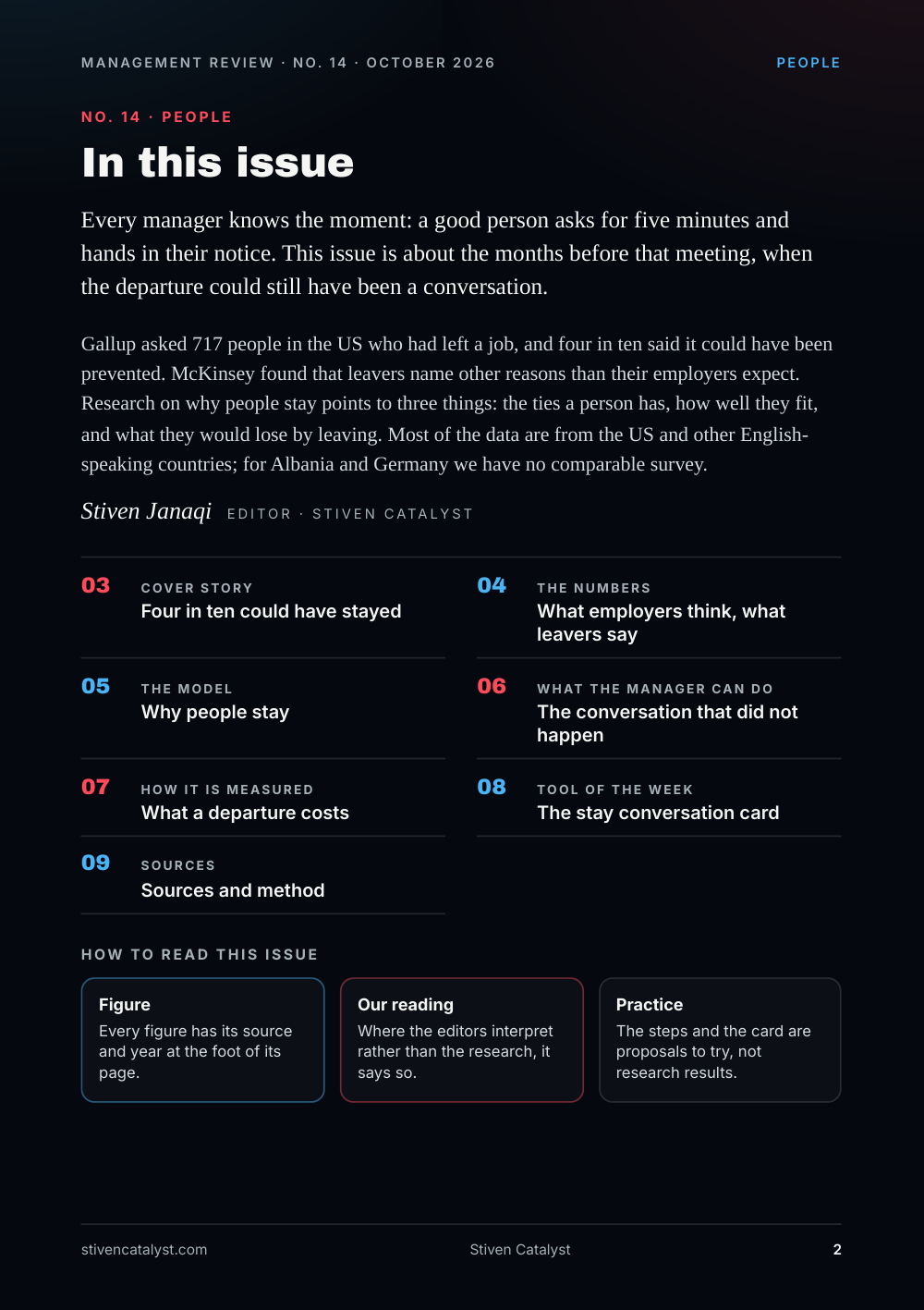
Every manager knows the moment: a good person asks for five minutes and hands in their notice. This issue is about the months before that meeting, when the departure could still have been a conversation.
Gallup asked 717 people in the US who had left a job, and four in ten said it could have been prevented. McKinsey found that leavers name other reasons than their employers expect. Research on why people stay points to three things: the ties a person has, how well they fit, and what they would lose by leaving. Most of the data are from the US and other English-speaking countries; for Albania and Germany we have no comparable survey.
Stiven Janaqi, Editor
Cover story
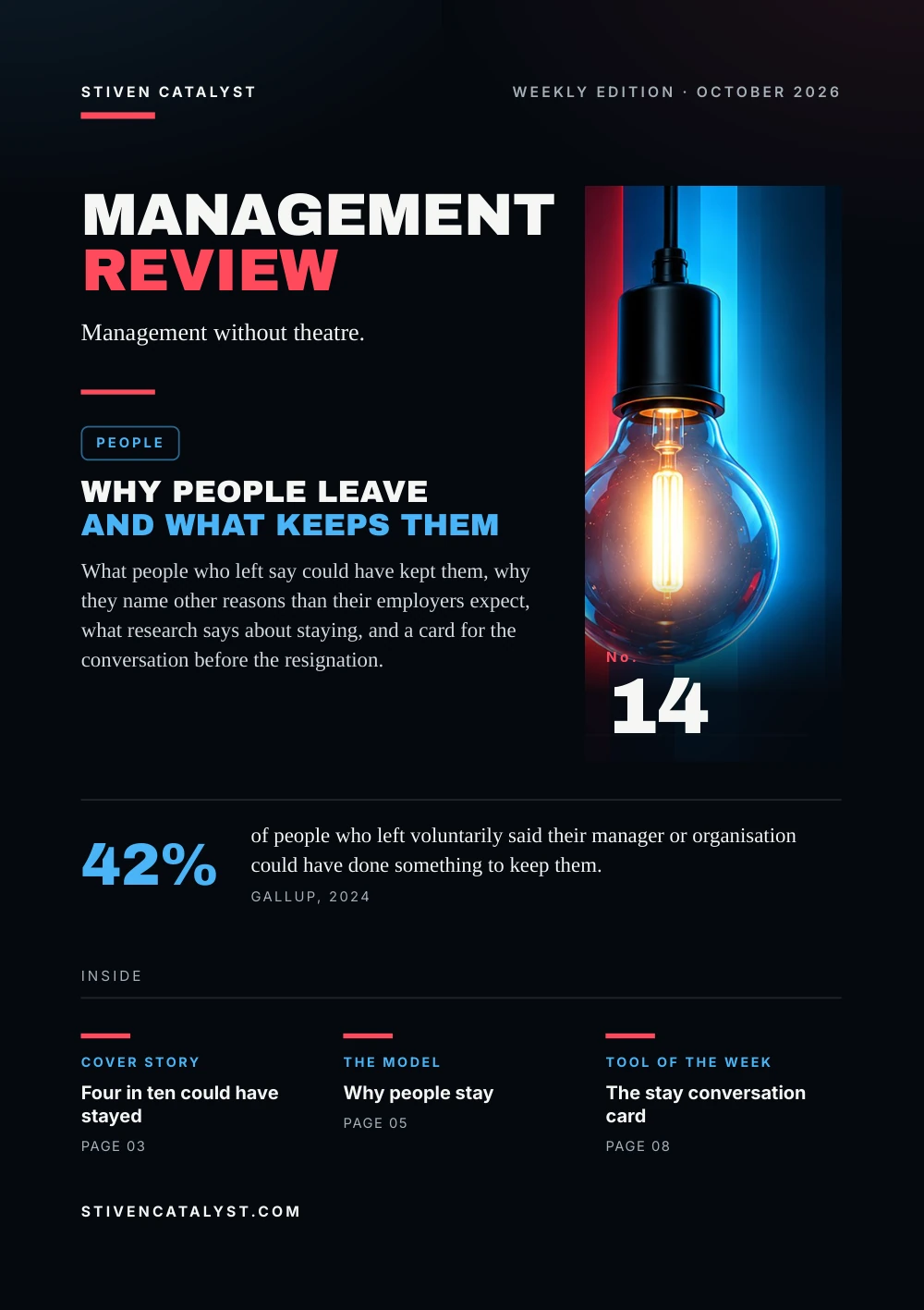
Four in ten could have stayed
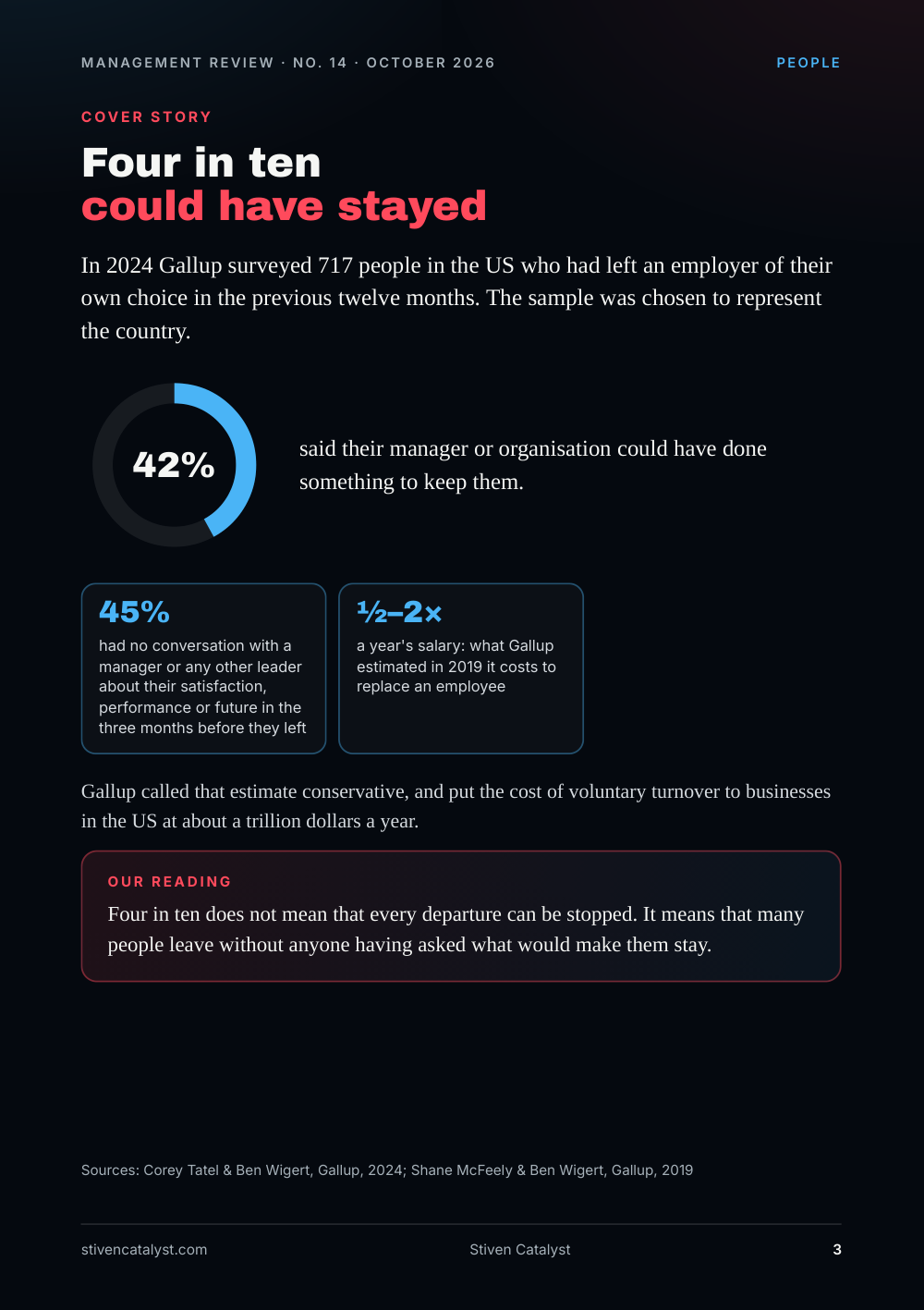
In 2024 Gallup surveyed 717 people in the US who had left an employer of their own choice in the previous twelve months. The sample was chosen to represent the country.
42% said their manager or organisation could have done something to keep them.
- 45% had no conversation with a manager or any other leader about their satisfaction, performance or future in the three months before they left
- ½–2× a year's salary: what Gallup estimated in 2019 it costs to replace an employee
Gallup called that estimate conservative, and put the cost of voluntary turnover to businesses in the US at about a trillion dollars a year.
Our reading
Four in ten does not mean that every departure can be stopped. It means that many people leave without anyone having asked what would make them stay.
Sources: Corey Tatel & Ben Wigert, Gallup, 2024; Shane McFeely & Ben Wigert, Gallup, 2019
The numbers
What employers think, what leavers say
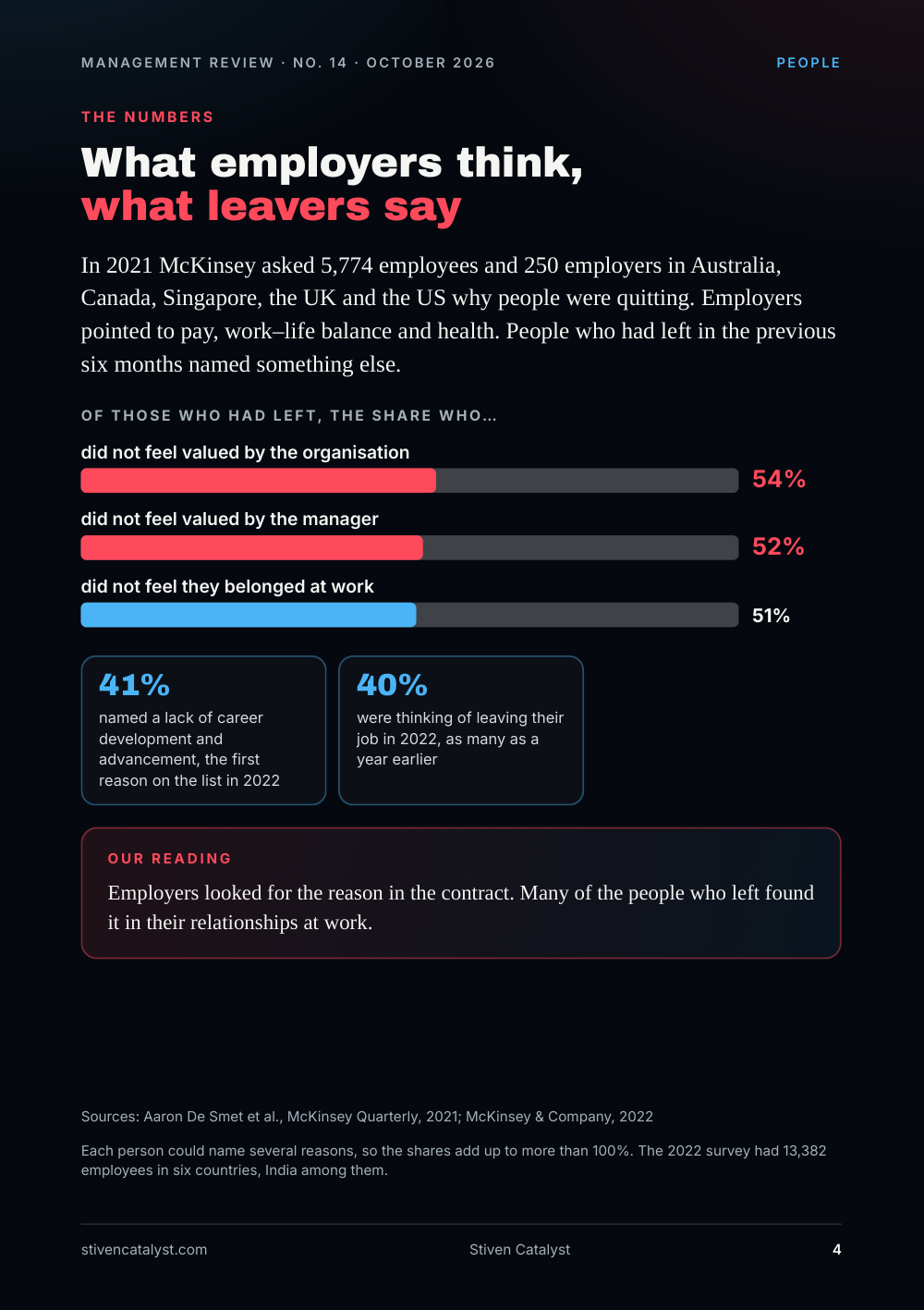
In 2021 McKinsey asked 5,774 employees and 250 employers in Australia, Canada, Singapore, the UK and the US why people were quitting. Employers pointed to pay, work–life balance and health. People who had left in the previous six months named something else.
Of those who had left, the share who…: did not feel valued by the organisation 54%, did not feel valued by the manager 52%, did not feel they belonged at work 51%.
- 41% named a lack of career development and advancement, the first reason on the list in 2022
- 40% were thinking of leaving their job in 2022, as many as a year earlier
Our reading
Employers looked for the reason in the contract. Many of the people who left found it in their relationships at work.
Each person could name several reasons, so the shares add up to more than 100%. The 2022 survey had 13,382 employees in six countries, India among them.
Sources: Aaron De Smet et al., McKinsey Quarterly, 2021; McKinsey & Company, 2022
The model
Why people stay
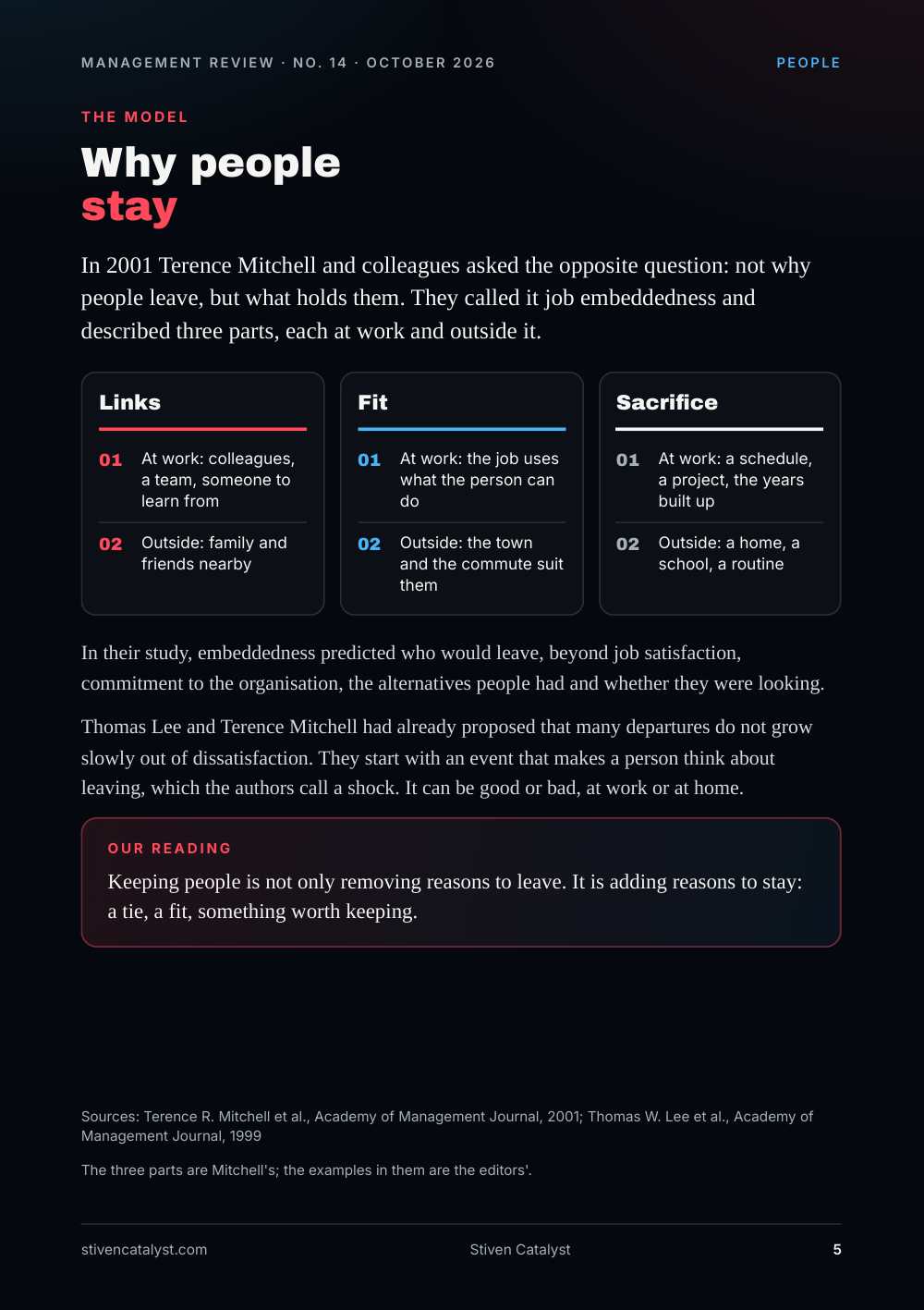
In 2001 Terence Mitchell and colleagues asked the opposite question: not why people leave, but what holds them. They called it job embeddedness and described three parts, each at work and outside it.
Links
- 01. At work: colleagues, a team, someone to learn from
- 02. Outside: family and friends nearby
Fit
- 01. At work: the job uses what the person can do
- 02. Outside: the town and the commute suit them
Sacrifice
- 01. At work: a schedule, a project, the years built up
- 02. Outside: a home, a school, a routine
In their study, embeddedness predicted who would leave, beyond job satisfaction, commitment to the organisation, the alternatives people had and whether they were looking.
Thomas Lee and Terence Mitchell had already proposed that many departures do not grow slowly out of dissatisfaction. They start with an event that makes a person think about leaving, which the authors call a shock. It can be good or bad, at work or at home.
Our reading
Keeping people is not only removing reasons to leave. It is adding reasons to stay: a tie, a fit, something worth keeping.
The three parts are Mitchell's; the examples in them are the editors'.
Sources: Terence R. Mitchell et al., Academy of Management Journal, 2001; Thomas W. Lee et al., Academy of Management Journal, 1999
What the manager can do
The conversation that did not happen
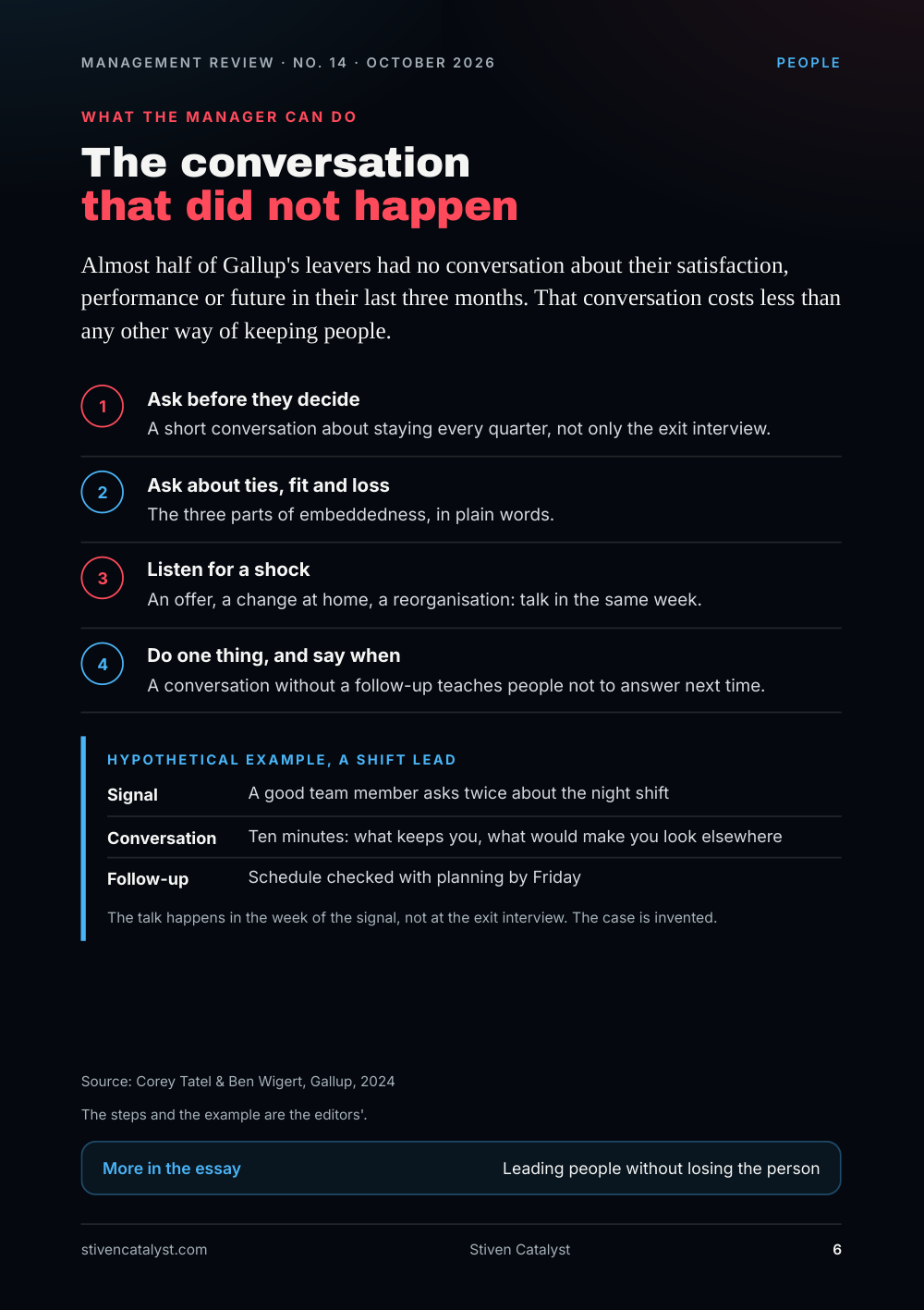
Almost half of Gallup's leavers had no conversation about their satisfaction, performance or future in their last three months. That conversation costs less than any other way of keeping people.
- Ask before th
e y decide. A short conversation about staying every quarter, not only the exit interview. - Ask about ties, fit and loss. The three parts of embeddedness, in plain words.
- Listen for a shock. An offer, a change at home, a reorganisation: talk in the same week.
- Do one thing, and say when. A conversation without a follow-up teaches people not to answer next time.
Hypothe tical example, a shif t lead
- Signal: A good team member asks twice about the night shift
- Conversation: Ten minutes: what keeps you, what would make you look elsewhere
- Follow-up: Schedule checked with planning by Friday
The talk happens in the week of the signal, not at the exit interview. The case is invented.
The steps and the example are the editors'.
Source: Corey Tatel & Ben Wigert, Gallup, 2024
More in the essay: Leading people without losing the person
How it is measured
What a depar ture costs
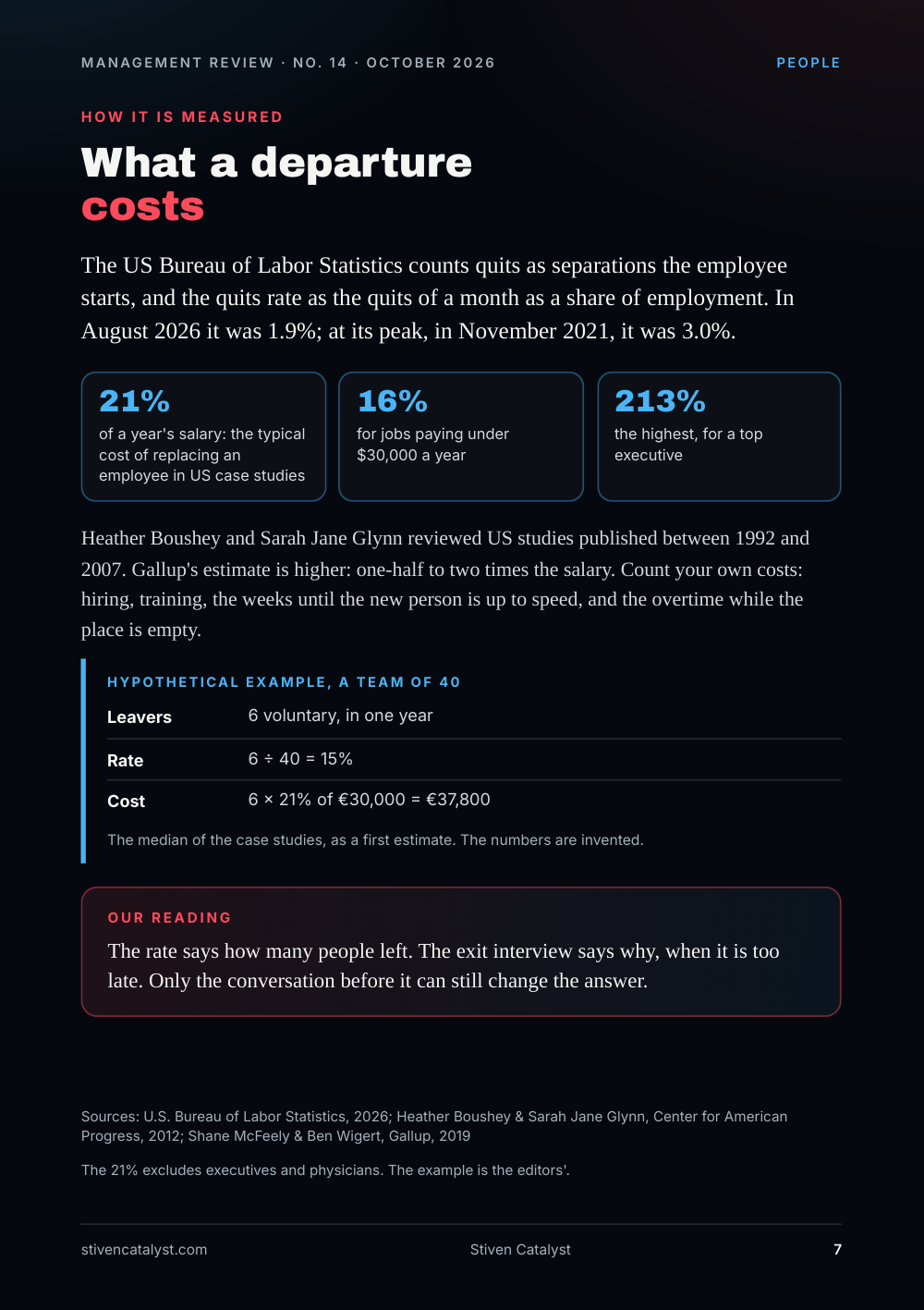
The US Bureau of Labor Statistics counts quits as separations the employee starts, and the quits rate as the quits of a month as a share of employment. In August 2026 it was 1.9%; at its peak, in November 2021, it was 3.0%.
- 21% of a year's salary: the typical cost of replacing an employee in US case studies
- 16% for jobs paying under $30,000 a year
- 213% the highest, for a top executive
Heather Boushey and Sarah Jane Glynn reviewed US studies published between 1992 and 2007. Gallup's estimate is higher: one-half to two times the salary. Count your own costs: hiring, training, the weeks until the new person is up to speed, and the overtime while the place is empty.
Hypothe tical example, a team of 40
- Leavers: 6 voluntary, in one year
- Rate: 6 ÷ 40 = 15%
- Cost: 6 × 21% of €30,000 = €37,800
The median of the case studies, as a first estimate. The numbers are invented.
Our reading
The rate says how many people left. The exit interview says why, when it is too late. Only the conversation before it can still change the answer.
The 21% excludes executives and physicians. The example is the editors'.
Sources: U.S. Bureau of Labor Statistics, 2026; Heather Boushey & Sarah Jane Glynn, Center for American Progress, 2012; Shane McFeely & Ben Wigert, Gallup, 2019
Tool of the week
The stay conversation card
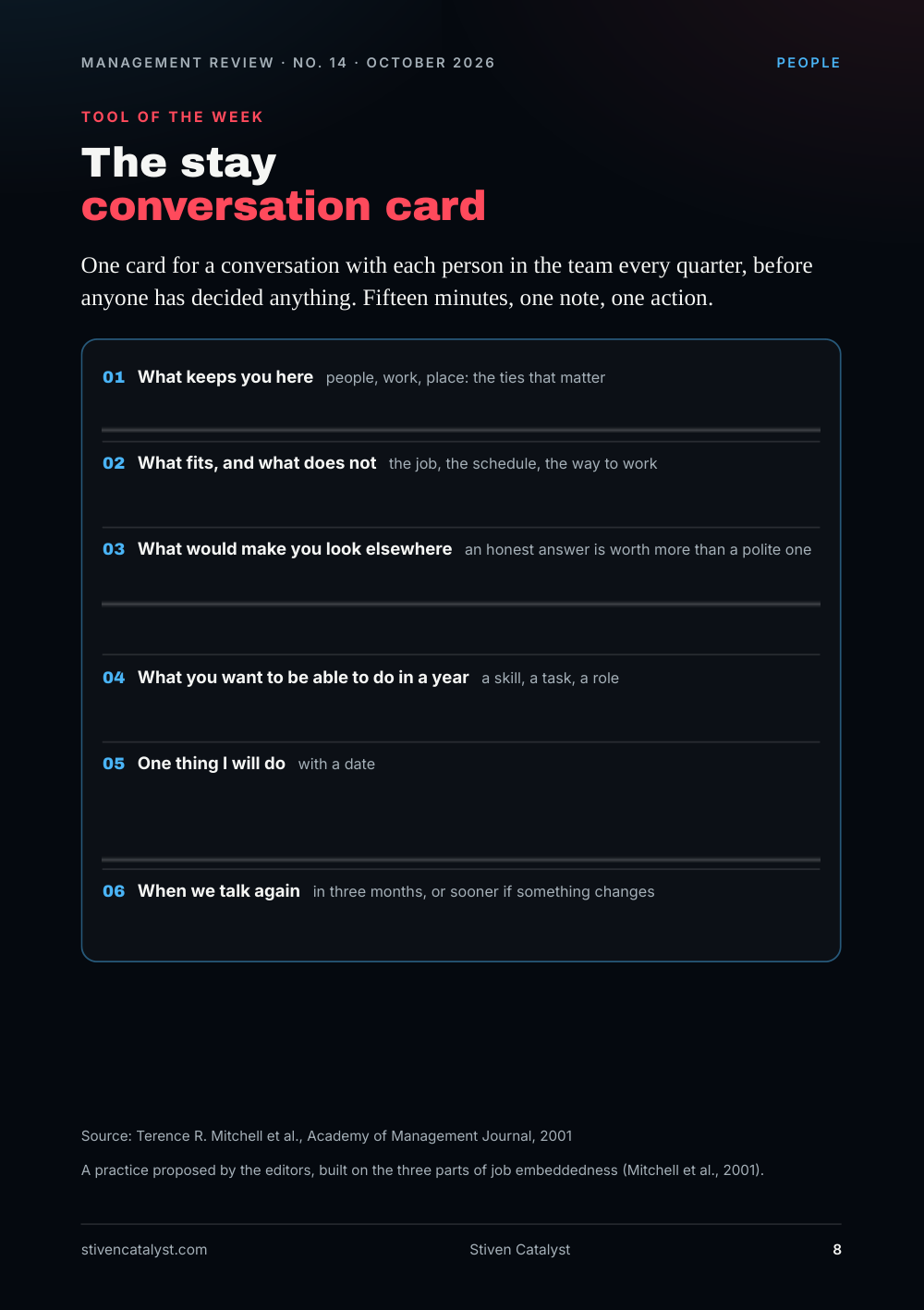
One card for a conversation with each person in the team every quarter, before anyone has decided anything. Fifteen minutes, one note, one action.
- What keeps you here people, work, place: the ties that matter
- What fits, and what does not the job, the schedule, the way to work
- What would make you look elsewhere an honest answer is worth more than a polite one
- What you want
t o be ablet o do in a year a skill, a task, a role - One thing I will do with a date
- When we talk again in three months, or sooner if something changes
A practice proposed by the editors, built on the three parts of job embeddedness (Mitchell et al., 2001).
Source: Terence R. Mitchell et al., Academy of Management Journal, 2001
Sources and method
Every figure has a source.
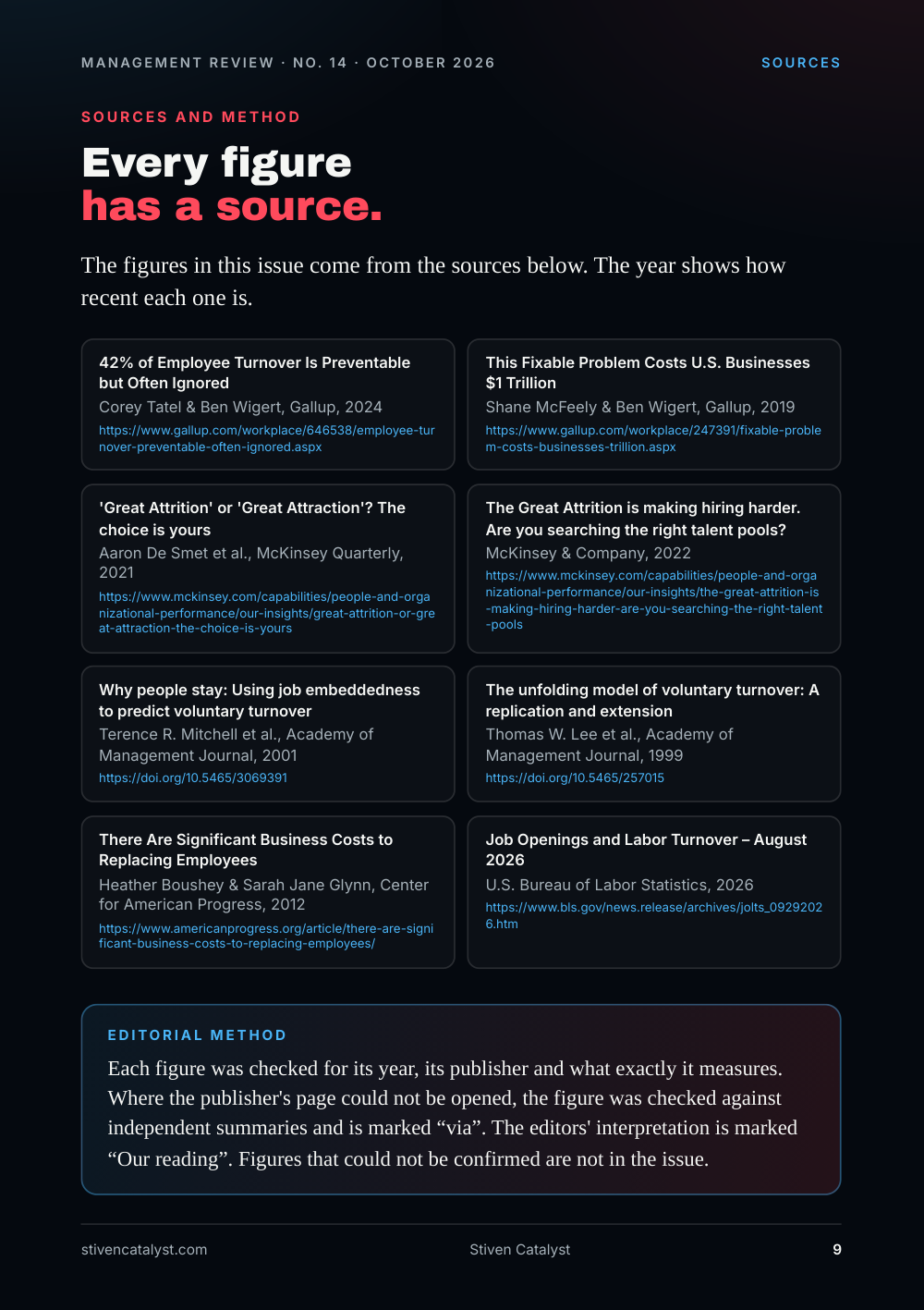
The figures in this issue come from the sources below. The year shows how recent each one is.
- Corey Tatel & Ben Wigert, Gallup, “42% of Employee Turnover Is Preventable but Often Ignored”, 2024. https://www.gallup.com/workplace/646538/employee-turnover-preventable-often-ignored.aspx
- Shane McFeely & Ben Wigert, Gallup, “This Fixable Problem Costs U.S. Businesses $1 Trillion”, 2019. https://www.gallup.com/workplace/247391/fixable-problem-costs-businesses-trillion.aspx
- Aaron De Smet et al., McKinsey Quarterly, “'Great Attrition' or 'Great Attraction'? The choice is yours”, 2021. https://www.mckinsey.com/capabilities/people-and-organizational-performance/our-insights/great-attrition-or-great-attraction-the-choice-is-yours
- McKinsey & Company, “The Great Attrition is making hiring harder. Are you searching the right talent pools?”, 2022. https://www.mckinsey.com/capabilities/people-and-organizational-performance/our-insights/the-great-attrition-is-making-hiring-harder-are-you-searching-the-right-talent-pools
- Terence R. Mitchell et al., Academy of Management Journal, “Why people stay: Using job embeddedness to predict voluntary turnover”, 2001. https://doi.org/10.5465/3069391
- Thomas W. Lee et al., Academy of Management Journal, “The unfolding model of voluntary turnover: A replication and extension”, 1999. https://doi.org/10.5465/257015
- Heather Boushey & Sarah Jane Glynn, Center for American Progress, “There Are Significant Business Costs to Replacing Employees”, 2012. https://www.americanprogress.org/article/there-are-significant-business-costs-to-replacing-employees/
- U.S. Bureau of Labor Statistics, “Job Openings and Labor Turnover – August 2026”, 2026. https://www.bls.gov/news.release/archives/jolts_09292026.htm
Edit orial me thod
Each figure was checked for its year, its publisher and what exactly it measures. Where the publisher's page could not be opened, the figure was checked against independent summaries and is marked “via”. The editors' interpretation is marked “Our reading”. Figures that could not be confirmed are not in the issue.