Researchers separate conflict about the task, about the relationship and about the process. Two meta-analyses, of 30 studies in 2003 and 116 in 2012, link personal friction with weaker teams, while for disagreement about the work the answer depends on the setting. In a 2008 survey in nine countries, employees said they spent 2.1 hours a week on conflict. Kenneth Thomas and Ralph Kilmann describe five ways of handling it, and a 2013 meta-analysis finds that how a team handles its differences matters at least as much as how much conflict it has.
Management Review · First series · October 2026 · No. 38
Conflict in the team
Three kinds of conflict and what each costs, the hours it takes every week, five ways of handling it, what goes with stronger teams, and a card for the next dispute.
- No.
- 38
- Pages
- 10
- Sources
- 7
- Topics
- People
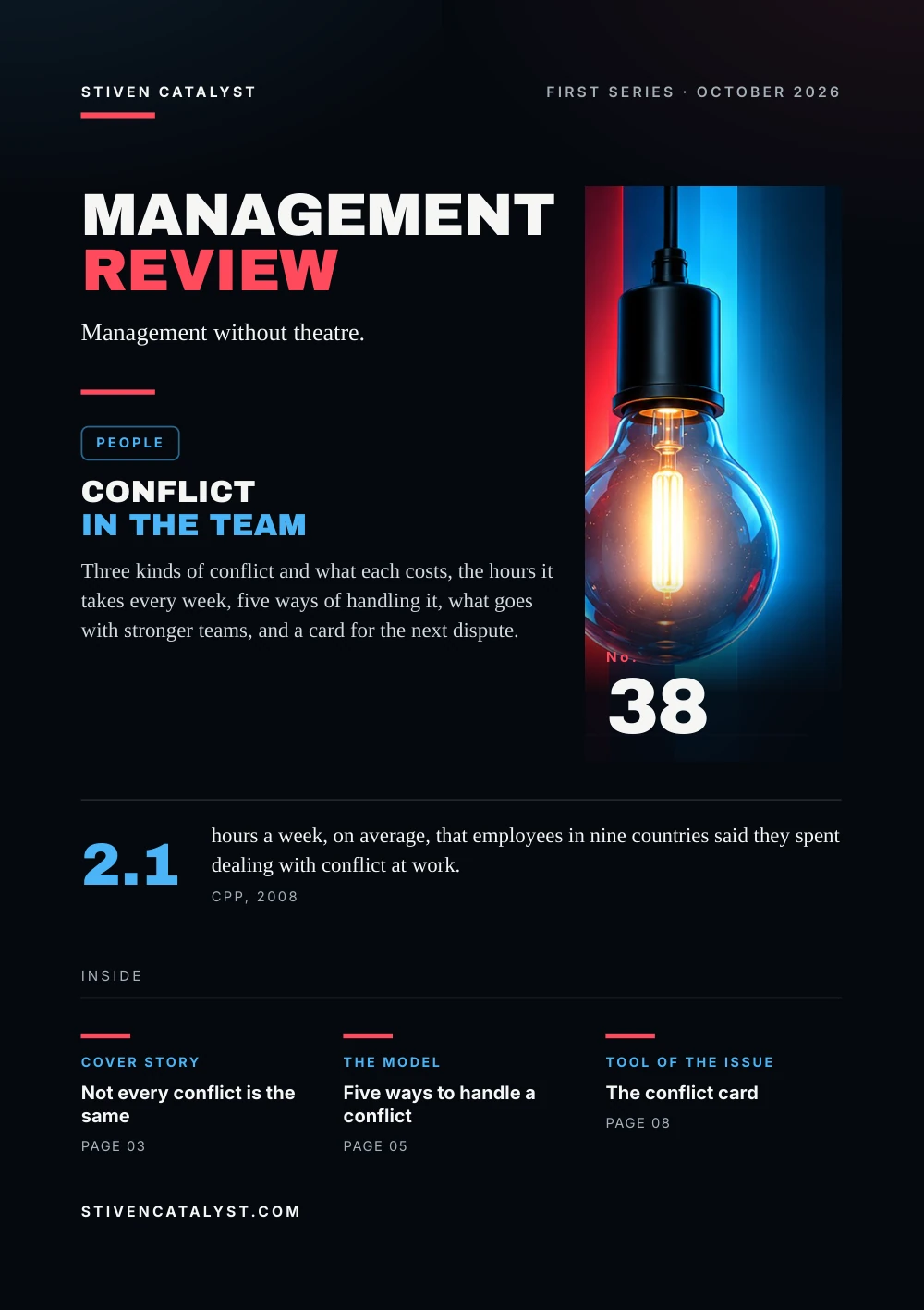
Stiven CatalystFirst series · October 2026
ManagementReview
Management without theatre.
People
Conflictin the team
Three kinds of conflict and what each costs, the hours it takes every week, five ways of handling it, what goes with stronger teams, and a card for the next dispute.

No.38
2.1
hours a week, on average, that employees in nine countries said they spent dealing with conflict at work.CPP, 2008
stivencatalyst.com
No. 38 · People
In this issue
Every team disagrees: about priorities, about who does what, sometimes about each other. This issue asks which conflict costs a team, which can help it, and what a manager can do once it starts.
- 03Cover storyNot every conflict is the same
- 04The numbersTwo hours a week
- 05The modelFive ways to handle a conflict
- 06What the research saysHow the team handles it
- 07How it is measuredAsk what it is about
- 08Tool of the issueThe conflict card
- 09SourcesSources and method
How to read this issue
Figure
Every figure has its source and year at the foot of its page.
Our reading
Where the editors interpret rather than the research, it says so.
Practice
The steps and the card are proposals to try, not research results.
Cover story
Not every conflictis the same
For years textbooks taught that disagreement about the work makes a team sharper and only personal friction harms it. In 2003 Carsten De Dreu and Laurie Weingart tested the idea across 30 studies.
01
Task
different views on the content of the work: ideas, opinions, decisions
02
Relationship
personal incompatibility, with tension, annoyance and animosity
03
Process
how the work gets done: who does what, and who is responsible
Their result went against the textbooks: task conflict went with weaker team performance (−0.23) about as much as relationship conflict (−0.22). In 2012 Frank de Wit, Lindred Greer and Karen Jehn repeated the test with 116 studies: relationship (−0.16) and process conflict (−0.15) still went with weaker performance, task conflict on average not at all (−0.01).
Our reading
Disagreeing about the work is not healthy by default. It helps only as long as it stays about the work.
Sources: Carsten K. W. De Dreu & Laurie R. Weingart, Journal of Applied Psychology, 2003; Tony L. Simons & Randall S. Peterson, Journal of Applied Psychology, 2000; Frank R. C. de Wit, Lindred L. Greer & Karen A. Jehn, Journal of Applied Psychology, 2012
Corrected correlations from correlational studies: a link, not proof of cause. Task and relationship conflict follow Karen Jehn (1995), as Simons and Peterson sum her up; process conflict follows de Wit and colleagues (2012).
More in the essayMistakes get lost between departments
The numbers
Two hoursa week
In May 2008 CPP, then the publisher of the Thomas-Kilmann instrument, surveyed 5,000 full-time employees in nine countries in Europe and the Americas. The hours a week they said they spent dealing with conflict:
Hours a week spent dealing with conflict at work, 2008
29%deal with conflict always or frequently; in Germany, 56%
67%have gone out of their way to avoid a colleague after a disagreement
22%of non-managers think their managers handle conflict well; 31% of managers think so of themselves
Causes named most: clashes of personality and ego (49%), stress (34%), heavy workloads (33%). Only in Germany did stress come first (41%).
Source: CPP, Inc., with OPP and Fellipelli, 2008
Commissioned by a firm that sells conflict instruments and training; self-reports from 2008, the hours are estimates. For Albania we have no comparable figure.
The model
Five wayst o handle a conflict
In 1974 Kenneth Thomas and Ralph Kilmann published an instrument of 30 pairs of statements. It places behaviour in a conflict on two dimensions: how far a person tries to satisfy their own concerns, and how far the other person's.
Competing
Assertive, not cooperative: you pursue your own concerns at the other person's expense.
Collaborating
Assertive and cooperative: you look for a solution that meets the concerns of both.
Compromising
Moderate on both: each side gives up part of what it wants.
Avoiding
Neither assertive nor cooperative: you pursue neither your concerns nor the other's, at least for now.
Accommodating
Cooperative, not assertive: you set your own concerns aside to meet the other's.
Our reading
Most of us have a habit, not a choice. Before a dispute, ask which mode the situation needs, not which one comes naturally.
Sources: Kenneth W. Thomas & Ralph H. Kilmann, Xicom, 1974 (via Kilmann Diagnostics); CPP, Inc., with OPP and Fellipelli, 2008
In Kilmann's words, everyone can use all five modes. The modes describe behaviour, not character. The instrument has been sold since 1998 by CPP, now The Myers-Briggs Company, which also commissioned the 2008 survey.
What the research says
How the teamhandles it
In 2013 Leslie DeChurch, Jessica Mesmer-Magnus and Dan Doty pooled 45 studies with 3,218 teams. They separated how much conflict a team has from the way it handles it.
How a team handles conflict and its performance (corrected correlation)
Beyond the amount of conflict, the way of handling it explained another 13% of the differences in performance and in how members felt. Avoiding needs a closer look: in a 2001 study by Carsten De Dreu and Annelies van Vianen, teams that avoided personal friction functioned better than those that fought it out or tried to resolve it together.
Our reading
Argue about the work in the open. A personal clash is often better taken out of the meeting.
Sources: Leslie A. DeChurch, Jessica R. Mesmer-Magnus & Dan Doty, Journal of Applied Psychology, 2013; Carsten K. W. De Dreu & Annelies E. M. van Vianen, Journal of Organizational Behavior, 2001
Correlations, not proof of cause; bars show the size of the link, red where it is negative. Across studies, avoiding ranged from negative to slightly positive. The 2001 result is one field study of teams in complex, non-routine work.
How it is measured
Ask whatit is about
Most studies ask team members a few short questions from Karen Jehn's scale, some about the work and some about friction between people. What matters is not only how much of each a team has, but whether the two move together.
Three questions for the team
- Work: how often do people here disagree about the work being done?
- Process: how often do we disagree about who does what?
- Relationship: how much friction is there between people in the team?
−0.10task conflict and performance, where task and relationship conflict were weakly linked
−0.35the same link where the two were strongly linked (De Dreu & Weingart, 2003)
In 70 top management teams, Tony Simons and Randall Peterson found that trust changed how closely disagreement about the work went together with personal conflict. Their conclusion: trust is the key to gaining from task conflict without paying for relationship conflict.
Sources: Carsten K. W. De Dreu & Laurie R. Weingart, Journal of Applied Psychology, 2003; Tony L. Simons & Randall S. Peterson, Journal of Applied Psychology, 2000; Frank R. C. de Wit, Lindred L. Greer & Karen A. Jehn, Journal of Applied Psychology, 2012
The questions are our wording, after the sample items reported for Jehn's scale; the process question follows de Wit and colleagues. Use the answers for the team, never to rate a person.
Tool of the issue
The conflictcard
Fill it in alone before the conversation, then go through it with the other person. If the same dispute keeps coming back, treat it as a problem in the process and look for its cause with the 5 Whys sheet.
01What it is aboutthe work, the process (who does what) or the relationship
02The facts we both acceptwhat happened, without adjectives
03My concernwhat I need, in one sentence
04Their concernwhat I think they need; check it with them
05The mode I choosecompete, collaborate, compromise, avoid for now or accommodate, and why
06What we agreewho does what, by when, and the date we check it
Sources: Kenneth W. Thomas & Ralph H. Kilmann, Xicom, 1974 (via Kilmann Diagnostics); Frank R. C. de Wit, Lindred L. Greer & Karen A. Jehn, Journal of Applied Psychology, 2012
A practice proposed by the editors, after the five modes of Thomas and Kilmann (1974) and the three kinds of conflict in de Wit, Greer and Jehn (2012).
Open the tool: 5 Whysstivencatalyst.com/tools/five-whys/
Sources and method
Every figurehas a source.
The figures in this issue come from the sources below. The year shows how recent each one is.
- Task Versus Relationship Conflict, Team Performance, and Team Member Satisfaction: A Meta-AnalysisCarsten K. W. De Dreu & Laurie R. Weingart, Journal of Applied Psychology, 2003https://doi.org/10.1037/0021-9010.88.4.741
- Task Conflict and Relationship Conflict in Top Management Teams: The Pivotal Role of Intragroup TrustTony L. Simons & Randall S. Peterson, Journal of Applied Psychology, 2000https://doi.org/10.1037/0021-9010.85.1.102
- The Paradox of Intragroup Conflict: A Meta-AnalysisFrank R. C. de Wit, Lindred L. Greer & Karen A. Jehn, Journal of Applied Psychology, 2012https://doi.org/10.1037/a0024844
- Workplace Conflict and How Businesses Can Harness It to Thrive (CPP Global Human Capital Report)CPP, Inc., with OPP and Fellipelli, 2008https://img.en25.com/Web/CPP/Conflict_report.pdf
- Thomas-Kilmann Conflict Mode InstrumentKenneth W. Thomas & Ralph H. Kilmann, Xicom, 1974 · via Kilmann Diagnosticshttps://kilmanndiagnostics.com/a-brief-overview-tki/
- Moving Beyond Relationship and Task Conflict: Toward a Process-State PerspectiveLeslie A. DeChurch, Jessica R. Mesmer-Magnus & Dan Doty, Journal of Applied Psychology, 2013https://doi.org/10.1037/a0032896
- Managing Relationship Conflict and the Effectiveness of Organizational TeamsCarsten K. W. De Dreu & Annelies E. M. van Vianen, Journal of Organizational Behavior, 2001https://doi.org/10.1002/job.71
Editorial method
Each figure was checked for its year, its publisher and what exactly it measures. Where the publisher's page could not be opened, the figure was checked against independent summaries and is marked “via”. The editors' interpretation is marked “Our reading”. Figures that could not be confirmed are not in the issue.
ManagementReview
Management without theatre.
Every issue, one management question, checked against the best research.
All issues
stivencatalyst.com/magazine/management-review.html
Management Review · No. 38 · October 2026 · Stiven Catalyst
Click or swipe a page to turn it. The arrow keys work too.
Management Review · No. 38
The figures of the issue
The charts of the printed pages, with their sources.
Source: CPP, Inc., with OPP and Fellipelli, 2008
Source: Leslie A. DeChurch, Jessica R. Mesmer-Magnus & Dan Doty, Journal of Applied Psychology, 2013
The whole text Read the issue as text For reading on a small screen, searching or a screen reader. The same words, without the page design.
In this issue
Every team disagrees: about priorities, about who does what, sometimes about each other. This issue asks which conflict costs a team, which can help it, and what a manager can do once it starts.
Researchers separate conflict about the task, about the relationship and about the process. Two meta-analyses, of 30 studies in 2003 and 116 in 2012, link personal friction with weaker teams, while for disagreement about the work the answer depends on the setting. In a 2008 survey in nine countries, employees said they spent 2.1 hours a week on conflict. Kenneth Thomas and Ralph Kilmann describe five ways of handling it, and a 2013 meta-analysis finds that how a team handles its differences matters at least as much as how much conflict it has.
Stiven Janaqi, Editor
Cover story
Not every conflict is the same
For years textbooks taught that disagreement about the work makes a team sharper and only personal friction harms it. In 2003 Carsten De Dreu and Laurie Weingart tested the idea across 30 studies.
- Task. different views on the content of the work: ideas, opinions, decisions
- Relationship. personal incompatibility, with tension, annoyance and animosity
- Process. how the work gets done: who does what, and who is responsible
Their result went against the textbooks: task conflict went with weaker team performance (−0.23) about as much as relationship conflict (−0.22). In 2012 Frank de Wit, Lindred Greer and Karen Jehn repeated the test with 116 studies: relationship (−0.16) and process conflict (−0.15) still went with weaker performance, task conflict on average not at all (−0.01).
Our reading
Disagreeing about the work is not healthy by default. It helps only as long as it stays about the work.
Corrected correlations from correlational studies: a link, not proof of cause. Task and relationship conflict follow Karen Jehn (1995), as Simons and Peterson sum her up; process conflict follows de Wit and colleagues (2012).
Sources: Carsten K. W. De Dreu & Laurie R. Weingart, Journal of Applied Psychology, 2003; Tony L. Simons & Randall S. Peterson, Journal of Applied Psychology, 2000; Frank R. C. de Wit, Lindred L. Greer & Karen A. Jehn, Journal of Applied Psychology, 2012
More in the essay: Mistakes get lost between departments
The numbers
Two hours a week
In May 2008 CPP, then the publisher of the Thomas-Kilmann instrument, surveyed 5,000 full-time employees in nine countries in Europe and the Americas. The hours a week they said they spent dealing with conflict:
Hours a week spent dealing with conflict at work, 2008: Germany 3.3 h, United States 2.8 h, Average of the nine countries 2.1 h, Netherlands 0.9 h.
- 29% deal with conflict always or frequently; in Germany, 56%
- 67% have gone out of their way to avoid a colleague after a disagreement
- 22% of non-managers think their managers handle conflict well; 31% of managers think so of themselves
Causes named most: clashes of personality and ego (49%), stress (34%), heavy workloads (33%). Only in Germany did stress come first (41%).
Commissioned by a firm that sells conflict instruments and training; self-reports from 2008, the hours are estimates. For Albania we have no comparable figure.
Source: CPP, Inc., with OPP and Fellipelli, 2008
The model
Five ways t o handle a conflict
In 1974 Kenneth Thomas and Ralph Kilmann published an instrument of 30 pairs of statements. It places behaviour in a conflict on two dimensions: how far a person tries to satisfy their own concerns, and how far the other person's.
- Comp
e ting. Assertive, not cooperative: you pursue your own concerns at the other person's expense. - Collaborating. Assertive and cooperative: you look for a solution that meets the concerns of both.
- Compromising. Moderate on both: each side gives up part of what it wants.
- Avoiding. Neither assertive nor cooperative: you pursue neither your concerns nor the other's, at least for now.
- Accommodating. Cooperative, not assertive: you set your own concerns aside to meet the other's.
Our reading
Most of us have a habit, not a choice. Before a dispute, ask which mode the situation needs, not which one comes naturally.
In Kilmann's words, everyone can use all five modes. The modes describe behaviour, not character. The instrument has been sold since 1998 by CPP, now The Myers-Briggs Company, which also commissioned the 2008 survey.
Sources: Kenneth W. Thomas & Ralph H. Kilmann, Xicom, 1974 (via Kilmann Diagnostics); CPP, Inc., with OPP and Fellipelli, 2008
What the research says
How the team handles it
In 2013 Leslie DeChurch, Jessica Mesmer-Magnus and Dan Doty pooled 45 studies with 3,218 teams. They separated how much conflict a team has from the way it handles it.
How a team handles conflict and its performance (corrected correlation): Discussing differences openly 0.33, Collaborating 0.31, Avoiding −0.17, Competing −0.23.
Beyond the amount of conflict, the way of handling it explained another 13% of the differences in performance and in how members felt. Avoiding needs a closer look: in a 2001 study by Carsten De Dreu and Annelies van Vianen, teams that avoided personal friction functioned better than those that fought it out or tried to resolve it together.
Our reading
Argue about the work in the open. A personal clash is often better taken out of the meeting.
Correlations, not proof of cause; bars show the size of the link, red where it is negative. Across studies, avoiding ranged from negative to slightly positive. The 2001 result is one field study of teams in complex, non-routine work.
Sources: Leslie A. DeChurch, Jessica R. Mesmer-Magnus & Dan Doty, Journal of Applied Psychology, 2013; Carsten K. W. De Dreu & Annelies E. M. van Vianen, Journal of Organizational Behavior, 2001
How it is measured
Ask what it is about
Most studies ask team members a few short questions from Karen Jehn's scale, some about the work and some about friction between people. What matters is not only how much of each a team has, but whether the two move together.
Three questions for the team
- Work: how often do people here disagree about the work being done?
- Process: how often do we disagree about who does what?
- Relationship: how much friction is there between people in the team?
- −0.10 task conflict and performance, where task and relationship conflict were weakly linked
- −0.35 the same link where the two were strongly linked (De Dreu & Weingart, 2003)
In 70 top management teams, Tony Simons and Randall Peterson found that trust changed how closely disagreement about the work went together with personal conflict. Their conclusion: trust is the key to gaining from task conflict without paying for relationship conflict.
The questions are our wording, after the sample items reported for Jehn's scale; the process question follows de Wit and colleagues. Use the answers for the team, never to rate a person.
Sources: Carsten K. W. De Dreu & Laurie R. Weingart, Journal of Applied Psychology, 2003; Tony L. Simons & Randall S. Peterson, Journal of Applied Psychology, 2000; Frank R. C. de Wit, Lindred L. Greer & Karen A. Jehn, Journal of Applied Psychology, 2012
Tool of the issue
The conflict card
Fill it in alone before the conversation, then go through it with the other person. If the same dispute keeps coming back, treat it as a problem in the process and look for its cause with the 5 Whys sheet.
- What it is about the work, the process (who does what) or the relationship
- The facts we both acce
p t what happened, without adjectives - My concern what I need, in one sentence
- Their concern what I think they need; check it with them
- The mode I choose compete, collaborate, compromise, avoid for now or accommodate, and why
- What we agree who does what, by when, and the date we check it
A practice proposed by the editors, after the five modes of Thomas and Kilmann (1974) and the three kinds of conflict in de Wit, Greer and Jehn (2012).
Sources: Kenneth W. Thomas & Ralph H. Kilmann, Xicom, 1974 (via Kilmann Diagnostics); Frank R. C. de Wit, Lindred L. Greer & Karen A. Jehn, Journal of Applied Psychology, 2012
Open the tool: 5 Whys
Sources and method
Every figure has a source.
The figures in this issue come from the sources below. The year shows how recent each one is.
- Carsten K. W. De Dreu & Laurie R. Weingart, Journal of Applied Psychology, “Task Versus Relationship Conflict, Team Performance, and Team Member Satisfaction: A Meta-Analysis”, 2003. https://doi.org/10.1037/0021-9010.88.4.741
- Tony L. Simons & Randall S. Peterson, Journal of Applied Psychology, “Task Conflict and Relationship Conflict in Top Management Teams: The Pivotal Role of Intragroup Trust”, 2000. https://doi.org/10.1037/0021-9010.85.1.102
- Frank R. C. de Wit, Lindred L. Greer & Karen A. Jehn, Journal of Applied Psychology, “The Paradox of Intragroup Conflict: A Meta-Analysis”, 2012. https://doi.org/10.1037/a0024844
- CPP, Inc., with OPP and Fellipelli, “Workplace Conflict and How Businesses Can Harness It to Thrive (CPP Global Human Capital Report)”, 2008. https://img.en25.com/Web/CPP/Conflict_report.pdf
- Kenneth W. Thomas & Ralph H. Kilmann, Xicom, “Thomas-Kilmann Conflict Mode Instrument”, 1974 (via Kilmann Diagnostics). https://kilmanndiagnostics.com/a-brief-overview-tki/
- Leslie A. DeChurch, Jessica R. Mesmer-Magnus & Dan Doty, Journal of Applied Psychology, “Moving Beyond Relationship and Task Conflict: Toward a Process-State Perspective”, 2013. https://doi.org/10.1037/a0032896
- Carsten K. W. De Dreu & Annelies E. M. van Vianen, Journal of Organizational Behavior, “Managing Relationship Conflict and the Effectiveness of Organizational Teams”, 2001. https://doi.org/10.1002/job.71
Edit orial me thod
Each figure was checked for its year, its publisher and what exactly it measures. Where the publisher's page could not be opened, the figure was checked against independent summaries and is marked “via”. The editors' interpretation is marked “Our reading”. Figures that could not be confirmed are not in the issue.
Management Review · Monthly edition