In a 2024 European survey, 21% of workers worked shifts and 17% worked at night at least once a month. Pooled studies show the risk of incidents rising over successive night shifts and with shifts longer than eight hours. The UK Health and Safety Executive advises forward, fast-rotating rosters with few nights in a row, though the evidence on rotation direction is very uncertain. IARC classifies night shift work as probably carcinogenic to humans, a statement about the hazard, not about the size of the risk. EU law sets limits and a free health assessment for night workers.
Management Review · Second series · November 2026 · No. 45
Shif t work and night work
Who works while others sleep, how risk climbs night after night, a roster that respects the body clock, what “probably carcinogenic” means, what EU law counts, and a card for checking a roster.
- No.
- 45
- Pages
- 10
- Sources
- 8
- Topics
- People
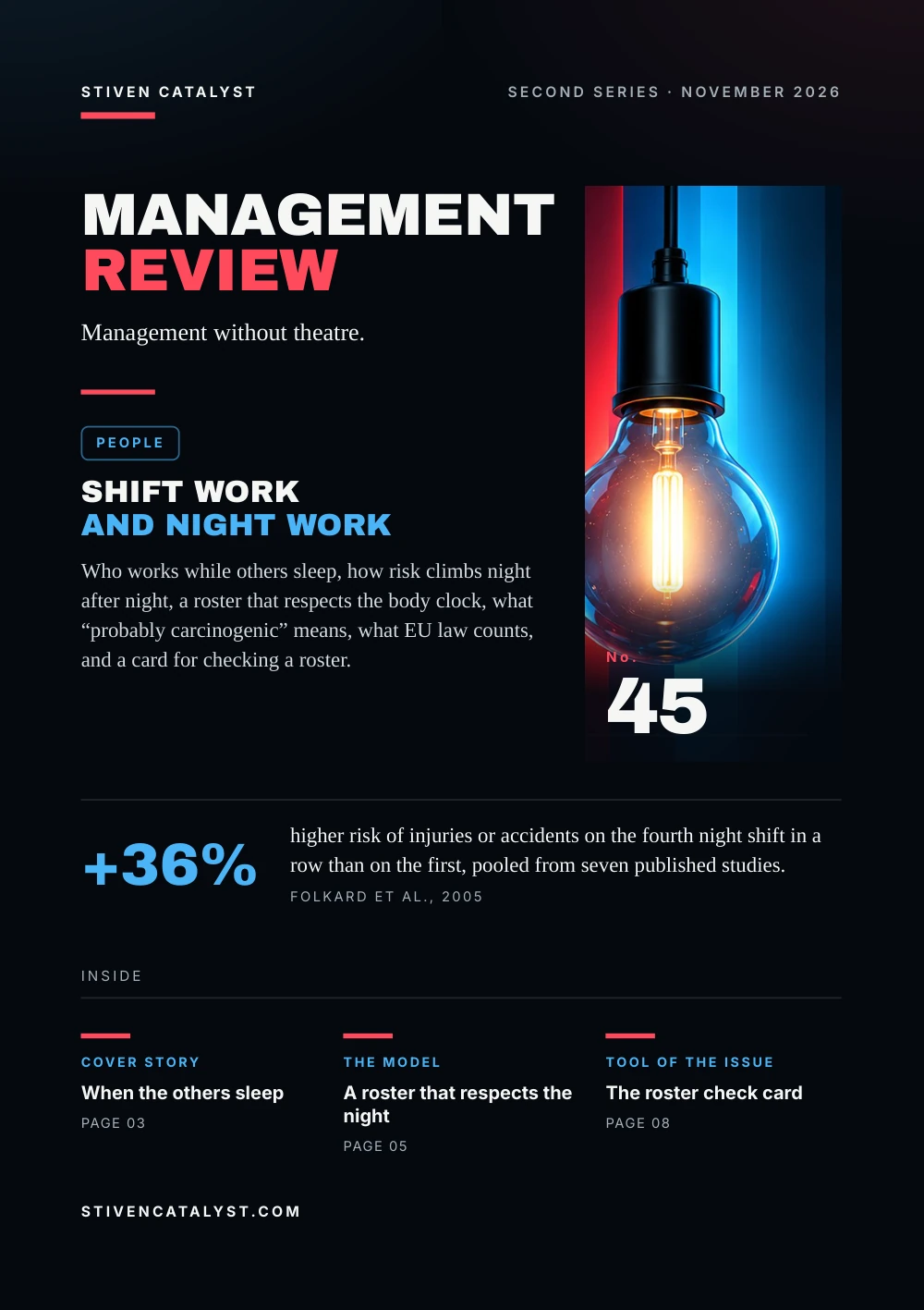
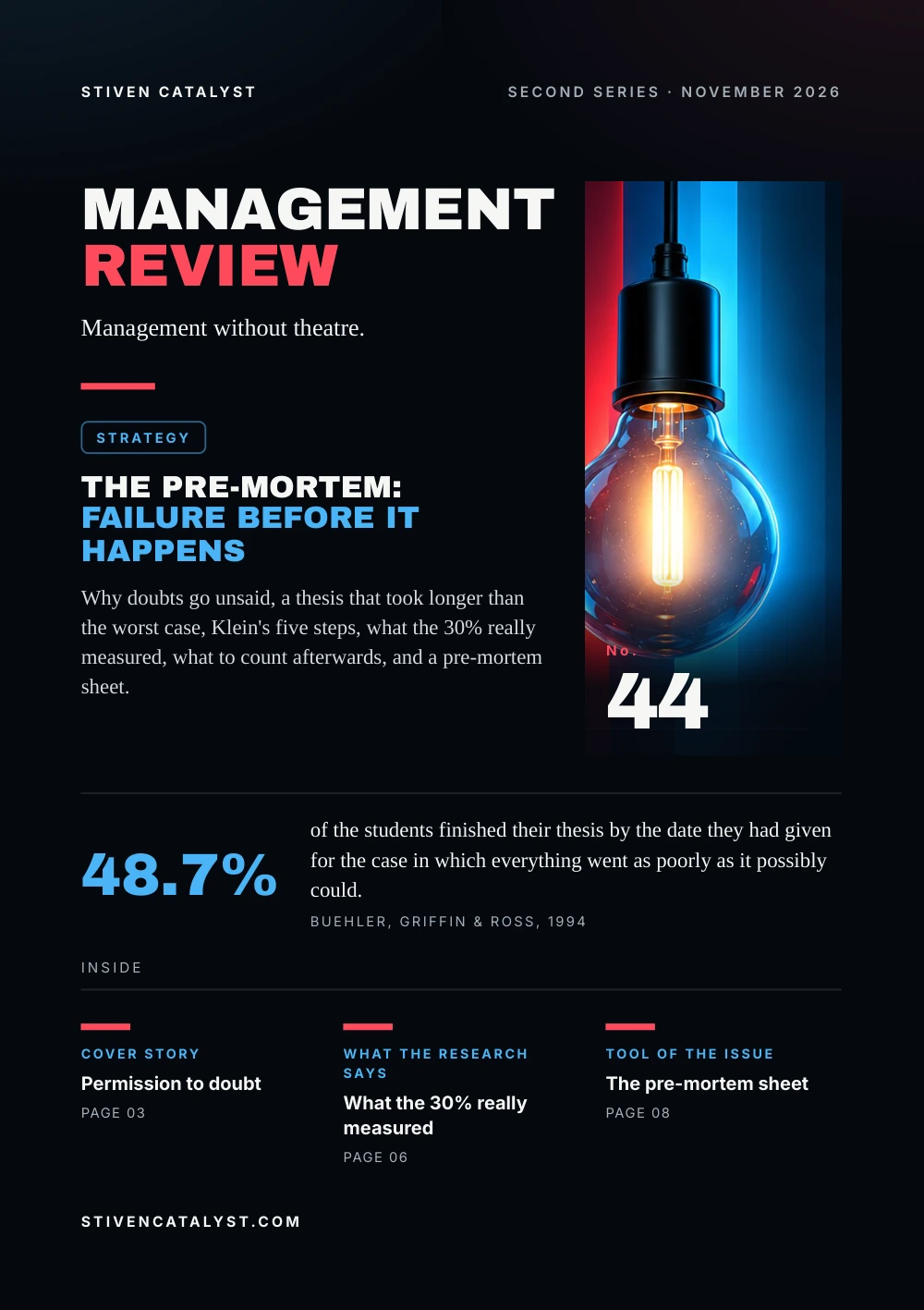
Stiven CatalystSecond series · November 2026
ManagementReview
Management without theatre.
People
Shift workand night work
Who works while others sleep, how risk climbs night after night, a roster that respects the body clock, what “probably carcinogenic” means, what EU law counts, and a card for checking a roster.

No.45
+36%
higher risk of injuries or accidents on the fourth night shift in a row than on the first, pooled from seven published studies.Folkard et al., 2005
stivencatalyst.com
No. 45 · People
In this issue
Hotels, hospitals, warehouses and transport run through the night, and someone draws up the roster. This issue looks at what the evidence says about working at night, what the law requires, and which choices in a roster are in a manager's hands.
- 03Cover storyWhen the others sleep
- 04The numbersNight after night
- 05The modelA roster that respects the night
- 06What the research saysProbably carcinogenic
- 07How it is measuredWhat the law counts
- 08Tool of the issueThe roster check card
- 09SourcesSources and method
How to read this issue
Figure
Every figure has its source and year at the foot of its page.
Our reading
Where the editors interpret rather than the research, it says so.
Practice
The steps and the card are proposals to try, not research results.
Cover story
When the otherssleep
For the European Working Conditions Survey 2024, Eurofound interviewed 36,644 people face to face in 35 countries, Albania among them. Its highlights on working time:
Workers in Europe, 2024
The 2021 telephone survey asked differently: in the EU, 21% worked at night sometimes or more often, 25% of men and 17% of women, most often in security jobs and in care, such as medical staff.
Our reading
Night work is not a niche. In most operations that never close, someone on the team works while the manager sleeps.
Sources: Eurofound, 2026; Eurofound, 2022 (via EU-OSHA, OSHwiki)
Self-reports. By Eurofound's account, night and weekend work have fallen since 2015 while shift work has stayed stable; 2021 asked differently. No separate figure for Albania in the highlights.
More in the essayWhat a Night Auditor learns about a business that most managers never see
The numbers
Night af ternight
Simon Folkard, David Lombardi and Philip Tucker pooled published studies of injuries and accidents at work: seven counted them over at least four night shifts in a row, five of these also over morning or day shifts.
Higher risk than on the first shift of a run, 2005
+30%on the night shift against the morning shift; afternoon: +18%
+27%on 12-hour shifts against 8-hour shifts; 10 hours: +13%
Our reading
The fourth night costs more than the first. How many nights in a row is decided in the roster.
Source: Simon Folkard, David A. Lombardi & Philip T. Tucker, Industrial Health, 2005
Relative risks pooled from a few studies, not the risk of one workplace. Shift length, nights in a row and breaks are to be judged together, the authors say.
The model
A roster thatrespects the night
The UK Health and Safety Executive's guide Managing shiftwork (HSG256, 2006) turns the research into advice for those who design rosters. Its main points:
01
Forward
morning, afternoon, then night; limited evidence that the body clock adapts faster
02
Fast or slow
change every 2–3 days or every 3–4 weeks, not every week or two
03
Few in a row
nights, long shifts, early starts: 2–3 in a row, then 2–3 days off
04
Length
at most 12 hours with overtime; 8 for nights and safety-critical work
05
Rest
11 hours between shifts; two nights' sleep when switching between days and nights
06
Timing
no starts before 7:00 unless needed; hard tasks away from low alertness
How strong is the evidence? In a 2023 Cochrane review of 11 studies, forward and faster rotation may reduce sleepiness on shift and may not change sleep quality, but the evidence is very uncertain: on direction, one trial with 62 participants gave usable data.
Our reading
Forward rotation is sensible advice, not a proven cure. The previous page points more clearly at nights in a row and shift length.
Sources: Health and Safety Executive, 2006; Hulsegge et al., Cochrane Database of Systematic Reviews, 2023 (via PubMed)
The advice is HSE's, written for Britain; the summary in the cards is the editors'. The review is Hulsegge et al. (2023).
What the research says
Probablycarcinogenic
In June 2019, 27 experts from 16 countries met at the International Agency for Research on Cancer (IARC) in Lyon and classified night shift work, work during the usual sleeping hours of the population, as probably carcinogenic to humans: Group 2A.
01
In humans
limited evidence: positive associations with cancers of the breast, prostate, colon and rectum; chance, bias or confounding not ruled out
02
In animals
sufficient evidence for altering the light–dark schedule
03
Mechanisms
strong evidence in experimental systems: immunosuppression, chronic inflammation, cell proliferation
The class says how strong the evidence of a hazard is, not how large the risk is. Working as a hairdresser or barber is in the same group, IARC notes, and agents in one group can carry very different risks. In 2007 an earlier working group had reached the same class for shift work that involves circadian disruption.
Our reading
For a manager the lesson is not a diagnosis but a duty of care: plan night work as a recognised hazard, and leave health questions to doctors.
Sources: IARC, 2020; IARC, 2019
IARC makes no recommendations for individuals; it tells those who are concerned to consult their physician. This issue gives no medical advice.
How it is measured
What the lawcounts
The EU Working Time Directive 2003/88/EC sets minimum rules; Articles 8 to 13 cover night work. Night time is at least seven hours, always including midnight to 05:00; a night worker normally works at least three hours of the working day in it.
Art. 8, length
on average at most 8 hours in 24; with special hazards or heavy strain, at most 8 in any 24 hours with night work
Art. 9, health
a free, confidential health assessment before assignment and at regular intervals; suitable day work where possible for health problems linked to night work
Art. 12, protection
protection that fits the work, with services available at all times
Art. 13, pattern
adapting work to the worker, easing monotonous work and work at a fixed pace
Hypothetical example, four weeks of a night team
- Nights in a row
- longest run 5; 2 runs longer than 3
- Rest
- 3 changeovers with under 11 hours
- Health
- assessment offered to 6 of 8 night workers
Three counts to check a roster against every month. The numbers are invented.
Source: European Parliament and Council of the EU, 2003 (via legislation.gov.uk)
Minimum rules; national law and collective agreements set the details and may go further. The 11 hours of daily rest are in Article 3. Not legal advice.
Tool of the issue
The rostercheck card
One roster period, one team. Fill it in before the roster is published, and again after it has been worked: the plan and what really happened can differ.
01Period and teamdates, team, how many people work nights
02Nights in a rowthe longest run, and the rest days after it
03Longest shifthours with overtime; which nights are safety-critical
04Shortest restfrom the end of one shift to the start of the next; any under 11 hours?
05Rotationforward or backward; every few days or every few weeks
06Health and handoverhealth assessment offered; what the night hands to the morning, and to whom
Sources: Simon Folkard, David A. Lombardi & Philip T. Tucker, Industrial Health, 2005; Health and Safety Executive, 2006; European Parliament and Council of the EU, 2003 (via legislation.gov.uk)
A practice proposed by the editors, after Folkard et al. (2005), HSE (2006) and Directive 2003/88/EC. It does not replace legal or medical advice.
Open the tool: Shift Handoverstivencatalyst.com/tools/shift-handover/
Sources and method
Every figurehas a source.
The figures in this issue come from the sources below. The year shows how recent each one is.
- European Working Conditions Survey 2024: HighlightsEurofound, 2026https://eurofound.shorthandstories.com/european-working-conditions-survey-2024-highlights/index.html
- Working conditions in the time of COVID-19: Implications for the futureEurofound, 2022 · via EU-OSHA, OSHwikihttps://www.eurofound.europa.eu/publications/report/2022/working-conditions-in-the-time-of-covid-19-implications-for-the-future
- Shiftwork: Safety, Sleepiness and SleepSimon Folkard, David A. Lombardi & Philip T. Tucker, Industrial Health, 2005https://www.jstage.jst.go.jp/article/indhealth/43/1/43_1_20/_article
- Managing shiftwork: Health and safety guidance (HSG256)Health and Safety Executive, 2006https://www.hse.gov.uk/pubns/priced/hsg256.pdf
- Adapting shift work schedules for sleep quality, sleep duration, and sleepiness in shift workersHulsegge et al., Cochrane Database of Systematic Reviews, 2023 · via PubMedhttps://doi.org/10.1002/14651858.CD010639.pub2
- Night Shift Work (IARC Monographs, Volume 124)IARC, 2020https://publications.iarc.who.int/Book-And-Report-Series/Iarc-Monographs-On-The-Identification-Of-Carcinogenic-Hazards-To-Humans/Night-Shift-Work-2020
- IARC Monographs Meeting 124: Night Shift Work. Questions and AnswersIARC, 2019https://www.iarc.who.int/wp-content/uploads/2019/07/QA_Monographs_Volume124.pdf
- Directive 2003/88/EC concerning certain aspects of the organisation of working timeEuropean Parliament and Council of the EU, 2003 · via legislation.gov.ukhttps://eur-lex.europa.eu/eli/dir/2003/88/oj/eng
Editorial method
Each figure was checked for its year, its publisher and what exactly it measures. Where the publisher's page could not be opened, the figure was checked against independent summaries and is marked “via”. The editors' interpretation is marked “Our reading”. Figures that could not be confirmed are not in the issue.
ManagementReview
Management without theatre.
Every issue, one management question, checked against the best research.
All issues
stivencatalyst.com/magazine/management-review.html
Management Review · No. 45 · November 2026 · Stiven Catalyst
Click or swipe a page to turn it. The arrow keys work too.
Management Review · No. 45
The figures of the issue
The charts of the printed pages, with their sources.
Source: Eurofound, 2026
Source: Simon Folkard, David A. Lombardi & Philip T. Tucker, Industrial Health, 2005
The whole text Read the issue as text For reading on a small screen, searching or a screen reader. The same words, without the page design.
In this issue
Hotels, hospitals, warehouses and transport run through the night, and someone draws up the roster. This issue looks at what the evidence says about working at night, what the law requires, and which choices in a roster are in a manager's hands.
In a 2024 European survey, 21% of workers worked shifts and 17% worked at night at least once a month. Pooled studies show the risk of incidents rising over successive night shifts and with shifts longer than eight hours. The UK Health and Safety Executive advises forward, fast-rotating rosters with few nights in a row, though the evidence on rotation direction is very uncertain. IARC classifies night shift work as probably carcinogenic to humans, a statement about the hazard, not about the size of the risk. EU law sets limits and a free health assessment for night workers.
Stiven Janaqi, Editor
Cover story
When the others sleep
For the European Working Conditions Survey 2024, Eurofound interviewed 36,644 people face to face in 35 countries, Albania among them. Its highlights on working time:
Workers in Europe, 2024: Worked shifts 21%, Worked 2+ hours between 22:00 and 05:00, at least monthly 17%, Under 11 hours' rest between working days, at least monthly 1 in 5.
The 2021 telephone survey asked differently: in the EU, 21% worked at night sometimes or more often, 25% of men and 17% of women, most often in security jobs and in care, such as medical staff.
Our reading
Night work is not a niche. In most operations that never close, someone on the team works while the manager sleeps.
Self-reports. By Eurofound's account, night and weekend work have fallen since 2015 while shift work has stayed stable; 2021 asked differently. No separate figure for Albania in the highlights.
Sources: Eurofound, 2026; Eurofound, 2022 (via EU-OSHA, OSHwiki)
More in the essay: What a Night Auditor learns about a business that most managers never see
The numbers
Night af ter night
Simon Folkard, David Lombardi and Philip Tucker pooled published studies of injuries and accidents at work: seven counted them over at least four night shifts in a row, five of these also over morning or day shifts.
Higher risk than on the first shift of a run, 2005: 2nd shift in a row: Morning or day shifts +2%, Night shifts +6%; 3rd shift in a row: Morning or day shifts +7%, Night shifts +17%; 4th shift in a row: Morning or day shifts +17%, Night shifts +36%.
- +30% on the night shift against the morning shift; afternoon: +18%
- +27% on 12-hour shifts against 8-hour shifts; 10 hours: +13%
Our reading
The fourth night costs more than the first. How many nights in a row is decided in the roster.
Relative risks pooled from a few studies, not the risk of one workplace. Shift length, nights in a row and breaks are to be judged together, the authors say.
Source: Simon Folkard, David A. Lombardi & Philip T. Tucker, Industrial Health, 2005
The model
A roster that respects the night
The UK Health and Safety Executive's guide Managing shiftwork (HSG256, 2006) turns the research into advice for those who design rosters. Its main points:
- Forward. morning, afternoon, then night; limited evidence that the body clock adapts faster
- Fast or slow. change every 2–3 days or every 3–4 weeks, not every week or two
- Few in a row. nights, long shifts, early starts: 2–3 in a row, then 2–3 days off
- Length. at most 12 hours with overtime; 8 for nights and safety-critical work
- Rest. 11 hours between shifts; two nights' sleep when switching between days and nights
- Timing. no starts before 7:00 unless needed; hard tasks away from low alertness
How strong is the evidence? In a 2023 Cochrane review of 11 studies, forward and faster rotation may reduce sleepiness on shift and may not change sleep quality, but the evidence is very uncertain: on direction, one trial with 62 participants gave usable data.
Our reading
Forward rotation is sensible advice, not a proven cure. The previous page points more clearly at nights in a row and shift length.
The advice is HSE's, written for Britain; the summary in the cards is the editors'. The review is Hulsegge et al. (2023).
Sources: Health and Safety Executive, 2006; Hulsegge et al., Cochrane Database of Systematic Reviews, 2023 (via PubMed)
What the research says
Probably carcinogenic
In June 2019, 27 experts from 16 countries met at the International Agency for Research on Cancer (IARC) in Lyon and classified night shift work, work during the usual sleeping hours of the population, as probably carcinogenic to humans: Group 2A.
- In humans. limited evidence: positive associations with cancers of the breast, prostate, colon and rectum; chance, bias or confounding not ruled out
- In animals. sufficient evidence for altering the light–dark schedule
- Mechanisms. strong evidence in experimental systems: immunosuppression, chronic inflammation, cell proliferation
The class says how strong the evidence of a hazard is, not how large the risk is. Working as a hairdresser or barber is in the same group, IARC notes, and agents in one group can carry very different risks. In 2007 an earlier working group had reached the same class for shift work that involves circadian disruption.
Our reading
For a manager the lesson is not a diagnosis but a duty of care: plan night work as a recognised hazard, and leave health questions to doctors.
IARC makes no recommendations for individuals; it tells those who are concerned to consult their physician. This issue gives no medical advice.
Sources: IARC, 2020; IARC, 2019
How it is measured
What the law counts
The EU Working Time Directive 2003/88/EC sets minimum rules; Articles 8 to 13 cover night work. Night time is at least seven hours, always including midnight to 05:00; a night worker normally works at least three hours of the working day in it.
- A
r t. 8, length. on average at most 8 hours in 24; with special hazards or heavy strain, at most 8 in any 24 hours with night work - A
r t. 9, health. a free, confidential health assessment before assignment and at regular intervals; suitable day work where possible for health problems linked to night work - A
r t. 12, protection. protection that fits the work, with services available at all times - A
r t. 13, pat tern. adapting work to the worker, easing monotonous work and work at a fixed pace
Hypothe tical example, four weeks of a night team
- Nights in a row: longest run 5; 2 runs longer than 3
- Rest: 3 changeovers with under 11 hours
- Health: assessment offered to 6 of 8 night workers
Three counts to check a roster against every month. The numbers are invented.
Minimum rules; national law and collective agreements set the details and may go further. The 11 hours of daily rest are in Article 3. Not legal advice.
Source: European Parliament and Council of the EU, 2003 (via legislation.gov.uk)
Tool of the issue
The roster check card
One roster period, one team. Fill it in before the roster is published, and again after it has been worked: the plan and what really happened can differ.
- Period and team dates, team, how many people work nights
- Nights in a row the longest run, and the rest days after it
- Longest shi
f t hours with overtime; which nights are safety-critical - Sho
r test rest from the end of one shift to the start of the next; any under 11 hours? - Rotation forward or backward; every few days or every few weeks
- Health and handover health assessment offered; what the night hands to the morning, and to whom
A practice proposed by the editors, after Folkard et al. (2005), HSE (2006) and Directive 2003/88/EC. It does not replace legal or medical advice.
Sources: Simon Folkard, David A. Lombardi & Philip T. Tucker, Industrial Health, 2005; Health and Safety Executive, 2006; European Parliament and Council of the EU, 2003 (via legislation.gov.uk)
Open the tool: Shift Handover
Sources and method
Every figure has a source.
The figures in this issue come from the sources below. The year shows how recent each one is.
- Eurofound, “European Working Conditions Survey 2024: Highlights”, 2026. https://eurofound.shorthandstories.com/european-working-conditions-survey-2024-highlights/index.html
- Eurofound, “Working conditions in the time of COVID-19: Implications for the future”, 2022 (via EU-OSHA, OSHwiki). https://www.eurofound.europa.eu/publications/report/2022/working-conditions-in-the-time-of-covid-19-implications-for-the-future
- Simon Folkard, David A. Lombardi & Philip T. Tucker, Industrial Health, “Shiftwork: Safety, Sleepiness and Sleep”, 2005. https://www.jstage.jst.go.jp/article/indhealth/43/1/43_1_20/_article
- Health and Safety Executive, “Managing shiftwork: Health and safety guidance (HSG256)”, 2006. https://www.hse.gov.uk/pubns/priced/hsg256.pdf
- Hulsegge et al., Cochrane Database of Systematic Reviews, “Adapting shift work schedules for sleep quality, sleep duration, and sleepiness in shift workers”, 2023 (via PubMed). https://doi.org/10.1002/14651858.CD010639.pub2
- IARC, “Night Shift Work (IARC Monographs, Volume 124)”, 2020. https://publications.iarc.who.int/Book-And-Report-Series/Iarc-Monographs-On-The-Identification-Of-Carcinogenic-Hazards-To-Humans/Night-Shift-Work-2020
- IARC, “IARC Monographs Meeting 124: Night Shift Work. Questions and Answers”, 2019. https://www.iarc.who.int/wp-content/uploads/2019/07/QA_Monographs_Volume124.pdf
- European Parliament and Council of the EU, “Directive 2003/88/EC concerning certain aspects of the organisation of working time”, 2003 (via legislation.gov.uk). https://eur-lex.europa.eu/eli/dir/2003/88/oj/eng
Edit orial me thod
Each figure was checked for its year, its publisher and what exactly it measures. Where the publisher's page could not be opened, the figure was checked against independent summaries and is marked “via”. The editors' interpretation is marked “Our reading”. Figures that could not be confirmed are not in the issue.
Management Review · Monthly edition