
In this issue
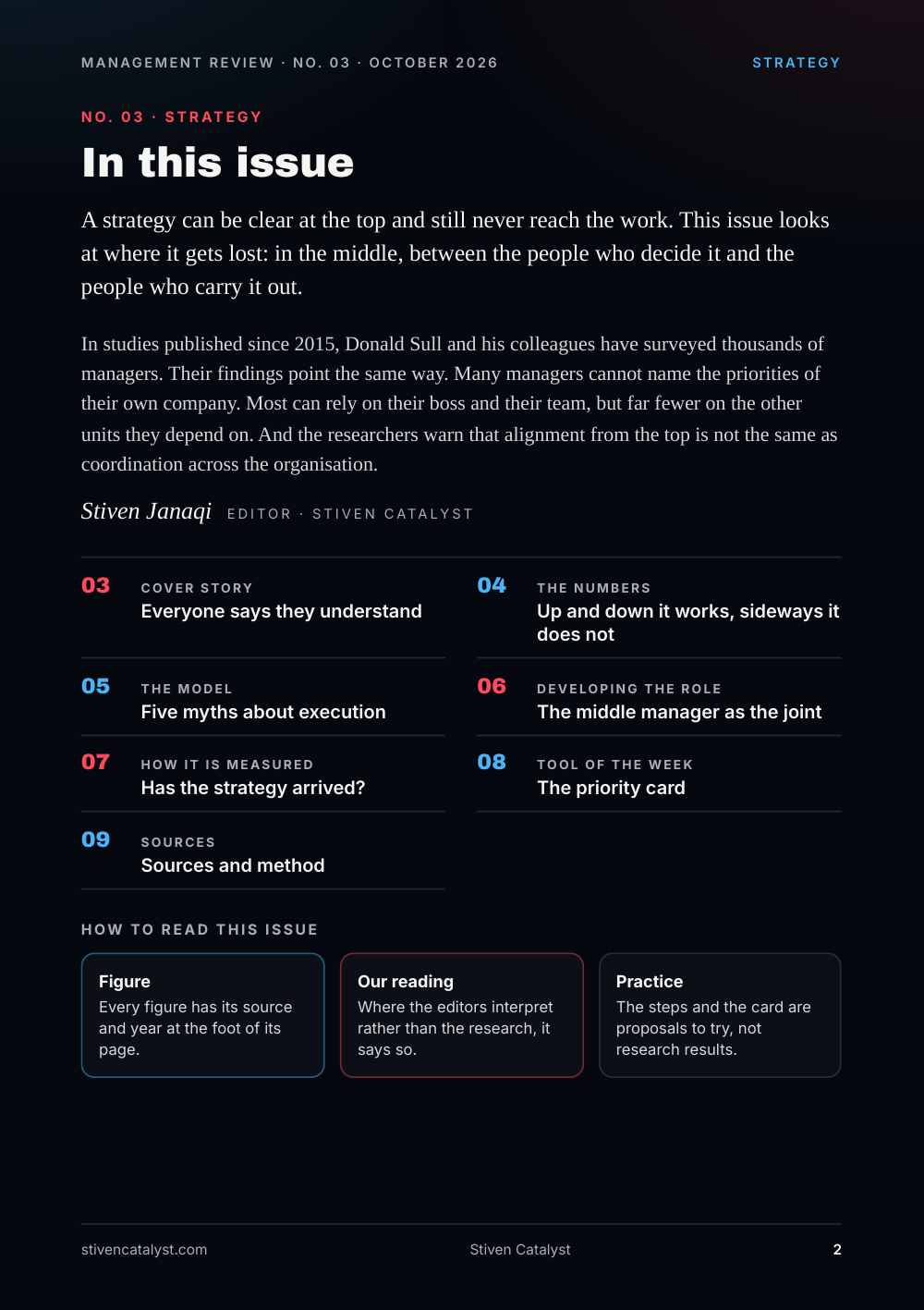
A strategy can be clear at the top and still never reach the work. This issue looks at where it gets lost: in the middle, between the people who decide it and the people who carry it out.
In studies published since 2015, Donald Sull and his colleagues have surveyed thousands of managers. Their findings point the same way. Many managers cannot name the priorities of their own company. Most can rely on their boss and their team, but far fewer on the other units they depend on. And the researchers warn that alignment from the top is not the same as coordination across the organisation.
Stiven Janaqi, Editor
Cover story
Everyone says the y understand
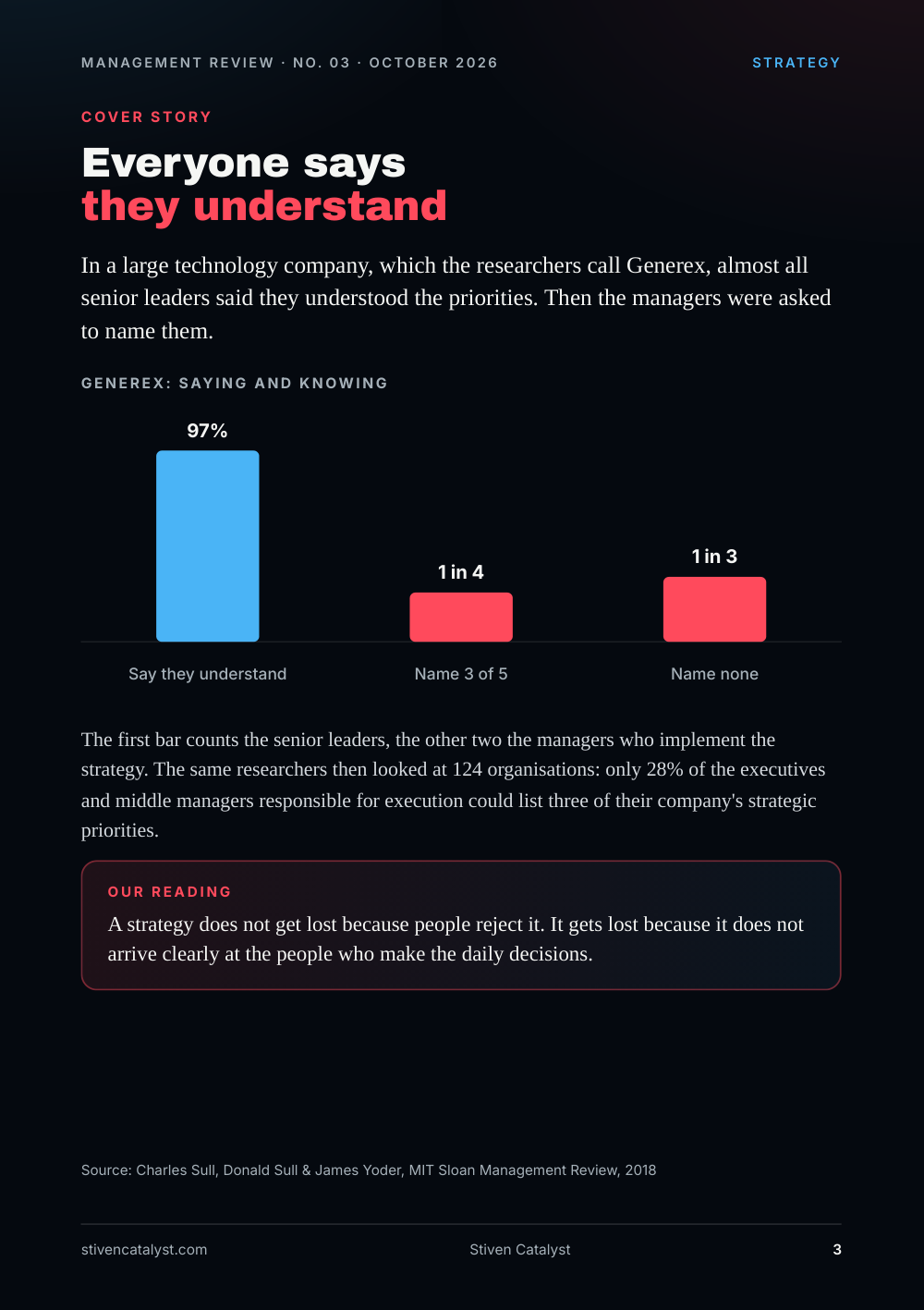
In a large technology company, which the researchers call Generex, almost all senior leaders said they understood the priorities. Then the managers were asked to name them.
Generex: saying and knowing: Say they understand 97%, Name 3 of 5 1 in 4, Name none 1 in 3.
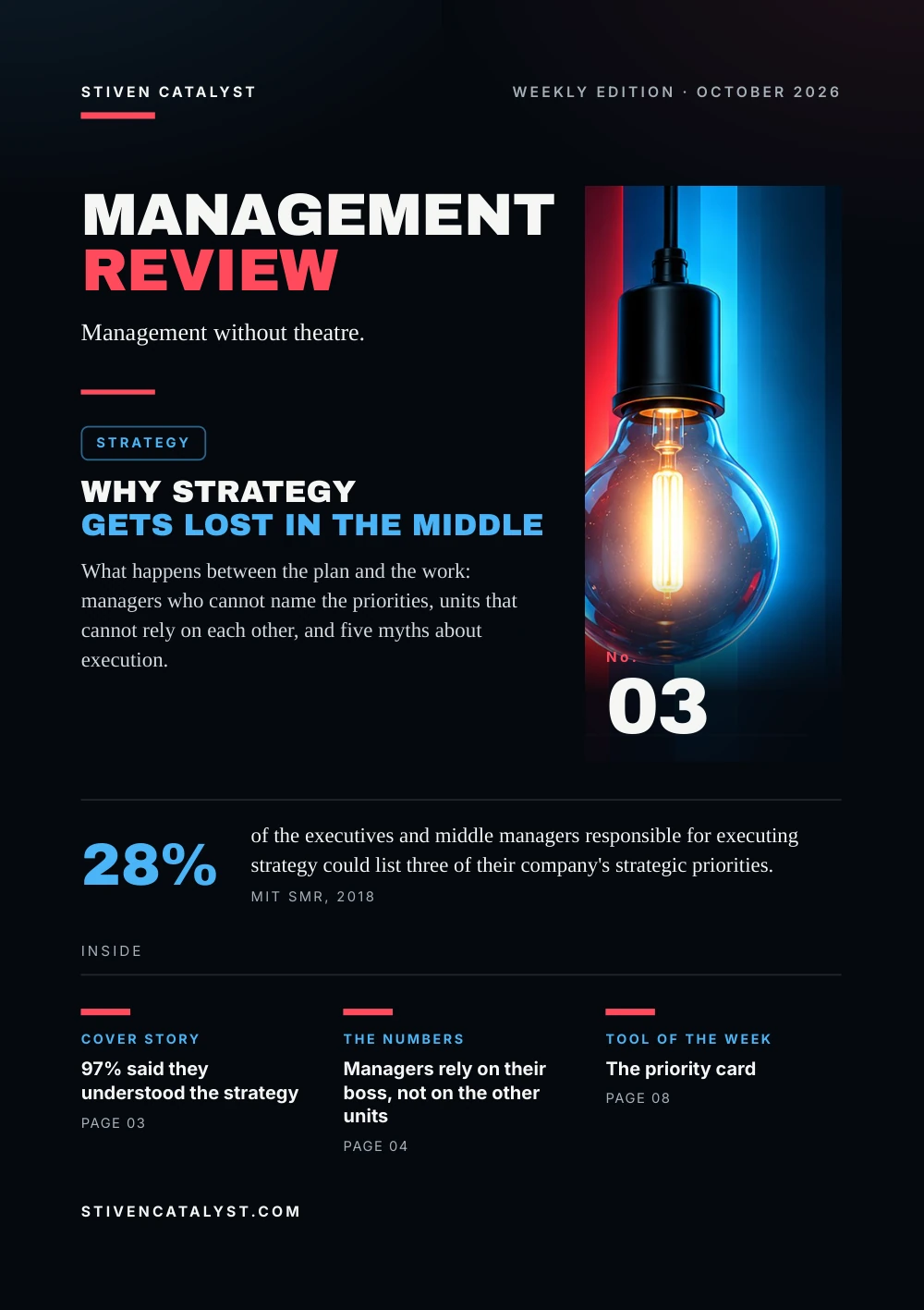
The first bar counts the senior leaders, the other two the managers who implement the strategy. The same researchers then looked at 124 organisations: only 28% of the executives and middle managers responsible for execution could list three of their company's strategic priorities.
Our reading
A strategy does not get lost because people reject it. It gets lost because it does not arrive clearly at the people who make the daily decisions.
Source: Charles Sull, Donald Sull & James Yoder, MIT Sloan Management Review, 2018
The numbers
Up and down it works, sideways it does not
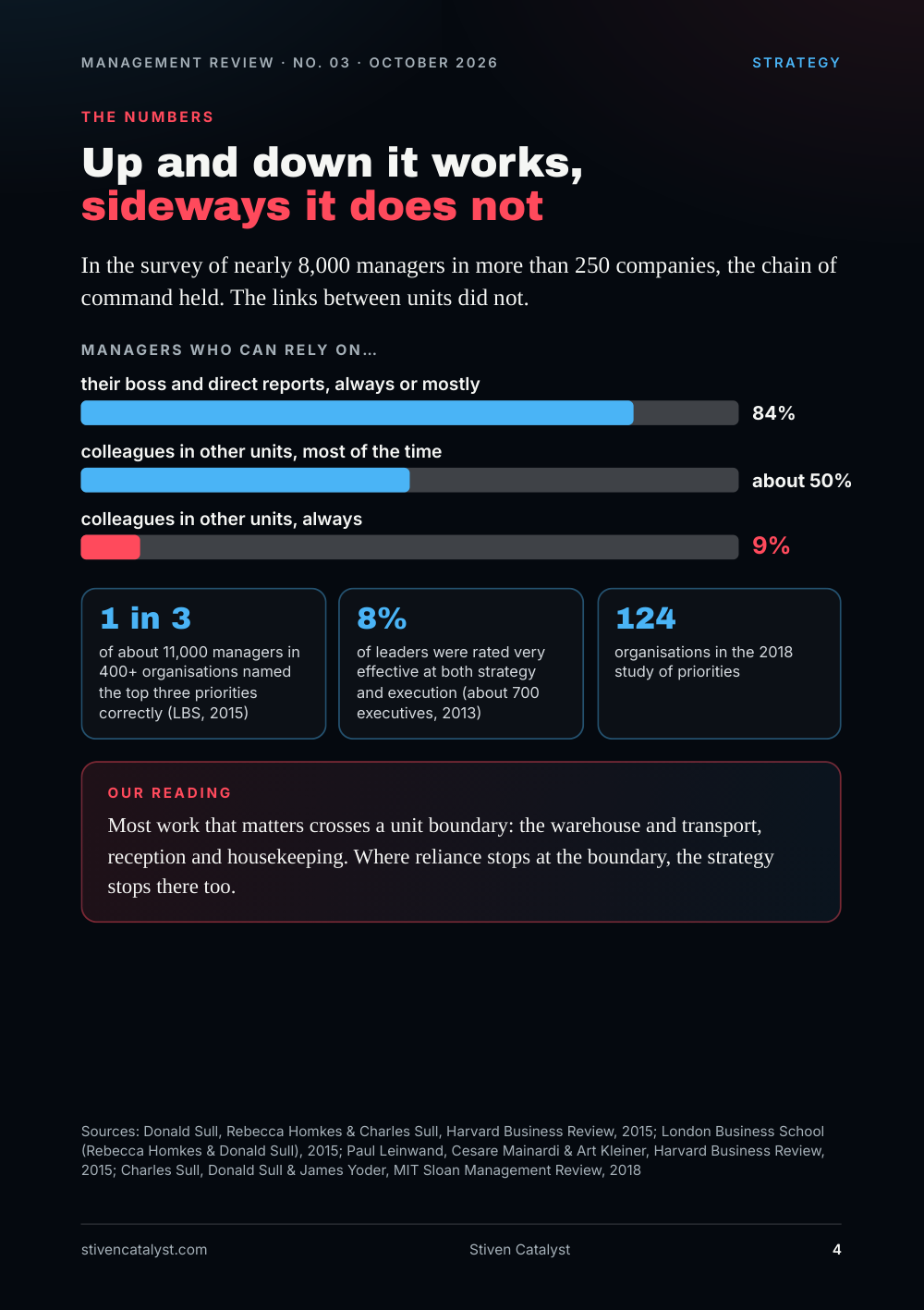
In the survey of nearly 8,000 managers in more than 250 companies, the chain of command held. The links between units did not.
Managers who can rely on…: their boss and direct reports, always or mostly 84%, colleagues in other units, most of the time about 50%, colleagues in other units, always 9%.
- 1 in 3 of about 11,000 managers in 400+ organisations named the top three priorities correctly (LBS, 2015)
- 8% of leaders were rated very effective at both strategy and execution (about 700 executives, 2013)
- 124 organisations in the 2018 study of priorities
Our reading
Most work that matters crosses a unit boundary: the warehouse and transport, reception and housekeeping. Where reliance stops at the boundary, the strategy stops there too.
Sources: Donald Sull, Rebecca Homkes & Charles Sull, Harvard Business Review, 2015; London Business School (Rebecca Homkes & Donald Sull), 2015; Paul Leinwand, Cesare Mainardi & Art Kleiner, Harvard Business Review, 2015; Charles Sull, Donald Sull & James Yoder, MIT Sloan Management Review, 2018
The model
Five my ths about execution
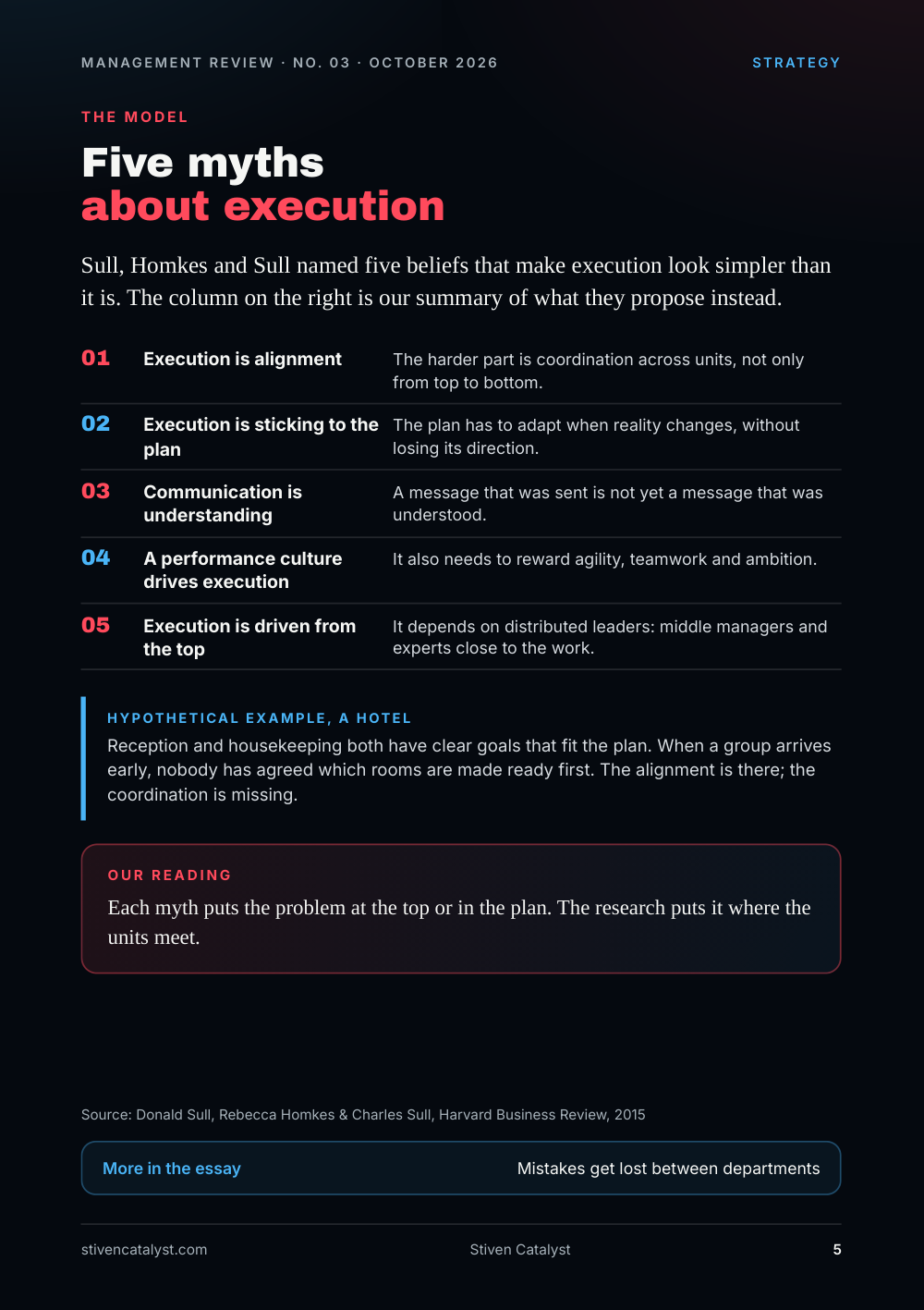
Sull, Homkes and Sull named five beliefs that make execution look simpler than it is. The column on the right is our summary of what they propose instead.
- Execution is alignment. The harder part is coordination across units, not only from top to bottom.
- Execution is sticking
t o the plan. The plan has to adapt when reality changes, without losing its direction. - Communication is understanding. A message that was sent is not yet a message that was understood.
- A performance culture drives execution. It also needs to reward agility, teamwork and ambition.
- Execution is driven from the
t op. It depends on distributed leaders: middle managers and experts close to the work.
Hypoth
Our reading
Each myth puts the problem at the top or in the plan. The research puts it where the units meet.
Source: Donald Sull, Rebecca Homkes & Charles Sull, Harvard Business Review, 2015
More in the essay: Mistakes get lost between departments
Developing the role
The middle manager as the joint
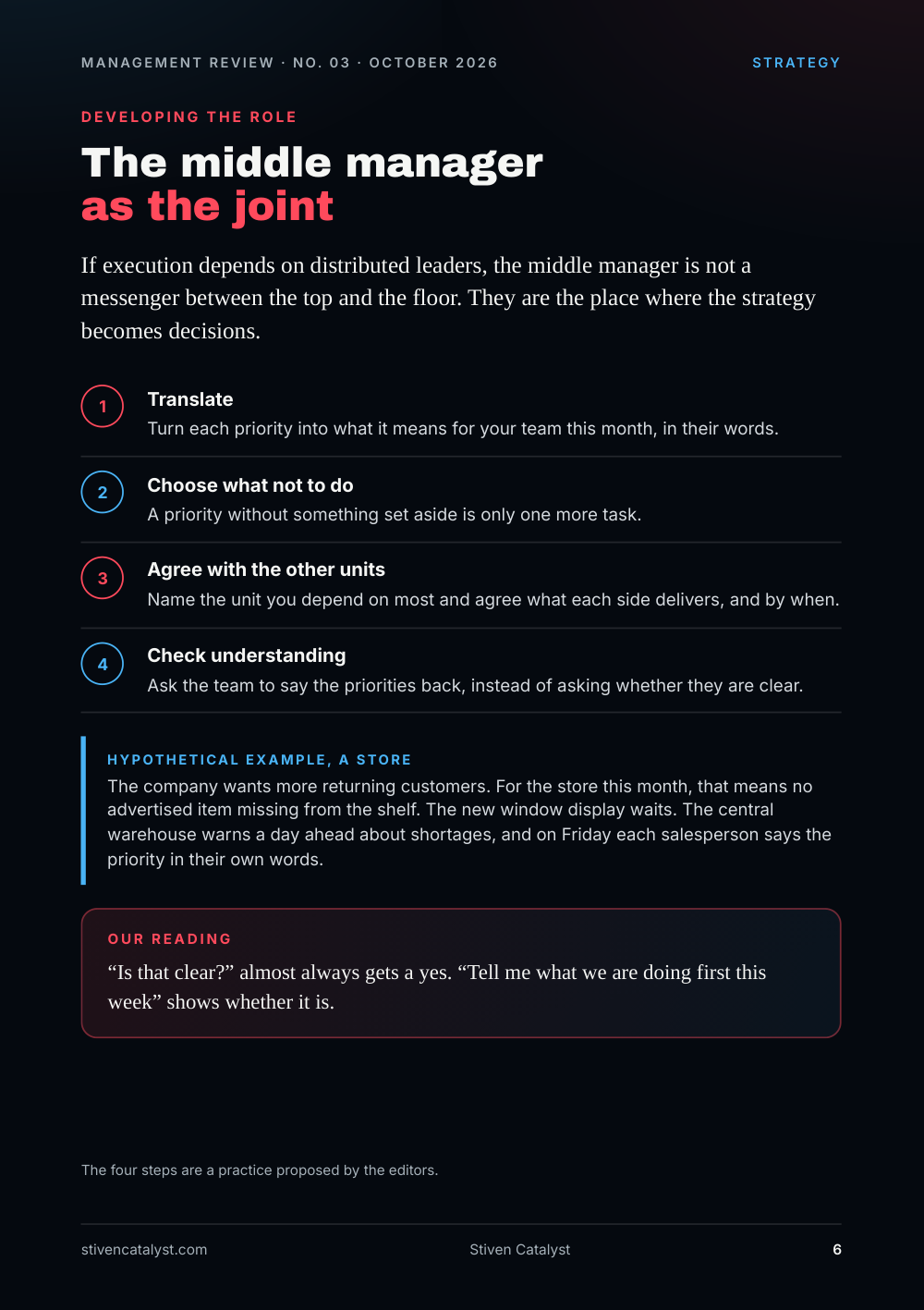
If execution depends on distributed leaders, the middle manager is not a messenger between the top and the floor. They are the place where the strategy becomes decisions.
- Translate. Turn each priority into what it means for your team this month, in their words.
- Choose what not
t o do. A priority without something set aside is only one more task. - Agree with the other units. Name the unit you depend on most and agree what each side delivers, and by when.
- Check understanding. Ask the team to say the priorities back, instead of asking whether they are clear.
Hypoth
Our reading
“Is that clear?” almost always gets a yes. “Tell me what we are doing first this week” shows whether it is.
The four steps are a practice proposed by the editors.
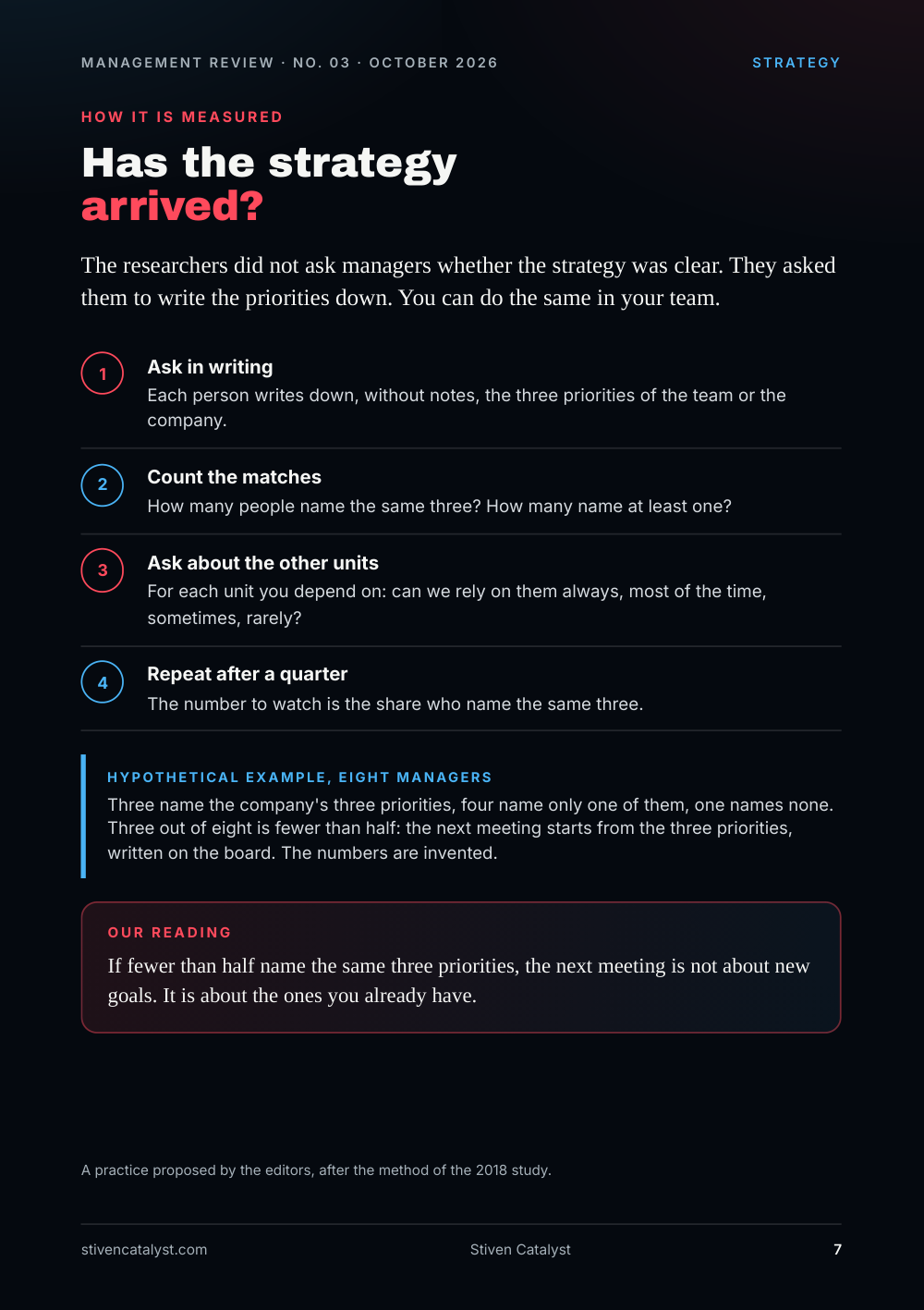
How it is measured
Has the strategy arrived?
The researchers did not ask managers whether the strategy was clear. They asked them to write the priorities down. You can do the same in your team.
- Ask in writing. Each person writes down, without notes, the three priorities of the team or the company.
- Count the ma
t ches. How many people name the same three? How many name at least one? - Ask about the other units. For each unit you depend on: can we rely on them always, most of the time, sometimes, rarely?
- Repeat a
f ter a quar ter. The number to watch is the share who name the same three.
Hypoth
Our reading
If fewer than half name the same three priorities, the next meeting is not about new goals. It is about the ones you already have.
A practice proposed by the editors, after the method of the 2018 study.
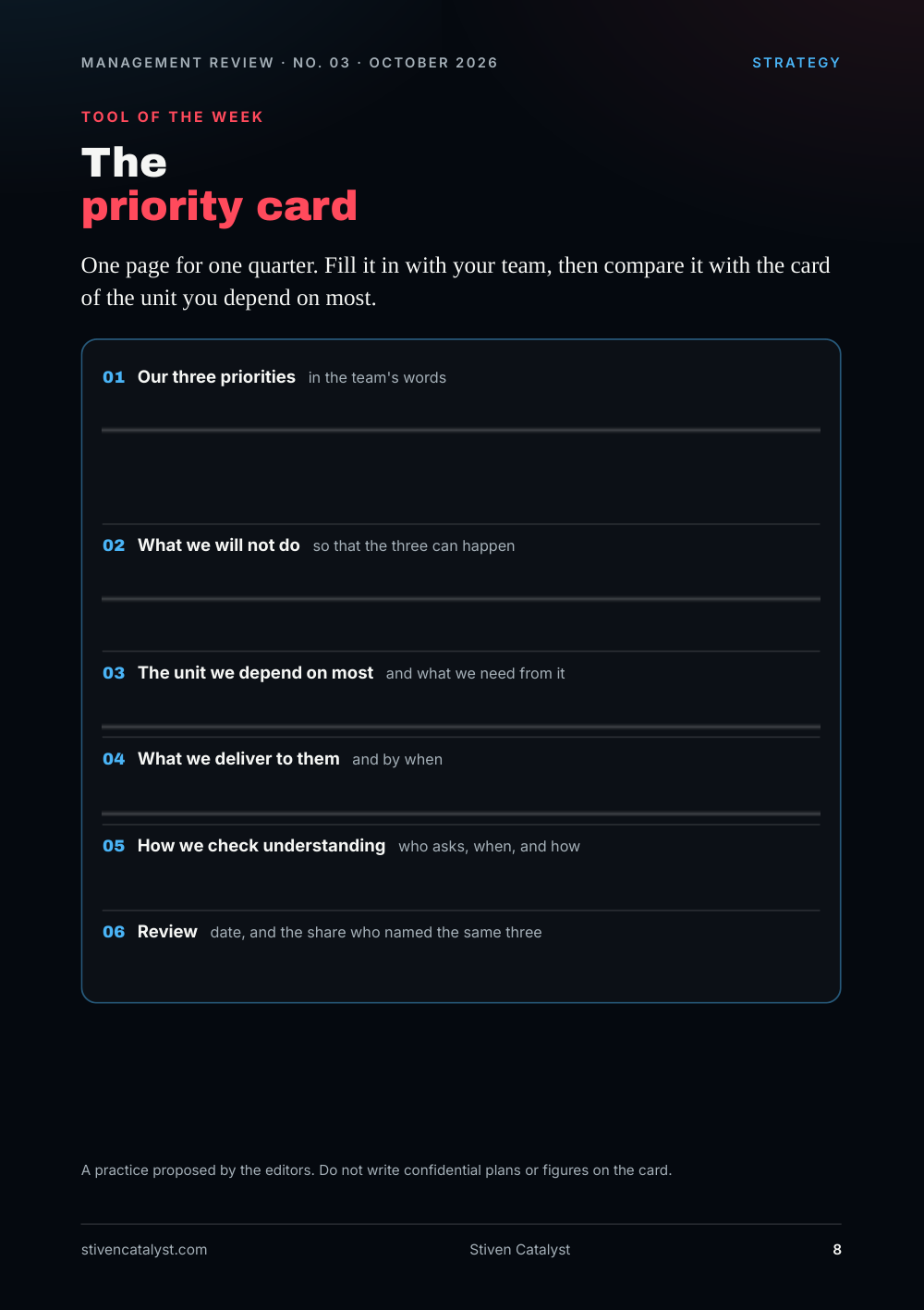
Tool of the week
The priorit y card
One page for one quarter. Fill it in with your team, then compare it with the card of the unit you depend on most.
- Our three priorities in the team's words
- What we will not do so that the three can happen
- The unit we depend on most and what we need from it
- What we deliver
t o them and by when - How we check understanding who asks, when, and how
- Review date, and the share who named the same three
A practice proposed by the editors. Do not write confidential plans or figures on the card.
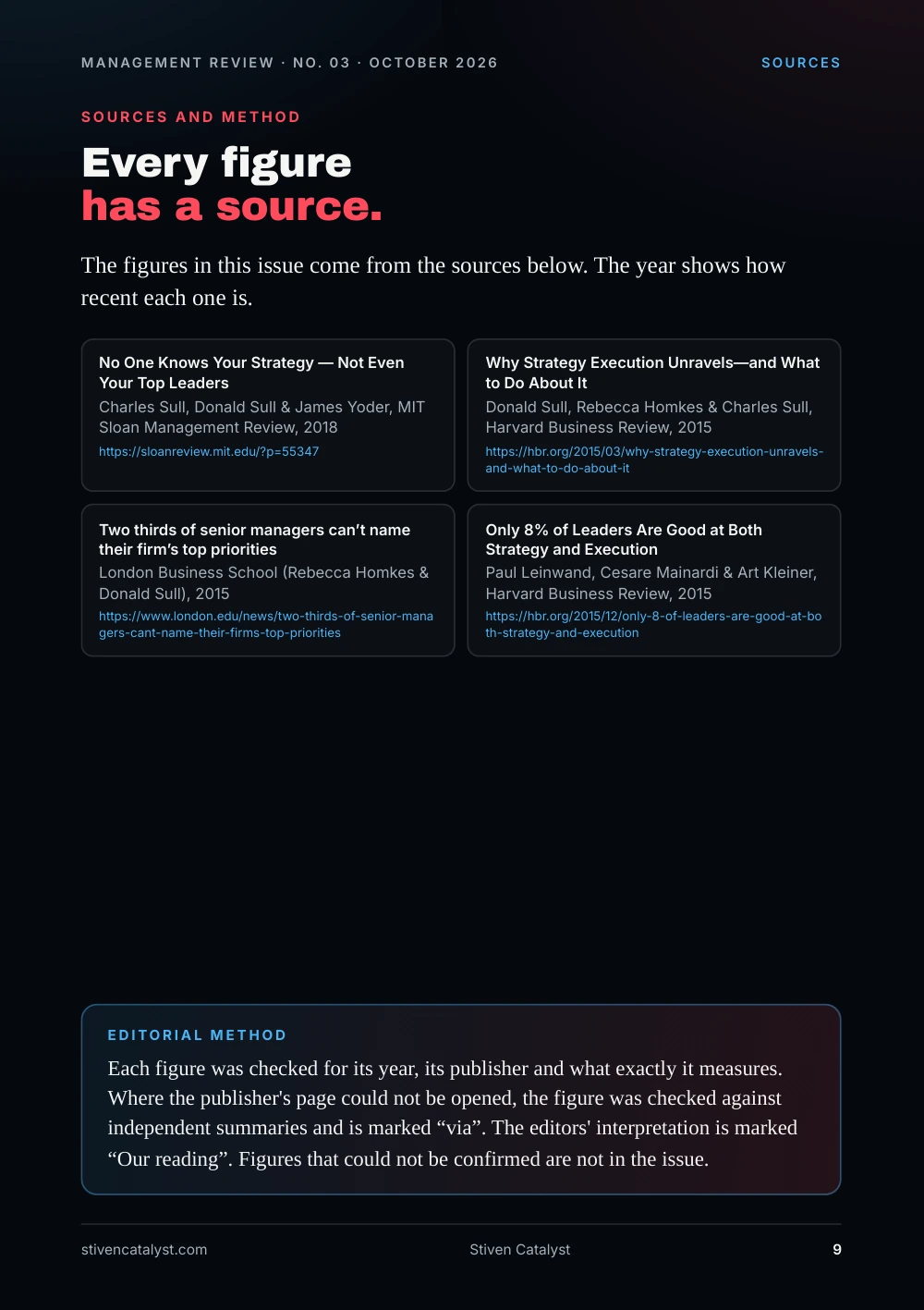
Sources and method
Every figure has a source.
The figures in this issue come from the sources below. The year shows how recent each one is.
- Charles Sull, Donald Sull & James Yoder, MIT Sloan Management Review, “No One Knows Your Strategy — Not Even Your Top Leaders”, 2018. https://sloanreview.mit.edu/?p=55347
- Donald Sull, Rebecca Homkes & Charles Sull, Harvard Business Review, “Why Strategy Execution Unravels—and What to Do About It”, 2015. https://hbr.org/2015/03/why-strategy-execution-unravels-and-what-to-do-about-it
- London Business School (Rebecca Homkes & Donald Sull), “Two thirds of senior managers can’t name their firm’s top priorities”, 2015. https://www.london.edu/news/two-thirds-of-senior-managers-cant-name-their-firms-top-priorities
- Paul Leinwand, Cesare Mainardi & Art Kleiner, Harvard Business Review, “Only 8% of Leaders Are Good at Both Strategy and Execution”, 2015. https://hbr.org/2015/12/only-8-of-leaders-are-good-at-both-strategy-and-execution
Edit orial me thod
Each figure was checked for its year, its publisher and what exactly it measures. Where the publisher's page could not be opened, the figure was checked against independent summaries and is marked “via”. The editors' interpretation is marked “Our reading”. Figures that could not be confirmed are not in the issue.