Directive (EU) 2024/2831 sets the EU's first rules on algorithmic management, for digital labour platforms, and must be transposed by 2 December 2026. Yet only 5% of EU workers earned income through a platform in the year to spring 2025, while about one in four say software allocates their tasks or shifts, and nearly as many that it instructs, rates or monitors them. In an OECD survey of over 6,000 managers, 60% of users say the tools improve their decisions, and nearly two-thirds have at least one concern. A Swedish study links heavy algorithmic management in logistics with more distress and accidents.
Management Review · Second series · November 2026 · No. 61
Algorithmic management of work
The EU's first rules on algorithmic management and their deadline, how many workers software already directs, instruct, monitor and evaluate, what managers worry about, four counts, and a card for one automated decision.
- No.
- 61
- Pages
- 10
- Sources
- 8
- Topics
- AI
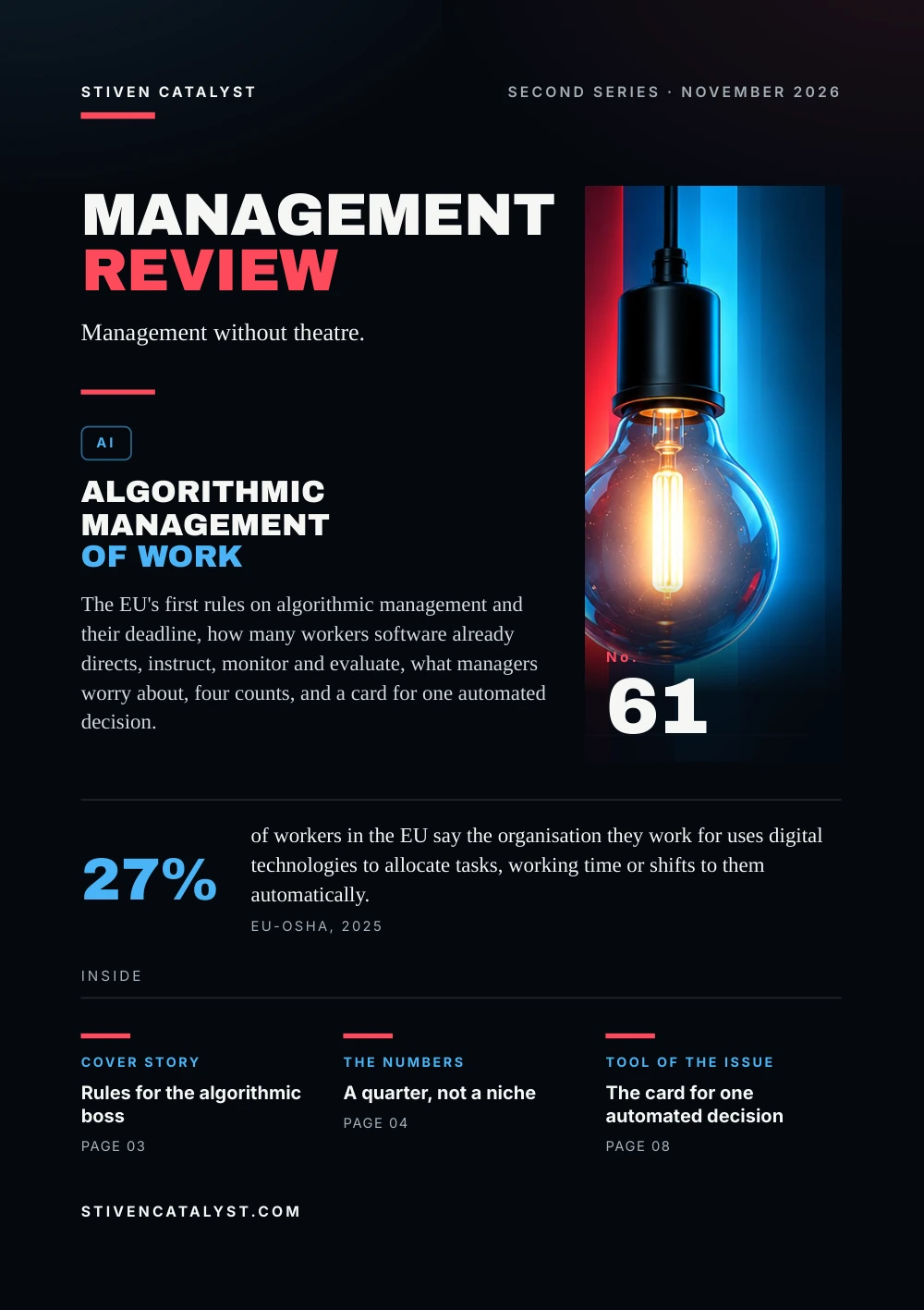
Stiven CatalystSecond series · November 2026
ManagementReview
Management without theatre.
AI
Algorithmic managementof work
The EU's first rules on algorithmic management and their deadline, how many workers software already directs, instruct, monitor and evaluate, what managers worry about, four counts, and a card for one automated decision.

No.61
27%
of workers in the EU say the organisation they work for uses digital technologies to allocate tasks, working time or shifts to them automatically.EU-OSHA, 2025
stivencatalyst.com
No. 61 · AI
In this issue
A roster drawn up by software, a task pushed to a phone, a score that ranks the team: parts of a manager's work are now done by algorithms. This issue asks how far that has gone, what the EU's first law on it requires, and what a manager still has to own. It describes the law; it is not legal advice.
- 03Cover storyRules for the algorithmic boss
- 04The numbersA quarter, not a niche
- 05The modelInstruct, monitor, evaluate
- 06What the research saysBetter decisions, unclear accountability
- 07How it is measuredFour counts for one system
- 08Tool of the issueOne automated decision card
- 09SourcesSources and method
How to read this issue
Figure
Every figure has its source and year at the foot of its page.
Our reading
Where the editors interpret rather than the research, it says so.
Practice
The steps and the card are proposals to try, not research results.
Cover story
Rules for thealgorithmic boss
Chapter III of Directive (EU) 2024/2831 on platform work, adopted in October 2024, holds the EU's first rules on algorithmic management; most also cover the self-employed. Member States must transpose it “by 2 December 2026”.
01
What it may not process
Emotional state, private conversations, data from outside working time (Art. 7).
02
Who is told what
Which systems monitor or decide, on what data, by the first working day (Art. 9).
03
A human oversees
An evaluation at least every two years; a human suspends or closes an account (Art. 10).
04
A right to an answer
An explanation, and a reply to a request for review within two weeks (Art. 11).
For other workplaces nothing is settled. In December 2025 the European Parliament asked for such rules in all of them; in July 2026 the Commission put algorithmic management into its consultation on a Quality Jobs Act.
Our reading
The directive is written for platforms, but its four questions fit any team where software hands out shifts or scores.
Sources: European Parliament and Council of the European Union, Official Journal L, 11 November 2024, 2024; European Parliament, 2025 (via Deutsche Sozialversicherung Europavertretung (December 2025) and EU Perspectives (November 2025)); European Commission, Employment, Social Affairs and Inclusion, 2026
Articles 7, 9–11 and 29, shortened; national laws will word them their own way. The Parliament's request is not law. A description, not legal advice.
The numbers
A quar ter,not a niche
In spring 2025, EU-OSHA's OSH Pulse asked 25,688 workers in the EU by telephone whether the organisation they work for uses digital technologies to manage parts of their work.
Workers in the EU, 2025
The JRC's AIM-WORK survey of 70,316 workers in late 2024 and early 2025 asked more narrowly about systems acting with little or no human input: 24% had their rosters or shift hours allocated automatically, 21% their tasks.
Our reading
The directive reaches the 5%. The practices it regulates reach about a quarter of all workers.
Sources: EU-OSHA, 2025; Ignacio González Vázquez, Enrique Fernández-Macías, Sally Wright & Davide Villani, European Commission, Joint Research Centre, 2025
Self-reports, EU-27. OSH Pulse asks what workers know of their organisation; 2–3% did not know. Platform income, over the past 12 months, is a separate question. The two surveys ask differently, so their figures differ.
The model
Instruct, monit or,evaluate
The OECD defines algorithmic management as software, with or without AI, that fully or partly automates tasks done by human managers. Its employer survey sorts fifteen uses into three groups and asked over 6,000 mid-level managers in six countries which ones their firm provides.
01
Instruct
schedules, activities, clients, task instructions
02
Monitor
work time, speed, location, tone of calls or emails, fatigue
03
Evaluate
targets, rewards, sanctions, leaderboards
Firms using each group, average of France, Germany, Italy and Spain
In the United States, adoption averages 90% across all three groups; in Japan, 40% of firms use any tool. Tools that sanction poor work are rarer everywhere than those that reward good work: 14% against 23%.
Our reading
The further a tool reaches into personal data or into consequences, the rarer it is, and the more a manager's judgement counts.
Sources: Anna Milanez, Annikka Lemmens & Carla Ruggiu, OECD Artificial Intelligence Papers No. 31, 2025 (via Abstract at RePEc (IDEAS); figures from the OECD policy brief of December 2025); OECD, policy brief, 2025
Managers answering for their firms. The OECD calls its definition broad: in the four European countries 79% use at least one tool. Not every tool uses AI, so the AI Act (No. 41) covers only some.
What the research says
Be t ter decisions,unclear accountabilit y
In the OECD survey, 60% of managers using the tools said their decisions had improved, through more information, speed and autonomy. Yet nearly two-thirds had at least one concern.
Managers using the tools who report the concern, six countries
For workers the evidence is thin. In a 2024 survey of nearly 1,000 drivers and warehouse workers in Sweden, the most exposed reported psychological distress about twice as often as the least exposed (ratio 2.12), accidents 1.9 times as often. The JRC finds clearly worse conditions for the 2% of EU workers subject to every form at once.
Our reading
The most common worry is not the software but the gap behind it: when a decision is wrong, nobody is sure who owns it.
Sources: OECD, policy brief, 2025; K. Hennum Nilsson, T. Bodin, P. Strauss et al., International Archives of Occupational and Environmental Health 98, 2025 (via Full text at PubMed Central (PMC12672710)); Ignacio González Vázquez, Enrique Fernández-Macías, Sally Wright & Davide Villani, European Commission, Joint Research Centre, 2025
Self-reports. The Swedish study is a one-time survey, recruited partly online: it shows a link, not a cause. Across all EU workers the JRC's links are mild and not causal either.
How it is measured
Four countsfor one system
The directive's yardsticks can serve any team as measures, platform or not. The survey question is a test too: ask the team what the system does, and compare their answers with what it really does.
Informed
Share of the team who can say what the system decides and on what data. A “don't know” is a finding.
Explained
Requests for an explanation or review answered within two weeks, the directive's limit for a review.
Decided by a person
Sanctions, suspensions or pay changes a human checked before they applied.
Evaluated
Date of the last review of the system's effect on the team, at least every two years.
Hypothetical example, a shift-planning system in a team of 30
- Informed
- 12 of 30 could say what it decides
- Explained
- 5 requests, 3 answered within two weeks
- Evaluated
- never in three years
The system may work well; the team cannot know. The numbers are invented.
Sources: European Parliament and Council of the European Union, Official Journal L, 11 November 2024, 2024; EU-OSHA, 2025
The counts are the editors' reading of Articles 9–11 of the directive and of the OSH Pulse question. Its limits bind platforms; for other employers they are a benchmark.
Tool of the issue
One aut omateddecision card
One card for each decision that software takes or prepares. Fill it in with the people it affects; where a line stays empty, the gap is the finding.
01The decisionwhat it decides or proposes: shifts, tasks, targets, a rating, a sanction
02Datawhat it uses, and what it must not: feelings, private talk, time off work
03Who can review itthe role that can check and override it, and how fast
04How the team learns of itwhen they were told, in what words, where it is written
05Explanation and challengewho answers, and within how many days
06Last evaluationdate, who took part, what changed
Sources: European Parliament and Council of the European Union, Official Journal L, 11 November 2024, 2024; OECD, policy brief, 2025
A practice proposed by the editors, after Articles 7–11 of the directive and the concerns in the OECD survey. When a decision proves wrong, the 5 Whys sheet helps trace why and name one owner.
Open the tool: 5 Whysstivencatalyst.com/tools/five-whys/
Sources and method
Every figurehas a source.
The figures in this issue come from the sources below. The year shows how recent each one is.
- Directive (EU) 2024/2831 on improving working conditions in platform workEuropean Parliament and Council of the European Union, Official Journal L, 11 November 2024, 2024https://eur-lex.europa.eu/eli/dir/2024/2831/oj/eng
- Recommendations to the Commission on digitalisation, artificial intelligence and algorithmic management in the workplace (2025/2080(INL))European Parliament, 2025 · via Deutsche Sozialversicherung Europavertretung (December 2025) and EU Perspectives (November 2025)https://www.europarl.europa.eu/doceo/document/TA-10-2025-0337_EN.html
- Commission opens second-phase consultation on Quality Jobs ActEuropean Commission, Employment, Social Affairs and Inclusion, 2026https://employment-social-affairs.ec.europa.eu/news/commission-opens-second-phase-consultation-quality-jobs-act-2026-07-20_en
- OSH Pulse 2025: Occupational safety and health in the era of climate and digital changeEU-OSHA, 2025https://osha.europa.eu/en/publications/osh-pulse-2025-occupational-safety-and-health-era-climate-and-digital-change
- Digital Monitoring, Algorithmic Management and the Platformisation of Work in EuropeIgnacio González Vázquez, Enrique Fernández-Macías, Sally Wright & Davide Villani, European Commission, Joint Research Centre, 2025https://doi.org/10.2760/9406086
- Algorithmic management in the workplace: New evidence from an OECD employer surveyAnna Milanez, Annikka Lemmens & Carla Ruggiu, OECD Artificial Intelligence Papers No. 31, 2025 · via Abstract at RePEc (IDEAS); figures from the OECD policy brief of December 2025https://doi.org/10.1787/287c13c4-en
- How widespread is algorithmic management in workplaces?OECD, policy brief, 2025https://www.oecd.org/content/dam/oecd/en/publications/reports/2025/12/how-widespread-is-algorithmic-management-in-workplaces_d1e62812/cda7a114-en.pdf
- Algorithmic management is associated with psychological distress, musculoskeletal pain, and occupational accidents: a cross-sectional study in logisticsK. Hennum Nilsson, T. Bodin, P. Strauss et al., International Archives of Occupational and Environmental Health 98, 2025 · via Full text at PubMed Central (PMC12672710)https://doi.org/10.1007/s00420-025-02180-5
Editorial method
Each figure was checked for its year, its publisher and what exactly it measures. Where the publisher's page could not be opened, the figure was checked against independent summaries and is marked “via”. The editors' interpretation is marked “Our reading”. Figures that could not be confirmed are not in the issue.
ManagementReview
Management without theatre.
Every issue, one management question, checked against the best research.
All issues
stivencatalyst.com/magazine/management-review.html
Management Review · No. 61 · November 2026 · Stiven Catalyst
Click or swipe a page to turn it. The arrow keys work too.
Management Review · No. 61
The figures of the issue
The charts of the printed pages, with their sources.
Source: EU-OSHA, 2025
Source: OECD, policy brief, 2025
Source: OECD, policy brief, 2025
The whole text Read the issue as text For reading on a small screen, searching or a screen reader. The same words, without the page design.
In this issue
A roster drawn up by software, a task pushed to a phone, a score that ranks the team: parts of a manager's work are now done by algorithms. This issue asks how far that has gone, what the EU's first law on it requires, and what a manager still has to own. It describes the law; it is not legal advice.
Directive (EU) 2024/2831 sets the EU's first rules on algorithmic management, for digital labour platforms, and must be transposed by 2 December 2026. Yet only 5% of EU workers earned income through a platform in the year to spring 2025, while about one in four say software allocates their tasks or shifts, and nearly as many that it instructs, rates or monitors them. In an OECD survey of over 6,000 managers, 60% of users say the tools improve their decisions, and nearly two-thirds have at least one concern. A Swedish study links heavy algorithmic management in logistics with more distress and accidents.
Stiven Janaqi, Editor
Cover story
Rules for the algorithmic boss
Chapter III of Directive (EU) 2024/2831 on platform work, adopted in October 2024, holds the EU's first rules on algorithmic management; most also cover the self-employed. Member States must transpose it “by 2 December 2026”.
- What it may not process. Emotional state, private conversations, data from outside working time (Art. 7).
- Who is
t old what. Which systems monitor or decide, on what data, by the first working day (Art. 9). - A human oversees. An evaluation at least every two years; a human suspends or closes an account (Art. 10).
- A right
t o an answer. An explanation, and a reply to a request for review within two weeks (Art. 11).
For other workplaces nothing is settled. In December 2025 the European Parliament asked for such rules in all of them; in July 2026 the Commission put algorithmic management into its consultation on a Quality Jobs Act.
Our reading
The directive is written for platforms, but its four questions fit any team where software hands out shifts or scores.
Articles 7, 9–11 and 29, shortened; national laws will word them their own way. The Parliament's request is not law. A description, not legal advice.
Sources: European Parliament and Council of the European Union, Official Journal L, 11 November 2024, 2024; European Parliament, 2025 (via Deutsche Sozialversicherung Europavertretung (December 2025) and EU Perspectives (November 2025)); European Commission, Employment, Social Affairs and Inclusion, 2026
The numbers
A quar ter, not a niche
In spring 2025, EU-OSHA's OSH Pulse asked 25,688 workers in the EU by telephone whether the organisation they work for uses digital technologies to manage parts of their work.
Workers in the EU, 2025: Software allocates tasks, working time or shifts 27%, Others rate their performance through it 26%, It gives automated instructions 26%, It monitors their work and behaviour 25%, Earned income through a platform 5%.
The JRC's AIM-WORK survey of 70,316 workers in late 2024 and early 2025 asked more narrowly about systems acting with little or no human input: 24% had their rosters or shift hours allocated automatically, 21% their tasks.
Our reading
The directive reaches the 5%. The practices it regulates reach about a quarter of all workers.
Self-reports, EU-27. OSH Pulse asks what workers know of their organisation; 2–3% did not know. Platform income, over the past 12 months, is a separate question. The two surveys ask differently, so their figures differ.
Sources: EU-OSHA, 2025; Ignacio González Vázquez, Enrique Fernández-Macías, Sally Wright & Davide Villani, European Commission, Joint Research Centre, 2025
The model
Instruct, monit or, evaluate
The OECD defines algorithmic management as software, with or without AI, that fully or partly automates tasks done by human managers. Its employer survey sorts fifteen uses into three groups and asked over 6,000 mid-level managers in six countries which ones their firm provides.
- Instruct. schedules, activities, clients, task instructions
- Moni
t or. work time, speed, location, tone of calls or emails, fatigue - Evaluate. targets, rewards, sanctions, leaderboards
Firms using each group, average of France, Germany, Italy and Spain: Instruct 69%, Monitor 67%, Evaluate 35%.
In the United States, adoption averages 90% across all three groups; in Japan, 40% of firms use any tool. Tools that sanction poor work are rarer everywhere than those that reward good work: 14% against 23%.
Our reading
The further a tool reaches into personal data or into consequences, the rarer it is, and the more a manager's judgement counts.
Managers answering for their firms. The OECD calls its definition broad: in the four European countries 79% use at least one tool. Not every tool uses AI, so the AI Act (No. 41) covers only some.
Sources: Anna Milanez, Annikka Lemmens & Carla Ruggiu, OECD Artificial Intelligence Papers No. 31, 2025 (via Abstract at RePEc (IDEAS); figures from the OECD policy brief of December 2025); OECD, policy brief, 2025
What the research says
Be t ter decisions, unclear accountabilit y
In the OECD survey, 60% of managers using the tools said their decisions had improved, through more information, speed and autonomy. Yet nearly two-thirds had at least one concern.
Managers using the tools who report the concern, six countries: Unclear accountability for a wrong decision 28%, Cannot follow the logic of a decision 27%, Workers' health poorly protected 27%.
For workers the evidence is thin. In a 2024 survey of nearly 1,000 drivers and warehouse workers in Sweden, the most exposed reported psychological distress about twice as often as the least exposed (ratio 2.12), accidents 1.9 times as often. The JRC finds clearly worse conditions for the 2% of EU workers subject to every form at once.
Our reading
The most common worry is not the software but the gap behind it: when a decision is wrong, nobody is sure who owns it.
Self-reports. The Swedish study is a one-time survey, recruited partly online: it shows a link, not a cause. Across all EU workers the JRC's links are mild and not causal either.
Sources: OECD, policy brief, 2025; K. Hennum Nilsson, T. Bodin, P. Strauss et al., International Archives of Occupational and Environmental Health 98, 2025 (via Full text at PubMed Central (PMC12672710)); Ignacio González Vázquez, Enrique Fernández-Macías, Sally Wright & Davide Villani, European Commission, Joint Research Centre, 2025
How it is measured
Four counts for one system
The directive's yardsticks can serve any team as measures, platform or not. The survey question is a test too: ask the team what the system does, and compare their answers with what it really does.
- Informed. Share of the team who can say what the system decides and on what data. A “don't know” is a finding.
- Explained. Requests for an explanation or review answered within two weeks, the directive's limit for a review.
- Decided by a person. Sanctions, suspensions or pay changes a human checked before they applied.
- Evaluated. Date of the last review of the system's effect on the team, at least every two years.
Hypothe tical example, a shif t-planning system in a team of 30
- Informed: 12 of 30 could say what it decides
- Explained: 5 requests, 3 answered within two weeks
- Evaluated: never in three years
The system may work well; the team cannot know. The numbers are invented.
The counts are the editors' reading of Articles 9–11 of the directive and of the OSH Pulse question. Its limits bind platforms; for other employers they are a benchmark.
Sources: European Parliament and Council of the European Union, Official Journal L, 11 November 2024, 2024; EU-OSHA, 2025
Tool of the issue
One aut omated decision card
One card for each decision that software takes or prepares. Fill it in with the people it affects; where a line stays empty, the gap is the finding.
- The decision what it decides or proposes: shifts, tasks, targets, a rating, a sanction
- Data what it uses, and what it must not: feelings, private talk, time off work
- Who can review it the role that can check and override it, and how fast
- How the team learns of it when they were told, in what words, where it is written
- Explanation and challenge who answers, and within how many days
- Last evaluation date, who took part, what changed
A practice proposed by the editors, after Articles 7–11 of the directive and the concerns in the OECD survey. When a decision proves wrong, the 5 Whys sheet helps trace why and name one owner.
Sources: European Parliament and Council of the European Union, Official Journal L, 11 November 2024, 2024; OECD, policy brief, 2025
Open the tool: 5 Whys
Sources and method
Every figure has a source.
The figures in this issue come from the sources below. The year shows how recent each one is.
- European Parliament and Council of the European Union, Official Journal L, 11 November 2024, “Directive (EU) 2024/2831 on improving working conditions in platform work”, 2024. https://eur-lex.europa.eu/eli/dir/2024/2831/oj/eng
- European Parliament, “Recommendations to the Commission on digitalisation, artificial intelligence and algorithmic management in the workplace (2025/2080(INL))”, 2025 (via Deutsche Sozialversicherung Europavertretung (December 2025) and EU Perspectives (November 2025)). https://www.europarl.europa.eu/doceo/document/TA-10-2025-0337_EN.html
- European Commission, Employment, Social Affairs and Inclusion, “Commission opens second-phase consultation on Quality Jobs Act”, 2026. https://employment-social-affairs.ec.europa.eu/news/commission-opens-second-phase-consultation-quality-jobs-act-2026-07-20_en
- EU-OSHA, “OSH Pulse 2025: Occupational safety and health in the era of climate and digital change”, 2025. https://osha.europa.eu/en/publications/osh-pulse-2025-occupational-safety-and-health-era-climate-and-digital-change
- Ignacio González Vázquez, Enrique Fernández-Macías, Sally Wright & Davide Villani, European Commission, Joint Research Centre, “Digital Monitoring, Algorithmic Management and the Platformisation of Work in Europe”, 2025. https://doi.org/10.2760/9406086
- Anna Milanez, Annikka Lemmens & Carla Ruggiu, OECD Artificial Intelligence Papers No. 31, “Algorithmic management in the workplace: New evidence from an OECD employer survey”, 2025 (via Abstract at RePEc (IDEAS); figures from the OECD policy brief of December 2025). https://doi.org/10.1787/287c13c4-en
- OECD, policy brief, “How widespread is algorithmic management in workplaces?”, 2025. https://www.oecd.org/content/dam/oecd/en/publications/reports/2025/12/how-widespread-is-algorithmic-management-in-workplaces_d1e62812/cda7a114-en.pdf
- K. Hennum Nilsson, T. Bodin, P. Strauss et al., International Archives of Occupational and Environmental Health 98, “Algorithmic management is associated with psychological distress, musculoskeletal pain, and occupational accidents: a cross-sectional study in logistics”, 2025 (via Full text at PubMed Central (PMC12672710)). https://doi.org/10.1007/s00420-025-02180-5
Edit orial me thod
Each figure was checked for its year, its publisher and what exactly it measures. Where the publisher's page could not be opened, the figure was checked against independent summaries and is marked “via”. The editors' interpretation is marked “Our reading”. Figures that could not be confirmed are not in the issue.
Management Review · Monthly edition