In four Polish clinics, experienced endoscopists found adenomas in 28.4% of colonoscopies without AI before it arrived, and in 22.4% three months after. In a Turkish school, most students with an open chatbot asked it for the answer, and did not feel they had learned less. A 2024 paper names two ways a skill is lost; a 1983 paper on automation and a 2013 aviation alert met it earlier. Five marks of a team that keeps its skill and a card close the issue.
Management Review · Third series · November 2026 · No. 86
Using AI without losing the skill
Experienced endoscopists who found fewer adenomas on their own after working with AI, students who asked the chatbot for answers and felt fine, two ways a skill is lost, an aviation rule for flying by hand, and a card for the switch-off check.
- No.
- 86
- Pages
- 10
- Sources
- 5
- Topics
- AI
- Online since
- 1 November 2026
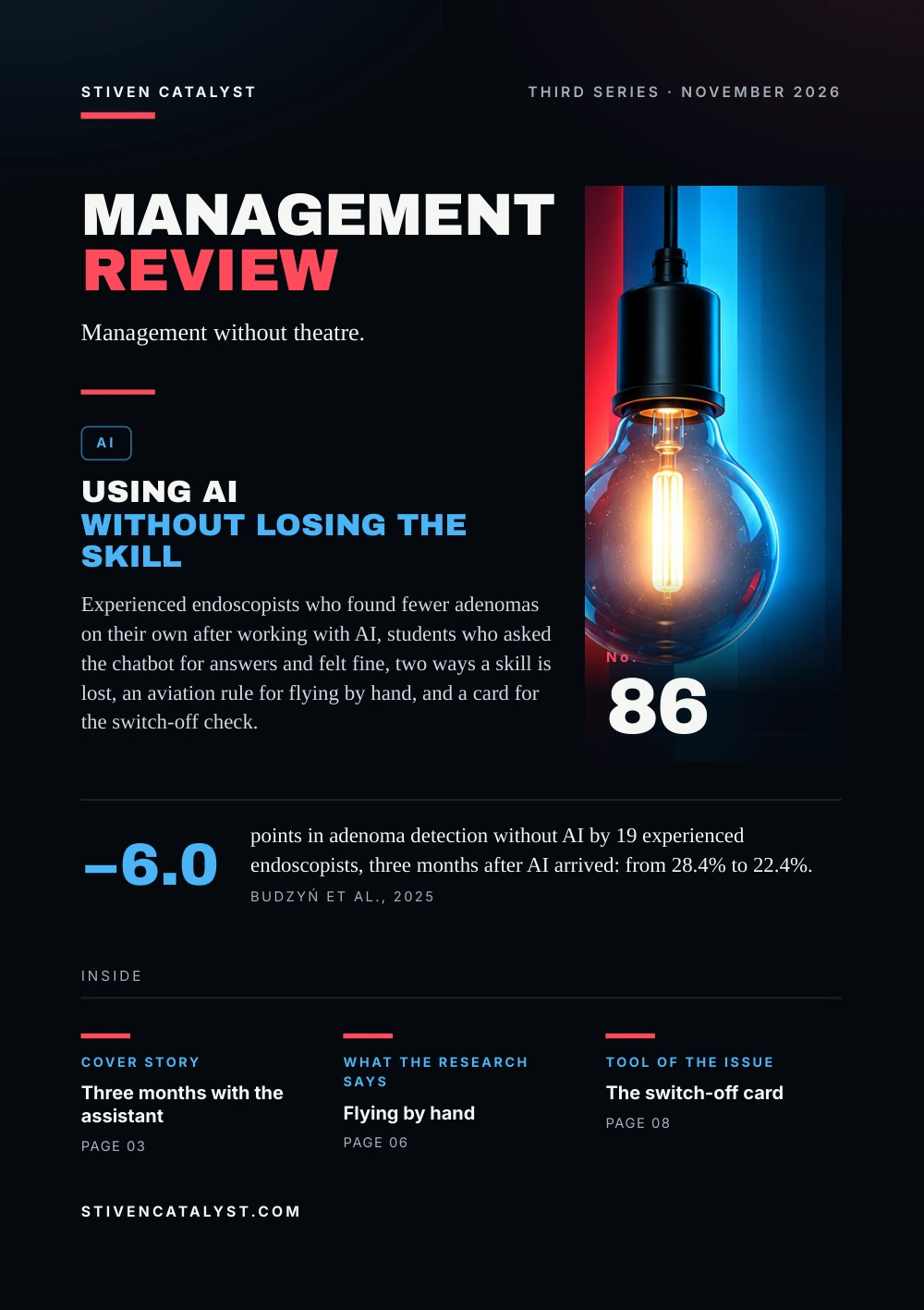
Stiven CatalystThird series · November 2026
ManagementReview
Management without theatre.
AI
Using AIwithout losing the skill
Experienced endoscopists who found fewer adenomas on their own after working with AI, students who asked the chatbot for answers and felt fine, two ways a skill is lost, an aviation rule for flying by hand, and a card for the switch-off check.

No.86
−6.0
points in adenoma detection without AI by 19 experienced endoscopists, three months after AI arrived: from 28.4% to 22.4%.Budzyń et al., 2025
stivencatalyst.com
No. 86 · AI
In this issue
Most studies of AI at work measure what people do with the tool. Fewer measure what they can still do without it. That second question decides what happens on the day the tool is down, wrong or replaced, and it is the subject of this issue.
- 03Cover storyThree months with the assistant
- 04The numbersAsking for the answer
- 05The modelTwo ways to lose a skill
- 06What the research saysFlying by hand
- 07How it is measuredMeasure it with the tool off
- 08Tool of the issueThe switch-off card
- 09SourcesSources and method
How to read this issue
Figure
Every figure has its source and year at the foot of its page.
Our reading
Where the editor interprets rather than the research, it says so.
Practice
The steps and the card are proposals to try, not research results.
Cover story
Three monthswith the assistant
At the end of 2021, four endoscopy centres in Poland began using an AI system that marks possible polyps on the screen. Whether it was on depended on the date of the examination. Krzysztof Budzyń and colleagues looked at the days it was off.
Colonoscopies with at least one adenoma found, four Polish centres, 2021–2022
The 19 endoscopists had each done more than 2,000 colonoscopies, with 27.6 years of experience on average. After the change their patients included more men and more were sedated, both of which usually raise detection. The authors suspect over-reliance: less motivated, less focused and less responsible when the AI is not there.
Our reading
Against the same weeks without AI, the AI looked better. Against the team three months earlier, it did not. The yardstick had moved.
Source: Krzysztof Budzyń et al., The Lancet Gastroenterology & Hepatology 10, 2025
Observational study of 1,443 colonoscopies without AI and 734 with it. Poland paused its screening programme in 2022, so later patients came from another waiting list. The authors call for randomised trials.
The numbers
Askingfor the answer
No. 51 gave the main result of a field experiment with nearly 1,000 students in Turkey: an open GPT-4 helped in practice and hurt in the exam without it. The full study also shows how the students used the chatbot, and what they thought it had done for them.
Students whose first message asked for the answer or repeated the question
51%of the open chatbot's answers to the practice problems were correct, asked ten times each
Students with the open version did worse in the exam but did not think they had learned less; those with the tutor thought they had done better, though they had not. The authors' reading: the open version was used as a crutch.
Our reading
How people feel about a tool is not a measure of what they can do without it.
Source: Hamsa Bastani, Osbert Bastani, Alp Sungu, Haosen Ge, Özge Kabakcı & Rei Mariman, PNAS 122(26), 2025
Students, not employees: one school, mathematics, autumn 2023, GPT-4. The bars are shares of opening messages as the authors classified them. The 48%, 127% and 17% are in No. 51.
The model
Two wayst o lose a skill
Brooke Macnamara and colleagues at Case Western Reserve University separate two risks of AI assistants, and a third that makes both worse: the person may not notice either of them.
Experts: the skill fades
- A skill used less declines; thinking skills faster than physical ones
- The work still gets done, so the loss stays hidden
- It shows when the tool is wrong, down or out of its depth
Learners: the skill never forms
- Performance rises fast with the tool
- The skill behind it may not develop
- It shows only when the tool is taken away
Automation bias, trusting a tool too far, goes away when the tool is switched off. A lost skill does not: it stays with the person. When the authors wrote, in 2024, they knew of no research on how AI assistants affect the user's skill.
Our reading
A tool's errors leave with the tool. A lost skill stays with the team.
Source: Brooke N. Macnamara et al., Cognitive Research: Principles and Implications 9, 2024
A theoretical paper with examples from radiology and robotic surgery; the columns shorten its two sections. Automation bias and the human override are in Volume 3 of the operational treatise.
What the research says
Flyingby hand
Industry and aviation met the problem first. In 1983 Lisanne Bainbridge of University College London wrote that physical skills deteriorate when they are not used, so a formerly experienced operator who has only been monitoring may now be an inexperienced one.
- 1983Bainbridge: give operators hands-on control for a short time in each shift, or a simulator.
- 2013FAA alert: more manual handling errors; airlines should let pilots fly by hand at low workload.
- 2024Macnamara et al.: no study yet of AI assistants' effect on users' skill.
- 2025Budzyń et al.: the first such result in medicine, in colonoscopy.
“The most successful automated systems, with rare need for manual intervention, … may need the greatest investment in human operator training.”
Our reading
The better the tool, the rarer the practice, and the more it has to be planned.
Sources: Lisanne Bainbridge, Automatica 19(6), 1983; Federal Aviation Administration, 2013; Brooke N. Macnamara et al., Cognitive Research: Principles and Implications 9, 2024; Krzysztof Budzyń et al., The Lancet Gastroenterology & Hepatology 10, 2025
Bainbridge wrote about process plants and cockpits, not AI; the quotation is hers, shortened, and the translations are ours. The FAA alert is guidance to airlines, not a rule. Her ironies of monitoring are in Volume 3 of the treatise.
How it is measured
Measure itwith the t ool off
The Polish study could see the loss because the AI was switched off on some days. Most teams have no such days, and notice what they can no longer do only when the system stops. Five marks of a team that keeps its skill:
A planned stretch without the tool
At low workload, as the FAA asks of airlines; not only when the system fails.
The same measure, both ways
Misses, errors or time with and without the tool, recorded apart.
Learners try first
New people work the case themselves; the tool hints or checks, as the tutor did in the school study.
Ability tested, not felt
A short task done alone, not a survey of confidence.
A name for the fallback
Who can do the work when the tool is down, and when they last did.
Our reading
A team that never works without the tool cannot know what it would do if it had to.
Sources: Krzysztof Budzyń et al., The Lancet Gastroenterology & Hepatology 10, 2025; Hamsa Bastani, Osbert Bastani, Alp Sungu, Haosen Ge, Özge Kabakcı & Rei Mariman, PNAS 122(26), 2025; Federal Aviation Administration, 2013; Brooke N. Macnamara et al., Cognitive Research: Principles and Implications 9, 2024
The marks are the editors', drawn from Budzyń et al. (2025), Bastani et al. (2025), the FAA alert (2013) and Macnamara et al. (2024). None of them was tested as a set.
More in the essayThe night the system went down
Tool of the issue
The swit ch-offcard
One card for each task the tool now helps with, filled in with the team. The Skills Matrix shows who can do each task without help, where cover is thin and whom to train next.
01The taskwhat the tool does in it: suggests, checks, decides or writes
02Without the toolwho can still do it alone; when each of them last did
03The measureone number to compare with and without the tool, recorded apart
04The practicewhen, how often, at what workload; who is there to help
05Learnerswhat new people do alone before the tool helps them
06Reviewwhat the last stretch without the tool showed; what changes; next date
Sources: Federal Aviation Administration, 2013; Lisanne Bainbridge, Automatica 19(6), 1983; Krzysztof Budzyń et al., The Lancet Gastroenterology & Hepatology 10, 2025; Hamsa Bastani, Osbert Bastani, Alp Sungu, Haosen Ge, Özge Kabakcı & Rei Mariman, PNAS 122(26), 2025
The card is the editors' proposal, built on the FAA alert (2013), Bainbridge (1983) and the designs of the studies by Budzyń et al. and Bastani et al. (2025).
Open the tool: Skills Matrixstivencatalyst.com/tools/skills-matrix/
Sources and method
Every figurehas a source.
The figures in this issue come from the sources below. The year shows how recent each one is.
- Endoscopist deskilling risk after exposure to artificial intelligence in colonoscopy: a multicentre, observational studyKrzysztof Budzyń et al., The Lancet Gastroenterology & Hepatology 10, 2025https://doi.org/10.1016/S2468-1253(25)00133-5
- Generative AI without guardrails can harm learning: Evidence from high school mathematicsHamsa Bastani, Osbert Bastani, Alp Sungu, Haosen Ge, Özge Kabakcı & Rei Mariman, PNAS 122(26), 2025https://doi.org/10.1073/pnas.2422633122
- Does using artificial intelligence assistance accelerate skill decay and hinder skill development without performers' awareness?Brooke N. Macnamara et al., Cognitive Research: Principles and Implications 9, 2024https://doi.org/10.1186/s41235-024-00572-8
- Ironies of AutomationLisanne Bainbridge, Automatica 19(6), 1983https://doi.org/10.1016/0005-1098(83)90046-8
- Safety Alert for Operators 13002: Manual Flight OperationsFederal Aviation Administration, 2013https://www.faa.gov/sites/faa.gov/files/other_visit/aviation_industry/airline_operators/airline_safety/SAFO13002.pdf
Editorial method
Each figure was checked for its year, its publisher and what it measures, in the full text where it could be opened. A source read only in a summary, an abstract or excerpts is marked “via”. A figure not confirmed in what was read is marked so on its page, or left out. The editor's interpretation is marked “Our reading”.
ManagementReview
Management without theatre.
Every issue, one management question, checked against the best research.
All issues
stivencatalyst.com/magazine/management-review.html
Management Review · No. 86 · November 2026 · Stiven Catalyst
Edited by Stiven Janaqi, who answers for it; “the editors” in this publication means him. Its texts, translations, layout and the checking of figures against their sources are done in working sessions with Claude, an AI model by Anthropic.
stivencatalyst.com/how-this-is-made.html
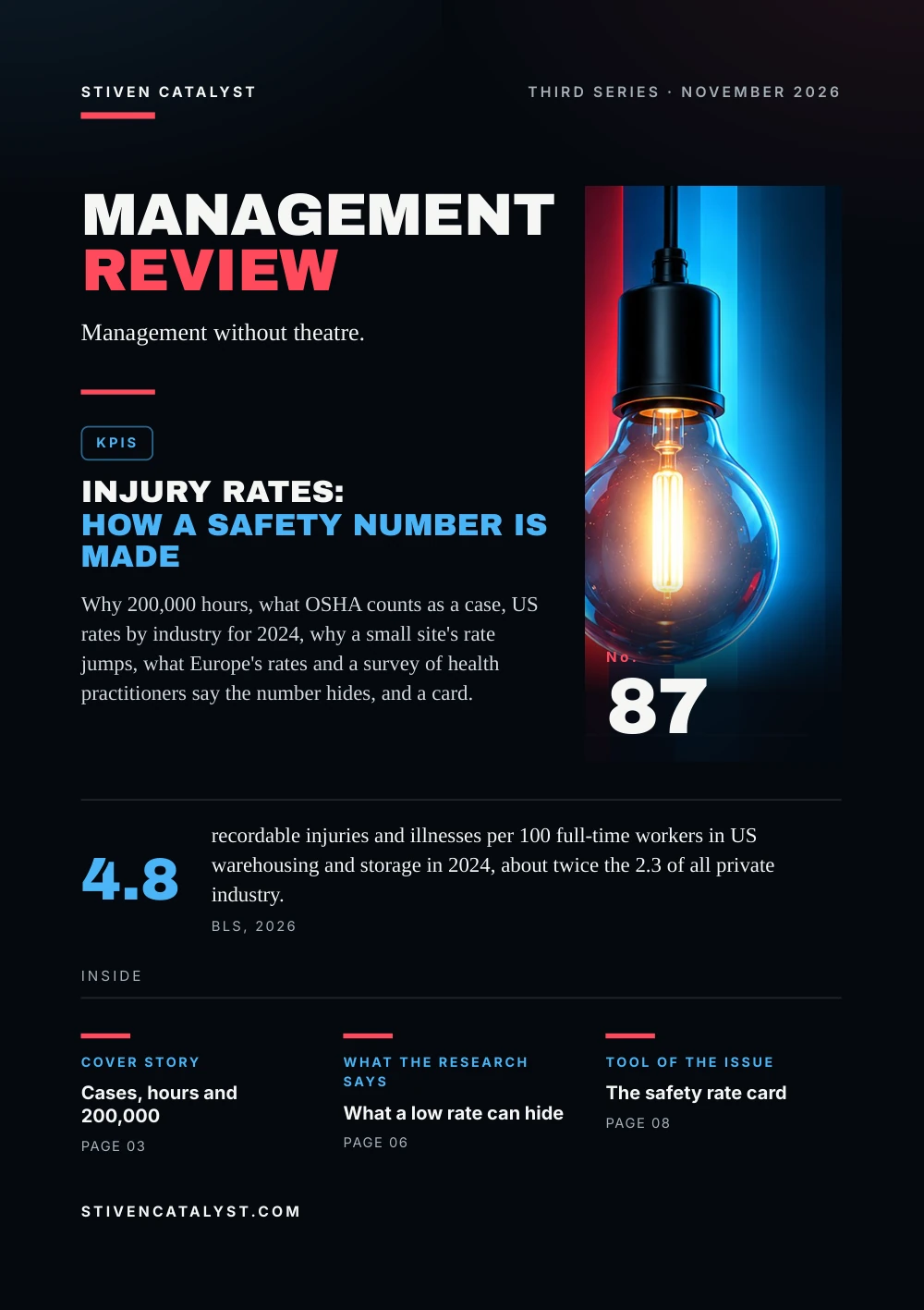 Next issue
Injury rates: how a safety number is made
Click or swipe a page to turn it. The arrow keys work too.
Management Review · No. 86
The figures of the issue
The charts of the printed pages, with their sources.
Observational study of 1,443 colonoscopies without AI and 734 with it. Poland paused its screening programme in 2022, so later patients came from another waiting list. The authors call for randomised trials.
Source: Krzysztof Budzyń et al., The Lancet Gastroenterology & Hepatology 10, 2025
Students, not employees: one school, mathematics, autumn 2023, GPT-4. The bars are shares of opening messages as the authors classified them. The 48%, 127% and 17% are in No. 51.
Source: Hamsa Bastani, Osbert Bastani, Alp Sungu, Haosen Ge, Özge Kabakcı & Rei Mariman, PNAS 122(26), 2025
The whole text Read the issue as text For reading on a small screen, searching or a screen reader. The same words, without the page design.
In this issue
Most studies of AI at work measure what people do with the tool. Fewer measure what they can still do without it. That second question decides what happens on the day the tool is down, wrong or replaced, and it is the subject of this issue.
In four Polish clinics, experienced endoscopists found adenomas in 28.4% of colonoscopies without AI before it arrived, and in 22.4% three months after. In a Turkish school, most students with an open chatbot asked it for the answer, and did not feel they had learned less. A 2024 paper names two ways a skill is lost; a 1983 paper on automation and a 2013 aviation alert met it earlier. Five marks of a team that keeps its skill and a card close the issue.
Stiven Janaqi, Editor
Cover story
Three months with the assistant
At the end of 2021, four endoscopy centres in Poland began using an AI system that marks possible polyps on the screen. Whether it was on depended on the date of the examination. Krzysztof Budzyń and colleagues looked at the days it was off.
Colonoscopies with at least one adenoma found, four Polish centres, 2021–2022: No AI, before 28.4%, No AI, after 22.4%, With AI, after 25.3%.
The 19 endoscopists had each done more than 2,000 colonoscopies, with 27.6 years of experience on average. After the change their patients included more men and more were sedated, both of which usually raise detection. The authors suspect over-reliance: less motivated, less focused and less responsible when the AI is not there.
Our reading
Against the same weeks without AI, the AI looked better. Against the team three months earlier, it did not. The yardstick had moved.
Observational study of 1,443 colonoscopies without AI and 734 with it. Poland paused its screening programme in 2022, so later patients came from another waiting list. The authors call for randomised trials.
Source: Krzysztof Budzyń et al., The Lancet Gastroenterology & Hepatology 10, 2025
The numbers
Asking for the answer
No. 51 gave the main result of a field experiment with nearly 1,000 students in Turkey: an open GPT-4 helped in practice and hurt in the exam without it. The full study also shows how the students used the chatbot, and what they thought it had done for them.
Students whose first message asked for the answer or repeated the question: Open chatbot (GPT Base): First problem 56%, All problems, session 1 67%; Tutor giving hints (GPT Tutor): First problem 42%, All problems, session 1 37%.
- 51% of the open chatbot's answers to the practice problems were correct, asked ten times each
Students with the open version did worse in the exam but did not think they had learned less; those with the tutor thought they had done better, though they had not. The authors' reading: the open version was used as a crutch.
Our reading
How people feel about a tool is not a measure of what they can do without it.
Students, not employees: one school, mathematics, autumn 2023, GPT-4. The bars are shares of opening messages as the authors classified them. The 48%, 127% and 17% are in No. 51.
Source: Hamsa Bastani, Osbert Bastani, Alp Sungu, Haosen Ge, Özge Kabakcı & Rei Mariman, PNAS 122(26), 2025
The model
Two ways t o lose a skill
Brooke Macnamara and colleagues at Case Western Reserve University separate two risks of AI assistants, and a third that makes both worse: the person may not notice either of them.
Exper ts: the skill fades
- A skill used less declines; thinking skills faster than physical ones
- The work still gets done, so the loss stays hidden
- It shows when the tool is wrong, down or out of its depth
Learners: the skill never forms
- Performance rises fast with the tool
- The skill behind it may not develop
- It shows only when the tool is taken away
Automation bias, trusting a tool too far, goes away when the tool is switched off. A lost skill does not: it stays with the person. When the authors wrote, in 2024, they knew of no research on how AI assistants affect the user's skill.
Our reading
A tool's errors leave with the tool. A lost skill stays with the team.
A theoretical paper with examples from radiology and robotic surgery; the columns shorten its two sections. Automation bias and the human override are in Volume 3 of the operational treatise.
Source: Brooke N. Macnamara et al., Cognitive Research: Principles and Implications 9, 2024
What the research says
Flying by hand
Industry and aviation met the problem first. In 1983 Lisanne Bainbridge of University College London wrote that physical skills deteriorate when they are not used, so a formerly experienced operator who has only been monitoring may now be an inexperienced one.
- 1983 Bainbridge: give operators hands-on control for a short time in each shift, or a simulator.
- 2013 FAA alert: more manual handling errors; airlines should let pilots fly by hand at low workload.
- 2024 Macnamara et al.: no study yet of AI assistants' effect on users' skill.
- 2025 Budzyń et al.: the first such result in medicine, in colonoscopy.
The most successful automated systems, with rare need for manual intervention, … may need the greatest investment in human operator training.
Our reading
The better the tool, the rarer the practice, and the more it has to be planned.
Bainbridge wrote about process plants and cockpits, not AI; the quotation is hers, shortened, and the translations are ours. The FAA alert is guidance to airlines, not a rule. Her ironies of monitoring are in Volume 3 of the treatise.
Sources: Lisanne Bainbridge, Automatica 19(6), 1983; Federal Aviation Administration, 2013; Brooke N. Macnamara et al., Cognitive Research: Principles and Implications 9, 2024; Krzysztof Budzyń et al., The Lancet Gastroenterology & Hepatology 10, 2025
How it is measured
Measure it with the t ool off
The Polish study could see the loss because the AI was switched off on some days. Most teams have no such days, and notice what they can no longer do only when the system stops. Five marks of a team that keeps its skill:
- A planned str
e t ch without thet ool. At low workload, as the FAA asks of airlines; not only when the system fails. - The same measure, both ways. Misses, errors or time with and without the tool, recorded apart.
- Learners try first. New people work the case themselves; the tool hints or checks, as the tutor did in the school study.
- Abili
t y tested, not felt. A short task done alone, not a survey of confidence. - A name for the fallback. Who can do the work when the tool is down, and when they last did.
Our reading
A team that never works without the tool cannot know what it would do if it had to.
The marks are the editors', drawn from Budzyń et al. (2025), Bastani et al. (2025), the FAA alert (2013) and Macnamara et al. (2024). None of them was tested as a set.
Sources: Krzysztof Budzyń et al., The Lancet Gastroenterology & Hepatology 10, 2025; Hamsa Bastani, Osbert Bastani, Alp Sungu, Haosen Ge, Özge Kabakcı & Rei Mariman, PNAS 122(26), 2025; Federal Aviation Administration, 2013; Brooke N. Macnamara et al., Cognitive Research: Principles and Implications 9, 2024
More in the essay: The night the system went down
Tool of the issue
The swit ch-off card
One card for each task the tool now helps with, filled in with the team. The Skills Matrix shows who can do each task without help, where cover is thin and whom to train next.
- The task what the tool does in it: suggests, checks, decides or writes
- Without the
t ool who can still do it alone; when each of them last did - The measure one number to compare with and without the tool, recorded apart
- The practice when, how often, at what workload; who is there to help
- Learners what new people do alone before the tool helps them
- Review what the last stretch without the tool showed; what changes; next date
The card is the editors' proposal, built on the FAA alert (2013), Bainbridge (1983) and the designs of the studies by Budzyń et al. and Bastani et al. (2025).
Sources: Federal Aviation Administration, 2013; Lisanne Bainbridge, Automatica 19(6), 1983; Krzysztof Budzyń et al., The Lancet Gastroenterology & Hepatology 10, 2025; Hamsa Bastani, Osbert Bastani, Alp Sungu, Haosen Ge, Özge Kabakcı & Rei Mariman, PNAS 122(26), 2025
Open the tool: Skills Matrix
Sources and method
Every figure has a source.
The figures in this issue come from the sources below. The year shows how recent each one is.
- Krzysztof Budzyń et al., The Lancet Gastroenterology & Hepatology 10, “Endoscopist deskilling risk after exposure to artificial intelligence in colonoscopy: a multicentre, observational study”, 2025. https://doi.org/10.1016/S2468-1253(25)00133-5
- Hamsa Bastani, Osbert Bastani, Alp Sungu, Haosen Ge, Özge Kabakcı & Rei Mariman, PNAS 122(26), “Generative AI without guardrails can harm learning: Evidence from high school mathematics”, 2025. https://doi.org/10.1073/pnas.2422633122
- Brooke N. Macnamara et al., Cognitive Research: Principles and Implications 9, “Does using artificial intelligence assistance accelerate skill decay and hinder skill development without performers' awareness?”, 2024. https://doi.org/10.1186/s41235-024-00572-8
- Lisanne Bainbridge, Automatica 19(6), “Ironies of Automation”, 1983. https://doi.org/10.1016/0005-1098(83)90046-8
- Federal Aviation Administration, “Safety Alert for Operators 13002: Manual Flight Operations”, 2013. https://www.faa.gov/sites/faa.gov/files/other_visit/aviation_industry/airline_operators/airline_safety/SAFO13002.pdf
Edit orial me thod
Each figure was checked for its year, its publisher and what it measures, in the full text where it could be opened. A source read only in a summary, an abstract or excerpts is marked “via”. A figure not confirmed in what was read is marked so on its page, or left out. The editor's interpretation is marked “Our reading”.
Edited by Stiven Janaqi, who answers for it; “the editors” in this publication means him. Its texts, translations, layout and the checking of figures against their sources are done in working sessions with Claude, an AI model by Anthropic. How this is made
Management Review · Monthly edition