In 1940 the United States needed 350 lens grinders and thought the craft took five years to learn. Breaking the work into steps and key points cut that to months, and by 1945 more than a million Job Instruction certificates had been issued. The pocket card puts the burden on the teacher. A study of expert surgeons shows why: teaching a procedure, they left out half or more of each kind of step. TWI's timetable shows how to measure training, and the sheet on page 8 is where it starts.
Management Review · Second series · November 2026 · No. 42
The manager as trainer: TWI Job Instruction
How key points cut lens grinding from five years to months, a pocket card with four steps, what experts leave out when they teach, the timetable that measures training, and a job breakdown sheet.
- No.
- 42
- Pages
- 10
- Sources
- 6
- Topics
- Role
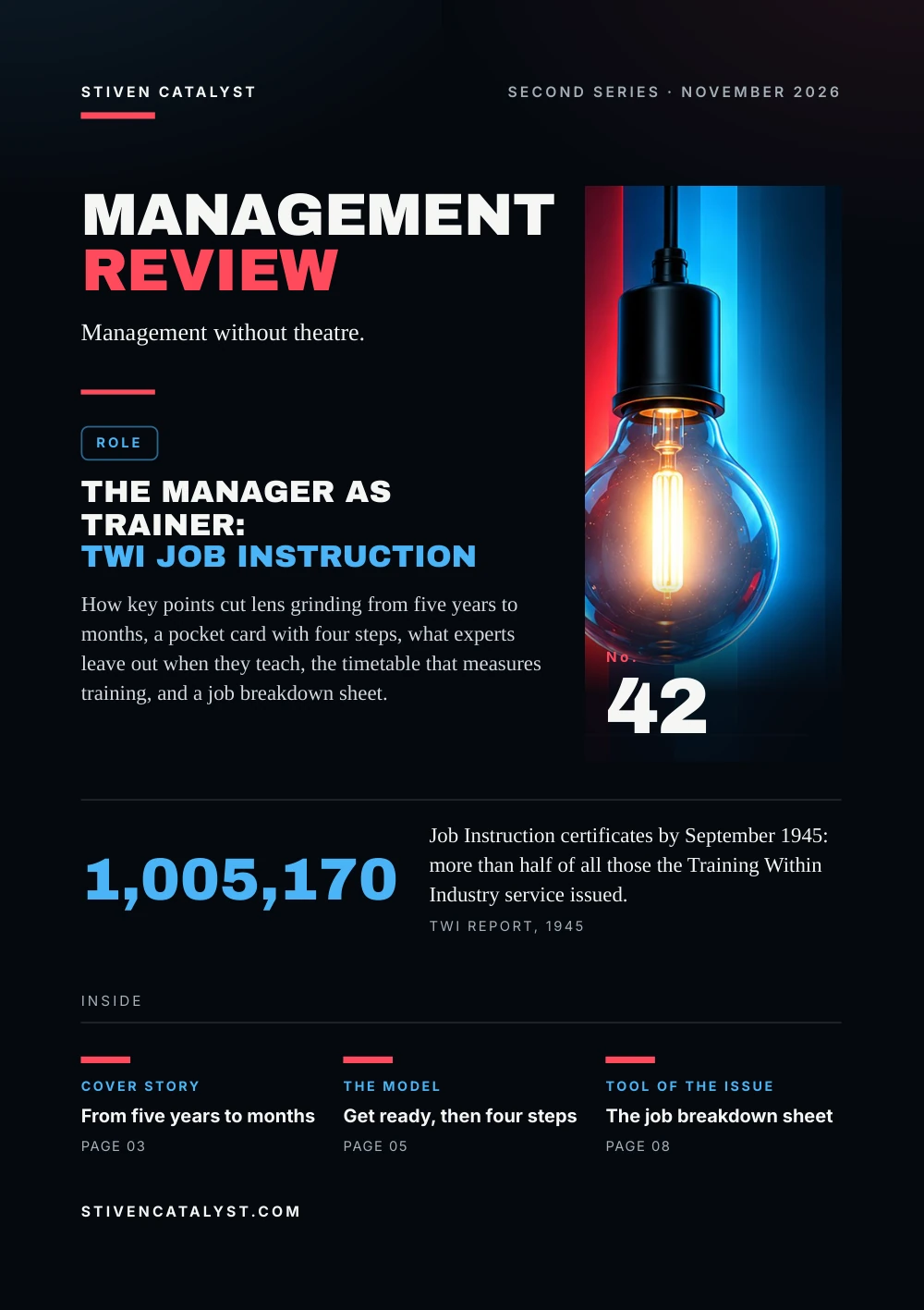
Stiven CatalystSecond series · November 2026
ManagementReview
Management without theatre.
Role
The manager as trainer:TWI Job Instruction
How key points cut lens grinding from five years to months, a pocket card with four steps, what experts leave out when they teach, the timetable that measures training, and a job breakdown sheet.

No.42
1,005,170
Job Instruction certificates by September 1945: more than half of all those the Training Within Industry service issued.TWI Report, 1945
stivencatalyst.com
No. 42 · Role
In this issue
Most managers were never taught how to teach. They learned the job, became good at it, and were then asked to pass it on. This issue is about a method that treats teaching a job as a skill of its own: Job Instruction, written in the Second World War and still in use.
- 03Cover storyFrom five years to months
- 04The numbersTraining time, seven counts
- 05The modelGet ready, then four steps
- 06What the research saysWhat experts leave out
- 07How it is measuredUntil you know they know
- 08Tool of the issueThe job breakdown sheet
- 09SourcesSources and method
How to read this issue
Figure
Every figure has its source and year at the foot of its page.
Our reading
Where the editors interpret rather than the research, it says so.
Practice
The steps and the card are proposals to try, not research results.
Cover story
From five yearst o months
In August 1940, in its first week, the Training Within Industry service (TWI) got its first task: to help US arsenals and navy yards find 350 qualified lens grinders. A learner was thought to do well to master the craft in five years.
Lens grinding turned out to be 20 jobs. New people were broken in on one simple job, and each part was studied for the few critical points that decided whether the whole operation succeeded. TWI called them key points. Training for the separate jobs fell from about five years to a matter of months.
- 1917–19Charles R. Allen trains shipyard instructors in four steps: show, tell, do, check.
- 1940Lens grinding: the key points are found.
- 1941The method fits into ten hours; a national programme from August.
- 19451,005,170 Job Instruction certificates in all.
Our reading
Key points are what the expert no longer notices. Once written down, they stop depending on who happens to do the teaching.
Source: War Manpower Commission, Bureau of Training, Training Within Industry Service, 1945
From TWI's own final report (1945). “Months” is the report's word; it gives no exact figure. Certificates, not people: one supervisor could hold several.
The numbers
Training time,seven counts
Seven times between May 1943 and September 1945, TWI tabulated the results that plants reported. Of the plants that reported a change in training time, the share with a reduction of 25% or more:
Plants reporting training time cut by 25% or more, by tabulation (month/year)
Job Instruction was the largest of TWI's programmes: 1,005,170 of the 1,750,650 certificates issued by 30 September 1945. A group of ten supervisors took it in five two-hour sessions. Some single plants reported training time cut by 90%.
Our reading
Plants chose whether to report, and TWI used the counts to defend its budget. The curve records conviction, not a controlled test; page 6 looks for a comparison.
Source: War Manpower Commission, Bureau of Training, Training Within Industry Service, 1945
Each share is of the plants that reported a training-time result in that tabulation; the report does not say how many plants each one counted. The first used more than 600 voluntary plant statements.
The model
Ge t ready,then four steps
Before teaching, the card says: have a timetable, break down the job into important steps and key points (safety is always a key point), have everything ready, and arrange the workplace as the worker will be expected to keep it. Then:
Prepare the worker
Put them at ease, find out what they already know, get them interested.
Present the operation
Tell, show and illustrate one important step at a time; stress each key point.
Try out performance
They do the job and explain each key point; continue until you know they know.
Follow up
Put them on their own, name who helps, check often, taper off.
“If the worker hasn't learned, the instructor hasn't taught.”
The TWI Institute still teaches the method in 10 hours to groups of up to 10. One stated aim: to replace job shadowing and “buddy” training. According to the Lean Enterprise Institute, Job Instruction is still the primary training tool of Toyota's team leaders worldwide.
Sources: War Manpower Commission, Bureau of Training, Training Within Industry Service, 1945; Lean Enterprise Institute, 2023; TWI Institute, 2026; Lean Enterprise Institute, 2014
Card wording after the TWI report (1945) and the Lean Enterprise Institute's reprint (2023), which writes “them” where the original wrote “him”. Translations are ours.
More in the essay“Watch how I do it” is not training
What the research says
What exper tsleave out
The 1945 report warned that a competent worker's familiarity with the work makes him overlook the difficulties he had at the start. In 2014, Maura Sullivan and colleagues filmed three expert surgeons teaching an emergency airway procedure and compared what they said with a full task list.
Steps left out while teaching, average of three experts, 2014
For action steps, the experts said how to do them only 13% of the time. Across 11,575 US firms, Nicola Bianchi and Michela Giorcelli found that Job Instruction raised sales and productivity for good, though less than Job Relations; trained firms then spent more on regular maintenance and less on machine repairs and injuries.
Our reading
The key-point column exists for the expert's blind spot: asking what makes or breaks the job brings back what practice has made invisible.
Sources: War Manpower Commission, Bureau of Training, Training Within Industry Service, 1945; Maura E. Sullivan, Kenneth A. Yates, Kenji Inaba, Lydia Lam & Richard E. Clark, Academic Medicine, 2014 (via PubMed abstract); Nicola Bianchi & Michela Giorcelli, Journal of Political Economy, 2022 (via NBER Working Paper 28833, 2021)
Sullivan et al.: three experts, one procedure, figures from the abstract. Bianchi and Giorcelli: a natural experiment, figures from the 2021 working paper.
How it is measured
Until you knowthe y know
TWI found that workers often just copied motions without understanding them. From January 1943 the manual required the learner in step 3 to give back what he was doing and why. Training is measured in three places:
Timetable
Workers down the side, jobs across the top; tick what each can already do, set a date for every gap.
Give-back
In the try-out, every key point and its reason, in the learner's own words.
Follow-up
Who they go to for help, when you check, when extra coaching ends.
Hypothetical example, the timetable of a returns desk
- Team
- 6 people, 4 jobs: 24 boxes
- Can do it
- 15 boxes ticked
- Gaps
- 9: 6 with a date and a trainer, 3 with neither
The three gaps without a date are where “watch how I do it” fills in. The numbers are invented.
Source: War Manpower Commission, Bureau of Training, Training Within Industry Service, 1945
The timetable and the give-back are from the 1945 report; the example is the editors'.
Tool of the issue
The job breakdownshee t
One job per sheet, written next to the work, not at a desk. If a KPI has turned red, first check that the cause is a matter of skill at all; the KPI diagnostic helps.
01The jobwhat is done, and what done well looks like
02Important steps (what)each a segment where the work moves forward
03Key points (how)what makes or breaks the job, could injure, or makes it easier
04Reasons (why)why each key point matters
05Timetablewho should do it, how well, by what date
06Try-out and follow-upkey points given back; who helps; check dates
Sources: War Manpower Commission, Bureau of Training, Training Within Industry Service, 1945; Lean Enterprise Institute, 2023
A practice proposed by the editors, after the Job Instruction card (1945) and the three-column sheet reprinted by the Lean Enterprise Institute (2023).
Open the tool: KPI Diagnosticstivencatalyst.com/tools/kpi-diagnostic/
Sources and method
Every figurehas a source.
The figures in this issue come from the sources below. The year shows how recent each one is.
- The Training Within Industry Report, 1940-1945War Manpower Commission, Bureau of Training, Training Within Industry Service, 1945https://www.govinfo.gov/content/pkg/GOVPUB-PR32_5200-00275cf1fd80a1d51995ae716fd38f34/html/GOVPUB-PR32_5200-00275cf1fd80a1d51995ae716fd38f34.htm
- Lean Lexicon: Training Within Industry (TWI)Lean Enterprise Institute, 2014https://www.lean.org/lexicon-terms/training-within-industry-twi/
- TWI training cards for printing: Job Instruction, Job Methods, Job Relations and the Job Breakdown SheetLean Enterprise Institute, 2023https://email.lean.org/hubfs/ebook%20files/TWI_training_cards_for_printing.pdf
- Job Instruction (JI)TWI Institute, 2026https://www.twi-institute.com/job-instruction/
- The Use of Cognitive Task Analysis to Reveal the Instructional Limitations of Experts in the Teaching of Procedural SkillsMaura E. Sullivan, Kenneth A. Yates, Kenji Inaba, Lydia Lam & Richard E. Clark, Academic Medicine, 2014 · via PubMed abstracthttps://doi.org/10.1097/ACM.0000000000000224
- The Dynamics and Spillovers of Management Interventions: Evidence from the Training Within Industry ProgramNicola Bianchi & Michela Giorcelli, Journal of Political Economy, 2022 · via NBER Working Paper 28833, 2021https://www.nber.org/papers/w28833
Editorial method
Each figure was checked for its year, its publisher and what exactly it measures. Where the publisher's page could not be opened, the figure was checked against independent summaries and is marked “via”. The editors' interpretation is marked “Our reading”. Figures that could not be confirmed are not in the issue.
ManagementReview
Management without theatre.
Every issue, one management question, checked against the best research.
All issues
stivencatalyst.com/magazine/management-review.html
Management Review · No. 42 · November 2026 · Stiven Catalyst
Click or swipe a page to turn it. The arrow keys work too.
Management Review · No. 42
The figures of the issue
The charts of the printed pages, with their sources.
Source: War Manpower Commission, Bureau of Training, Training Within Industry Service, 1945
Source: Maura E. Sullivan, Kenneth A. Yates, Kenji Inaba, Lydia Lam & Richard E. Clark, Academic Medicine, 2014 (via PubMed abstract)
The whole text Read the issue as text For reading on a small screen, searching or a screen reader. The same words, without the page design.
In this issue
Most managers were never taught how to teach. They learned the job, became good at it, and were then asked to pass it on. This issue is about a method that treats teaching a job as a skill of its own: Job Instruction, written in the Second World War and still in use.
In 1940 the United States needed 350 lens grinders and thought the craft took five years to learn. Breaking the work into steps and key points cut that to months, and by 1945 more than a million Job Instruction certificates had been issued. The pocket card puts the burden on the teacher. A study of expert surgeons shows why: teaching a procedure, they left out half or more of each kind of step. TWI's timetable shows how to measure training, and the sheet on page 8 is where it starts.
Stiven Janaqi, Editor
Cover story
From five years t o months
In August 1940, in its first week, the Training Within Industry service (TWI) got its first task: to help US arsenals and navy yards find 350 qualified lens grinders. A learner was thought to do well to master the craft in five years.
Lens grinding turned out to be 20 jobs. New people were broken in on one simple job, and each part was studied for the few critical points that decided whether the whole operation succeeded. TWI called them key points. Training for the separate jobs fell from about five years to a matter of months.
- 1917–19 Charles R. Allen trains shipyard instructors in four steps: show, tell, do, check.
- 1940 Lens grinding: the key points are found.
- 1941 The method fits into ten hours; a national programme from August.
- 1945 1,005,170 Job Instruction certificates in all.
Our reading
Key points are what the expert no longer notices. Once written down, they stop depending on who happens to do the teaching.
From TWI's own final report (1945). “Months” is the report's word; it gives no exact figure. Certificates, not people: one supervisor could hold several.
Source: War Manpower Commission, Bureau of Training, Training Within Industry Service, 1945
The numbers
Training time, seven counts
Seven times between May 1943 and September 1945, TWI tabulated the results that plants reported. Of the plants that reported a change in training time, the share with a reduction of 25% or more:
Plants reporting training time cut by 25% or more, by tabulation (month/year): 5/43 48%, 9/43 69%, 2/44 79%, 11/44 92%, 4/45 96%, 7/45 95%, 9/45 100%.
Job Instruction was the largest of TWI's programmes: 1,005,170 of the 1,750,650 certificates issued by 30 September 1945. A group of ten supervisors took it in five two-hour sessions. Some single plants reported training time cut by 90%.
Our reading
Plants chose whether to report, and TWI used the counts to defend its budget. The curve records conviction, not a controlled test; page 6 looks for a comparison.
Each share is of the plants that reported a training-time result in that tabulation; the report does not say how many plants each one counted. The first used more than 600 voluntary plant statements.
Source: War Manpower Commission, Bureau of Training, Training Within Industry Service, 1945
The model
Ge t ready, then four steps
Before teaching, the card says: have a timetable, break down the job into important steps and key points (safety is always a key point), have everything ready, and arrange the workplace as the worker will be expected to keep it. Then:
- Prepare the worker. Put them at ease, find out what they already know, get them interested.
- Present the operation. Tell, show and illustrate one important step at a time; stress each key point.
- Try out performance. They do the job and explain each key point; continue until you know they know.
- Follow up. Put them on their own, name who helps, check often, taper off.
If the worker hasn't learned, the instructor hasn't taught.
The TWI Institute still teaches the method in 10 hours to groups of up to 10. One stated aim: to replace job shadowing and “buddy” training. According to the Lean Enterprise Institute, Job Instruction is still the primary training tool of Toyota's team leaders worldwide.
Card wording after the TWI report (1945) and the Lean Enterprise Institute's reprint (2023), which writes “them” where the original wrote “him”. Translations are ours.
Sources: War Manpower Commission, Bureau of Training, Training Within Industry Service, 1945; Lean Enterprise Institute, 2023; TWI Institute, 2026; Lean Enterprise Institute, 2014
More in the essay: “Watch how I do it” is not training
What the research says
What exper ts leave out
The 1945 report warned that a competent worker's familiarity with the work makes him overlook the difficulties he had at the start. In 2014, Maura Sullivan and colleagues filmed three expert surgeons teaching an emergency airway procedure and compared what they said with a full task list.
Steps left out while teaching, average of three experts, 2014: Clinical knowledge steps 71%, Action steps 51%, Decision steps 73%.
For action steps, the experts said how to do them only 13% of the time. Across 11,575 US firms, Nicola Bianchi and Michela Giorcelli found that Job Instruction raised sales and productivity for good, though less than Job Relations; trained firms then spent more on regular maintenance and less on machine repairs and injuries.
Our reading
The key-point column exists for the expert's blind spot: asking what makes or breaks the job brings back what practice has made invisible.
Sullivan et al.: three experts, one procedure, figures from the abstract. Bianchi and Giorcelli: a natural experiment, figures from the 2021 working paper.
Sources: War Manpower Commission, Bureau of Training, Training Within Industry Service, 1945; Maura E. Sullivan, Kenneth A. Yates, Kenji Inaba, Lydia Lam & Richard E. Clark, Academic Medicine, 2014 (via PubMed abstract); Nicola Bianchi & Michela Giorcelli, Journal of Political Economy, 2022 (via NBER Working Paper 28833, 2021)
How it is measured
Until you know the y know
TWI found that workers often just copied motions without understanding them. From January 1943 the manual required the learner in step 3 to give back what he was doing and why. Training is measured in three places:
- Tim
e table. Workers down the side, jobs across the top; tick what each can already do, set a date for every gap. - Give-back. In the try-out, every key point and its reason, in the learner's own words.
- Follow-up. Who they go to for help, when you check, when extra coaching ends.
Hypothe tical example, the time table of a re turns desk
- Team: 6 people, 4 jobs: 24 boxes
- Can do it: 15 boxes ticked
- Gaps: 9: 6 with a date and a trainer, 3 with neither
The three gaps without a date are where “watch how I do it” fills in. The numbers are invented.
The timetable and the give-back are from the 1945 report; the example is the editors'.
Source: War Manpower Commission, Bureau of Training, Training Within Industry Service, 1945
Tool of the issue
The job breakdown shee t
One job per sheet, written next to the work, not at a desk. If a KPI has turned red, first check that the cause is a matter of skill at all; the KPI diagnostic helps.
- The job what is done, and what done well looks like
- Impo
r tant steps (what) each a segment where the work moves forward - K
e y points (how) what makes or breaks the job, could injure, or makes it easier - Reasons (why) why each key point matters
- Tim
e table who should do it, how well, by what date - Try-out and follow-up key points given back; who helps; check dates
A practice proposed by the editors, after the Job Instruction card (1945) and the three-column sheet reprinted by the Lean Enterprise Institute (2023).
Sources: War Manpower Commission, Bureau of Training, Training Within Industry Service, 1945; Lean Enterprise Institute, 2023
Open the tool: KPI Diagnostic
Sources and method
Every figure has a source.
The figures in this issue come from the sources below. The year shows how recent each one is.
- War Manpower Commission, Bureau of Training, Training Within Industry Service, “The Training Within Industry Report, 1940-1945”, 1945. https://www.govinfo.gov/content/pkg/GOVPUB-PR32_5200-00275cf1fd80a1d51995ae716fd38f34/html/GOVPUB-PR32_5200-00275cf1fd80a1d51995ae716fd38f34.htm
- Lean Enterprise Institute, “Lean Lexicon: Training Within Industry (TWI)”, 2014. https://www.lean.org/lexicon-terms/training-within-industry-twi/
- Lean Enterprise Institute, “TWI training cards for printing: Job Instruction, Job Methods, Job Relations and the Job Breakdown Sheet”, 2023. https://email.lean.org/hubfs/ebook%20files/TWI_training_cards_for_printing.pdf
- TWI Institute, “Job Instruction (JI)”, 2026. https://www.twi-institute.com/job-instruction/
- Maura E. Sullivan, Kenneth A. Yates, Kenji Inaba, Lydia Lam & Richard E. Clark, Academic Medicine, “The Use of Cognitive Task Analysis to Reveal the Instructional Limitations of Experts in the Teaching of Procedural Skills”, 2014 (via PubMed abstract). https://doi.org/10.1097/ACM.0000000000000224
- Nicola Bianchi & Michela Giorcelli, Journal of Political Economy, “The Dynamics and Spillovers of Management Interventions: Evidence from the Training Within Industry Program”, 2022 (via NBER Working Paper 28833, 2021). https://www.nber.org/papers/w28833
Edit orial me thod
Each figure was checked for its year, its publisher and what exactly it measures. Where the publisher's page could not be opened, the figure was checked against independent summaries and is marked “via”. The editors' interpretation is marked “Our reading”. Figures that could not be confirmed are not in the issue.
Management Review · Monthly edition