In England and Wales 1.2% of working adults suffered violence at work in a year, threats included; in protective services 6.8%. In Germany 61% of violent accidents came from outsiders. The ILO convention asks employers to assess the risk with their workers. A hospital trial worked with each ward's own data; training alone has little proof. A card for one area closes the issue.
Management Review · Third series · November 2026 · No. 109
When the cust omer turns aggressive
Threats and attacks from customers and the public: who is most at risk in Britain, where it happens in Germany, what the ILO convention asks of employers, a trial in seven hospitals, what to record, and a card for one area.
- No.
- 109
- Pages
- 10
- Sources
- 6
- Topics
- People
- Online since
- 7 November 2026
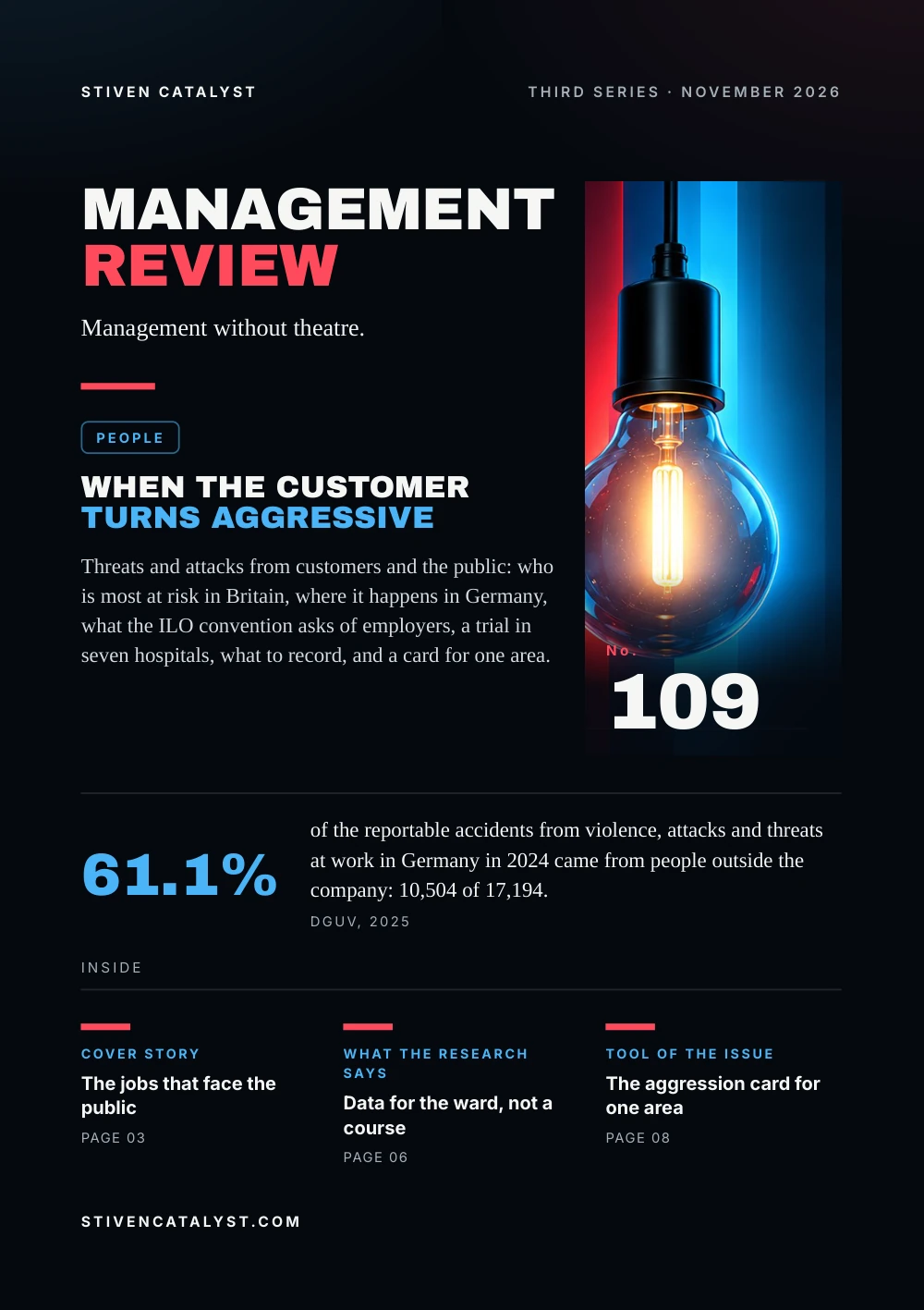
Stiven CatalystThird series · November 2026
ManagementReview
Management without theatre.
People
When the customerturns aggressive
Threats and attacks from customers and the public: who is most at risk in Britain, where it happens in Germany, what the ILO convention asks of employers, a trial in seven hospitals, what to record, and a card for one area.

No.109
61.1%
of the reportable accidents from violence, attacks and threats at work in Germany in 2024 came from people outside the company: 10,504 of 17,194.DGUV, 2025
stivencatalyst.com
No. 109 · People
In this issue
A receptionist is shouted at over a bill, a driver is threatened at a door, a call ends in abuse. It is often filed as part of the job. This issue treats it as a risk of work with numbers, duties and a record, like any other.
- 03Cover storyThe jobs that face the public
- 04The numbersWhere it happens in Germany
- 05The modelFour duties of the employer
- 06What the research saysData for the ward, not a course
- 07How it is measuredCount the threats, not only the injuries
- 08Tool of the issueThe aggression card for one area
- 09SourcesSources and method
How to read this issue
Figure
Every figure has its source and year at the foot of its page.
Our reading
Where the editor interprets rather than the research, it says so.
Practice
The steps and the card are proposals to try, not research results.
Cover story
The jobs thatface the public
The Crime Survey for England and Wales counts violence at work, threats included. For 2024/25 it estimates 689,000 incidents, 370,000 assaults and 319,000 threats, against 329,000 working adults. The average risk is 1.2% a year; for the jobs that meet the public it is higher.
Working adults who suffered violence at work once or more in a year, England and Wales, 2023/24 and 2024/25
In 54% of incidents the offender was a stranger; where known, most often a client or member of the public met through work. 38% of assaults caused an injury. Victims saw alcohol in 40% of threats and 21% of assaults, and 23% of victims went through it three times or more.
Our reading
The same person at the same counter is hit again. Repeat cases point to a place and a task, not to bad luck.
Source: Health and Safety Executive, from the Crime Survey for England and Wales, 2025
HSE, Violence at work statistics 2024/25, and its CSEW tables 4–8. Bars: share of working adults aged 16–64 in each occupation group, two survey years combined; the 95% intervals are wide (protective services 3.7–9.9%). Domestic violence is excluded. Incivility between colleagues is in No. 79.
The numbers
Where it happensin Germany
The German statutory accident insurance counts accidents from violence, attacks, threats and witnessing an extreme event, if they kept someone off work for more than three days or were fatal. In 2024 there were 17,194; 10,504 came from people outside the company, 1,647 from colleagues.
61.1%came from people outside the company
56%of the new accident pensions from these accidents had shock as the first diagnosis
Violence, attacks and threats as a share of all reportable accidents at work in the sector, Germany, 2024
Our reading
A middling share can hide the largest count: land transport's 6.6% is 2,277 accidents, more than any other sector listed. The share says where violence dominates; the count says where it adds up.
Source: Deutsche Gesetzliche Unfallversicherung (DGUV), Referat Statistik und Datenanalyse, 2025
DGUV, Statistik Arbeitsunfallgeschehen 2024 (2025), tables 63 and 64: employees and entrepreneurs, without professional athletes; the sector shares are for the commercial trade associations and include witnessing. In the public sector the share is 7.0%, with railways at 30.9%. For just under 14% the report gave no detail of the violence.
The model
Four dutiesof the employer
The ILO Violence and Harassment Convention, adopted in June 2019, covers threats as well as acts, single or repeated. It reaches work-related calls and messages and the way to and from work, and asks states to take violence involving third parties into account. Article 9 sets out what employers are to do.
A policy, made with the workers
on violence and harassment, adopted and applied
Part of safety and health
with the psychosocial risks that go with it
Hazards found, risks assessed
with the workers taking part, and measures to control them
Information and training
on the risks found, the measures and everyone's rights
56%of EU workplaces name difficult customers, patients or pupils as a risk (2024)
54%of those with 20 or more staff have a procedure for threats, abuse or assaults by outsiders
Our reading
The convention starts with an assessment made together with the people at the counter, not with a poster at the entrance.
Sources: International Labour Conference, 108th Session, Geneva, 2019; European Agency for Safety and Health at Work (EU-OSHA), 2025
C190, Articles 1, 3, 4 and 9, shortened by the editors. It binds the states that ratify it, which then oblige employers by law. ESENER 2024, first findings (EU-OSHA, 2025): one respondent per workplace; the procedure question was asked only where the risk was named; it was 51% in 2019, 72% in health and social work.
What the research says
Data for the ward,not a course
Judith Arnetz and colleagues randomised high-risk units in seven US hospitals; 41 were analysed. On 21 of them, the supervisor got three years of the unit's own violence data in a visit of at most 45 minutes and drew up an action plan with the staff; the other 20 carried on as usual. The outcome was violence from patients and visitors.
Violent events per 100 full-time staff a year, 41 hospital units (2017)
The gap held at six months, then closed: after two years both groups were higher. Injuries were lower with the plan at 24 months, 2.81 against 8.09. A Cochrane review of nine studies with 1,688 health workers found that training may raise knowledge but may not reduce aggression; the evidence is weak.
Our reading
A course once a year is the easiest measure to buy and the hardest to prove. A unit's own numbers, read with its staff and read again, did more.
Sources: Judith E. Arnetz, Lydia Hamblin, Jim Russell, Mark J. Upfal, Mark Luborsky, James Janisse & Lynnette Essenmacher, Journal of Occupational and Environmental Medicine 59(1), 2017; Steve Geoffrion, Danny J. Hills, Heather M. Ross et al., Cochrane Database of Systematic Reviews, CD011860, 2020
Arnetz et al. (2017), one Midwest hospital system; rates from reported events and paid hours. The six-month effect came from the control units rising; the authors suggest a booster. Geoffrion et al. (2020): very low to low certainty, long-term RR 1.14. Both are from health care; the editors' reading is that the method carries over.
How it is measured
Count the threats,not only the injuries
Injury reports miss most of it. Britain's RIDDOR counts only physical violence; verbal abuse is excluded even if it leads to time off. In the hospitals of the trial, comparing staff surveys with the reporting system showed that 88% of violent events went unreported.
What happened
abuse, threat, physical attack; on site, at a door, by phone or message
Where and doing what
area, task, the moment: a refusal, a bill, a wait, bad news
Who
stranger, known customer, the same person again
What it did
injury, shock, time off, a colleague who witnessed it
Rate, not count
events per 100 full-time staff, by area, every quarter
Our reading
If abuse is not written down, it is accepted. The first measure is that staff know a threat counts.
Sources: Health and Safety Executive, from the Crime Survey for England and Wales, 2025; Judith E. Arnetz, Lydia Hamblin, Jim Russell, Mark J. Upfal, Mark Luborsky, James Janisse & Lynnette Essenmacher, Journal of Occupational and Environmental Medicine 59(1), 2017; International Labour Conference, 108th Session, Geneva, 2019
The fields are the editors' selection, built on what the trial's unit reports showed (type of incident, job, location, rates per 100 full-time staff from paid hours) and on C190's coverage of calls and messages. The 88% is an earlier study in the same hospital system, as Arnetz et al. report it.
Tool of the issue
The aggression cardfor one area
One card per area that meets the public, filled in with the people who work there and read again after every incident. The Risk Assessment tool keeps the result for each work area, with measures, owners and the date of the next review.
01Area and contactdesk, door, phone; who works there and when
02What staff have metasked in person; abuse and threats count
03The moments that trigger itrefusals, bills, waits, bad news, alcohol
04What already protectswho can be called, what staff may decide, what they are told
05Agreed measureswhat, who, by when; agreed with the staff of the area
06After an incidenttalk it through the same day, time off if needed, the card read again
Sources: International Labour Conference, 108th Session, Geneva, 2019; Judith E. Arnetz, Lydia Hamblin, Jim Russell, Mark J. Upfal, Mark Luborsky, James Janisse & Lynnette Essenmacher, Journal of Occupational and Environmental Medicine 59(1), 2017
The card is the editors' proposal, built on Article 9 of C190 and the action plans of Arnetz et al. (2017); it is not tested as a whole. The risk matrix is in No. 28. The essay linked below is about an angry complaint at night, not violence: listening first and saying what can be done at that hour.
More in the essayThe angry guest at 2 a.m.
Open the tool: Risk Assessmentstivencatalyst.com/tools/risk-assessment/
Sources and method
Every figurehas a source.
The figures in this issue come from the sources below. The year shows how recent each one is.
- Violence at work statistics, 2024/25Health and Safety Executive, from the Crime Survey for England and Wales, 2025https://www.hse.gov.uk/statistics/assets/docs/work-related-violence-report.pdf
- Statistik Arbeitsunfallgeschehen 2024Deutsche Gesetzliche Unfallversicherung (DGUV), Referat Statistik und Datenanalyse, 2025https://publikationen.dguv.de/statistiken/arbeitsunfallgeschehen/5157/arbeitsunfallgeschehen-2024
- Violence and Harassment Convention, 2019 (No. 190)International Labour Conference, 108th Session, Geneva, 2019https://www.ilo.org/sites/default/files/wcmsp5/groups/public/@ed_norm/@relconf/documents/meetingdocument/wcms_711570.pdf
- First findings of the Fourth European Survey of Enterprises on New and Emerging Risks (ESENER 2024)European Agency for Safety and Health at Work (EU-OSHA), 2025https://osha.europa.eu/en/publications/first-findings-fourth-european-survey-enterprises-new-and-emerging-risks-esener-2024
- Preventing Patient-to-Worker Violence in Hospitals: Outcome of a Randomized Controlled InterventionJudith E. Arnetz, Lydia Hamblin, Jim Russell, Mark J. Upfal, Mark Luborsky, James Janisse & Lynnette Essenmacher, Journal of Occupational and Environmental Medicine 59(1), 2017https://doi.org/10.1097/JOM.0000000000000909
- Education and training for preventing and minimizing workplace aggression directed toward healthcare workersSteve Geoffrion, Danny J. Hills, Heather M. Ross et al., Cochrane Database of Systematic Reviews, CD011860, 2020https://doi.org/10.1002/14651858.CD011860.pub2
Editorial method
Each figure was checked for its year, its publisher and what it measures, in the full text where it could be opened. A source read only in a summary, an abstract or excerpts is marked “via”. A figure not confirmed in what was read is marked so on its page, or left out. The editor's interpretation is marked “Our reading”.
ManagementReview
Management without theatre.
Every issue, one management question, checked against the best research.
All issues
stivencatalyst.com/magazine/management-review.html
Management Review · No. 109 · November 2026 · Stiven Catalyst
Edited by Stiven Janaqi, who answers for it; “the editors” in this publication means him. Its texts, translations, layout and the checking of figures against their sources are done in working sessions with Claude, an AI model by Anthropic.
stivencatalyst.com/how-this-is-made.html
 Next issue
The wait the customer feels
Click or swipe a page to turn it. The arrow keys work too.
Management Review · No. 109
The figures of the issue
The charts of the printed pages, with their sources.
HSE, Violence at work statistics 2024/25, and its CSEW tables 4–8. Bars: share of working adults aged 16–64 in each occupation group, two survey years combined; the 95% intervals are wide (protective services 3.7–9.9%). Domestic violence is excluded. Incivility between colleagues is in No. 79.
Source: Health and Safety Executive, from the Crime Survey for England and Wales, 2025
DGUV, Statistik Arbeitsunfallgeschehen 2024 (2025), tables 63 and 64: employees and entrepreneurs, without professional athletes; the sector shares are for the commercial trade associations and include witnessing. In the public sector the share is 7.0%, with railways at 30.9%. For just under 14% the report gave no detail of the violence.
Source: Deutsche Gesetzliche Unfallversicherung (DGUV), Referat Statistik und Datenanalyse, 2025
Arnetz et al. (2017), one Midwest hospital system; rates from reported events and paid hours. The six-month effect came from the control units rising; the authors suggest a booster. Geoffrion et al. (2020): very low to low certainty, long-term RR 1.14. Both are from health care; the editors' reading is that the method carries over.
Source: Judith E. Arnetz, Lydia Hamblin, Jim Russell, Mark J. Upfal, Mark Luborsky, James Janisse & Lynnette Essenmacher, Journal of Occupational and Environmental Medicine 59(1), 2017
The whole text Read the issue as text For reading on a small screen, searching or a screen reader. The same words, without the page design.
In this issue
A receptionist is shouted at over a bill, a driver is threatened at a door, a call ends in abuse. It is often filed as part of the job. This issue treats it as a risk of work with numbers, duties and a record, like any other.
In England and Wales 1.2% of working adults suffered violence at work in a year, threats included; in protective services 6.8%. In Germany 61% of violent accidents came from outsiders. The ILO convention asks employers to assess the risk with their workers. A hospital trial worked with each ward's own data; training alone has little proof. A card for one area closes the issue.
Stiven Janaqi, Editor
Cover story
The jobs that face the public
The Crime Survey for England and Wales counts violence at work, threats included. For 2024/25 it estimates 689,000 incidents, 370,000 assaults and 319,000 threats, against 329,000 working adults. The average risk is 1.2% a year; for the jobs that meet the public it is higher.
Working adults who suffered violence at work once or more in a year, England and Wales, 2023/24 and 2024/25: Protective services 6.8%, Health and social care associate professionals 2.7%, Transport drivers and operatives 2.4%, Sales occupations 2.2%, All occupations 1.2%.
In 54% of incidents the offender was a stranger; where known, most often a client or member of the public met through work. 38% of assaults caused an injury. Victims saw alcohol in 40% of threats and 21% of assaults, and 23% of victims went through it three times or more.
Our reading
The same person at the same counter is hit again. Repeat cases point to a place and a task, not to bad luck.
HSE, Violence at work statistics 2024/25, and its CSEW tables 4–8. Bars: share of working adults aged 16–64 in each occupation group, two survey years combined; the 95% intervals are wide (protective services 3.7–9.9%). Domestic violence is excluded. Incivility between colleagues is in No. 79.
Source: Health and Safety Executive, from the Crime Survey for England and Wales, 2025
The numbers
Where it happens in Germany
The German statutory accident insurance counts accidents from violence, attacks, threats and witnessing an extreme event, if they kept someone off work for more than three days or were fatal. In 2024 there were 17,194; 10,504 came from people outside the company, 1,647 from colleagues.
- 61.1% came from people outside the company
- 56% of the new accident pensions from these accidents had shock as the first diagnosis
Violence, attacks and threats as a share of all reportable accidents at work in the sector, Germany, 2024: Security services 24.6%, Care and residential homes 11.2%, Land transport 6.6%, Restaurants and catering 2.5%, All trade associations 2.1%.
Our reading
A middling share can hide the largest count: land transport's 6.6% is 2,277 accidents, more than any other sector listed. The share says where violence dominates; the count says where it adds up.
DGUV, Statistik Arbeitsunfallgeschehen 2024 (2025), tables 63 and 64: employees and entrepreneurs, without professional athletes; the sector shares are for the commercial trade associations and include witnessing. In the public sector the share is 7.0%, with railways at 30.9%. For just under 14% the report gave no detail of the violence.
Source: Deutsche Gesetzliche Unfallversicherung (DGUV), Referat Statistik und Datenanalyse, 2025
The model
Four duties of the employer
The ILO Violence and Harassment Convention, adopted in June 2019, covers threats as well as acts, single or repeated. It reaches work-related calls and messages and the way to and from work, and asks states to take violence involving third parties into account. Article 9 sets out what employers are to do.
- A policy, made with the workers. on violence and harassment, adopted and applied
- Pa
r t of safe t y and health. with the psychosocial risks that go with it - Hazards found, risks assessed. with the workers taking part, and measures to control them
- Information and training. on the risks found, the measures and everyone's rights
- 56% of EU workplaces name difficult customers, patients or pupils as a risk (2024)
- 54% of those with 20 or more staff have a procedure for threats, abuse or assaults by outsiders
Our reading
The convention starts with an assessment made together with the people at the counter, not with a poster at the entrance.
C190, Articles 1, 3, 4 and 9, shortened by the editors. It binds the states that ratify it, which then oblige employers by law. ESENER 2024, first findings (EU-OSHA, 2025): one respondent per workplace; the procedure question was asked only where the risk was named; it was 51% in 2019, 72% in health and social work.
Sources: International Labour Conference, 108th Session, Geneva, 2019; European Agency for Safety and Health at Work (EU-OSHA), 2025
What the research says
Data for the ward, not a course
Judith Arnetz and colleagues randomised high-risk units in seven US hospitals; 41 were analysed. On 21 of them, the supervisor got three years of the unit's own violence data in a visit of at most 45 minutes and drew up an action plan with the staff; the other 20 carried on as usual. The outcome was violence from patients and visitors.
Violent events per 100 full-time staff a year, 41 hospital units (2017): Own data and a plan: Before (3 years) 8.05, 6 months after 6.71; Usual practice: Before (3 years) 8.32, 6 months after 14.36.
The gap held at six months, then closed: after two years both groups were higher. Injuries were lower with the plan at 24 months, 2.81 against 8.09. A Cochrane review of nine studies with 1,688 health workers found that training may raise knowledge but may not reduce aggression; the evidence is weak.
Our reading
A course once a year is the easiest measure to buy and the hardest to prove. A unit's own numbers, read with its staff and read again, did more.
Arnetz et al. (2017), one Midwest hospital system; rates from reported events and paid hours. The six-month effect came from the control units rising; the authors suggest a booster. Geoffrion et al. (2020): very low to low certainty, long-term RR 1.14. Both are from health care; the editors' reading is that the method carries over.
Sources: Judith E. Arnetz, Lydia Hamblin, Jim Russell, Mark J. Upfal, Mark Luborsky, James Janisse & Lynnette Essenmacher, Journal of Occupational and Environmental Medicine 59(1), 2017; Steve Geoffrion, Danny J. Hills, Heather M. Ross et al., Cochrane Database of Systematic Reviews, CD011860, 2020
How it is measured
Count the threats, not only the injuries
Injury reports miss most of it. Britain's RIDDOR counts only physical violence; verbal abuse is excluded even if it leads to time off. In the hospitals of the trial, comparing staff surveys with the reporting system showed that 88% of violent events went unreported.
- What happened. abuse, threat, physical attack; on site, at a door, by phone or message
- Where and doing what. area, task, the moment: a refusal, a bill, a wait, bad news
- Who. stranger, known customer, the same person again
- What it did. injury, shock, time off, a colleague who witnessed it
- Rate, not count. events per 100 full-time staff, by area, every quarter
Our reading
If abuse is not written down, it is accepted. The first measure is that staff know a threat counts.
The fields are the editors' selection, built on what the trial's unit reports showed (type of incident, job, location, rates per 100 full-time staff from paid hours) and on C190's coverage of calls and messages. The 88% is an earlier study in the same hospital system, as Arnetz et al. report it.
Sources: Health and Safety Executive, from the Crime Survey for England and Wales, 2025; Judith E. Arnetz, Lydia Hamblin, Jim Russell, Mark J. Upfal, Mark Luborsky, James Janisse & Lynnette Essenmacher, Journal of Occupational and Environmental Medicine 59(1), 2017; International Labour Conference, 108th Session, Geneva, 2019
Tool of the issue
The aggression card for one area
One card per area that meets the public, filled in with the people who work there and read again after every incident. The Risk Assessment tool keeps the result for each work area, with measures, owners and the date of the next review.
- Area and contact desk, door, phone; who works there and when
- What staff have m
e t asked in person; abuse and threats count - The moments that trigger it refusals, bills, waits, bad news, alcohol
- What already protects who can be called, what staff may decide, what they are told
- Agreed measures what, who, by when; agreed with the staff of the area
- A
f ter an incident talk it through the same day, time off if needed, the card read again
The card is the editors' proposal, built on Article 9 of C190 and the action plans of Arnetz et al. (2017); it is not tested as a whole. The risk matrix is in No. 28. The essay linked below is about an angry complaint at night, not violence: listening first and saying what can be done at that hour.
Sources: International Labour Conference, 108th Session, Geneva, 2019; Judith E. Arnetz, Lydia Hamblin, Jim Russell, Mark J. Upfal, Mark Luborsky, James Janisse & Lynnette Essenmacher, Journal of Occupational and Environmental Medicine 59(1), 2017
More in the essay: The angry guest at 2 a.m.
Open the tool: Risk Assessment
Sources and method
Every figure has a source.
The figures in this issue come from the sources below. The year shows how recent each one is.
- Health and Safety Executive, from the Crime Survey for England and Wales, “Violence at work statistics, 2024/25”, 2025. https://www.hse.gov.uk/statistics/assets/docs/work-related-violence-report.pdf
- Deutsche Gesetzliche Unfallversicherung (DGUV), Referat Statistik und Datenanalyse, “Statistik Arbeitsunfallgeschehen 2024”, 2025. https://publikationen.dguv.de/statistiken/arbeitsunfallgeschehen/5157/arbeitsunfallgeschehen-2024
- International Labour Conference, 108th Session, Geneva, “Violence and Harassment Convention, 2019 (No. 190)”, 2019. https://www.ilo.org/sites/default/files/wcmsp5/groups/public/@ed_norm/@relconf/documents/meetingdocument/wcms_711570.pdf
- European Agency for Safety and Health at Work (EU-OSHA), “First findings of the Fourth European Survey of Enterprises on New and Emerging Risks (ESENER 2024)”, 2025. https://osha.europa.eu/en/publications/first-findings-fourth-european-survey-enterprises-new-and-emerging-risks-esener-2024
- Judith E. Arnetz, Lydia Hamblin, Jim Russell, Mark J. Upfal, Mark Luborsky, James Janisse & Lynnette Essenmacher, Journal of Occupational and Environmental Medicine 59(1), “Preventing Patient-to-Worker Violence in Hospitals: Outcome of a Randomized Controlled Intervention”, 2017. https://doi.org/10.1097/JOM.0000000000000909
- Steve Geoffrion, Danny J. Hills, Heather M. Ross et al., Cochrane Database of Systematic Reviews, CD011860, “Education and training for preventing and minimizing workplace aggression directed toward healthcare workers”, 2020. https://doi.org/10.1002/14651858.CD011860.pub2
Edit orial me thod
Each figure was checked for its year, its publisher and what it measures, in the full text where it could be opened. A source read only in a summary, an abstract or excerpts is marked “via”. A figure not confirmed in what was read is marked so on its page, or left out. The editor's interpretation is marked “Our reading”.
Edited by Stiven Janaqi, who answers for it; “the editors” in this publication means him. Its texts, translations, layout and the checking of figures against their sources are done in working sessions with Claude, an AI model by Anthropic. How this is made
Management Review · Monthly edition