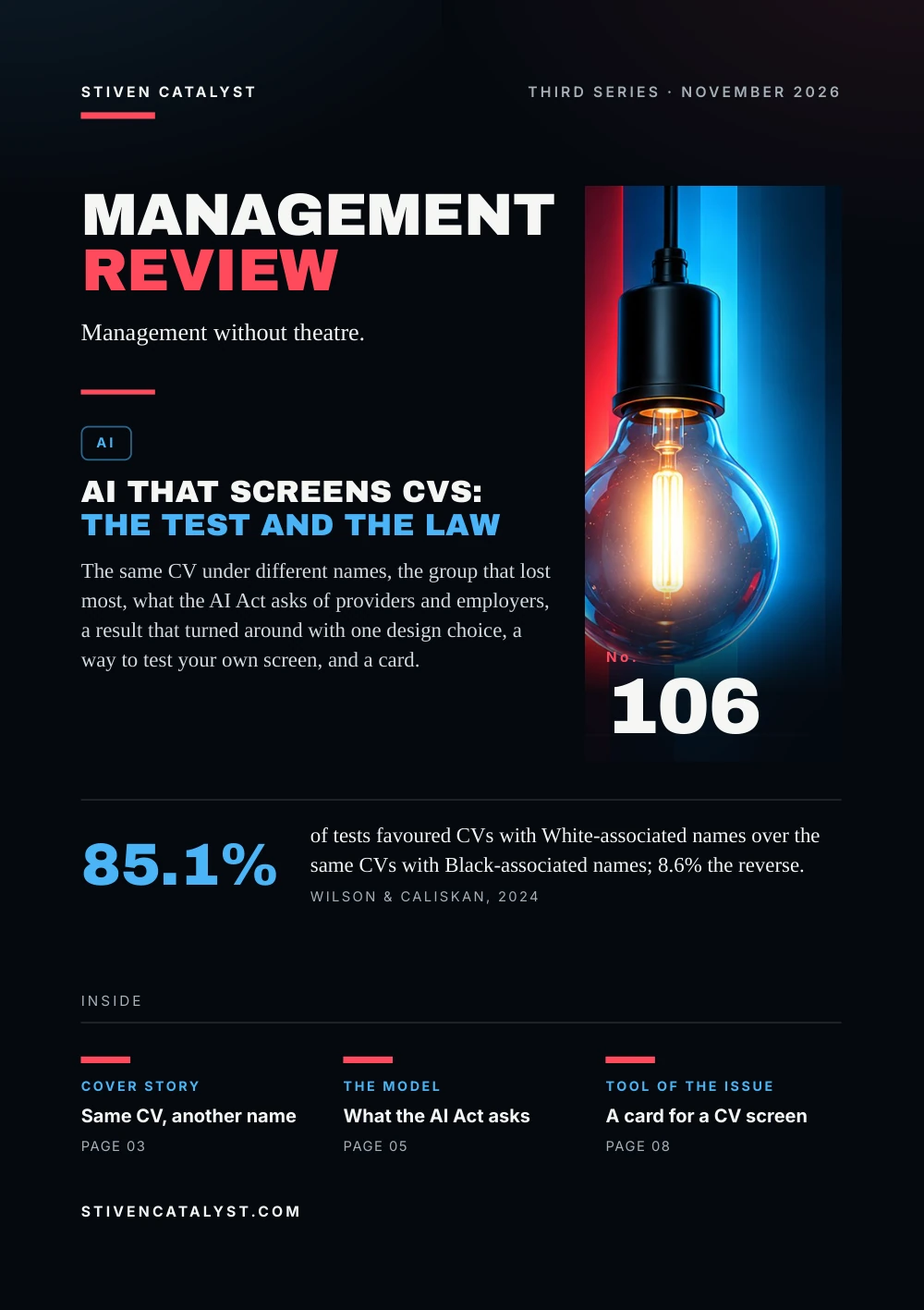
In a 2024 study the same CVs, under different names, were ranked against real job ads by three AI models. Names associated with White people were favoured in 85.1% of tests, and Black men's names never beat White men's. A correction in 2026 and a test with other names show how much the design matters. The AI Act counts such systems as high-risk and sets duties for providers and employers. A name-swap test and a card close the issue.
Management Review · Third series · November 2026 · No. 106
AI that screens CVs: the test and the law
The same CV under different names, the group that lost most, what the AI Act asks of providers and employers, a result that turned around with one design choice, a way to test your own screen, and a card.
- No.
- 106
- Pages
- 10
- Sources
- 3
- Topics
- AI
- Online since
- 7 November 2026
Stiven CatalystThird series · November 2026
ManagementReview
Management without theatre.
AI
AI that screens CVs:the test and the law
The same CV under different names, the group that lost most, what the AI Act asks of providers and employers, a result that turned around with one design choice, a way to test your own screen, and a card.

No.106
85.1%
of tests favoured CVs with White-associated names over the same CVs with Black-associated names; 8.6% the reverse.Wilson & Caliskan, 2024
stivencatalyst.com
No. 106 · AI
In this issue
Many applications are read by software before a person sees them, and language models make it cheap to add one more filter. A filter that ranks people decides who gets a look. This issue asks what a careful test found when only the name changed, and what European law now asks before such a system screens anyone.
- 03Cover storySame CV, another name
- 04The numbersThe group that lost most
- 05The modelWhat the AI Act asks
- 06What the research saysA result that turned around
- 07How it is measuredTest your own screen
- 08Tool of the issueA card for a CV screen
- 09SourcesSources and method
How to read this issue
Figure
Every figure has its source and year at the foot of its page.
Our reading
Where the editor interprets rather than the research, it says so.
Practice
The steps and the card are proposals to try, not research results.
Cover story
Same CV,another name
Kyra Wilson and Aylin Caliskan took 554 public CVs and 571 job ads in nine occupations, from chief executives to teachers. Each CV got a first name linked to Black or White men or women, and the surname Williams. Three open AI models, built to match texts, ranked the CVs for each ad, and the top 10% counted as selected.
Tests by race only, three models × nine occupations: which CVs were selected significantly more often (2024)
The set-up worked as a screen: without names, CVs from the advertised occupation scored higher than others for every occupation. The only tests where Black-associated names won came from one of the three models.
Our reading
Nothing in these CVs differed but the name. Whatever the models preferred, it was not the work.
Source: Kyra Wilson & Aylin Caliskan, Proceedings of the AAAI/ACM Conference on AI, Ethics, and Society 7, 2024
Wilson & Caliskan (2024), figure 4. A simulation with US names and occupations, not an audit of a tool in use; CVs were cut at 1,300 tokens. Shares are of 27 chi-square tests at p < 0.05. Names signal race and gender only roughly, as the authors note.
The numbers
The group thatlost most
The researchers then compared the four groups pair by pair, again 27 tests for each pair. The differences between White men's and White women's names were the smallest; comparisons that included Black names showed larger ones.
Share of 27 tests in which the first group's CVs were selected significantly more often (2024)
Black men's names were preferred to Black women's in 14.8% of tests and to White men's in none. The authors note that this follows what field studies of hiring have long found, and that the bias against one group is not the sum of a race effect and a gender effect.
Our reading
A check by race alone and by gender alone can miss the group that loses most. Test the combinations.
Source: Kyra Wilson & Aylin Caliskan, Proceedings of the AAAI/ACM Conference on AI, Ethics, and Society 7, 2024
Wilson & Caliskan (2024), figures 6–9; 20 names per group. The rest of each 100% is tests with no significant difference. These intersectional results were not affected by the 2026 correction and were replicated by a team at the University of Salzburg.
The model
What the AI Actasks
Annex III, point 4(a) lists AI meant for recruitment or selection, in particular to target job ads, to analyse and filter applications and to evaluate candidates. Such systems are high-risk; the rules apply from 2 December 2027. Here is what falls on each side.
The provider, who builds it
- Examines its data for possible biases and takes measures to detect, prevent and reduce them (Art. 10(2)(f), (g))
- States accuracy and, where appropriate, results for specific groups in the instructions (13(3)(b))
- Is built so overseers stay aware of over-reliance and can override the output (14(4)(b), (d))
The employer, who uses it
- Keeps the input data it controls relevant and sufficiently representative (26(4))
- Explains, when an affected candidate asks, the AI's role and the main elements of the decision (86)
- Can become the provider by turning a general AI system to screening CVs (25(1)(c))
The last line matters most for small firms: a general chatbot set to sort applicants is put to a high-risk purpose it was not placed on the market for. Article 25 then gives the firm that did so the provider's duties under Article 16.
Our reading
“A person checks it” is not oversight if that person only sees the shortlist. Oversight starts with the rejected.
Sources: European Parliament and Council of the European Union, Official Journal of the EU, 2024; European Parliament and Council of the European Union, Official Journal of the EU, 2026
Regulation (EU) 2024/1689, Articles 10, 13, 14, 16, 25, 26 and 86 and Annex III; date from Article 113 as amended by Regulation (EU) 2026/1744, which left the provisions cited here unchanged. The wording and the callout are the editors'; not legal advice. Dates, the employer's other duties and Article 6(3) are in No. 41. The linked essay is the author's view of who decides when a system decides first.
More in the essayThe system is faster than you
What the research says
A result thatturned around
The main test used White names that occur about 5.5 times as often in written text as the Black names, matching the population. In a second run the White names were about as frequent as the Black ones. Nothing else changed.
Share of 27 race tests won by each group, by how the names were chosen (2024)
In August 2026 the authors added a correction: after a team at the University of Salzburg tried to replicate the study, a bug was found that had swapped the labels in the gender-only tests. Women's names, not men's, were the ones preferred in 51.9% of those tests. The race and intersectional results stood.
Our reading
One audit is a reading, not a verdict. Ask how the test was built, and whether anyone repeated it.
Source: Kyra Wilson & Aylin Caliskan, Proceedings of the AAAI/ACM Conference on AI, Ethics, and Society 7, 2024
Wilson & Caliskan (2024), arXiv version 3 (30 August 2026) with the correction note; section “Frequency effects”. The authors read the reversal as the models' sensitivity to how often a name occurs. The callout is the editors'.
How it is measured
Test yourown screen
The study's method can be turned into a test for a screen a team already uses: identical CVs that differ in one signal, run through the same step, with the selection rates compared. The steps below are the editors' proposal, not the study's.
Take real ads, invented CVs
No real applicant's data; several occupations.
Change one signal only
A name, a women's club, a school, an age; and their combinations.
Keep your real cut-off
The share that a person actually reads, such as the top 10%.
Compare selection rates
Per group and per combination; then vary length and wording.
Report it
Keep the record; tell the provider of any risk (Art. 26(5)).
Our reading
A screen that was never tested with a swapped name has no known bias, which is not the same as none.
Sources: Kyra Wilson & Aylin Caliskan, Proceedings of the AAAI/ACM Conference on AI, Ethics, and Society 7, 2024; European Parliament and Council of the European Union, Official Journal of the EU, 2024; European Parliament and Council of the European Union, Official Journal of the EU, 2026
Proposal of the editors, modelled on Wilson & Caliskan (2024), who also changed CV length and found it altered results. Since July 2026, Article 4a lets employers using high-risk AI process sensitive data to detect bias, under strict conditions; it creates no duty to do so. The structured interview is in No. 65.
Tool of the issue
A card fora CV screen
One card for each system that reads applications before a person does. The ATS CV tool shows the other side: how application software reads a CV, and what a candidate can do so it is read correctly.
01System and its intended purposebuilt for recruitment, or a general tool we turned to it?
02What it does in the processtargets ads, filters, ranks or scores; where a person comes in
03Who sees the rejecteda name, how many are reviewed, who may override
04Last swapped-name testdate, signals and combinations tested, result, sent to provider
05Our input dataads and criteria we feed it: relevant to the job?
06Candidates told and explainedwhere they learn AI is used; who answers a request
Sources: European Parliament and Council of the European Union, Official Journal of the EU, 2024; Kyra Wilson & Aylin Caliskan, Proceedings of the AAAI/ACM Conference on AI, Ethics, and Society 7, 2024
The card is the editors' proposal, built on Articles 14, 25, 26 and 86 of the AI Act and on the method of Wilson & Caliskan (2024); it is not a tested instrument and not legal advice. The employer's duties before use, such as informing workers' representatives, are in No. 41.
Open the tool: ATS CVstivencatalyst.com/tools/ats-cv/
Sources and method
Every figurehas a source.
The figures in this issue come from the sources below. The year shows how recent each one is.
- Gender, Race, and Intersectional Bias in Resume Screening via Language Model Retrieval (arXiv version 3, with the authors' correction of 29 August 2026)Kyra Wilson & Aylin Caliskan, Proceedings of the AAAI/ACM Conference on AI, Ethics, and Society 7, 2024https://arxiv.org/abs/2407.20371
- Regulation (EU) 2024/1689 laying down harmonised rules on artificial intelligence (Artificial Intelligence Act)European Parliament and Council of the European Union, Official Journal of the EU, 2024https://eur-lex.europa.eu/eli/reg/2024/1689/oj
- Regulation (EU) 2026/1744 amending Regulations (EU) 2024/1689, (EU) 2018/1139 and (EU) 2023/1230 (Digital Omnibus on AI)European Parliament and Council of the European Union, Official Journal of the EU, 2026https://eur-lex.europa.eu/eli/reg/2026/1744/oj
Editorial method
Each figure was checked for its year, its publisher and what it measures, in the full text where it could be opened. A source read only in a summary, an abstract or excerpts is marked “via”. A figure not confirmed in what was read is marked so on its page, or left out. The editor's interpretation is marked “Our reading”.
ManagementReview
Management without theatre.
Every issue, one management question, checked against the best research.
All issues
stivencatalyst.com/magazine/management-review.html
Management Review · No. 106 · November 2026 · Stiven Catalyst
Edited by Stiven Janaqi, who answers for it; “the editors” in this publication means him. Its texts, translations, layout and the checking of figures against their sources are done in working sessions with Claude, an AI model by Anthropic.
stivencatalyst.com/how-this-is-made.html
 Next issue
Decision fatigue: the hungry judges
Click or swipe a page to turn it. The arrow keys work too.
Management Review · No. 106
The figures of the issue
The charts of the printed pages, with their sources.
Wilson & Caliskan (2024), figure 4. A simulation with US names and occupations, not an audit of a tool in use; CVs were cut at 1,300 tokens. Shares are of 27 chi-square tests at p < 0.05. Names signal race and gender only roughly, as the authors note.
Source: Kyra Wilson & Aylin Caliskan, Proceedings of the AAAI/ACM Conference on AI, Ethics, and Society 7, 2024
Wilson & Caliskan (2024), figures 6–9; 20 names per group. The rest of each 100% is tests with no significant difference. These intersectional results were not affected by the 2026 correction and were replicated by a team at the University of Salzburg.
Source: Kyra Wilson & Aylin Caliskan, Proceedings of the AAAI/ACM Conference on AI, Ethics, and Society 7, 2024
Wilson & Caliskan (2024), arXiv version 3 (30 August 2026) with the correction note; section “Frequency effects”. The authors read the reversal as the models' sensitivity to how often a name occurs. The callout is the editors'.
Source: Kyra Wilson & Aylin Caliskan, Proceedings of the AAAI/ACM Conference on AI, Ethics, and Society 7, 2024
The whole text Read the issue as text For reading on a small screen, searching or a screen reader. The same words, without the page design.
In this issue
Many applications are read by software before a person sees them, and language models make it cheap to add one more filter. A filter that ranks people decides who gets a look. This issue asks what a careful test found when only the name changed, and what European law now asks before such a system screens anyone.
In a 2024 study the same CVs, under different names, were ranked against real job ads by three AI models. Names associated with White people were favoured in 85.1% of tests, and Black men's names never beat White men's. A correction in 2026 and a test with other names show how much the design matters. The AI Act counts such systems as high-risk and sets duties for providers and employers. A name-swap test and a card close the issue.
Stiven Janaqi, Editor
Cover story
Same CV, another name
Kyra Wilson and Aylin Caliskan took 554 public CVs and 571 job ads in nine occupations, from chief executives to teachers. Each CV got a first name linked to Black or White men or women, and the surname Williams. Three open AI models, built to match texts, ranked the CVs for each ad, and the top 10% counted as selected.
Tests by race only, three models × nine occupations: which CVs were selected significantly more often (2024): CVs with White-associated names 85.1%, CVs with Black-associated names 8.6%, No significant difference 6.3%.
The set-up worked as a screen: without names, CVs from the advertised occupation scored higher than others for every occupation. The only tests where Black-associated names won came from one of the three models.
Our reading
Nothing in these CVs differed but the name. Whatever the models preferred, it was not the work.
Wilson & Caliskan (2024), figure 4. A simulation with US names and occupations, not an audit of a tool in use; CVs were cut at 1,300 tokens. Shares are of 27 chi-square tests at p < 0.05. Names signal race and gender only roughly, as the authors note.
Source: Kyra Wilson & Aylin Caliskan, Proceedings of the AAAI/ACM Conference on AI, Ethics, and Society 7, 2024
The numbers
The group that lost most
The researchers then compared the four groups pair by pair, again 27 tests for each pair. The differences between White men's and White women's names were the smallest; comparisons that included Black names showed larger ones.
Share of 27 tests in which the first group's CVs were selected significantly more often (2024): White men over Black men 100%, Black women over Black men 66.7%, White women over Black women 48.1%, Black women over White women 25.9%, White women over White men 25.9%, White men over White women 18.5%.
Black men's names were preferred to Black women's in 14.8% of tests and to White men's in none. The authors note that this follows what field studies of hiring have long found, and that the bias against one group is not the sum of a race effect and a gender effect.
Our reading
A check by race alone and by gender alone can miss the group that loses most. Test the combinations.
Wilson & Caliskan (2024), figures 6–9; 20 names per group. The rest of each 100% is tests with no significant difference. These intersectional results were not affected by the 2026 correction and were replicated by a team at the University of Salzburg.
Source: Kyra Wilson & Aylin Caliskan, Proceedings of the AAAI/ACM Conference on AI, Ethics, and Society 7, 2024
The model
What the AI Act asks
Annex III, point 4(a) lists AI meant for recruitment or selection, in particular to target job ads, to analyse and filter applications and to evaluate candidates. Such systems are high-risk; the rules apply from 2 December 2027. Here is what falls on each side.
The provider, who builds it
- Examines its data for possible biases and takes measures to detect, prevent and reduce them (Art. 10(2)(f), (g))
- States accuracy and, where appropriate, results for specific groups in the instructions (13(3)(b))
- Is built so overseers stay aware of over-reliance and can override the output (14(4)(b), (d))
The employer, who uses it
- Keeps the input data it controls relevant and sufficiently representative (26(4))
- Explains, when an affected candidate asks, the AI's role and the main elements of the decision (86)
- Can become the provider by turning a general AI system to screening CVs (25(1)(c))
The last line matters most for small firms: a general chatbot set to sort applicants is put to a high-risk purpose it was not placed on the market for. Article 25 then gives the firm that did so the provider's duties under Article 16.
Our reading
“A person checks it” is not oversight if that person only sees the shortlist. Oversight starts with the rejected.
Regulation (EU) 2024/1689, Articles 10, 13, 14, 16, 25, 26 and 86 and Annex III; date from Article 113 as amended by Regulation (EU) 2026/1744, which left the provisions cited here unchanged. The wording and the callout are the editors'; not legal advice. Dates, the employer's other duties and Article 6(3) are in No. 41. The linked essay is the author's view of who decides when a system decides first.
Sources: European Parliament and Council of the European Union, Official Journal of the EU, 2024; European Parliament and Council of the European Union, Official Journal of the EU, 2026
More in the essay: The system is faster than you
What the research says
A result that turned around
The main test used White names that occur about 5.5 times as often in written text as the Black names, matching the population. In a second run the White names were about as frequent as the Black ones. Nothing else changed.
Share of 27 race tests won by each group, by how the names were chosen (2024): White-associated names: Names in proportion 85.1%, Names equally frequent 22.2%; Black-associated names: Names in proportion 8.6%, Names equally frequent 51.9%.
In August 2026 the authors added a correction: after a team at the University of Salzburg tried to replicate the study, a bug was found that had swapped the labels in the gender-only tests. Women's names, not men's, were the ones preferred in 51.9% of those tests. The race and intersectional results stood.
Our reading
One audit is a reading, not a verdict. Ask how the test was built, and whether anyone repeated it.
Wilson & Caliskan (2024), arXiv version 3 (30 August 2026) with the correction note; section “Frequency effects”. The authors read the reversal as the models' sensitivity to how often a name occurs. The callout is the editors'.
Source: Kyra Wilson & Aylin Caliskan, Proceedings of the AAAI/ACM Conference on AI, Ethics, and Society 7, 2024
How it is measured
Test your own screen
The study's method can be turned into a test for a screen a team already uses: identical CVs that differ in one signal, run through the same step, with the selection rates compared. The steps below are the editors' proposal, not the study's.
- Take real ads, invented CVs. No real applicant's data; several occupations.
- Change one signal only. A name, a women's club, a school, an age; and their combinations.
- Keep your real cut-off. The share that a person actually reads, such as the top 10%.
- Compare selection rates. Per group and per combination; then vary length and wording.
- Repo
r t it. Keep the record; tell the provider of any risk (Art. 26(5)).
Our reading
A screen that was never tested with a swapped name has no known bias, which is not the same as none.
Proposal of the editors, modelled on Wilson & Caliskan (2024), who also changed CV length and found it altered results. Since July 2026, Article 4a lets employers using high-risk AI process sensitive data to detect bias, under strict conditions; it creates no duty to do so. The structured interview is in No. 65.
Sources: Kyra Wilson & Aylin Caliskan, Proceedings of the AAAI/ACM Conference on AI, Ethics, and Society 7, 2024; European Parliament and Council of the European Union, Official Journal of the EU, 2024; European Parliament and Council of the European Union, Official Journal of the EU, 2026
Tool of the issue
A card for a CV screen
One card for each system that reads applications before a person does. The ATS CV tool shows the other side: how application software reads a CV, and what a candidate can do so it is read correctly.
- System and its intended purpose built for recruitment, or a general tool we turned to it?
- What it does in the process targets ads, filters, ranks or scores; where a person comes in
- Who sees the r
e jected a name, how many are reviewed, who may override - Last swapped-name test date, signals and combinations tested, result, sent to provider
- Our input data ads and criteria we feed it: relevant to the job?
- Candidates
t old and explained where they learn AI is used; who answers a request
The card is the editors' proposal, built on Articles 14, 25, 26 and 86 of the AI Act and on the method of Wilson & Caliskan (2024); it is not a tested instrument and not legal advice. The employer's duties before use, such as informing workers' representatives, are in No. 41.
Sources: European Parliament and Council of the European Union, Official Journal of the EU, 2024; Kyra Wilson & Aylin Caliskan, Proceedings of the AAAI/ACM Conference on AI, Ethics, and Society 7, 2024
Open the tool: ATS CV
Sources and method
Every figure has a source.
The figures in this issue come from the sources below. The year shows how recent each one is.
- Kyra Wilson & Aylin Caliskan, Proceedings of the AAAI/ACM Conference on AI, Ethics, and Society 7, “Gender, Race, and Intersectional Bias in Resume Screening via Language Model Retrieval (arXiv version 3, with the authors' correction of 29 August 2026)”, 2024. https://arxiv.org/abs/2407.20371
- European Parliament and Council of the European Union, Official Journal of the EU, “Regulation (EU) 2024/1689 laying down harmonised rules on artificial intelligence (Artificial Intelligence Act)”, 2024. https://eur-lex.europa.eu/eli/reg/2024/1689/oj
- European Parliament and Council of the European Union, Official Journal of the EU, “Regulation (EU) 2026/1744 amending Regulations (EU) 2024/1689, (EU) 2018/1139 and (EU) 2023/1230 (Digital Omnibus on AI)”, 2026. https://eur-lex.europa.eu/eli/reg/2026/1744/oj
Edit orial me thod
Each figure was checked for its year, its publisher and what it measures, in the full text where it could be opened. A source read only in a summary, an abstract or excerpts is marked “via”. A figure not confirmed in what was read is marked so on its page, or left out. The editor's interpretation is marked “Our reading”.
Edited by Stiven Janaqi, who answers for it; “the editors” in this publication means him. Its texts, translations, layout and the checking of figures against their sources are done in working sessions with Claude, an AI model by Anthropic. How this is made
Management Review · Monthly edition