Managers tend to value visible evidence. A late departure has a timestamp. A missing bag creates an exception. A room issue may enter a shift log. What does a report show when a worker notices a flawed instruction, judges that raising it is pointless and quietly works around it? Often nothing at all. The absent signal cannot be counted the way a recorded failure can. This volume studies the conditions under which useful knowledge fails to travel upward. Its subject is not politeness or personality. It is an information problem shaped by authority, anticipated consequences, the design of reporting channels and the credibility of the managerial response. A company can be busy collecting data while losing the first-hand observations that would make the data intelligible. The author has worked in last-mile loading and coordination, with wholesale partners, and with Front Office and Night Audit procedures. Those are verified categories of work, not evidence that a particular employer discouraged reporting. The scenes in this volume are expressly constructed; they contain no identifiable staff, guest, customer, company or private internal information. Edmondson gives the language of psychological safety. Milliken, Morrison and Hewlin examine why employees keep concerns to themselves. Detert and Burris show why managerial openness matters. Research in healthcare and a wider meta-analysis provide comparisons with their own limits. The practical question is what a manager can do after an employee takes the risk of telling the truth.
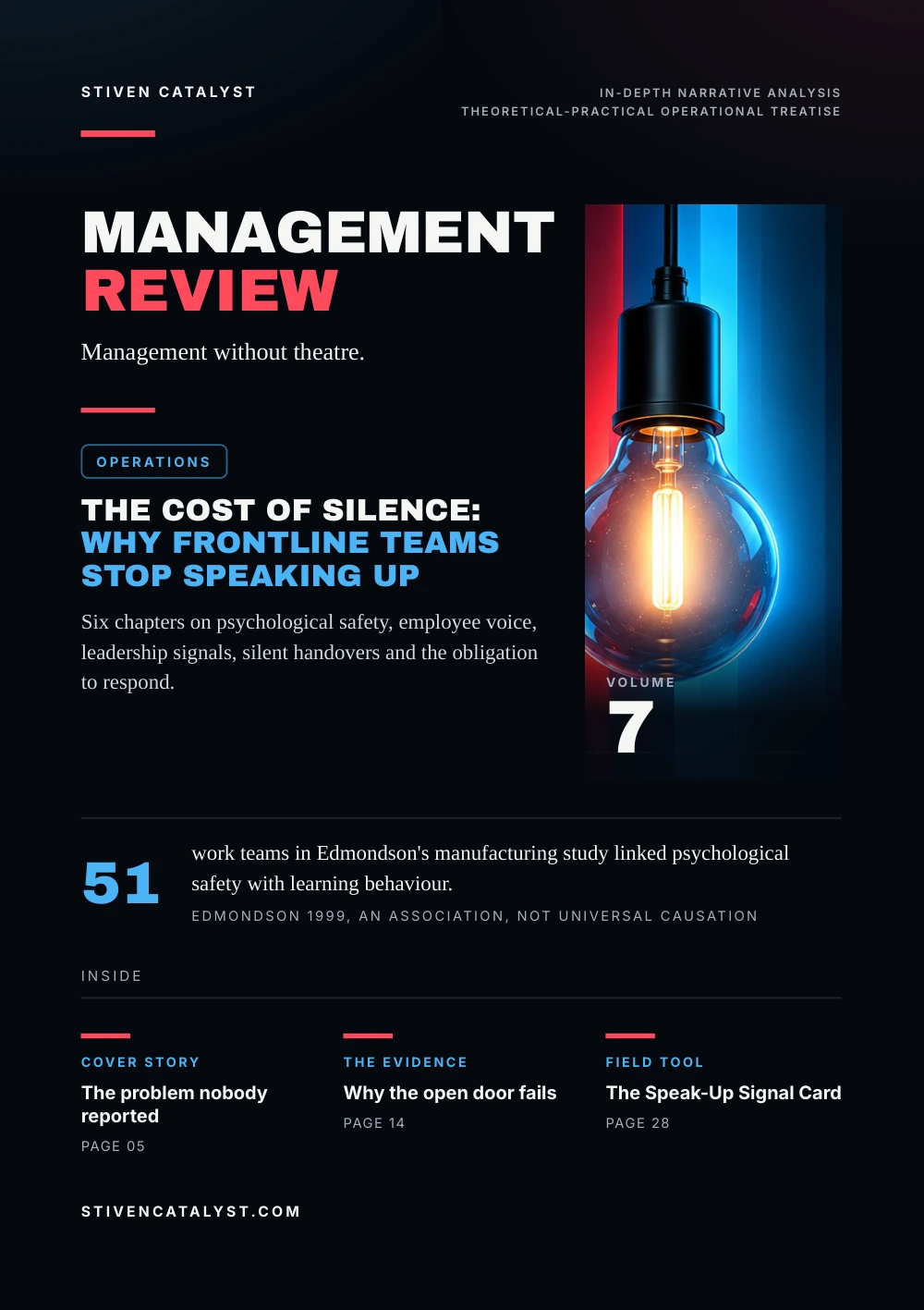
In-depth narrative analysis and theoretical-practical operational treatise · Volume 7 · October 2026
The cost of silence: why frontline teams st op speaking up
Six chapters on psychological safety, employee voice, leadership signals, silent handovers and the obligation to respond.
- Volume
- 7
- Chapters
- 6
- Pages
- 32
- Sources
- 10
- Online since
- 23 October 2026
How every chapter is built
- 1The living scene
A shift, a ramp, a desk at 03:00: one piece of work followed as it actually happens, with the hand-off where it breaks. Scenes are constructed from real categories of work and say so.
- 2The conce
p tual and scientific breakdownThe mechanism behind the scene, named with the model that explains it, and the research that tests it: the study, its population, its year and its limits, before it is applied anywhere else.
- 3The operating pro
t ocol for actionWhat a working team can try on Monday: fields, questions, a cadence and a count, each with an owner, a next step and a return of information to the people who do the work.
Theoretical-practical operational treatise
Management without theatre.
Operations
Six chapters on psychological safety, employee voice, leadership signals, silent handovers and the obligation to respond.

Volume7
work teams in Edmondson's manufacturing study linked psychological safety with learning behaviour.Edmondson 1999, an association, not universal causation
stivencatalyst.com
Editorial · Volume 7
What silencecosts a business
A dashboard can be accurate and still miss the most important operational fact: someone saw a problem and decided not to say it.
How every chapter is built
- 1
The living scene
A shift, a ramp, a desk at 03:00: one piece of work followed as it actually happens, with the hand-off where it breaks. Scenes are constructed from real categories of work and say so.
- 2
The conceptual and scientific breakdown
The mechanism behind the scene, named with the model that explains it, and the research that tests it: the study, its population, its year and its limits, before it is applied anywhere else.
- 3
The operating protocol for action
What a working team can try on Monday: fields, questions, a cadence and a count, each with an owner, a next step and a return of information to the people who do the work.
The reading contract
Field
Real categories of operational work, no invented personal incidents.
Evidence
Research setting, sample, method and limits stated together.
Action
A concern is closed only when the decision has been told back.
Contents
The chap ters,in three layers
Chapter IThe problem nobody reported05
1 SceneThe problem nobody reported052 BreakdownThe missing signal in the feedback system06Where the knowledge is lost on the way up073 ProtocolAsk about the work before asking for blame08Chapter IIThe fear of speaking up09
1 SceneThe sentence left unsaid092 BreakdownPsychological safety is not comfort10Two studies, different questions113 ProtocolMake the first response worth the risk12Chapter IIIThe open door nobody uses13
1 SceneThe open door nobody enters132 BreakdownOpenness is observable behaviour14The influence above the supervisor153 ProtocolA listening routine that can be checked16Chapter IVThe silent shift17
1 SceneThe quiet handover172 BreakdownThe handover has two channels18When workarounds mask failure193 ProtocolCarry the uncertainty across the shift20Chapter VWhen speaking up changes nothing21
1 SceneThe meeting that returns no answer212 BreakdownSilence can follow a failed response22The funnel of unanswered concerns233 ProtocolReturn with a decision, not a slogan24Chapter VIBuilding a culture that hears25
1 SceneThe useful uncomfortable question252 BreakdownFive steps from voice to action263 ProtocolA short trial of real listening27
Also in this volume
- 04Research noteThe absence of a report is not a statistic
- 28Field toolThe Speak-Up Signal Card
- 29Closing essayWhat the quiet room cannot tell you
- 30MethodEvery claim has a boundary
- 31SourcesSources and method
Research note
The absence of a repor tis not a statistic
Silence is difficult to observe directly. The studies below help us reason about it, not calculate a universal percentage of silent workers.
Organisational voice is the voluntary expression of work-relevant ideas or concerns. Organisational silence, in the tradition of Morrison and Milliken, is the withholding of potentially important information. Not every quiet employee is withholding something: they may have nothing to add, may not have been asked, or may use a different channel. Counting zero reports cannot distinguish these possibilities. The evidence base mixes designs. Edmondson studied 51 work teams at one manufacturing company. Milliken, Morrison and Hewlin interviewed 40 employees. Detert and Burris analysed 3,149 employees and 223 managers in a restaurant chain. Frazier and colleagues synthesised 136 independent samples. These counts identify the scale and setting of each study; they are not comparable rates of silence.
Observed
A defined sample, a research design and a reported association.
Transferred
A cautious management hypothesis to test locally.
Unproven
Any claim that the author measured silence or fixed it at an employer.
The strongest statement this literature supports is directional: interpersonal risk, managerial behaviour and organisational context are associated with whether workers speak and whether teams learn. We cannot infer that an unreported issue exists at a specific warehouse or hotel, nor that an editorial protocol will produce a particular improvement.
A complaint count is evidence of reporting. It is not a census of everything workers know.
Sources: Amy Edmondson, Administrative Science Quarterly, 1999; Frances J. Milliken, Elizabeth W. Morrison & Patricia F. Hewlin, Journal of Management Studies 40(6), 2003 (via Authors' manuscript); James R. Detert & Ethan R. Burris, Academy of Management Journal 50(4), 2007; M. Lance Frazier, Stav Fainshmidt, Ryan L. Klinger, Amir Pezeshkan & Veselina Vracheva, Personnel Psychology, 2017 (via Abstract; QIC-WD and Michigan MDHHS summaries); Elizabeth W. Morrison, Annual Review of Organizational Psychology and Organizational Behavior 1, 2014
Edmondson (1999); Milliken, Morrison and Hewlin (2003); Detert and Burris (2007); Frazier et al. (2017). Voice and silence defined after Morrison (2014).
- 1Scene
- 2Breakdown
- 3Protocol
Chapter I · The problem nobody reported
The problemnobody repor ted
A small workaround can conceal the fact that the next shift inherited a system that does not quite work.
Constructed last-mile scene, not a recorded personal incident
A loading area prepares for departures. A worker notices that a particular handover routinely produces an unclear status. The next colleague can still make the order ready by checking twice and asking someone nearby. Today the team is under pressure. The worker finds the answer, corrects the immediate situation and returns to the queue. No exception is raised. From the dashboard, the episode looks ordinary. This is not a story of misconduct. The employee may reasonably believe that reporting a small problem takes longer than fixing it. Perhaps no simple reporting channel exists. Perhaps a past suggestion received no answer. Or perhaps the local standard expects an exception to be recorded and the worker made a poor choice. Without asking, the manager cannot know which explanation fits.
The author has documented categories such as mixed trolleys, missing bags and operational handovers from last-mile work. The person, the exchange, the timing and the reason for silence in this scene are invented. Their use is analytical: a process may recover from an obstacle without teaching the organisation why that obstacle appeared.
An apparently normal departure may hide the extra effort that made it possible.
Source: Anita L. Tucker & Amy C. Edmondson, California Management Review, 2003
Editorial illustration informed by Tucker and Edmondson (2003); no employer-level voice data. The essay named below goes to the floor to see the work.
- 1Scene
- 2Breakdown
- 3Protocol
Chapter I · The problem nobody reported
The missing signalin the feedback system
A reported exception is only one possible outcome of a problem being noticed.
Morrison and Milliken argued in 2000 that organisational silence can become collective: people infer from leadership behaviour and shared experience that speaking up carries costs or little prospect of influence. Their paper is a conceptual framework, not a survey proving that most organisations suppress information. It nevertheless separates an operational problem from the social route by which the problem becomes known. A worker must first notice an issue, interpret it as relevant, see a feasible channel, judge the interpersonal risk and decide whether to use that channel. Even after speaking, the information must be received and processed. At every step an organisation may lose knowledge. A manager who measures only the final complaint count observes the end of this chain, not the conditions upstream.
- 01
Notice
A problem or an improvement idea.
- 02
Assess
Risk and likely usefulness.
- 03
Speak
A usable channel.
- 04
Receive
The listener understands.
- 05
Act
Decision and feedback.
This is why silence cannot be treated as a personal flaw. A conscientious worker can still judge that a meeting with little time, a public audience and no feedback is an unhelpful place to raise a concern. The alternative is not to excuse every failure to report: safety and compliance duties remain binding. The task is to improve both the channel and the expectation that a concern will be fairly evaluated.
The absence of recorded concerns cannot establish the absence of operational obstacles.
Sources: Elizabeth W. Morrison & Frances J. Milliken, Academy of Management Review 25(4), 2000; Elizabeth W. Morrison, Annual Review of Organizational Psychology and Organizational Behavior 1, 2014
Conceptual source: Morrison and Milliken (2000); voice definitions after Morrison (2014). The five-stage flow is editorial.
- 1Scene
- 2Breakdown
- 3Protocol
Chapter I · The problem nobody reported
Where the knowledgeis lost on the way up
A fully synthetic illustration of the chain on the previous page: twenty invented observations, followed stage by stage.
Synthetic example, authored for this volume; not employer data
Invented cohort of 20 noticed problems
Every count is invented so the arithmetic can be followed. The manager's log would show six entries and three closures, while seventeen of the twenty observations never became visible. The largest losses sit upstream: eleven observations were filtered out by the worker's own judgement of risk, usefulness or the lack of a channel. No real operation has these proportions. A low complaint count can describe a quiet channel as easily as a quiet process; only asking the people who notice tells the two apart.
The complaint log counts what survived the chain. Manage the chain, not the log.
Source: Elizabeth W. Morrison & Frances J. Milliken, Academy of Management Review 25(4), 2000
Every value on this page is synthetic, authored for this volume; the stages follow Morrison and Milliken (2000). The PDF draws only the downstream funnel of Chapter V.
- 1Scene
- 2Breakdown
- 3Protocol
Chapter I · The problem nobody reported
Ask about the workbefore asking for blame
A first inquiry should make problems observable without forcing people to identify colleagues or disclose sensitive data.
Choose one handover
A loading, order-preparation or shift-transfer process with an observable result.
Ask where people recover
What do workers double-check, chase or explain to make the next step possible?
Separate observation from interpretation
Record what was checked, what was said and what remains uncertain.
Check the safe channels
How can a worker raise a recurring issue confidentially through the right organisational route?
Assign the next decision
A responsible role and a near-term date for a response; no premature promise of a fix.
Return to the team
Share what was verified, what will change and what still needs investigation.
A safety-critical matter follows the existing immediate escalation rules; a process question can receive a slower, transparent review. The two should not be merged because the same worker identified them. Watch for one effect: after an invitation, reporting may rise because detection improved, not because the operation deteriorated.
The useful question is not “Why did nobody report it?” but “What made reporting possible, safe and worthwhile?”
Sources: Elizabeth W. Morrison & Frances J. Milliken, Academy of Management Review 25(4), 2000; Anita L. Tucker & Amy C. Edmondson, California Management Review, 2003
Proposed operating checklist, not a validated intervention. Research foundations: Morrison and Milliken (2000); Tucker and Edmondson (2003).
- 1Scene
- 2Breakdown
- 3Protocol
Chapter II · The fear of speaking up
The sentencelef t unsaid
The cost of saying something can be immediate and personal; the benefit may be distant and uncertain.
Hypothetical team interaction, not the author's reported dialogue
A new team member spots an ambiguity in an instruction. The experienced colleagues proceed without discussion. The worker could ask, but the question may sound basic in front of a crowded room. There is no evidence that the instruction is wrong; the problem may be the employee's incomplete understanding. Still, the worker decides that asking later will be easier. The briefing ends; the ambiguity remains. A manager later says that everyone had the opportunity to ask. Technically, that may be true. Yet the relevant question is whether the opportunity felt usable to the people least familiar with the system. Speaking is a social act. A question carries information about the work, but it can also expose uncertainty, interrupt a supervisor and invite comparison with peers.
This constructed scene illustrates an interpersonal risk, not a proven event at a hotel or last-mile employer. It argues neither that every silence means fear nor that safety removes accountability. It suggests that access to information depends partly on how people expect others to respond to an inconvenient question.
An invitation has little value if the employee expects the cost of using it to outweigh the benefit.
Sources: Amy Edmondson, Administrative Science Quarterly, 1999; Frances J. Milliken, Elizabeth W. Morrison & Patricia F. Hewlin, Journal of Management Studies 40(6), 2003 (via Authors' manuscript)
Constructed illustration; the psychological-safety concept after Edmondson (1999), the employee interviews after Milliken, Morrison and Hewlin (2003). The essay named below works in a team of many languages.
- 1Scene
- 2Breakdown
- 3Protocol
Chapter II · The fear of speaking up
Psychological safe t yis not comfor t
The construct concerns perceived interpersonal risk when asking, admitting uncertainty or challenging a practice.
Amy Edmondson defined team psychological safety in 1999 as a shared belief that the team is safe for interpersonal risk taking. The distinction is exacting: it is not a promise that colleagues will always agree, that every criticism will be accepted or that professional standards can be ignored. A team can expect disciplined, high-quality work and still allow employees to identify a mistake without humiliation. Edmondson's field study examined 51 work teams within one manufacturing company. Psychological safety was associated with learning behaviours such as seeking feedback and discussing errors. The association was not a randomised test of a managerial training programme, and it establishes no universal numerical benefit for transport, hotels or wholesale operations.
Voice
Can I ask or warn without being treated as disloyal?
Standards
Will the concern be tested against the real requirement?
Accountability
What must I still do, including urgent reporting duties?
A manager can reduce unnecessary interpersonal risk by asking precise questions, thanking the person for specific information and separating the report of a problem from proof of responsibility. Conversely, a warm tone without consequences for unresolved risks is not enough. Psychological safety becomes operationally relevant when information moves into verification and a decision.
Safety to speak and responsibility to act are complements, not opposites.
Source: Amy Edmondson, Administrative Science Quarterly, 1999
Edmondson, Administrative Science Quarterly (1999). The three-part practical interpretation is editorial.
- 1Scene
- 2Breakdown
- 3Protocol
Chapter II · The fear of speaking up
Two studies,different questions
One examines learning in teams. Another asks why employees decide to remain silent. A third separates two kinds of voice.
The samples cannot be combined into a prevalence estimate. The manufacturing study concerns team-level beliefs and behaviours. The interview study explores employees' accounts of situations in which they chose not to raise concerns; it is not designed to say what share of all workers behave this way. Both make the social cost of voice analytically visible, but neither proves the outcome of a specific speak-up initiative at a loading point. The distinction between promotive and prohibitive voice deepens this. A suggestion for a better process and a warning that a current process is unsafe or failing feel quite different. Liang, Farh and Farh followed 239 employees in a two-wave study and reported different psychological antecedents for the two kinds of voice. A channel that attracts ideas will not automatically attract difficult warnings.
Count the study participants accurately. Never turn their stories into an invented company-wide silence rate.
Sources: Amy Edmondson, Administrative Science Quarterly, 1999; Frances J. Milliken, Elizabeth W. Morrison & Patricia F. Hewlin, Journal of Management Studies 40(6), 2003 (via Authors' manuscript); Jian Liang, Crystal I. C. Farh & Jiing-Lih Farh, Academy of Management Journal 55(1), 2012
Edmondson (1999); Milliken, Morrison and Hewlin (2003); Liang, Farh and Farh (2012). No cross-study effect is calculated.
- 1Scene
- 2Breakdown
- 3Protocol
Chapter II · The fear of speaking up
Make the first responsewor th the risk
The first managerial reaction can lower or raise the perceived risk of the next report.
Acknowledge the contribution
The person supplied potentially useful information; say so without certifying a cause.
Clarify the observation
What happened, when it was noticed and what the worker could actually verify.
Do not demand an instant culprit
Distinguish an honest report from any later finding about conduct or compliance.
Protect appropriate privacy
Authorised channels for serious allegations or confidential details; no published case files.
Give a realistic next step
The role that will review the matter and the timing of an update.
Follow through
Even when the claim proves incorrect, explain the reasoning respectfully where appropriate.
An urgent concern uses the existing emergency or escalation process. In routine improvement, leaders should avoid teaching employees that a problem becomes dangerous to their reputation merely because it is uncomfortable for the manager. Equally, a fair inquiry allows the concern to be inaccurate; it does not presume the reporter was right.
The first response to a concern is also a lesson to everybody deciding whether to speak next time.
Sources: Amy Edmondson, Administrative Science Quarterly, 1999; Frances J. Milliken, Elizabeth W. Morrison & Patricia F. Hewlin, Journal of Management Studies 40(6), 2003 (via Authors' manuscript)
Original practice proposal informed by Edmondson (1999), Milliken, Morrison and Hewlin (2003) and Morrison (2014).
- 1Scene
- 2Breakdown
- 3Protocol
Chapter III · The open door nobody uses
The open doornobody enters
A leader can sincerely invite feedback and still, without meaning to, make the invitation difficult to accept.
Hypothetical leadership scene, not a documented meeting
A supervisor ends the weekly briefing by saying that the door is open. The team nods. During the meeting the supervisor had interrupted one colleague repeatedly, explained away a concern before hearing its details and described another question as something everybody should already know. No explicit prohibition has been issued. Nevertheless, the team has received more than one message about what kind of speaking is welcome. Another employee knows that a recurrent task has become harder since a process change. It is possible to talk to the supervisor privately. But asking for attention feels like arguing with the person who owns the new procedure. The employee waits for a better moment, and the manager later infers from the quiet meeting that the rollout is complete.
This scene is assembled to illustrate managerial signals. It accuses no named leader or organisation and is not a transcript from the author's experience. Its question is practical: which matters more, the verbal invitation or the way leaders react when a concern finally arrives?
An open door is a claim about access. The response to the first inconvenient question tests that claim.
Sources: James R. Detert & Ethan R. Burris, Academy of Management Journal 50(4), 2007; Ingrid M. Nembhard & Amy C. Edmondson, Journal of Organizational Behavior 27(7), 2006
Constructed scene. Research lens: Detert and Burris (2007); Nembhard and Edmondson (2006). The essay named below leads people without losing the person.
- 1Scene
- 2Breakdown
- 3Protocol
Chapter III · The open door nobody uses
Openness isobservable behaviour
Leadership affects voice not only through its declared values, but through the social signals attached to everyday responses.
Detert and Burris examined employee voice in a two-phase study of 3,149 employees and 223 managers at a restaurant chain. Managerial openness was more consistently associated with improvement-oriented voice than the other leadership construct they measured, transformational leadership, and perceived psychological safety mediated the relationship in their model. This does not show that merely telling managers to smile makes employees speak. Nembhard and Edmondson studied 23 neonatal intensive care units engaged in improvement projects. Their survey results supported a model in which inclusive words and actions from leaders related to psychological safety and to engagement in improvement, in the presence of professional-status differences. Those findings come from clinical teams, not hotels or transport operators.
Invite
Ask for inconvenient information, not just good news.
Receive
Make room for clarification without interruption or ridicule.
Conclude
Describe the decision and the right channel for further action.
These principles are deliberately behavioural. A worker evaluates a leader's reaction to correction, uncertainty and disagreement. A stated intention matters, but is weaker evidence than the visible response to an actual concern. Open dialogue still requires verification, good faith and compliance with the standards that protect customers and workers.
Openness becomes credible through a repeated pattern of response, not a sign on the office door.
Sources: James R. Detert & Ethan R. Burris, Academy of Management Journal 50(4), 2007; Ingrid M. Nembhard & Amy C. Edmondson, Journal of Organizational Behavior 27(7), 2006
Detert and Burris, Academy of Management Journal (2007); Nembhard and Edmondson, Journal of Organizational Behavior (2006).
- 1Scene
- 2Breakdown
- 3Protocol
Chapter III · The open door nobody uses
The influenceabove the supervisor
Workers read the wider hierarchy, not only the personality of their immediate manager.
Employees described direct supervisors and leaders several levels higher as influencing whether speaking up seemed risky or futile. The findings complicate the advice to fix the relationship with the immediate manager. A frontline employee may expect the local supervisor to listen, yet believe that someone with authority over the actual process will ignore or penalise the message. The number 89 counts interviews, not silenced employees. The research did not measure what share of operational issues went unreported; it identified pathways of perceived influence in one company. Its relevance to a warehouse, a hotel or a wholesale service is a hypothesis about hierarchy to be checked, not assumed.
Leader signal, and a possible reading by the team
Asks for contradictions
Inconvenient facts may be useful.
Explains an unresolved decision
The issue was heard, even without a fix.
Dismisses a question publicly
Speaking up may risk reputation.
Escalates carefully
Authority may support local learning.
The reporting line and the decision-making line are not always the same line.
Source: James R. Detert & Linda K. Treviño, Organization Science 21(1), 2010
Detert and Treviño, Organization Science (2010), qualitative research. The interpretive table is editorial.
- 1Scene
- 2Breakdown
- 3Protocol
Chapter III · The open door nobody uses
A listening routinethat can be checked
Turn openness into a small set of public behaviours without exposing employees or confidential issues.
Ask one focused question
For example: which part of today's handover forced a second explanation?
Allow a second interpretation
Invite the team to correct the leader's understanding before a conclusion is drawn.
Protect dissent
Separate the content of a concern from assumptions about attitude or loyalty.
Name the responsible level
If the local supervisor cannot change the condition, clarify the authorised escalation route.
Report the status truthfully
Acknowledged, under review, decision reached and closed are different conditions.
Check the next meeting
Did the team receive a meaningful answer about the issue previously raised?
A routine does not turn every meeting into a public complaints session. Some issues belong in confidential, human-resources, safety or other formal channels. The common principle is that the employee knows where to raise an issue and how to get a response, without the concern being turned into an accusation by default.
The observable test of openness is whether the team can bring difficult facts into a usable decision process.
Sources: James R. Detert & Ethan R. Burris, Academy of Management Journal 50(4), 2007; James R. Detert & Linda K. Treviño, Organization Science 21(1), 2010; Ingrid M. Nembhard & Amy C. Edmondson, Journal of Organizational Behavior 27(7), 2006
Editorial protocol developed from Detert and Burris (2007), Detert and Treviño (2010) and Nembhard and Edmondson (2006).
- 1Scene
- 2Breakdown
- 3Protocol
Chapter IV · The silent shift
The quie thandover
Work moves between people who may never have the chance to explain it face to face.
Constructed hotel-shift example, not a claimed guest incident
An evening team completes its shift. A small service concern was raised earlier; somebody has looked at it, but another department must decide what happens next. The situation is not urgent. A brief handover note says only that it needs follow-up. The night colleague can see the open item, but not the uncertainty behind it: what was actually checked, which answer was given and who owns the next step. At first glance the issue is an incomplete handover. Yet one more question matters. Did the earlier colleague omit information because the template made it hard to record, because the person did not know which detail was useful, or because an uncomfortable uncertainty seemed better left unsaid? The manager cannot diagnose intentional silence from an incomplete note alone.
The author has handled Night Audit documentation, technical room issues and shift handovers. The time, the particular case and the motives in this scene are fictional. No guest or payment data, security procedure, room identifier or internal technology is revealed.
An unfinished task may be visible in a log while the uncertainty needed to finish it remains invisible.
Sources: Elizabeth W. Morrison, Annual Review of Organizational Psychology and Organizational Behavior 1, 2014; Anita L. Tucker & Amy C. Edmondson, California Management Review, 2003
Constructed illustration using verified categories of hospitality work. Conceptual references: Morrison (2014); Tucker and Edmondson (2003). The essay named below makes the case for the handover.
- 1Scene
- 2Breakdown
- 3Protocol
Chapter IV · The silent shift
The handoverhas two channels
A status can move to the next shift without moving the judgement that the next worker needs.
In a shift-based service, the handover carries two kinds of information. The formal channel contains fields, statuses, timestamps and assigned work. The informal channel contains context: what a person is uncertain about, why a promised action did not happen or which interpretation has not been confirmed. Both can be needed, but the informal channel is particularly vulnerable when a shift ends under time pressure. The manager's task is not to encourage uncontrolled verbal storytelling. It is to make the formal record expressive enough for uncertainty. A useful handover distinguishes observed facts, reported claims, actions already taken and the decision still required. The next shift should be able to act without reconstructing a conversation whose participants have gone home.
Status
What the system says, and when it was updated.
Uncertainty
What remains unverified or disputed.
Next owner
Who is authorised to review, decide and respond.
Operational silence can arise here without anyone intending to suppress information. Workers may be unsure whether an unresolved problem will be read as failure, or may lack a safe channel for disagreement about the state of a case. The remedy must distinguish communication design, training needs and interpersonal risk; none can be diagnosed from the number of notes alone.
A handover is complete only when the receiving person knows what is known and what is not.
Source: Elizabeth W. Morrison, Annual Review of Organizational Psychology and Organizational Behavior 1, 2014
Editorial cross-shift application; voice concepts from Morrison (2014). Not a property-specific hotel procedure.
- 1Scene
- 2Breakdown
- 3Protocol
Chapter IV · The silent shift
When workaroundsmask failure
Evidence from healthcare illustrates the difference between recovering from an obstacle and learning why it recurred.
The researchers described an operational equilibrium in which frontline professionals worked around recurring process problems. Their study of nurses in nine hospitals differentiated errors from problems and examined why recovery on the day did not automatically generate organisational learning. This is a valuable analogy for information that vanishes at a handover, but it is not a study of hotel Night Audit. A second distinction comes from Liang, Farh and Farh's two-wave study of 239 employees. They separated promotive voice, which proposes improvement, from prohibitive voice, which warns about harmful practices, and found psychological safety particularly relevant to subsequent prohibitive voice. The exact relationships depend on their design and population. Together these studies pose a question worth testing: does our handover format allow staff to flag what may be wrong, as well as record what was done?
Recovery gets the shift through the night. Learning asks why recovery was necessary.
Sources: Anita L. Tucker & Amy C. Edmondson, California Management Review, 2003; Jian Liang, Crystal I. C. Farh & Jiing-Lih Farh, Academy of Management Journal 55(1), 2012
Tucker and Edmondson (2003); Liang, Farh and Farh (2012). The sector transfer is explicitly hypothetical.
- 1Scene
- 2Breakdown
- 3Protocol
Chapter IV · The silent shift
Carry the uncer taint yacross the shif t
A handover format can preserve dissent without inviting speculation or exposing private information.
State the observed issue
A neutral category and the factual condition; identifiable detail stays in the approved internal system.
Separate reported from verified
What a colleague or customer said is not necessarily what was observed.
Explain the remaining question
What has not been established, and what information would settle it.
Record the action actually taken
Do not turn an attempted step into a completed outcome.
Transfer responsibility
The authorised receiving role and the next review point.
Report back where appropriate
The person who raised the concern should learn that a decision was made, within confidentiality limits.
No public text should reproduce private hotel procedures, payment controls or security details. For operational use the template is reconciled with the organisation's official requirements; an anonymous example teaches the structure while the authoritative record stays in the approved system.
The next shift deserves the truth about an open problem, including the part nobody has yet resolved.
Sources: Elizabeth W. Morrison, Annual Review of Organizational Psychology and Organizational Behavior 1, 2014; Anita L. Tucker & Amy C. Edmondson, California Management Review, 2003
Original editorial handover protocol; no claim of certification or managerial approval at a named employer. The site's shift-handover tool follows the same structure.
- 1Scene
- 2Breakdown
- 3Protocol
Chapter V · When speaking up changes nothing
The mee ting thatre turns no answer
Listening can create an expectation that a concern will travel somewhere useful.
Constructed follow-up scene, not a reported experience
A staff member raises an obstacle that recurs every week. The supervisor writes it down and thanks the worker. Days pass without an update. In the next meeting the team is asked to describe possible improvements. The same obstacle comes up, this time more cautiously. Nobody needs to be hostile for the message to become clear: speaking creates work for the employee, but its effect is impossible to see. Perhaps the manager escalated the issue and received no decision. Perhaps the problem is technically complicated. Perhaps the observation was incorrect. Silence from management gives the team no way to tell these cases apart. The organisation has created an information exchange without completing it.
This is not an accusation about a real supervisor; the sequence is hypothetical. It shows why a listening practice should be judged not only by how many concerns it gathers, but by what the organisation can verify, act upon and communicate afterwards.
Being heard once is not the same as knowing what happened to what you said.
Sources: Elizabeth W. Morrison, Annual Review of Organizational Psychology and Organizational Behavior 1, 2014; Anita L. Tucker & Amy C. Edmondson, California Management Review, 2003
Constructed scenario. Conceptual sources: Morrison (2014); Tucker and Edmondson (2003). The essay named below decides whether to solve or escalate.
- 1Scene
- 2Breakdown
- 3Protocol
Chapter V · When speaking up changes nothing
Silence can followa failed response
The perceived futility of voice is a distinct risk from the fear of interpersonal consequences.
Morrison's 2014 review of employee voice and silence synthesises work on whether employees communicate suggestions and concerns upward, the factors influencing that choice and the implications for organisations. Silence can be related to the expectation that speaking will be risky; it can also emerge when speaking seems unlikely to make a difference. These are analytically different problems. A manager may respond politely while having no mechanism to bring a cross-functional concern to a decision. Detert and Treviño's interviews showed that voice perceptions were influenced by several levels of leadership. A local supervisor may receive a concern but not control the process causing it. Without a defined route to the person who can act, even a sympathetic response may become another unfulfilled promise.
Captured
The concern exists in a recognised, appropriate channel.
Acknowledged
Receipt is confirmed, not the truth of the claim.
Verified
A responsible person has investigated the evidence.
Decided
An action, a reasoned refusal or an identified dependency.
Told back
The reporting worker or team has received an appropriate explanation.
Feedback is not a courtesy at the end of listening. It completes the information process the report started.
Sources: Elizabeth W. Morrison, Annual Review of Organizational Psychology and Organizational Behavior 1, 2014; James R. Detert & Linda K. Treviño, Organization Science 21(1), 2010
Morrison (2014); Detert and Treviño (2010). The five-status model is editorial; an honest no-action decision made visible can be better than a promise that authority or evidence cannot support.
- 1Scene
- 2Breakdown
- 3Protocol
Chapter V · When speaking up changes nothing
The funnel ofunanswered concerns
A fully synthetic illustration of why the count of reports is not the count of resolved problems: one cohort of twelve findings.
Synthetic example, authored for this volume; not employer data
Illustrative counts, one cohort of 12 findings
Twelve concerns produce only three returns of information, while the record claims activity because seven issues have an owner. Ownership is not action, action is not closure and closure is not communication to the people who spoke. Nor are the other nine proven unfair: some may be confidential or still under review. Never make a low complaint count a performance goal; it rewards discouraged reporting. More concerns may mean safer disclosure, a worse process or better detection; the count alone cannot tell.
Measure the route from report to decision, while refusing to reward silence.
Source: Elizabeth W. Morrison, Annual Review of Organizational Psychology and Organizational Behavior 1, 2014
All counts and bar proportions are fabricated for demonstration, as in the author's PDF; no local response rate is estimated. Statuses after the five-status model on the previous page.
- 1Scene
- 2Breakdown
- 3Protocol
Chapter V · When speaking up changes nothing
Re turn with a decision,not a slogan
A proportionate feedback practice protects privacy and avoids promising what the organisation cannot deliver.
Confirm receipt through the right channel
Acknowledge without prejudging truth or liability.
Triage by risk and authority
Safety and protected reporting follow formal channels, not the improvement queue.
Verify facts and scope
Hear the sending and the receiving side of the process, where appropriate.
Name the next owner
Specific enough that a concern cannot vanish between departments.
State the decision and the uncertainty
Solved, testing, awaiting authority, insufficient evidence or declined, with reasons.
Tell back at the right level
What is allowed, when the next update comes, how more information can be added.
A review rhythm is an operating experiment, not a scientific standard: urgent matters cannot wait for the meeting, complex ones may take longer than one cycle. The minimum obligation is a truthful, timely update through an authorised route. If more concerns arrive, ask whether trust, exposure or the underlying failures changed before claiming success or deterioration.
A concern is not closed by assigning a number. The information loop ends when the outcome is understood.
Sources: Elizabeth W. Morrison, Annual Review of Organizational Psychology and Organizational Behavior 1, 2014; James R. Detert & Linda K. Treviño, Organization Science 21(1), 2010
Original operating proposal synthesising Morrison (2014) and Detert and Treviño (2010); not formally validated.
- 1Scene
- 2Breakdown
- 3Protocol
Chapter VI · Building a culture that hears
The usefuluncomfor table question
A leadership team can decide differently by hearing a warning before a defect becomes a headline.
Hypothetical leadership scene, not a documented achievement
A process change is being reviewed. The dashboard looks encouraging. The manager asks whether anyone has seen a condition that would make the reported result unreliable. A junior colleague says that one category of requests is being completed differently from the others. The manager asks for the observation, not a verdict. Someone checks the definition and agrees to compare a small sample. The review closes with an owner and a follow-up date, not a promise that the new process is already wrong. The warning may prove correct, partly correct or mistaken. All three outcomes support learning when the evidence is examined fairly. A speaking-up culture does not treat every objection as fact. It lets important doubts enter a responsible decision system before hierarchy or fear filters them out.
This is a constructed scene, not a claim that the author delivered a programme that improved speaking-up rates. The operations background shows where information matters; the voice mechanism described here remains a proposal to test.
The outcome of speaking is not automatic agreement. It is a fair and traceable decision.
Sources: Amy Edmondson, Administrative Science Quarterly, 1999; James R. Detert & Ethan R. Burris, Academy of Management Journal 50(4), 2007; Elizabeth W. Morrison, Annual Review of Organizational Psychology and Organizational Behavior 1, 2014
Editorial scene informed by Edmondson (1999), Detert and Burris (2007) and Morrison (2014). The essay named below describes the manager this volume argues for.
- 1Scene
- 2Breakdown
- 3Protocol
Chapter VI · Building a culture that hears
Five stepsfrom voice t o action
An operating system for concerns must include the opportunity to speak and the obligation to respond.
Invite
A realistic route to raise process defects, improvement ideas and uncomfortable warnings.
Protect
Good-faith reporting is not a personal accusation; formal escalation and confidentiality are safeguarded.
Verify
Distinguish the report from what has been independently observed; seek competing explanations.
Decide
What is within local authority, what needs cross-team approval and what cannot be adopted.
Return
An authorised response, including what remains open and when it will be reviewed.
These steps are a synthesis, not an intervention trial. Frazier and colleagues' 2017 meta-analysis aggregated 136 independent samples involving over 22,000 individuals and nearly 5,000 groups. That breadth supports taking psychological safety seriously as an organisational construct. It does not validate this five-step procedure or guarantee that it changes performance in a particular hotel or logistics operation. The goal is observable management behaviour. Publicity is not protection: a suggestion channel must not publish worker identities, guest information, operational credentials or details of a protected complaint. Real organisations adapt the framework to labour rules, safeguarding requirements and authorised workflows.
A culture that hears is one where an important message can reach someone who can decide responsibly.
Source: M. Lance Frazier, Stav Fainshmidt, Ryan L. Klinger, Amir Pezeshkan & Veselina Vracheva, Personnel Psychology, 2017 (via Abstract; QIC-WD and Michigan MDHHS summaries)
Frazier et al. (2017) sample totals; the five-stage framework is editorial, developed from the cited voice literature.
- 1Scene
- 2Breakdown
- 3Protocol
Chapter VI · Building a culture that hears
A shor t trialof real listening
Test whether an improvement process can receive, verify and respond to concerns without tracking personal identities in public.
Select one bounded workflow
Its owner and authorised reporting channel are known.
Set definitions before collecting
Improvement idea, risk warning, complaint and routine clarification differ.
Ask consistently
One question about recurring obstacles, one about consequences.
Record safely
Approved systems; publish only anonymous categories and aggregate status.
Resolve or explain
Check facts, name a decision-maker, return a status even when nothing changes.
Review the effects
Watch recurrence and side effects; fewer reports is never the success target.
Review the channel after two weeks and the process after a month: local choices, not evidence-based deadlines, with serious risks treated at once under existing rules. If staff do not use the channel, do not conclude the system is healthy; examine access, trust, language, confidentiality and whether earlier submissions got real answers.
The measure of leadership is not how often a manager says “speak freely”, but what happens after someone does.
Sources: Amy Edmondson, Administrative Science Quarterly, 1999; Elizabeth W. Morrison, Annual Review of Organizational Psychology and Organizational Behavior 1, 2014; M. Lance Frazier, Stav Fainshmidt, Ryan L. Klinger, Amir Pezeshkan & Veselina Vracheva, Personnel Psychology, 2017 (via Abstract; QIC-WD and Michigan MDHHS summaries)
Proposed operating experiment after the cited voice literature; no guaranteed effectiveness or implied prior implementation.
Field tool
The Speak-UpSignal Card
One issue, one safe pathway, one decision and one return message. Keep confidential case detail in the authorised system.
01The processwhich one process or handover does the concern refer to?
02Observed or reportedwhat is known first-hand, and what is only an account or an interpretation?
03The cost of speakingdoes the person have a usable, appropriately protected reporting route?
04The right responsewhich risk category and authorised owner should review the issue?
05The decisionwhat was verified, decided, deferred or declined, and on what basis?
06Told backwho can receive which update, through what approved channel, and by when?
Sources: Amy Edmondson, Administrative Science Quarterly, 1999; Elizabeth W. Morrison, Annual Review of Organizational Psychology and Organizational Behavior 1, 2014; James R. Detert & Ethan R. Burris, Academy of Management Journal 50(4), 2007
An editorial checklist, not a validated psychological-safety survey, a whistleblowing mechanism or a replacement for formal safety and HR procedures. Do not record identifiable people or confidential hotel, guest, payment or logistics data on the public copy.
Closing essay
What the quie t roomcannot tell you
The absence of disagreement can mean alignment. It can also mean that the information the manager needs has nowhere safe to go.
An operations manager wants the day to be predictable. Vehicles should depart with complete loads. Customers should receive what was promised. An arriving shift should understand what the previous shift could not finish. Reports should contain reliable facts. These are legitimate expectations. But none of them can be met sustainably if staff have to choose between keeping the manager comfortable and making the process visible. In loading operations, a small workaround can look like competence and conceal recurrent waste. In a hotel, an unresolved issue may carry a status without the context needed for a fair next decision. In a wholesale relationship, the people closest to fulfilment may know that a promise needs clarification long before a sales target reveals any problem. Different sectors, one shared danger: the organisation mistakes the information that reaches the system for all the information that exists.
The literature does not invite a sentimental answer. Psychological safety is not the abolition of standards. Evidence must still be checked. Employees can be mistaken; managers sometimes have to disagree; protected concerns must use the appropriate channels. The research instead sets a practical challenge: make it possible for people to bring relevant concerns forward, then treat those concerns as inputs to an honest decision. That decision may be a correction, a refusal with reasons, an escalation or a question that remains open. No amount of listening theatre can substitute for the difficult second half of the work. A note must find an owner. An uncertainty must find a way to be verified. A response must return to those who need it, without violating privacy. A manager need not promise to solve every problem today. A manager can promise not to confuse a conversation with a completed improvement. The quietest team is not necessarily the strongest. Sometimes silence is what a team has learned to offer when it doubts that the truth will be useful.
The problems a team never reports cannot be managed by a dashboard. They must first become safe enough to be seen.
Editorial conclusion. No discouraged reporting, suppressed concern or sanction is attributed to any named employer.
Method
Every claimhas a boundary
An evidence-informed editorial synthesis, not new field research. All managerial conversations and shift scenes are constructed and labelled as such; sample counts describe published studies, never silence rates at the author's workplaces.
Concept
Morrison and Milliken (2000) and Morrison (2014) define silence and voice; they are frameworks and a review, not measured rates.
Field studies
51 teams (Edmondson 1999), 40 interviews (Milliken et al. 2003), 9 hospitals (Tucker and Edmondson 2003), 23 NICUs (Nembhard and Edmondson 2006), 3,149 employees and 223 managers (Detert and Burris 2007), 89 interviews (Detert and Treviño 2010), 239 employees (Liang et al. 2012).
Synthesis
Frazier et al. (2017): 136 independent samples, over 22,000 individuals, nearly 5,000 groups; it supports the construct, not any protocol here.
Invented counts
20 → 14 → 9 → 6 → 5 → 3 (Chapter I) and 12 → 9 → 7 → 5 → 3 → 2 (Chapter V) are illustrations, flagged on their pages; no proportion is a benchmark.
The Speak-Up Signal Card, the listening routine and the short trial are designs for local assessment and require formal approval before operational use. Confidential data, personnel allegations and employer-specific procedures are excluded. Editorial standard: a concept, a field study, a synthesis and a proposal are named as such, and the sentence stops claiming where the evidence stops.
Sources: Amy Edmondson, Administrative Science Quarterly, 1999; Elizabeth W. Morrison & Frances J. Milliken, Academy of Management Review 25(4), 2000; Frances J. Milliken, Elizabeth W. Morrison & Patricia F. Hewlin, Journal of Management Studies 40(6), 2003 (via Authors' manuscript); Anita L. Tucker & Amy C. Edmondson, California Management Review, 2003; Ingrid M. Nembhard & Amy C. Edmondson, Journal of Organizational Behavior 27(7), 2006; James R. Detert & Ethan R. Burris, Academy of Management Journal 50(4), 2007; James R. Detert & Linda K. Treviño, Organization Science 21(1), 2010; Jian Liang, Crystal I. C. Farh & Jiing-Lih Farh, Academy of Management Journal 55(1), 2012; Elizabeth W. Morrison, Annual Review of Organizational Psychology and Organizational Behavior 1, 2014; M. Lance Frazier, Stav Fainshmidt, Ryan L. Klinger, Amir Pezeshkan & Veselina Vracheva, Personnel Psychology, 2017 (via Abstract; QIC-WD and Michigan MDHHS summaries)
Every source is cited at its DOI or page on the next page. The author's PDF also mentions Tucker (2004) beside Chapter I without listing it among its sources; the site cites Tucker and Edmondson (2003) alone.
Sources and method
Where the claimscome from
The figures in this volume come from the sources below, each with its year. The scenes are constructed; the protocols are proposals; what is research is named as research.
- Psychological Safety and Learning Behavior in Work TeamsAmy Edmondson, Administrative Science Quarterly, 1999https://doi.org/10.2307/2666999
- Organizational Silence: A Barrier to Change and Development in a Pluralistic WorldElizabeth W. Morrison & Frances J. Milliken, Academy of Management Review 25(4), 2000https://doi.org/10.2307/259200
- An Exploratory Study of Employee Silence: Issues that Employees Don't Communicate Upward and WhyFrances J. Milliken, Elizabeth W. Morrison & Patricia F. Hewlin, Journal of Management Studies 40(6), 2003 · via Authors' manuscripthttps://doi.org/10.1111/1467-6486.00387
- Why Hospitals Don't Learn from FailuresAnita L. Tucker & Amy C. Edmondson, California Management Review, 2003https://cmr.berkeley.edu/2003/02/45-2-why-hospitals-dont-learn-from-failures-organizational-and-psychological-dynamics-that-inhibit-system-change
- Making It Safe: The Effects of Leader Inclusiveness and Professional Status on Psychological Safety and Improvement Efforts in Health Care TeamsIngrid M. Nembhard & Amy C. Edmondson, Journal of Organizational Behavior 27(7), 2006https://doi.org/10.1002/job.413
- Leadership Behavior and Employee Voice: Is the Door Really Open?James R. Detert & Ethan R. Burris, Academy of Management Journal 50(4), 2007https://doi.org/10.5465/amj.2007.26279183
- Speaking Up to Higher-Ups: How Supervisors and Skip-Level Leaders Influence Employee VoiceJames R. Detert & Linda K. Treviño, Organization Science 21(1), 2010https://doi.org/10.1287/orsc.1080.0405
- Psychological Antecedents of Promotive and Prohibitive Voice: A Two-Wave ExaminationJian Liang, Crystal I. C. Farh & Jiing-Lih Farh, Academy of Management Journal 55(1), 2012https://doi.org/10.5465/amj.2010.0176
- Employee Voice and SilenceElizabeth W. Morrison, Annual Review of Organizational Psychology and Organizational Behavior 1, 2014https://doi.org/10.1146/annurev-orgpsych-031413-091328
- Psychological Safety: A Meta-Analytic Review and ExtensionM. Lance Frazier, Stav Fainshmidt, Ryan L. Klinger, Amir Pezeshkan & Veselina Vracheva, Personnel Psychology, 2017 · via Abstract; QIC-WD and Michigan MDHHS summarieshttps://doi.org/10.1111/peps.12183
Management without theatre.
Every volume, one question about operations, followed from the floor to the protocol and tested against research.
All volumes
stivencatalyst.com/magazine/operational-treatise.html
Operational Treatise · Volume 7 · October 2026 · Stiven Catalyst
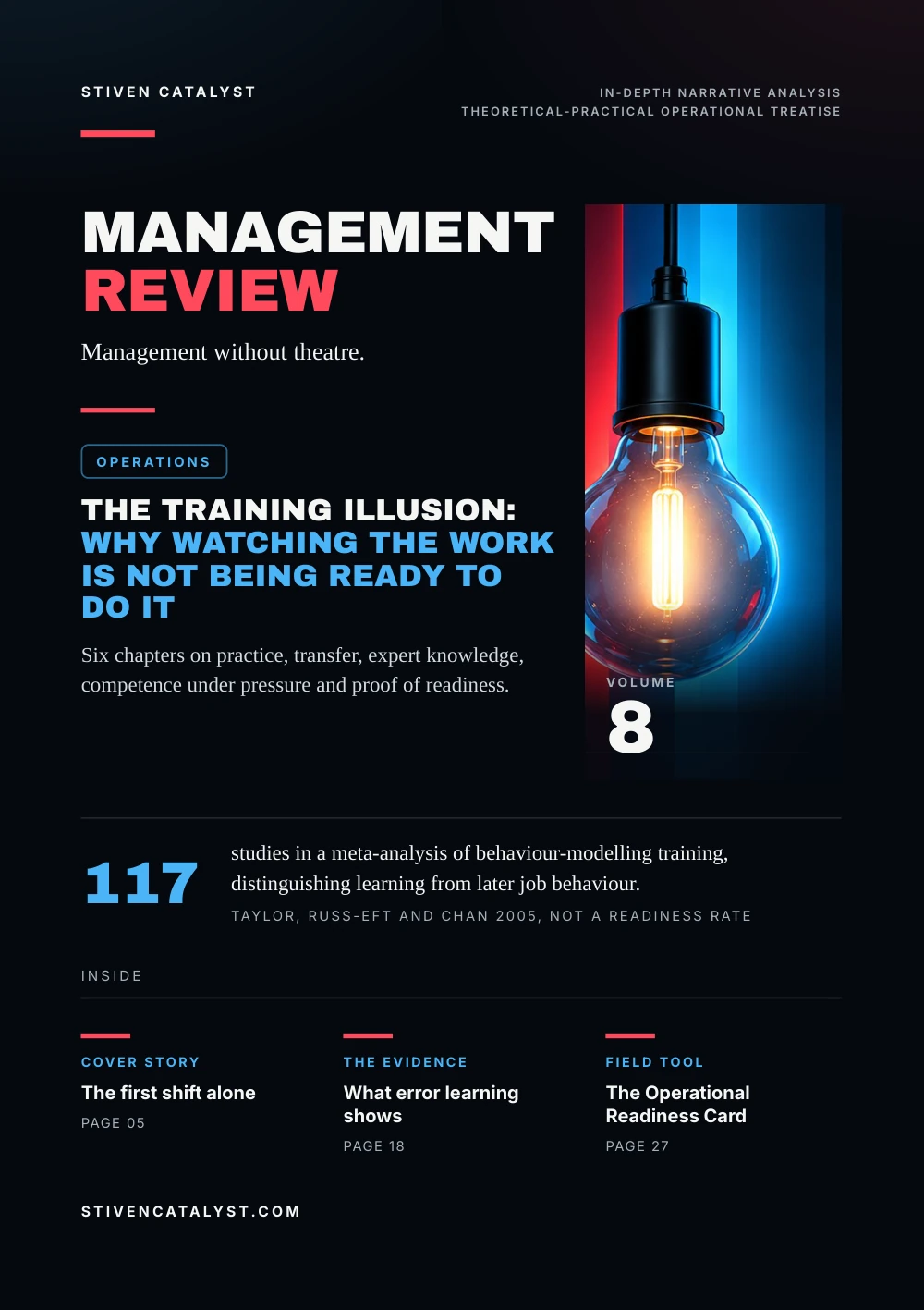 Next volume
The training illusion: why watching the work is not being ready to do it
Click or swipe a page to turn it. The arrow keys work too.
Operational Treatise · Volume 7
The figures of the volume
The charts of the printed pages, with their sources. Invented examples are marked as such.
Source: Invented example by the editors, so the arithmetic can be checked; not a measurement
Source: Invented example by the editors, so the arithmetic can be checked; not a measurement
The whole text Read the volume as text For reading on a small screen, searching or a screen reader. The same words, without the page design.
Editorial
What silence costs a business
A dashboard can be accurate and still miss the most important operational fact: someone saw a problem and decided not to say it.
Managers tend to value visible evidence. A late departure has a timestamp. A missing bag creates an exception. A room issue may enter a shift log. What does a report show when a worker notices a flawed instruction, judges that raising it is pointless and quietly works around it? Often nothing at all. The absent signal cannot be counted the way a recorded failure can. This volume studies the conditions under which useful knowledge fails to travel upward. Its subject is not politeness or personality. It is an information problem shaped by authority, anticipated consequences, the design of reporting channels and the credibility of the managerial response. A company can be busy collecting data while losing the first-hand observations that would make the data intelligible. The author has worked in last-mile loading and coordination, with wholesale partners, and with Front Office and Night Audit procedures. Those are verified categories of work, not evidence that a particular employer discouraged reporting. The scenes in this volume are expressly constructed; they contain no identifiable staff, guest, customer, company or private internal information. Edmondson gives the language of psychological safety. Milliken, Morrison and Hewlin examine why employees keep concerns to themselves. Detert and Burris show why managerial openness matters. Research in healthcare and a wider meta-analysis provide comparisons with their own limits. The practical question is what a manager can do after an employee takes the risk of telling the truth.
Stiven Janaqi, Editor
How every chap ter is built
- The living scene. A shift, a ramp, a desk at 03:00: one piece of work followed as it actually happens, with the hand-off where it breaks. Scenes are constructed from real categories of work and say so.
- The conce
p tual and scientific breakdown. The mechanism behind the scene, named with the model that explains it, and the research that tests it: the study, its population, its year and its limits, before it is applied anywhere else. - The operating pro
t ocol for action. What a working team can try on Monday: fields, questions, a cadence and a count, each with an owner, a next step and a return of information to the people who do the work.
The reading contract
- Field. Real categories of operational work, no invented personal incidents.
- Evidence. Research setting, sample, method and limits stated together.
- Action. A concern is closed only when the decision has been told back.
Research note
The absence of a repor t is not a statistic
Silence is difficult to observe directly. The studies below help us reason about it, not calculate a universal percentage of silent workers.
Organisational voice is the voluntary expression of work-relevant ideas or concerns. Organisational silence, in the tradition of Morrison and Milliken, is the withholding of potentially important information. Not every quiet employee is withholding something: they may have nothing to add, may not have been asked, or may use a different channel. Counting zero reports cannot distinguish these possibilities. The evidence base mixes designs. Edmondson studied 51 work teams at one manufacturing company. Milliken, Morrison and Hewlin interviewed 40 employees. Detert and Burris analysed 3,149 employees and 223 managers in a restaurant chain. Frazier and colleagues synthesised 136 independent samples. These counts identify the scale and setting of each study; they are not comparable rates of silence.
- Observed. A defined sample, a research design and a reported association.
- Transferred. A cautious management hypothesis to test locally.
- Unproven. Any claim that the author measured silence or fixed it at an employer.
The strongest statement this literature supports is directional: interpersonal risk, managerial behaviour and organisational context are associated with whether workers speak and whether teams learn. We cannot infer that an unreported issue exists at a specific warehouse or hotel, nor that an editorial protocol will produce a particular improvement.
Our reading
A complaint count is evidence of reporting. It is not a census of everything workers know.
Edmondson (1999); Milliken, Morrison and Hewlin (2003); Detert and Burris (2007); Frazier et al. (2017). Voice and silence defined after Morrison (2014).
Sources: Amy Edmondson, Administrative Science Quarterly, 1999; Frances J. Milliken, Elizabeth W. Morrison & Patricia F. Hewlin, Journal of Management Studies 40(6), 2003 (via Authors' manuscript); James R. Detert & Ethan R. Burris, Academy of Management Journal 50(4), 2007; M. Lance Frazier, Stav Fainshmidt, Ryan L. Klinger, Amir Pezeshkan & Veselina Vracheva, Personnel Psychology, 2017 (via Abstract; QIC-WD and Michigan MDHHS summaries); Elizabeth W. Morrison, Annual Review of Organizational Psychology and Organizational Behavior 1, 2014
Chap ter I: The problem nobody repor ted
Layer 1 · The living scene
The problem nobody repor ted
A small workaround can conceal the fact that the next shift inherited a system that does not quite work.
Constructed last-mile scene, not a recorded personal incident
A loading area prepares for departures. A worker notices that a particular handover routinely produces an unclear status. The next colleague can still make the order ready by checking twice and asking someone nearby. Today the team is under pressure. The worker finds the answer, corrects the immediate situation and returns to the queue. No exception is raised. From the dashboard, the episode looks ordinary. This is not a story of misconduct. The employee may reasonably believe that reporting a small problem takes longer than fixing it. Perhaps no simple reporting channel exists. Perhaps a past suggestion received no answer. Or perhaps the local standard expects an exception to be recorded and the worker made a poor choice. Without asking, the manager cannot know which explanation fits.
The author has documented categories such as mixed trolleys, missing bags and operational handovers from last-mile work. The person, the exchange, the timing and the reason for silence in this scene are invented. Their use is analytical: a process may recover from an obstacle without teaching the organisation why that obstacle appeared.
Our reading
An apparently normal departure may hide the extra effort that made it possible.
Editorial illustration informed by Tucker and Edmondson (2003); no employer-level voice data. The essay named below goes to the floor to see the work.
Source: Anita L. Tucker & Amy C. Edmondson, California Management Review, 2003
More in the essay: Gemba: what you see on the floor that the report does not show
Layer 2 · The conceptual and scientific breakdown
The missing signal in the feedback system
A reported exception is only one possible outcome of a problem being noticed.
Morrison and Milliken argued in 2000 that organisational silence can become collective: people infer from leadership behaviour and shared experience that speaking up carries costs or little prospect of influence. Their paper is a conceptual framework, not a survey proving that most organisations suppress information. It nevertheless separates an operational problem from the social route by which the problem becomes known. A worker must first notice an issue, interpret it as relevant, see a feasible channel, judge the interpersonal risk and decide whether to use that channel. Even after speaking, the information must be received and processed. At every step an organisation may lose knowledge. A manager who measures only the final complaint count observes the end of this chain, not the conditions upstream.
- Notice. A problem or an improvement idea.
- Assess. Risk and likely usefulness.
- Speak. A usable channel.
- Receive. The listener understands.
- Act. Decision and feedback.
This is why silence cannot be treated as a personal flaw. A conscientious worker can still judge that a meeting with little time, a public audience and no feedback is an unhelpful place to raise a concern. The alternative is not to excuse every failure to report: safety and compliance duties remain binding. The task is to improve both the channel and the expectation that a concern will be fairly evaluated.
Our reading
The absence of recorded concerns cannot establish the absence of operational obstacles.
Conceptual source: Morrison and Milliken (2000); voice definitions after Morrison (2014). The five-stage flow is editorial.
Sources: Elizabeth W. Morrison & Frances J. Milliken, Academy of Management Review 25(4), 2000; Elizabeth W. Morrison, Annual Review of Organizational Psychology and Organizational Behavior 1, 2014
Layer 2 · The conceptual and scientific breakdown
Where the knowledge is lost on the way up
A fully synthetic illustration of the chain on the previous page: twenty invented observations, followed stage by stage.
Synthetic example, authored for this volume; not employer data
Invented cohort of 20 noticed problems: Noticed 20, Worth raising 14, Channel seen 9, Spoken 6, Understood 5, Fed back 3.
Every count is invented so the arithmetic can be followed. The manager's log would show six entries and three closures, while seventeen of the twenty observations never became visible. The largest losses sit upstream: eleven observations were filtered out by the worker's own judgement of risk, usefulness or the lack of a channel. No real operation has these proportions. A low complaint count can describe a quiet channel as easily as a quiet process; only asking the people who notice tells the two apart.
Our reading
The complaint log counts what survived the chain. Manage the chain, not the log.
Every value on this page is synthetic, authored for this volume; the stages follow Morrison and Milliken (2000). The PDF draws only the downstream funnel of Chapter V.
Source: Elizabeth W. Morrison & Frances J. Milliken, Academy of Management Review 25(4), 2000
Layer 3 · The operating protocol for action
Ask about the work before asking for blame
A first inquiry should make problems observable without forcing people to identify colleagues or disclose sensitive data.
- Choose one handover. A loading, order-preparation or shift-transfer process with an observable result.
- Ask where people recover. What do workers double-check, chase or explain to make the next step possible?
- Separate observation from interpr
e tation. Record what was checked, what was said and what remains uncertain. - Check the safe channels. How can a worker raise a recurring issue confidentially through the right organisational route?
- Assign the next decision. A responsible role and a near-term date for a response; no premature promise of a fix.
- R
e turnt o the team. Share what was verified, what will change and what still needs investigation.
A safety-critical matter follows the existing immediate escalation rules; a process question can receive a slower, transparent review. The two should not be merged because the same worker identified them. Watch for one effect: after an invitation, reporting may rise because detection improved, not because the operation deteriorated.
Our reading
The useful question is not “Why did nobody report it?” but “What made reporting possible, safe and worthwhile?”
Proposed operating checklist, not a validated intervention. Research foundations: Morrison and Milliken (2000); Tucker and Edmondson (2003).
Sources: Elizabeth W. Morrison & Frances J. Milliken, Academy of Management Review 25(4), 2000; Anita L. Tucker & Amy C. Edmondson, California Management Review, 2003
Chap ter II: The fear of speaking up
Layer 1 · The living scene
The sentence lef t unsaid
The cost of saying something can be immediate and personal; the benefit may be distant and uncertain.
Hypothetical team interaction, not the author's reported dialogue
A new team member spots an ambiguity in an instruction. The experienced colleagues proceed without discussion. The worker could ask, but the question may sound basic in front of a crowded room. There is no evidence that the instruction is wrong; the problem may be the employee's incomplete understanding. Still, the worker decides that asking later will be easier. The briefing ends; the ambiguity remains. A manager later says that everyone had the opportunity to ask. Technically, that may be true. Yet the relevant question is whether the opportunity felt usable to the people least familiar with the system. Speaking is a social act. A question carries information about the work, but it can also expose uncertainty, interrupt a supervisor and invite comparison with peers.
This constructed scene illustrates an interpersonal risk, not a proven event at a hotel or last-mile employer. It argues neither that every silence means fear nor that safety removes accountability. It suggests that access to information depends partly on how people expect others to respond to an inconvenient question.
Our reading
An invitation has little value if the employee expects the cost of using it to outweigh the benefit.
Constructed illustration; the psychological-safety concept after Edmondson (1999), the employee interviews after Milliken, Morrison and Hewlin (2003). The essay named below works in a team of many languages.
Sources: Amy Edmondson, Administrative Science Quarterly, 1999; Frances J. Milliken, Elizabeth W. Morrison & Patricia F. Hewlin, Journal of Management Studies 40(6), 2003 (via Authors' manuscript)
More in the essay: Teams with many languages and many countries
Layer 2 · The conceptual and scientific breakdown
Psychological safe t y is not comfor t
The construct concerns perceived interpersonal risk when asking, admitting uncertainty or challenging a practice.
Amy Edmondson defined team psychological safety in 1999 as a shared belief that the team is safe for interpersonal risk taking. The distinction is exacting: it is not a promise that colleagues will always agree, that every criticism will be accepted or that professional standards can be ignored. A team can expect disciplined, high-quality work and still allow employees to identify a mistake without humiliation. Edmondson's field study examined 51 work teams within one manufacturing company. Psychological safety was associated with learning behaviours such as seeking feedback and discussing errors. The association was not a randomised test of a managerial training programme, and it establishes no universal numerical benefit for transport, hotels or wholesale operations.
- Voice. Can I ask or warn without being treated as disloyal?
- Standards. Will the concern be tested against the real requirement?
- Accountabili
t y. What must I still do, including urgent reporting duties?
A manager can reduce unnecessary interpersonal risk by asking precise questions, thanking the person for specific information and separating the report of a problem from proof of responsibility. Conversely, a warm tone without consequences for unresolved risks is not enough. Psychological safety becomes operationally relevant when information moves into verification and a decision.
Our reading
Safety to speak and responsibility to act are complements, not opposites.
Edmondson, Administrative Science Quarterly (1999). The three-part practical interpretation is editorial.
Source: Amy Edmondson, Administrative Science Quarterly, 1999
Layer 2 · The conceptual and scientific breakdown
Two studies, different questions
One examines learning in teams. Another asks why employees decide to remain silent. A third separates two kinds of voice.
- 51 manufacturing work teams in Edmondson's 1999 field study; psychological safety associated with learning behaviour, with the study's controls
- 40 employees interviewed in Milliken, Morrison and Hewlin's 2003 exploratory study; fear of negative labels and damaged relationships was frequently described
The samples cannot be combined into a prevalence estimate. The manufacturing study concerns team-level beliefs and behaviours. The interview study explores employees' accounts of situations in which they chose not to raise concerns; it is not designed to say what share of all workers behave this way. Both make the social cost of voice analytically visible, but neither proves the outcome of a specific speak-up initiative at a loading point. The distinction between promotive and prohibitive voice deepens this. A suggestion for a better process and a warning that a current process is unsafe or failing feel quite different. Liang, Farh and Farh followed 239 employees in a two-wave study and reported different psychological antecedents for the two kinds of voice. A channel that attracts ideas will not automatically attract difficult warnings.
Our reading
Count the study participants accurately. Never turn their stories into an invented company-wide silence rate.
Edmondson (1999); Milliken, Morrison and Hewlin (2003); Liang, Farh and Farh (2012). No cross-study effect is calculated.
Sources: Amy Edmondson, Administrative Science Quarterly, 1999; Frances J. Milliken, Elizabeth W. Morrison & Patricia F. Hewlin, Journal of Management Studies 40(6), 2003 (via Authors' manuscript); Jian Liang, Crystal I. C. Farh & Jiing-Lih Farh, Academy of Management Journal 55(1), 2012
Layer 3 · The operating protocol for action
Make the first response wor th the risk
The first managerial reaction can lower or raise the perceived risk of the next report.
- Acknowledge the contribution. The person supplied potentially useful information; say so without certifying a cause.
- Clari
f y the observation. What happened, when it was noticed and what the worker could actually verify. - Do not demand an instant culprit. Distinguish an honest report from any later finding about conduct or compliance.
- Protect appropriate privacy. Authorised channels for serious allegations or confidential details; no published case files.
- Give a realistic next step. The role that will review the matter and the timing of an update.
- Follow through. Even when the claim proves incorrect, explain the reasoning respectfully where appropriate.
An urgent concern uses the existing emergency or escalation process. In routine improvement, leaders should avoid teaching employees that a problem becomes dangerous to their reputation merely because it is uncomfortable for the manager. Equally, a fair inquiry allows the concern to be inaccurate; it does not presume the reporter was right.
Our reading
The first response to a concern is also a lesson to everybody deciding whether to speak next time.
Original practice proposal informed by Edmondson (1999), Milliken, Morrison and Hewlin (2003) and Morrison (2014).
Sources: Amy Edmondson, Administrative Science Quarterly, 1999; Frances J. Milliken, Elizabeth W. Morrison & Patricia F. Hewlin, Journal of Management Studies 40(6), 2003 (via Authors' manuscript)
Chap ter III: The open door nobody uses
Layer 1 · The living scene
The open door nobody enters
A leader can sincerely invite feedback and still, without meaning to, make the invitation difficult to accept.
Hypothetical leadership scene, not a documented meeting
A supervisor ends the weekly briefing by saying that the door is open. The team nods. During the meeting the supervisor had interrupted one colleague repeatedly, explained away a concern before hearing its details and described another question as something everybody should already know. No explicit prohibition has been issued. Nevertheless, the team has received more than one message about what kind of speaking is welcome. Another employee knows that a recurrent task has become harder since a process change. It is possible to talk to the supervisor privately. But asking for attention feels like arguing with the person who owns the new procedure. The employee waits for a better moment, and the manager later infers from the quiet meeting that the rollout is complete.
This scene is assembled to illustrate managerial signals. It accuses no named leader or organisation and is not a transcript from the author's experience. Its question is practical: which matters more, the verbal invitation or the way leaders react when a concern finally arrives?
Our reading
An open door is a claim about access. The response to the first inconvenient question tests that claim.
Constructed scene. Research lens: Detert and Burris (2007); Nembhard and Edmondson (2006). The essay named below leads people without losing the person.
Sources: James R. Detert & Ethan R. Burris, Academy of Management Journal 50(4), 2007; Ingrid M. Nembhard & Amy C. Edmondson, Journal of Organizational Behavior 27(7), 2006
More in the essay: Leading people without losing the person
Layer 2 · The conceptual and scientific breakdown
Openness is observable behaviour
Leadership affects voice not only through its declared values, but through the social signals attached to everyday responses.
Detert and Burris examined employee voice in a two-phase study of 3,149 employees and 223 managers at a restaurant chain. Managerial openness was more consistently associated with improvement-oriented voice than the other leadership construct they measured, transformational leadership, and perceived psychological safety mediated the relationship in their model. This does not show that merely telling managers to smile makes employees speak. Nembhard and Edmondson studied 23 neonatal intensive care units engaged in improvement projects. Their survey results supported a model in which inclusive words and actions from leaders related to psychological safety and to engagement in improvement, in the presence of professional-status differences. Those findings come from clinical teams, not hotels or transport operators.
- Invite. Ask for inconvenient information, not just good news.
- Receive. Make room for clarification without interruption or ridicule.
- Conclude. Describe the decision and the right channel for further action.
These principles are deliberately behavioural. A worker evaluates a leader's reaction to correction, uncertainty and disagreement. A stated intention matters, but is weaker evidence than the visible response to an actual concern. Open dialogue still requires verification, good faith and compliance with the standards that protect customers and workers.
Our reading
Openness becomes credible through a repeated pattern of response, not a sign on the office door.
Detert and Burris, Academy of Management Journal (2007); Nembhard and Edmondson, Journal of Organizational Behavior (2006).
Sources: James R. Detert & Ethan R. Burris, Academy of Management Journal 50(4), 2007; Ingrid M. Nembhard & Amy C. Edmondson, Journal of Organizational Behavior 27(7), 2006
Layer 2 · The conceptual and scientific breakdown
The influence above the supervisor
Workers read the wider hierarchy, not only the personality of their immediate manager.
89 interviews in Detert and Treviño's qualitative research at a multinational technology company, across manufacturing and research-and-development units
Employees described direct supervisors and leaders several levels higher as influencing whether speaking up seemed risky or futile. The findings complicate the advice to fix the relationship with the immediate manager. A frontline employee may expect the local supervisor to listen, yet believe that someone with authority over the actual process will ignore or penalise the message. The number 89 counts interviews, not silenced employees. The research did not measure what share of operational issues went unreported; it identified pathways of perceived influence in one company. Its relevance to a warehouse, a hotel or a wholesale service is a hypothesis about hierarchy to be checked, not assumed.
Leader signal, and a possible reading by the team
- Asks for contradictions. Inconvenient facts may be useful.
- Explains an unresolved decision. The issue was heard, even without a fix.
- Dismisses a question publicly. Speaking up may risk reputation.
- Escalates carefully. Authority may support local learning.
Our reading
The reporting line and the decision-making line are not always the same line.
Detert and Treviño, Organization Science (2010), qualitative research. The interpretive table is editorial.
Source: James R. Detert & Linda K. Treviño, Organization Science 21(1), 2010
Layer 3 · The operating protocol for action
A listening routine that can be checked
Turn openness into a small set of public behaviours without exposing employees or confidential issues.
- Ask one focused question. For example: which part of today's handover forced a second explanation?
- Allow a second interpr
e tation. Invite the team to correct the leader's understanding before a conclusion is drawn. - Protect dissent. Separate the content of a concern from assumptions about attitude or loyalty.
- Name the responsible level. If the local supervisor cannot change the condition, clarify the authorised escalation route.
- Repo
r t the status truthfully. Acknowledged, under review, decision reached and closed are different conditions. - Check the next me
e ting. Did the team receive a meaningful answer about the issue previously raised?
A routine does not turn every meeting into a public complaints session. Some issues belong in confidential, human-resources, safety or other formal channels. The common principle is that the employee knows where to raise an issue and how to get a response, without the concern being turned into an accusation by default.
Our reading
The observable test of openness is whether the team can bring difficult facts into a usable decision process.
Editorial protocol developed from Detert and Burris (2007), Detert and Treviño (2010) and Nembhard and Edmondson (2006).
Sources: James R. Detert & Ethan R. Burris, Academy of Management Journal 50(4), 2007; James R. Detert & Linda K. Treviño, Organization Science 21(1), 2010; Ingrid M. Nembhard & Amy C. Edmondson, Journal of Organizational Behavior 27(7), 2006
Chap ter IV: The silent shif t
Layer 1 · The living scene
The quie t handover
Work moves between people who may never have the chance to explain it face to face.
Constructed hotel-shift example, not a claimed guest incident
An evening team completes its shift. A small service concern was raised earlier; somebody has looked at it, but another department must decide what happens next. The situation is not urgent. A brief handover note says only that it needs follow-up. The night colleague can see the open item, but not the uncertainty behind it: what was actually checked, which answer was given and who owns the next step. At first glance the issue is an incomplete handover. Yet one more question matters. Did the earlier colleague omit information because the template made it hard to record, because the person did not know which detail was useful, or because an uncomfortable uncertainty seemed better left unsaid? The manager cannot diagnose intentional silence from an incomplete note alone.
The author has handled Night Audit documentation, technical room issues and shift handovers. The time, the particular case and the motives in this scene are fictional. No guest or payment data, security procedure, room identifier or internal technology is revealed.
Our reading
An unfinished task may be visible in a log while the uncertainty needed to finish it remains invisible.
Constructed illustration using verified categories of hospitality work. Conceptual references: Morrison (2014); Tucker and Edmondson (2003). The essay named below makes the case for the handover.
Sources: Elizabeth W. Morrison, Annual Review of Organizational Psychology and Organizational Behavior 1, 2014; Anita L. Tucker & Amy C. Edmondson, California Management Review, 2003
More in the essay: Why the shift handover is one of the most underrated processes
Layer 2 · The conceptual and scientific breakdown
The handover has two channels
A status can move to the next shift without moving the judgement that the next worker needs.
In a shift-based service, the handover carries two kinds of information. The formal channel contains fields, statuses, timestamps and assigned work. The informal channel contains context: what a person is uncertain about, why a promised action did not happen or which interpretation has not been confirmed. Both can be needed, but the informal channel is particularly vulnerable when a shift ends under time pressure. The manager's task is not to encourage uncontrolled verbal storytelling. It is to make the formal record expressive enough for uncertainty. A useful handover distinguishes observed facts, reported claims, actions already taken and the decision still required. The next shift should be able to act without reconstructing a conversation whose participants have gone home.
- Status. What the system says, and when it was updated.
- Unce
r taint y. What remains unverified or disputed. - Next owner. Who is authorised to review, decide and respond.
Operational silence can arise here without anyone intending to suppress information. Workers may be unsure whether an unresolved problem will be read as failure, or may lack a safe channel for disagreement about the state of a case. The remedy must distinguish communication design, training needs and interpersonal risk; none can be diagnosed from the number of notes alone.
Our reading
A handover is complete only when the receiving person knows what is known and what is not.
Editorial cross-shift application; voice concepts from Morrison (2014). Not a property-specific hotel procedure.
Source: Elizabeth W. Morrison, Annual Review of Organizational Psychology and Organizational Behavior 1, 2014
Layer 2 · The conceptual and scientific breakdown
When workarounds mask failure
Evidence from healthcare illustrates the difference between recovering from an obstacle and learning why it recurred.
9 hospitals in Tucker and Edmondson's 2003 qualitative field research on nurses' responses to process failures and the barriers to system change
The researchers described an operational equilibrium in which frontline professionals worked around recurring process problems. Their study of nurses in nine hospitals differentiated errors from problems and examined why recovery on the day did not automatically generate organisational learning. This is a valuable analogy for information that vanishes at a handover, but it is not a study of hotel Night Audit. A second distinction comes from Liang, Farh and Farh's two-wave study of 239 employees. They separated promotive voice, which proposes improvement, from prohibitive voice, which warns about harmful practices, and found psychological safety particularly relevant to subsequent prohibitive voice. The exact relationships depend on their design and population. Together these studies pose a question worth testing: does our handover format allow staff to flag what may be wrong, as well as record what was done?
Our reading
Recovery gets the shift through the night. Learning asks why recovery was necessary.
Tucker and Edmondson (2003); Liang, Farh and Farh (2012). The sector transfer is explicitly hypothetical.
Sources: Anita L. Tucker & Amy C. Edmondson, California Management Review, 2003; Jian Liang, Crystal I. C. Farh & Jiing-Lih Farh, Academy of Management Journal 55(1), 2012
Layer 3 · The operating protocol for action
Carry the uncer taint y across the shif t
A handover format can preserve dissent without inviting speculation or exposing private information.
- State the observed issue. A neutral category and the factual condition; identifiable detail stays in the approved internal system.
- Separate repo
r ted from verified. What a colleague or customer said is not necessarily what was observed. - Explain the remaining question. What has not been established, and what information would settle it.
- Record the action actually taken. Do not turn an attempted step into a completed outcome.
- Transfer responsibili
t y. The authorised receiving role and the next review point. - Repo
r t back where appropriate. The person who raised the concern should learn that a decision was made, within confidentiality limits.
No public text should reproduce private hotel procedures, payment controls or security details. For operational use the template is reconciled with the organisation's official requirements; an anonymous example teaches the structure while the authoritative record stays in the approved system.
Our reading
The next shift deserves the truth about an open problem, including the part nobody has yet resolved.
Original editorial handover protocol; no claim of certification or managerial approval at a named employer. The site's shift-handover tool follows the same structure.
Sources: Elizabeth W. Morrison, Annual Review of Organizational Psychology and Organizational Behavior 1, 2014; Anita L. Tucker & Amy C. Edmondson, California Management Review, 2003
Chap ter V: When speaking up changes nothing
Layer 1 · The living scene
The mee ting that re turns no answer
Listening can create an expectation that a concern will travel somewhere useful.
Constructed follow-up scene, not a reported experience
A staff member raises an obstacle that recurs every week. The supervisor writes it down and thanks the worker. Days pass without an update. In the next meeting the team is asked to describe possible improvements. The same obstacle comes up, this time more cautiously. Nobody needs to be hostile for the message to become clear: speaking creates work for the employee, but its effect is impossible to see. Perhaps the manager escalated the issue and received no decision. Perhaps the problem is technically complicated. Perhaps the observation was incorrect. Silence from management gives the team no way to tell these cases apart. The organisation has created an information exchange without completing it.
This is not an accusation about a real supervisor; the sequence is hypothetical. It shows why a listening practice should be judged not only by how many concerns it gathers, but by what the organisation can verify, act upon and communicate afterwards.
Our reading
Being heard once is not the same as knowing what happened to what you said.
Constructed scenario. Conceptual sources: Morrison (2014); Tucker and Edmondson (2003). The essay named below decides whether to solve or escalate.
Sources: Elizabeth W. Morrison, Annual Review of Organizational Psychology and Organizational Behavior 1, 2014; Anita L. Tucker & Amy C. Edmondson, California Management Review, 2003
More in the essay: When to solve it yourself and when to take it higher
Layer 2 · The conceptual and scientific breakdown
Silence can follow a failed response
The perceived futility of voice is a distinct risk from the fear of interpersonal consequences.
Morrison's 2014 review of employee voice and silence synthesises work on whether employees communicate suggestions and concerns upward, the factors influencing that choice and the implications for organisations. Silence can be related to the expectation that speaking will be risky; it can also emerge when speaking seems unlikely to make a difference. These are analytically different problems. A manager may respond politely while having no mechanism to bring a cross-functional concern to a decision. Detert and Treviño's interviews showed that voice perceptions were influenced by several levels of leadership. A local supervisor may receive a concern but not control the process causing it. Without a defined route to the person who can act, even a sympathetic response may become another unfulfilled promise.
- Ca
p tured. The concern exists in a recognised, appropriate channel. - Acknowledged. Receipt is confirmed, not the truth of the claim.
- Verified. A responsible person has investigated the evidence.
- Decided. An action, a reasoned refusal or an identified dependency.
T old back. The reporting worker or team has received an appropriate explanation.
Our reading
Feedback is not a courtesy at the end of listening. It completes the information process the report started.
Morrison (2014); Detert and Treviño (2010). The five-status model is editorial; an honest no-action decision made visible can be better than a promise that authority or evidence cannot support.
Sources: Elizabeth W. Morrison, Annual Review of Organizational Psychology and Organizational Behavior 1, 2014; James R. Detert & Linda K. Treviño, Organization Science 21(1), 2010
Layer 2 · The conceptual and scientific breakdown
The funnel of unanswered concerns
A fully synthetic illustration of why the count of reports is not the count of resolved problems: one cohort of twelve findings.
Synthetic example, authored for this volume; not employer data
Illustrative counts, one cohort of 12 findings: Raised 12, Acknowledged 9, Assigned 7, Action started 5, Told back 3, Verified closed 2.
Twelve concerns produce only three returns of information, while the record claims activity because seven issues have an owner. Ownership is not action, action is not closure and closure is not communication to the people who spoke. Nor are the other nine proven unfair: some may be confidential or still under review. Never make a low complaint count a performance goal; it rewards discouraged reporting. More concerns may mean safer disclosure, a worse process or better detection; the count alone cannot tell.
Our reading
Measure the route from report to decision, while refusing to reward silence.
All counts and bar proportions are fabricated for demonstration, as in the author's PDF; no local response rate is estimated. Statuses after the five-status model on the previous page.
Source: Elizabeth W. Morrison, Annual Review of Organizational Psychology and Organizational Behavior 1, 2014
Layer 3 · The operating protocol for action
Re turn with a decision, not a slogan
A proportionate feedback practice protects privacy and avoids promising what the organisation cannot deliver.
- Confirm recei
p t through the right channel. Acknowledge without prejudging truth or liability. - Triage by risk and authori
t y. Safety and protected reporting follow formal channels, not the improvement queue. - Veri
f y facts and scope. Hear the sending and the receiving side of the process, where appropriate. - Name the next owner. Specific enough that a concern cannot vanish between departments.
- State the decision and the unce
r taint y. Solved, testing, awaiting authority, insufficient evidence or declined, with reasons. - Tell back at the right level. What is allowed, when the next update comes, how more information can be added.
A review rhythm is an operating experiment, not a scientific standard: urgent matters cannot wait for the meeting, complex ones may take longer than one cycle. The minimum obligation is a truthful, timely update through an authorised route. If more concerns arrive, ask whether trust, exposure or the underlying failures changed before claiming success or deterioration.
Our reading
A concern is not closed by assigning a number. The information loop ends when the outcome is understood.
Original operating proposal synthesising Morrison (2014) and Detert and Treviño (2010); not formally validated.
Sources: Elizabeth W. Morrison, Annual Review of Organizational Psychology and Organizational Behavior 1, 2014; James R. Detert & Linda K. Treviño, Organization Science 21(1), 2010
Chap ter VI: Building a culture that hears
Layer 1 · The living scene
The useful uncomfor table question
A leadership team can decide differently by hearing a warning before a defect becomes a headline.
Hypothetical leadership scene, not a documented achievement
A process change is being reviewed. The dashboard looks encouraging. The manager asks whether anyone has seen a condition that would make the reported result unreliable. A junior colleague says that one category of requests is being completed differently from the others. The manager asks for the observation, not a verdict. Someone checks the definition and agrees to compare a small sample. The review closes with an owner and a follow-up date, not a promise that the new process is already wrong. The warning may prove correct, partly correct or mistaken. All three outcomes support learning when the evidence is examined fairly. A speaking-up culture does not treat every objection as fact. It lets important doubts enter a responsible decision system before hierarchy or fear filters them out.
This is a constructed scene, not a claim that the author delivered a programme that improved speaking-up rates. The operations background shows where information matters; the voice mechanism described here remains a proposal to test.
Our reading
The outcome of speaking is not automatic agreement. It is a fair and traceable decision.
Editorial scene informed by Edmondson (1999), Detert and Burris (2007) and Morrison (2014). The essay named below describes the manager this volume argues for.
Sources: Amy Edmondson, Administrative Science Quarterly, 1999; James R. Detert & Ethan R. Burris, Academy of Management Journal 50(4), 2007; Elizabeth W. Morrison, Annual Review of Organizational Psychology and Organizational Behavior 1, 2014
More in the essay: The Operations Manager I want to be
Layer 2 · The conceptual and scientific breakdown
Five steps from voice t o action
An operating system for concerns must include the opportunity to speak and the obligation to respond.
- Invite. A realistic route to raise process defects, improvement ideas and uncomfortable warnings.
- Protect. Good-faith reporting is not a personal accusation; formal escalation and confidentiality are safeguarded.
- Veri
f y. Distinguish the report from what has been independently observed; seek competing explanations. - Decide. What is within local authority, what needs cross-team approval and what cannot be adopted.
- R
e turn. An authorised response, including what remains open and when it will be reviewed.
These steps are a synthesis, not an intervention trial. Frazier and colleagues' 2017 meta-analysis aggregated 136 independent samples involving over 22,000 individuals and nearly 5,000 groups. That breadth supports taking psychological safety seriously as an organisational construct. It does not validate this five-step procedure or guarantee that it changes performance in a particular hotel or logistics operation. The goal is observable management behaviour. Publicity is not protection: a suggestion channel must not publish worker identities, guest information, operational credentials or details of a protected complaint. Real organisations adapt the framework to labour rules, safeguarding requirements and authorised workflows.
Our reading
A culture that hears is one where an important message can reach someone who can decide responsibly.
Frazier et al. (2017) sample totals; the five-stage framework is editorial, developed from the cited voice literature.
Source: M. Lance Frazier, Stav Fainshmidt, Ryan L. Klinger, Amir Pezeshkan & Veselina Vracheva, Personnel Psychology, 2017 (via Abstract; QIC-WD and Michigan MDHHS summaries)
Layer 3 · The operating protocol for action
A shor t trial of real listening
Test whether an improvement process can receive, verify and respond to concerns without tracking personal identities in public.
- Select one bounded workflow. Its owner and authorised reporting channel are known.
- S
e t definitions before collecting. Improvement idea, risk warning, complaint and routine clarification differ. - Ask consistently. One question about recurring obstacles, one about consequences.
- Record safely. Approved systems; publish only anonymous categories and aggregate status.
- Resolve or explain. Check facts, name a decision-maker, return a status even when nothing changes.
- Review the effects. Watch recurrence and side effects; fewer reports is never the success target.
Review the channel after two weeks and the process after a month: local choices, not evidence-based deadlines, with serious risks treated at once under existing rules. If staff do not use the channel, do not conclude the system is healthy; examine access, trust, language, confidentiality and whether earlier submissions got real answers.
Our reading
The measure of leadership is not how often a manager says “speak freely”, but what happens after someone does.
Proposed operating experiment after the cited voice literature; no guaranteed effectiveness or implied prior implementation.
Sources: Amy Edmondson, Administrative Science Quarterly, 1999; Elizabeth W. Morrison, Annual Review of Organizational Psychology and Organizational Behavior 1, 2014; M. Lance Frazier, Stav Fainshmidt, Ryan L. Klinger, Amir Pezeshkan & Veselina Vracheva, Personnel Psychology, 2017 (via Abstract; QIC-WD and Michigan MDHHS summaries)
Field tool
The Speak-Up Signal Card
One issue, one safe pathway, one decision and one return message. Keep confidential case detail in the authorised system.
- The process which one process or handover does the concern refer to?
- Observed or repo
r ted what is known first-hand, and what is only an account or an interpretation? - The cost of speaking does the person have a usable, appropriately protected reporting route?
- The right response which risk category and authorised owner should review the issue?
- The decision what was verified, decided, deferred or declined, and on what basis?
T old back who can receive which update, through what approved channel, and by when?
An editorial checklist, not a validated psychological-safety survey, a whistleblowing mechanism or a replacement for formal safety and HR procedures. Do not record identifiable people or confidential hotel, guest, payment or logistics data on the public copy.
Sources: Amy Edmondson, Administrative Science Quarterly, 1999; Elizabeth W. Morrison, Annual Review of Organizational Psychology and Organizational Behavior 1, 2014; James R. Detert & Ethan R. Burris, Academy of Management Journal 50(4), 2007
Open the tool: Shift Handover
Closing essay
What the quie t room cannot tell you
The absence of disagreement can mean alignment. It can also mean that the information the manager needs has nowhere safe to go.
An operations manager wants the day to be predictable. Vehicles should depart with complete loads. Customers should receive what was promised. An arriving shift should understand what the previous shift could not finish. Reports should contain reliable facts. These are legitimate expectations. But none of them can be met sustainably if staff have to choose between keeping the manager comfortable and making the process visible. In loading operations, a small workaround can look like competence and conceal recurrent waste. In a hotel, an unresolved issue may carry a status without the context needed for a fair next decision. In a wholesale relationship, the people closest to fulfilment may know that a promise needs clarification long before a sales target reveals any problem. Different sectors, one shared danger: the organisation mistakes the information that reaches the system for all the information that exists.
The literature does not invite a sentimental answer. Psychological safety is not the abolition of standards. Evidence must still be checked. Employees can be mistaken; managers sometimes have to disagree; protected concerns must use the appropriate channels. The research instead sets a practical challenge: make it possible for people to bring relevant concerns forward, then treat those concerns as inputs to an honest decision. That decision may be a correction, a refusal with reasons, an escalation or a question that remains open. No amount of listening theatre can substitute for the difficult second half of the work. A note must find an owner. An uncertainty must find a way to be verified. A response must return to those who need it, without violating privacy. A manager need not promise to solve every problem today. A manager can promise not to confuse a conversation with a completed improvement. The quietest team is not necessarily the strongest. Sometimes silence is what a team has learned to offer when it doubts that the truth will be useful.
Our reading
The problems a team never reports cannot be managed by a dashboard. They must first become safe enough to be seen.
Editorial conclusion. No discouraged reporting, suppressed concern or sanction is attributed to any named employer.
Method
Every claim has a boundary
An evidence-informed editorial synthesis, not new field research. All managerial conversations and shift scenes are constructed and labelled as such; sample counts describe published studies, never silence rates at the author's workplaces.
- Conce
p t. Morrison and Milliken (2000) and Morrison (2014) define silence and voice; they are frameworks and a review, not measured rates. - Field studies. 51 teams (Edmondson 1999), 40 interviews (Milliken et al. 2003), 9 hospitals (Tucker and Edmondson 2003), 23 NICUs (Nembhard and Edmondson 2006), 3,149 employees and 223 managers (Detert and Burris 2007), 89 interviews (Detert and Treviño 2010), 239 employees (Liang et al. 2012).
- Synthesis. Frazier et al. (2017): 136 independent samples, over 22,000 individuals, nearly 5,000 groups; it supports the construct, not any protocol here.
- Invented counts. 20 → 14 → 9 → 6 → 5 → 3 (Chapter I) and 12 → 9 → 7 → 5 → 3 → 2 (Chapter V) are illustrations, flagged on their pages; no proportion is a benchmark.
The Speak-Up Signal Card, the listening routine and the short trial are designs for local assessment and require formal approval before operational use. Confidential data, personnel allegations and employer-specific procedures are excluded. Editorial standard: a concept, a field study, a synthesis and a proposal are named as such, and the sentence stops claiming where the evidence stops.
Every source is cited at its DOI or page on the next page. The author's PDF also mentions Tucker (2004) beside Chapter I without listing it among its sources; the site cites Tucker and Edmondson (2003) alone.
Sources: Amy Edmondson, Administrative Science Quarterly, 1999; Elizabeth W. Morrison & Frances J. Milliken, Academy of Management Review 25(4), 2000; Frances J. Milliken, Elizabeth W. Morrison & Patricia F. Hewlin, Journal of Management Studies 40(6), 2003 (via Authors' manuscript); Anita L. Tucker & Amy C. Edmondson, California Management Review, 2003; Ingrid M. Nembhard & Amy C. Edmondson, Journal of Organizational Behavior 27(7), 2006; James R. Detert & Ethan R. Burris, Academy of Management Journal 50(4), 2007; James R. Detert & Linda K. Treviño, Organization Science 21(1), 2010; Jian Liang, Crystal I. C. Farh & Jiing-Lih Farh, Academy of Management Journal 55(1), 2012; Elizabeth W. Morrison, Annual Review of Organizational Psychology and Organizational Behavior 1, 2014; M. Lance Frazier, Stav Fainshmidt, Ryan L. Klinger, Amir Pezeshkan & Veselina Vracheva, Personnel Psychology, 2017 (via Abstract; QIC-WD and Michigan MDHHS summaries)
Sources and method
Where the claims come from
The figures in this volume come from the sources below, each with its year. The scenes are constructed; the protocols are proposals; what is research is named as research.
- Amy Edmondson, Administrative Science Quarterly, “Psychological Safety and Learning Behavior in Work Teams”, 1999. https://doi.org/10.2307/2666999
- Elizabeth W. Morrison & Frances J. Milliken, Academy of Management Review 25(4), “Organizational Silence: A Barrier to Change and Development in a Pluralistic World”, 2000. https://doi.org/10.2307/259200
- Frances J. Milliken, Elizabeth W. Morrison & Patricia F. Hewlin, Journal of Management Studies 40(6), “An Exploratory Study of Employee Silence: Issues that Employees Don't Communicate Upward and Why”, 2003 (via Authors' manuscript). https://doi.org/10.1111/1467-6486.00387
- Anita L. Tucker & Amy C. Edmondson, California Management Review, “Why Hospitals Don't Learn from Failures”, 2003. https://cmr.berkeley.edu/2003/02/45-2-why-hospitals-dont-learn-from-failures-organizational-and-psychological-dynamics-that-inhibit-system-change
- Ingrid M. Nembhard & Amy C. Edmondson, Journal of Organizational Behavior 27(7), “Making It Safe: The Effects of Leader Inclusiveness and Professional Status on Psychological Safety and Improvement Efforts in Health Care Teams”, 2006. https://doi.org/10.1002/job.413
- James R. Detert & Ethan R. Burris, Academy of Management Journal 50(4), “Leadership Behavior and Employee Voice: Is the Door Really Open?”, 2007. https://doi.org/10.5465/amj.2007.26279183
- James R. Detert & Linda K. Treviño, Organization Science 21(1), “Speaking Up to Higher-Ups: How Supervisors and Skip-Level Leaders Influence Employee Voice”, 2010. https://doi.org/10.1287/orsc.1080.0405
- Jian Liang, Crystal I. C. Farh & Jiing-Lih Farh, Academy of Management Journal 55(1), “Psychological Antecedents of Promotive and Prohibitive Voice: A Two-Wave Examination”, 2012. https://doi.org/10.5465/amj.2010.0176
- Elizabeth W. Morrison, Annual Review of Organizational Psychology and Organizational Behavior 1, “Employee Voice and Silence”, 2014. https://doi.org/10.1146/annurev-orgpsych-031413-091328
- M. Lance Frazier, Stav Fainshmidt, Ryan L. Klinger, Amir Pezeshkan & Veselina Vracheva, Personnel Psychology, “Psychological Safety: A Meta-Analytic Review and Extension”, 2017 (via Abstract; QIC-WD and Michigan MDHHS summaries). https://doi.org/10.1111/peps.12183
Edit orial me thod
Each figure was checked for its year, its publisher and what exactly it measures, at the full text where it could be opened. Where the publisher's page could not be opened, the figure was checked against independent summaries and is marked “via”. The editors' interpretation is marked “Our reading”. No figure of the author's own workplaces is claimed.
Operational Treatise · Operational treatise