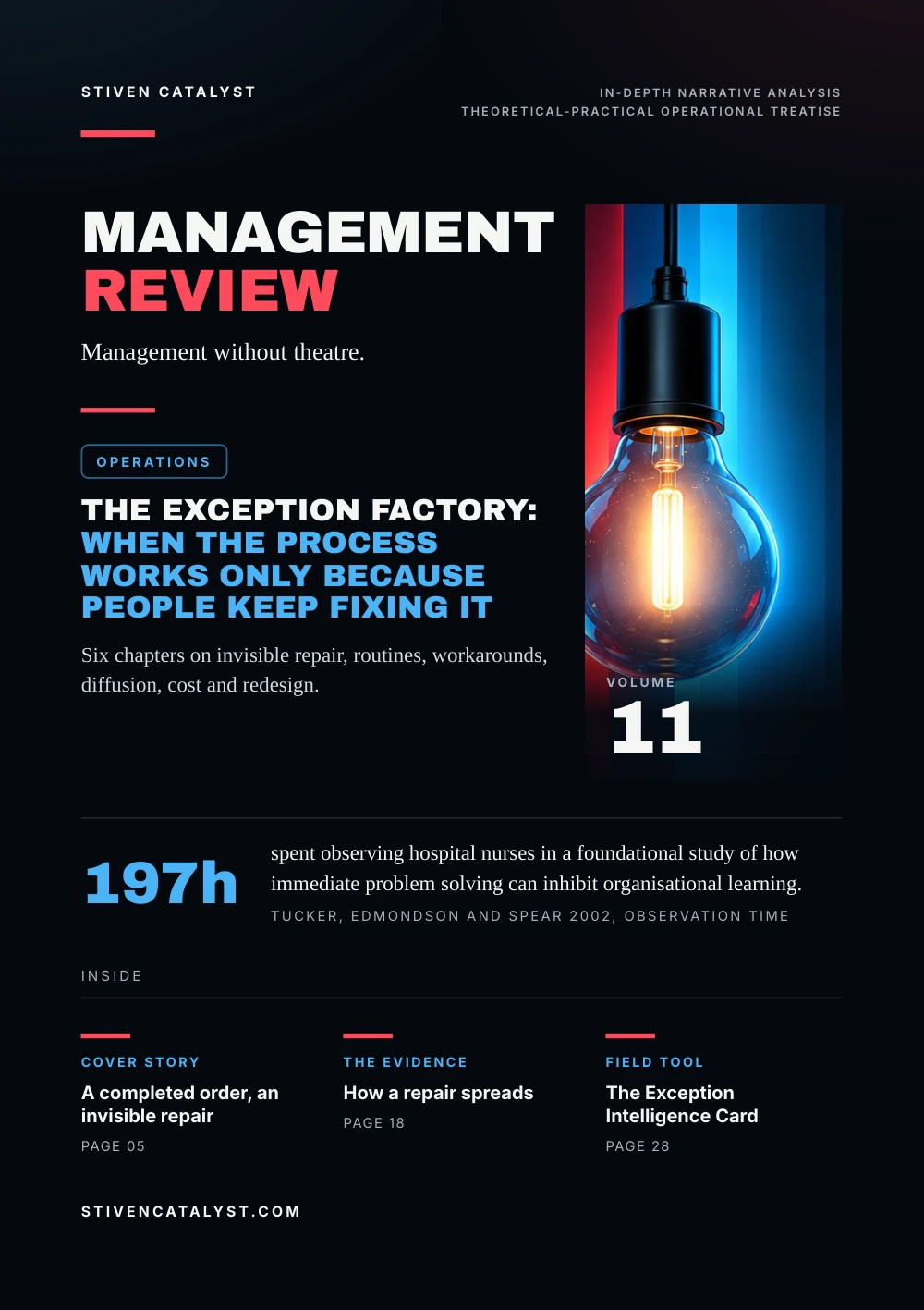
A shift can look fully staffed and still leave a worker without enough uninterrupted attention to complete a critical task. A call arrives while a record is being prepared. A second issue appears before the first is closed. The employee returns to the original screen and has to reconstruct which part was already verified. Nothing spectacular has happened; the operating design has quietly demanded another mental transition. Attention is not interchangeable with time on a staffing plan. Two tasks may fit into an hour on paper but interact badly when each requires a chain of decisions. The cost may appear as a delay in resuming, an unnecessary recheck, increased effort or a mistake. Yet interruptions can also be vital: a safety warning, an urgent guest concern or an exception that needs a rapid response cannot always wait for a convenient moment. This volume studies the distinction, with cognitive models of suspended goals, experiments on timing and resumption, research on strain and observation from healthcare, each used only for what its method supports. The author's work has included last-mile coordination, multiple operational signals and night-audit procedures; these give realistic settings, not a verified record of each scene, and every composite situation is labelled hypothetical. The purpose is not an interruption-free workplace. It is work that tells urgency from noise, protects the next necessary action and makes a safe return to an unfinished task possible.
In-depth narrative analysis and theoretical-practical operational treatise · Volume 12 · October 2026
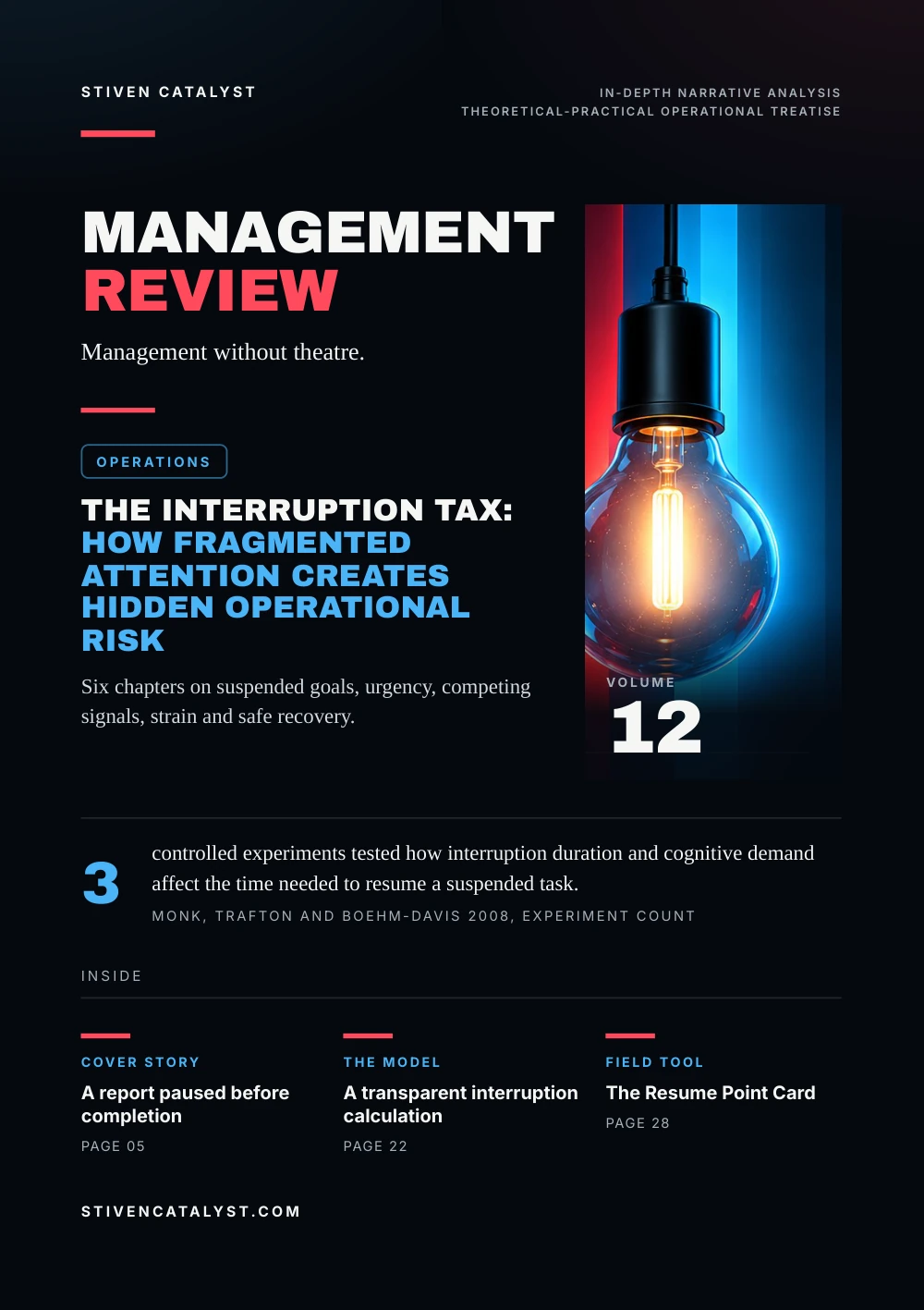
The interrup tion tax: how fragmented at tention creates hidden operational risk
Six chapters on suspended goals, urgency, competing signals, strain and safe recovery.
- Volume
- 12
- Chapters
- 6
- Pages
- 32
- Sources
- 11
- Online since
- 25 October 2026
How every chapter is built
- 1The living scene
A shift, a ramp, a desk at 03:00: one piece of work followed as it actually happens, with the hand-off where it breaks. Scenes are constructed from real categories of work and say so.
- 2The conce
p tual and scientific breakdownThe mechanism behind the scene, named with the model that explains it, and the research that tests it: the study, its population, its year and its limits, before it is applied anywhere else.
- 3The operating pro
t ocol for actionWhat a working team can try on Monday: fields, questions, a cadence and a count, each with an owner, a next step and a return of information to the people who do the work.
Theoretical-practical operational treatise
Management without theatre.
Operations
Six chapters on suspended goals, urgency, competing signals, strain and safe recovery.

Volume12
controlled experiments tested how interruption duration and cognitive demand affect the time needed to resume a suspended task.Monk, Trafton and Boehm-Davis 2008, experiment count
stivencatalyst.com
Editorial · Volume 12
The work lef thalf-finished
An interruption ends when the new request is handled. Its operational consequences may last longer.
How every chapter is built
- 1
The living scene
A shift, a ramp, a desk at 03:00: one piece of work followed as it actually happens, with the hand-off where it breaks. Scenes are constructed from real categories of work and say so.
- 2
The conceptual and scientific breakdown
The mechanism behind the scene, named with the model that explains it, and the research that tests it: the study, its population, its year and its limits, before it is applied anywhere else.
- 3
The operating protocol for action
What a working team can try on Monday: fields, questions, a cadence and a count, each with an owner, a next step and a return of information to the people who do the work.
The reading contract
Notice the break
Identify what must stop and what must continue.
Preserve the state
Make the unfinished step recoverable.
Verify the return
Re-enter work by checking, not guessing.
Contents
The chap ters,in three layers
Chapter IThe task left half-finished05
1 SceneA report paused before completion052 BreakdownFour moments in one interruption063 ProtocolProtect the return without delaying urgency07Chapter IIThe science of resuming work08
1 SceneThe question that remains open082 BreakdownThe architecture of a suspended goal09What the experiments actually show103 ProtocolMake the next step recoverable11Chapter IIIThe urgency illusion12
1 SceneEverything sounds important122 BreakdownPriority is a decision, not a sound13The timing of the request143 ProtocolRoute the demand before it fragments work15Chapter IVOne dispatcher, many signals16
1 SceneThe screen shows many routes at once162 BreakdownAttention residue and unfinished work17When productivity hides lost accuracy183 ProtocolDesign for several open commitments19Chapter VThe hidden cost of switching20
1 SceneThe busy shift that looks productive202 BreakdownFaster completion, higher reported strain21Estimate without inventing a benchmark22Where errors change the stakes233 ProtocolMeasure the switch, not the slogan24Chapter VIDesigning work for attention25
1 SceneThe next shift can find the next step252 BreakdownDesign the system around human limits263 ProtocolA controlled return-to-work cycle27
Also in this volume
- 04Research mapA mechanism, not a universal penalty
- 28Field toolThe Resume Point Card
- 29Closing essayThe human cost of seamless service
- 30MethodWhere the evidence comes from
- 31SourcesSources and method
Research map
A mechanism,not a universal penalt y
A careful study of interruptions cannot begin with a popular claim about lost minutes.
Research distinguishes the interruption itself from the time and mental effort needed to resume the original activity. Effects depend on duration, demand, complexity, timing, available cues and the consequence of an error: some findings show slower return or more mistakes, others faster completion with higher stress. We use three kinds of evidence. Cognitive experiments test mechanisms under controlled conditions; field observations examine particular workplaces; design proposals turn mechanisms into hypotheses to evaluate locally. A controlled task may justify measuring a similar phenomenon, never supply a ready-made correction factor for night audit or dispatch. Of every figure, ask what was measured, where, with whom, and what remains uncertain. No rule such as interruptions times twenty minutes appears here; the one numerical exercise is invented and labelled.
Lab · mechanism
Goal retrieval, timing, re-entry delay and accuracy.
Field · context
Observed work, strain and the conditions that change consequences.
Design · hypothesis
Small process changes evaluated with outcome and safety checks.
Can be tested
Time to resume, next-step accuracy, unresolved work, reported strain.
Cannot be assumed
A universal interruption cost, or a causal effect in the author's workplaces.
Must be protected
Safety obligations, confidentiality, authorised escalation and customer service.
The most useful unit of analysis is not the notification. It is the interrupted task and the quality of the return.
Sources: Erik M. Altmann & J. Gregory Trafton, Cognitive Science 26(1), 2002; J. Gregory Trafton, Erik M. Altmann, Derek P. Brock & Farilee E. Mintz, International Journal of Human-Computer Studies 58(5), 2003; Christopher A. Monk, J. Gregory Trafton & Deborah A. Boehm-Davis, Journal of Experimental Psychology: Applied 14(4), 2008; Gloria Mark, Daniela Gudith & Ulrich Klocke, Proceedings of CHI 2008, 2008
Research orientation: Altmann and Trafton (2002); Trafton et al. (2003); Monk et al. (2008); Mark et al. (2008). Applications are editorial.
- 1Scene
- 2Breakdown
- 3Protocol
Chapter I · The task left half-finished
A repor t pausedbefore comple tion
The desk may be quiet again while the interrupted task remains cognitively unfinished.
Hypothetical hotel scene, not a documented personal incident
A night employee is compiling a routine report. Several figures have been checked; one comparison still needs attention. Before the next step, a guest asks for help. The employee stops, listens, clarifies the request and handles it within the authorised scope of the role. The interaction ends without drama. Back at the workstation, the report is still open. The screen shows numbers, but not the state of the employee's thinking. Was the last line already verified? Was a discrepancy cleared, or merely noted for follow-up? The cursor cannot answer. The worker re-reads an earlier section to rebuild context; in a rushed environment they might skip the recheck. Neither outcome can be inferred from the final timestamp of the report. The interruption may have been fully justified: a real guest cannot always wait until the next report line. The design question is not whether the employee should have ignored the guest. It is whether the work environment supported a reliable return to the interrupted task afterward.
This scene is constructed. The author's hotel experience includes night-audit reports, operational handovers and guest-facing work, but no verified event record supports this exact interruption or its outcome. The point is structural: formal systems preserve data more reliably than they preserve a person's place in an unfolding line of reasoning.
The work is not complete merely because the interruption has ended. There is still an unfinished goal to recover.
Sources: Erik M. Altmann & J. Gregory Trafton, Cognitive Science 26(1), 2002; J. Gregory Trafton, Erik M. Altmann, Derek P. Brock & Farilee E. Mintz, International Journal of Human-Computer Studies 58(5), 2003
Scene constructed for analysis; source concepts from Altmann and Trafton (2002) and Trafton et al. (2003). No hotel control instructions are disclosed. The essay named below is about what a night auditor learns.
- 1Scene
- 2Breakdown
- 3Protocol
Chapter I · The task left half-finished
Four momentsin one interrup tion
A single event contains at least two transitions, and both are part of the work.
An interruption can be analysed as a sequence rather than a single distraction. The person works on a primary task with an active goal. An event calls for attention and may create a short warning interval. The person performs the interrupting task. Then they try to reconstruct and resume the suspended activity. These periods differ and need not be equally costly. Trafton and colleagues (2003) investigated whether a brief opportunity to prepare before an interruption could improve later resumption; their laboratory work supports the idea that an unfinished intention can be encoded for return, although the benefit depends on conditions. Altmann and Trafton's (2002) model describes how pending goals remain accessible or become harder to retrieve. In operations the most visible part of the interruption may be the shortest. A quick call can finish promptly while the original task still needs several checks to regain context; if the task was at a natural breakpoint, the return may be straightforward. Managers can make this structure visible without recording private calls or tracking individuals: at process level it may be enough to note the interruption type, whether a task was left incomplete and what verification the return required.
- 01
Primary
Working goal.
- 02
Trigger
Alert or request.
- 03
Secondary
New demand.
- 04
Resume
Rebuild context.
Resumption lag is conceptually separate from the time spent handling the interrupting request.
Sources: Erik M. Altmann & J. Gregory Trafton, Cognitive Science 26(1), 2002; J. Gregory Trafton, Erik M. Altmann, Derek P. Brock & Farilee E. Mintz, International Journal of Human-Computer Studies 58(5), 2003
Altmann and Trafton (2002), Cognitive Science 26(1); Trafton, Altmann, Brock and Mintz (2003). The diagram is an editorial simplification.
- 1Scene
- 2Breakdown
- 3Protocol
Chapter I · The task left half-finished
Protect the re turnwithout delaying urgency
A small design intervention begins before the worker leaves a task, when circumstances allow.
Classify the new demand
Is there immediate safety or service risk? Follow authorised priority rules.
Preserve the task state
If safe and permitted, mark the current step or checklist state.
Name the next action
A non-sensitive cue: which comparison or decision remains?
Handle the interruption
Within the approved role; never through an informal bypass.
Reopen at a known point
Review the preserved status rather than trusting memory alone.
Verify before closure
Confirm the next required step and who receives any open item.
A resume cue can be as modest as a stage in an approved checklist, never guest identities, account details or sensitive records in a personal note; when urgency is immediate, safety comes before a perfect bookmark. Test with routine, low-risk work first: can people name the next authorised step, and do omitted follow-ups become rarer? If the cue costs more than it saves or creates a second, conflicting record, revise it.
Protect the right to interrupt for important reasons. Improve the return, not the appearance of uninterrupted work.
Sources: J. Gregory Trafton, Erik M. Altmann, Derek P. Brock & Farilee E. Mintz, International Journal of Human-Computer Studies 58(5), 2003; Erik M. Altmann & J. Gregory Trafton, Cognitive Science 26(1), 2002
Original editorial protocol informed by Trafton et al. (2003) and Altmann and Trafton (2002); not a hotel or logistics SOP.
- 1Scene
- 2Breakdown
- 3Protocol
Chapter II · The science of resuming work
The questionthat remains open
An incomplete task can continue to occupy attention long after the worker has moved on.
Hypothetical office-operations scene, constructed
A coordinator is checking a sequence of work items and meets a status that needs clarification. A colleague asks an unrelated question. The coordinator answers but keeps thinking about the uncertain item, then returns to the dashboard. A third request has arrived in the meantime. They feel busy, yet can no longer say with confidence which case needed the next check. The situation contains more than one cost. There may be delay in reconstructing the suspended task. There may be mental residue from the unresolved question while the new request is handled. There may be a decision to review earlier actions again to avoid an error. Each can be sensible, depending on the risks of the process. The theoretical question is why a goal that was clear seconds earlier becomes harder to retrieve. It is not an accusation that the worker lacks attention. It is a question about the design of activities that repeatedly require people to suspend and rebuild goal states.
This is an illustration, not an account of a measured shift. Coordinating many vehicles from a distance creates the possibility of competing signals, but it does not establish how many interruptions a particular dispatcher meets or their effect on accuracy. There are no internal data in this scene.
The workplace can be busy while the mental continuity needed for precise action keeps being broken.
Sources: Erik M. Altmann & J. Gregory Trafton, Cognitive Science 26(1), 2002; Sophie Leroy, Organizational Behavior and Human Decision Processes 109(2), 2009 (via the publisher's record and secondary summaries)
Constructed narrative; Altmann and Trafton (2002) and Leroy (2009) provide the theoretical lenses. The essay named below is about what the systems in every shift know and what they were never told.
- 1Scene
- 2Breakdown
- 3Protocol
Chapter II · The science of resuming work
The architectureof a suspended goal
A person does not resume work by returning to a screen alone; the relevant intention must become available again.
Altmann and Trafton (2002) proposed an activation-based account of remembering goals. Their model uses memory activation and associative priming to explain how an intended next step becomes more or less accessible; it is a cognitive model tested through simulations of laboratory data, not a formula for minutes lost in a hotel. Two ideas are operationally useful. A suspended goal can weaken while the person attends to another demand. A meaningful cue can help retrieve the intended next action, but it must match the actual state of the work: an outdated or ambiguous marker can be worse than none, because it invites false confidence. Monk, Trafton and Boehm-Davis (2008) then reported three experiments with a hierarchical, interactive task: longer and more demanding interruptions led to longer resumption times, for durations up to a minute. The findings support the importance of both time away and what the competing task requires mentally. The lesson for managers is to stop treating an alert and the recovery after it as one event. If people must constantly switch between demanding tasks, the operating model should give them a safe way to preserve the original task's state. No amount of motivation makes working memory unlimited.
Goal · intention
What was the next step before work stopped?
Cue · retrieval
What reliable sign helps the worker find that step?
Check · confirm
What must be verified before the work is marked complete?
A well-designed cue reduces ambiguity; it does not remove the need for verification.
Sources: Erik M. Altmann & J. Gregory Trafton, Cognitive Science 26(1), 2002; Christopher A. Monk, J. Gregory Trafton & Deborah A. Boehm-Davis, Journal of Experimental Psychology: Applied 14(4), 2008
Altmann and Trafton (2002); Monk, Trafton and Boehm-Davis (2008), Journal of Experimental Psychology: Applied 14(4), three experiments.
- 1Scene
- 2Breakdown
- 3Protocol
Chapter II · The science of resuming work
What the experimentsactually show
Controlled research supplies mechanisms; it cannot supply a universal interruption tax.
Trafton and colleagues (2003) compared an 8-second interruption lag, a warning interval before the interruption, with no lag at all. Participants who had the lag prepared more and resumed faster; those interrupted immediately also became faster with practice, which suggests people adapt. That is a reason to test brief, permitted pause points, not a mandate to spend eight seconds writing notes during every operational emergency. Monk and colleagues (2008) showed in three experiments that resumption time depended on interruption length and mental demand: a minute in a demanding secondary task was not equivalent to a minute in a simple one. Brumby and colleagues (2013) exposed a further complexity. In a routine sequential data-entry task, fast resumption went with more errors; in their second experiment a 10-second system lockout after the interruption significantly reduced resumption errors by preventing fast, inaccurate returns. That does not mean systems should impose lockouts indiscriminately. It shows that a rapid return is not automatically a reliable one. Together the experiments give three questions for process design: can the worker remember what was left, can the step be retrieved safely, and is the return checked enough to avoid missed or duplicated work?
2003
Preparation before interruption: an 8-second lag against none.
2008
Three experiments on interruption duration and cognitive demand.
2013
Speed and accuracy of resumption in routine data entry; a 10-second lockout.
Study durations are conditions of experiments, not recommended policy thresholds.
Sources: J. Gregory Trafton, Erik M. Altmann, Derek P. Brock & Farilee E. Mintz, International Journal of Human-Computer Studies 58(5), 2003; Christopher A. Monk, J. Gregory Trafton & Deborah A. Boehm-Davis, Journal of Experimental Psychology: Applied 14(4), 2008; Duncan P. Brumby, Anna L. Cox, Jonathan Back & Sandy J. J. Gould, Journal of Experimental Psychology: Applied 19(2), 2013
Trafton et al. (2003), International Journal of Human-Computer Studies 58(5); Monk et al. (2008); Brumby et al. (2013), Journal of Experimental Psychology: Applied 19(2). No local trial was conducted for this publication.
- 1Scene
- 2Breakdown
- 3Protocol
Chapter II · The science of resuming work
Make the next steprecoverable
The most practical memory aid is specific, authorised and close to the task itself.
Locate natural breakpoints
Stages where work can pause without losing a critical decision.
Use a single source
An approved task record rather than separate personal notes.
Preserve only the next action
No long free text and no duplicated sensitive data.
Give context on return
Show what is finished, what is open and what changed.
Require a selective recheck
Reconfirm the last critical step and any downstream dependency.
Test for unintended costs
Note burden, delayed response and conflicting statuses.
The point is not to document every thought but to reduce the reconstruction a safe next action needs: a checklist stage, an authorised handover entry or a clear status in software. A pilot records whether the cue is used and whether it helps people resume correctly. If teams abandon it, ask why: hard to enter, not visible, or the answer already lives in another system.
Recoverability is a design quality, not a memory test for the employee.
Sources: Erik M. Altmann & J. Gregory Trafton, Cognitive Science 26(1), 2002; J. Gregory Trafton, Erik M. Altmann, Derek P. Brock & Farilee E. Mintz, International Journal of Human-Computer Studies 58(5), 2003; Duncan P. Brumby, Anna L. Cox, Jonathan Back & Sandy J. J. Gould, Journal of Experimental Psychology: Applied 19(2), 2013
Editorial protocol after Altmann and Trafton (2002), Trafton et al. (2003) and Brumby et al. (2013).
- 1Scene
- 2Breakdown
- 3Protocol
Chapter III · The urgency illusion
Every thing soundsimpor tant
When every message demands immediate attention, the word urgent stops helping people choose.
Hypothetical coordination scene, not a recorded shift
On a busy shift, a coordinator is reviewing a delayed departure. A routine status request appears. Then a colleague asks a question that a shared guide could answer. Another notification concerns a situation that needs immediate attention. All three may arrive through the same channel, with the same sound and the same visual treatment. The worker cannot solve this by working faster. The questions differ in consequence, authority and urgency: one can safely wait, one can be routed to a different owner, and one requires action under an established escalation procedure. Yet a system that presents them equally forces the worker to triage while already engaged in another decision. Important interruptions are part of good operations; their value is lost when truly urgent signals cannot be told from routine requests. The management question is not how to silence everyone. It is how to keep the right person reachable at once while non-urgent work arrives at a sensible time, never asking anyone to ignore safety-critical communication in the name of productivity.
The scene is constructed and contains no real dispatch messages, routes or customer details. It illustrates an information-design issue, not a verified failure in any company.
An interruption can be necessary without every interruption deserving the same priority.
Sources: Piotr D. Adamczyk & Brian P. Bailey, Proceedings of CHI 2004, 2004; Brian P. Bailey & Joseph A. Konstan, Computers in Human Behavior 22(4), 2006 (via the publisher's record and secondary summaries)
Hypothetical scene; interruption-timing literature: Adamczyk and Bailey (2004); Bailey and Konstan (2006). The essay named below treats escalation as a system, not a temperament.
- 1Scene
- 2Breakdown
- 3Protocol
Chapter III · The urgency illusion
Priorit y is a decision,not a sound
Urgency depends on consequence, time sensitivity and ownership, not just the volume of the notification.
A notification's arrival time is a poor substitute for its importance. A manager should separate the seriousness of the event from the convenience of responding at once. A genuinely time-critical risk must reach the responsible person now. A routine request may wait for a natural task boundary, especially when an immediate switch raises the chance of losing an unfinished step. Adamczyk and Bailey (2004) interrupted users at different moments within computer-supported tasks, chosen from models of the task's cognitive load. Different moments had different effects on users' emotional state and on how positively they judged the interrupter. That is not evidence for a minute-by-minute notification schedule in a warehouse; it is evidence that timing itself is a design variable. Bailey and Konstan (2006) measured, in a controlled study, how interruptions at different moments affected task performance, error rate, annoyance and anxiety. Those outcomes show why notification speed alone is the wrong thing to optimise. In practice triage needs three questions: what harm follows if the message waits, who is authorised to act, and how does the recipient know what to do next? A message labelled urgent without consequence and ownership is not operationally complete.
Immediate
Safety or other time-critical obligations: follow the authorised response path.
Time-sensitive
A deadline approaches: assign an owner and a clear decision point.
Routine
A documented queue, or delivery at a natural task boundary.
The three tiers are an editorial design model, not an employer policy or a universal classification.
Sources: Piotr D. Adamczyk & Brian P. Bailey, Proceedings of CHI 2004, 2004; Brian P. Bailey & Joseph A. Konstan, Computers in Human Behavior 22(4), 2006 (via the publisher's record and secondary summaries)
Adamczyk and Bailey (2004), CHI 2004; Bailey and Konstan (2006), Computers in Human Behavior 22(4). The three priority tiers are proposed, not experimentally validated.
- 1Scene
- 2Breakdown
- 3Protocol
Chapter III · The urgency illusion
The timingof the request
When an interruption arrives can influence its burden, even when its content stays the same.
A task has a rhythm. At some points a worker is collecting inputs; at others they are comparing alternatives, committing a decision or verifying completion. Interrupting these stages may place different demands on memory. The aim is not a universal perfect moment; it is to recognise that a uniform interrupt-now design can ignore the structure of the work. Adamczyk and Bailey's (2004) laboratory study used models of task execution to choose interruption moments, and found that the moment changed users' emotional state and their social attribution. Their setting was computer tasks and simulated alerts, not hotel guests or safety events. The lesson is about permission to defer, not a guarantee of saved time. Routine administrative notifications may be batched or routed if users and managers approve. Urgent operational signals cannot be withheld because the recipient is deeply focused; an attention-aware design must make critical messages easier to reach, not harder. A pilot can compare identical message categories delivered immediately and at a defined boundary, where deferral is safe and authorised, and judge both the primary task and the new request: response time, missed action, resumption accuracy and strain. If service or safety worsens, the design has not succeeded.
When · boundary
Can this request wait for a safe transition point?
Who · ownership
Is the recipient the person able to act?
What · next step
Does the message name the required response?
A quieter interface is not automatically a safer or more effective operating system.
Sources: Piotr D. Adamczyk & Brian P. Bailey, Proceedings of CHI 2004, 2004; Brian P. Bailey & Joseph A. Konstan, Computers in Human Behavior 22(4), 2006 (via the publisher's record and secondary summaries)
Adamczyk and Bailey (2004); Bailey and Konstan (2006). The design tests are proposals for local validation.
- 1Scene
- 2Breakdown
- 3Protocol
Chapter III · The urgency illusion
Route the demandbefore it fragments work
The best interruption is sometimes a direct, necessary question. The worst is one sent everywhere without an owner.
Define the event family
Critical response, time-sensitive exceptions and routine inquiries.
Match consequence to channel
Only approved systems and escalation rules for urgent matters.
Name the receiver
Route requests to the role that can verify or decide.
Give a clear action
No vague messages that force several clarification exchanges.
Preserve interrupted work
A safe resume cue where possible and permitted.
Audit missed signals
Both over-alerting and delayed or unanswered critical requests.
A priority scheme fails if a team labels a critical issue routine to protect its dashboard, and equally if everything escalates to the same person. Review one message category at a time, with frontline users, supervisors and the functions responsible for safety, security and privacy. The manager's own vague, non-urgent messages deserve the same scrutiny as the software.
Protect the essential signal. Reduce avoidable competition for attention.
Sources: Piotr D. Adamczyk & Brian P. Bailey, Proceedings of CHI 2004, 2004; Brian P. Bailey & Joseph A. Konstan, Computers in Human Behavior 22(4), 2006 (via the publisher's record and secondary summaries)
Original editorial triage protocol drawing on Adamczyk and Bailey (2004) and Bailey and Konstan (2006).
- 1Scene
- 2Breakdown
- 3Protocol
Chapter IV · One dispatcher, many signals
The screen showsmany routes at once
A broad operational view can be valuable while its signals compete for the same person's attention.
Hypothetical remote-dispatch scene, no company events reproduced
A remote coordinator reviews vehicle statuses. One issue concerns an arrival estimate, another an update from a route, a third an unresolved question from the previous shift. The coordinator begins to verify the first case, switches to the second after a message, then receives confirmation on the third. Each move is understandable in isolation. Across the hour, the sequence becomes hard to reconstruct. Nothing in this scene requires the systems to be inaccurate. It is enough that several legitimate demands arrive before the previous decision cycle ends. The dispatcher may have every relevant fact somewhere on the screen and still need time to recover which action was decided, which is pending and who owns the next step. If management treats this as a purely personal concentration problem, it may prescribe more vigilance while adding more alerts. A better investigation asks whether tasks are clearly owned, whether routine questions can be routed elsewhere and whether unfinished decisions stay visible when the worker changes context.
The author has coordinated large numbers of vehicles and drivers remotely. This scene does not establish the real systems used, their update frequency, a particular call or a documented missed route; those facts are unknown and are not implied.
More operational visibility does not automatically create more cognitive capacity.
Sources: Sophie Leroy, Organizational Behavior and Human Decision Processes 109(2), 2009 (via the publisher's record and secondary summaries); Rachel F. Adler & Raquel Benbunan-Fich, International Journal of Human-Computer Studies 70(2), 2012 (via the abstract)
Constructed scenario; Leroy (2009) and Adler and Benbunan-Fich (2012) motivate the attention-switching analysis. The essay named below is about coordinating 80 vehicles you cannot see.
- 1Scene
- 2Breakdown
- 3Protocol
Chapter IV · One dispatcher, many signals
At tention residueand unfinished work
Moving to the next task is not the same as having mentally left the previous one.
Sophie Leroy (2009) studied switching between work tasks in experiments. Her account of attention residue describes how thoughts about an unfinished task can stay active and impair performance on the next one. The experiments do not establish that every multitasking operator becomes less accurate, and they should not become a rule against parallel work. A dispatcher often cannot finish each case before responding to the next. The problem is not sequential versus parallel work in the abstract; it is how the operation makes unfinished items, responsibilities and return points visible while new demands are prioritised. A status that has been seen is not a case that has been decided, and a decided case may still await confirmation. Adler and Benbunan-Fich (2012) found in a controlled experiment that the answer depends on what is measured: efficiency followed an inverted U across multitasking intensity, while accuracy declined as multitasking increased. That cautions against judging a busy coordinator by throughput or messages handled alone. Design can reduce unnecessary switching by pairing related information, clarifying ownership and defining task states that persist across transitions, without pretending that every task can be finished before the next request arrives.
Seen
Information reached the user's attention.
Owned
A person is responsible for the next action.
Resolved
A verified outcome or an authorised transfer has occurred.
The three statuses are different managerial commitments; one must not stand in for another.
Sources: Sophie Leroy, Organizational Behavior and Human Decision Processes 109(2), 2009 (via the publisher's record and secondary summaries); Rachel F. Adler & Raquel Benbunan-Fich, International Journal of Human-Computer Studies 70(2), 2012 (via the abstract)
Leroy (2009), Organizational Behavior and Human Decision Processes 109(2); Adler and Benbunan-Fich (2012). The three-status framework is editorial, not a software specification.
- 1Scene
- 2Breakdown
- 3Protocol
Chapter IV · One dispatcher, many signals
When productivit yhides lost accuracy
The metric used to judge multitasking can change the conclusion about whether it helps.
Adler and Benbunan-Fich (2012) investigated multitasking in a computer-based controlled experiment. They distinguished efficiency, roughly productive output, from effectiveness, correctness. Efficiency rose and then fell across levels of multitasking; accuracy declined at higher levels. The results describe the research task, not real dispatch. The distinction still matters. A team may congratulate itself for answering more messages per hour while leaving more unresolved items to revisit; another may handle fewer immediate requests and achieve better first-time resolution. Without a quality measure, the faster queue looks like the winner even if it creates rework. Attention residue adds a second mechanism: the worker may carry an unfinished question into the next task, and a dashboard that shows many statuses at once cannot show whether the operator has mentally released the earlier goal. The remedies are partly informational: make commitments explicit, show what remains open and avoid duplication across channels. The right metric pairing depends on the process, for example response timeliness with correctly resolved exceptions in last-mile coordination, or report completion with verified open-item continuity in a hotel. These are candidate metrics, not measurements from an employer.
Conceptual trade-off, not field data
Low switching
Baseline: review the output and its quality together.
Moderate switching
Variable: output may rise; check whether accuracy holds.
High switching
Risk: review open items, rework and missed follow-ups first.
Being fast at switching is not proof that the right actions have been completed.
Sources: Rachel F. Adler & Raquel Benbunan-Fich, International Journal of Human-Computer Studies 70(2), 2012 (via the abstract); Sophie Leroy, Organizational Behavior and Human Decision Processes 109(2), 2009 (via the publisher's record and secondary summaries)
Adler and Benbunan-Fich (2012), International Journal of Human-Computer Studies 70(2); Leroy (2009). The three rows are an editorial review order, not study results or a universal scale.
- 1Scene
- 2Breakdown
- 3Protocol
Chapter IV · One dispatcher, many signals
Design for severalopen commitments
A coordination role needs a trustworthy record of what remains to be decided, not more notifications about the same work.
Map the signal streams
List message types without copying route or customer data.
Identify decisions
Separate information from requests that change the action.
Assign clear ownership
Who is responsible, and who only needs visibility.
Expose unfinished states
Approved status values for pending, delegated and verified.
Consolidate duplicates
Repeated alerts about the same underlying issue.
Check result quality
Missed follow-ups, rework and response to critical events.
The target is the lowest avoidable burden consistent with reliable service, not the fewest messages: one high-priority message may rightly interrupt everything, while ten routine duplicates may be unnecessary. Start with one safely observable process and prefer an approved interface to new personal trackers.
A multi-signal role deserves a multi-commitment design, not a demand for impossible memory.
Sources: Sophie Leroy, Organizational Behavior and Human Decision Processes 109(2), 2009 (via the publisher's record and secondary summaries); Rachel F. Adler & Raquel Benbunan-Fich, International Journal of Human-Computer Studies 70(2), 2012 (via the abstract); J. Gregory Trafton, Erik M. Altmann, Derek P. Brock & Farilee E. Mintz, International Journal of Human-Computer Studies 58(5), 2003
Editorial process design drawing on Leroy (2009), Adler and Benbunan-Fich (2012) and Trafton et al. (2003).
- 1Scene
- 2Breakdown
- 3Protocol
Chapter V · The hidden cost of switching
The busy shif tthat looks productive
A quick response can be genuinely useful and still impose a cost that routine throughput does not reveal.
Hypothetical multi-task scene, not a measured workplace event
A coordinator clears a queue of short questions before returning to a report. The messages are handled quickly. A manager notices the response count and praises the pace. The worker has also returned to the report four times, rechecked the previous section twice and stayed tense about an unresolved decision. The dashboard records the questions answered, not the repeated mental rebuilding. It would be equally misleading to claim the interruptions necessarily delayed the report. Some may have been related to the same task and helpful; a question can prevent an error or bring information the worker did not have. What matters is the combined cost and benefit: was the new demand necessary, was it routed to the right person, what quality resulted and what effort was needed to recover the original activity? A professionally designed metric should not reward quick messages while ignoring reopened cases, late verification or exhaustion, nor suppress critical communication to make the statistics look good.
This illustration has no real call logs, times or error rates; the counts are invented. It describes a plausible tension in work with many requests, and the literature itself does not point in one simple direction: speed and strain may move differently.
Completed output is a partial description of performance, not the full experience of producing it.
Sources: Gloria Mark, Daniela Gudith & Ulrich Klocke, Proceedings of CHI 2008, 2008; Brian P. Bailey & Joseph A. Konstan, Computers in Human Behavior 22(4), 2006 (via the publisher's record and secondary summaries)
Constructed scenario; Mark, Gudith and Klocke (2008); Bailey and Konstan (2006). The essay named below is about days when demand outran the forecast.
- 1Scene
- 2Breakdown
- 3Protocol
Chapter V · The hidden cost of switching
Faster comple tion,higher repor ted strain
A result that challenges the idea that the only cost of interruptions is elapsed time.
Mark, Gudith and Klocke (2008) reported an empirical study in which people completed interrupted tasks in less time, with no difference in quality. Their data suggest that people compensate by working faster, at a price: more stress, higher frustration, time pressure and effort. The counterintuitive finding deserves to be kept, not edited away to support a simple productivity slogan. It suggests that an output metric may look favourable while the work feels more demanding. It does not mean interruptions make all workers faster, or that compensation is sustainable across long shifts, and it does not show burnout, which the study did not measure. Bailey and Konstan (2006) likewise measured performance together with annoyance and anxiety, a reminder that the human cost of information systems cannot be read from completion time alone. Brumby and colleagues (2013), in turn, showed that faster resumption can create accuracy problems under particular laboratory conditions. A sound operational study therefore needs a balanced view: completion, quality or error, the urgency of incoming requests and a measure of experienced strain. If only speed improves, the evidence for overall improvement is incomplete.
An apparent productivity gain may coexist with a human cost not visible in the ordinary report.
Sources: Gloria Mark, Daniela Gudith & Ulrich Klocke, Proceedings of CHI 2008, 2008; Brian P. Bailey & Joseph A. Konstan, Computers in Human Behavior 22(4), 2006 (via the publisher's record and secondary summaries); Duncan P. Brumby, Anna L. Cox, Jonathan Back & Sandy J. J. Gould, Journal of Experimental Psychology: Applied 19(2), 2013
Mark, Gudith and Klocke (2008), CHI 2008, 107–110; Bailey and Konstan (2006); Brumby et al. (2013).
- 1Scene
- 2Breakdown
- 3Protocol
Chapter V · The hidden cost of switching
Estimate withoutinventing a benchmark
A transparent illustrative calculation is more useful than a viral rule about minutes lost per interruption.
Synthetic example, authored for this volume; not employer data
Synthetic re-entry time per day, 40 seconds assumed per switch
Suppose a hypothetical administrative role meets twelve task switches a day that need some resumption effort, and assume, purely for illustration, that each adds forty seconds to regain the right work state: 12 × 40 seconds = 480 seconds, or eight minutes. The time spent handling the incoming requests is not included; neither are mistakes, necessary rechecks or strain. Now imagine an authorised change in the routing of routine messages cuts the switches needing full resumption from twelve to seven, with the same assumed forty seconds: 7 × 40 = 280 seconds, four minutes forty, a difference of 200 seconds, three minutes twenty a day in this toy example. No source cited here establishes forty seconds as an average for a dispatcher, hotel employee or warehouse worker, and both counts are invented. Real re-entry times have distributions, depend on the task and cannot be multiplied naively when interruptions overlap or tasks are deliberately interleaved. The value is methodological: define the denominator, separate response time from resumption time and state what is assumed.
The calculation teaches how to ask a question; it does not answer how much an actual employer loses.
The whole figure and the arithmetic are hypothetical: 12 × 40 s = 480 s; 7 × 40 s = 280 s; 480 − 280 = 200 s. No empirical average re-entry time is claimed.
- 1Scene
- 2Breakdown
- 3Protocol
Chapter V · The hidden cost of switching
Where errorschange the stakes
In high-consequence work, interruptions demand more careful study than a count of notifications per hour.
Share of medication administrations with a failure, by interruptions during the administration
Westbrook and colleagues (2010) observed 98 nurses preparing and administering 4,271 medications on six wards of two teaching hospitals in Sydney, over 505 hours. Each interruption was associated with a 12.1% increase in procedural failures and a 12.7% increase in clinical errors, and severity rose with interruption frequency. The study is observational and about medication: it sets no causal percentage for logistics or hotels. Grundgeiger and Sanderson (2009) reviewed theoretical views of interruptions in healthcare: they can distract, but can also carry information safe coordination needs, so a blanket ban creates its own risks. The transferable question is how interruption and resumption interact with the consequence of a missed step. Protection is tiered: keep emergency communication first, make critical steps explicit through authorised controls, and for lower-risk work try pause points, quiet windows and return cues, with a downstream check on safety and service.
The cost of an interruption depends partly on what could be lost, not only on how long attention moved away.
Sources: Johanna I. Westbrook et al., Archives of Internal Medicine 170(8), 2010; Tobias Grundgeiger & Penelope Sanderson, International Journal of Medical Informatics 78(5), 2009 (via the publisher's record)
Westbrook et al. (2010), Archives of Internal Medicine 170(8): the rates in the chart are those of the abstract, observational associations in one sector; Grundgeiger and Sanderson (2009). The cross-sector application is editorial, not causal evidence.
- 1Scene
- 2Breakdown
- 3Protocol
Chapter V · The hidden cost of switching
Measure the swit ch,not the slogan
Before any claim of saved minutes, separate the response from the return and count both sides of the trade.
Define the denominator
One task class, one observation window, the switches that need resumption.
Separate the two times
Time spent on the request apart from time to resume the task.
State the assumptions
Any assumed duration is written as an assumption, never as a finding.
Observe with permission
Aggregated, lawful observations, not individual tracking.
Pair speed with quality
Errors, reopened cases and reported strain beside elapsed time.
Protect the urgent path
A change that saves minutes but delays important cases fails.
A small sample is enough if its limits are stated; voluntary reports are not every switch, and a busy week is not compared with a quiet one without saying so. Real re-entry times vary, so report the spread, not only an average. Where the work is safety-critical, the measurement itself must not delay a required response.
A saved minute counts only if the next correct action and the next urgent request are both still served.
Sources: Gloria Mark, Daniela Gudith & Ulrich Klocke, Proceedings of CHI 2008, 2008; Duncan P. Brumby, Anna L. Cox, Jonathan Back & Sandy J. J. Gould, Journal of Experimental Psychology: Applied 19(2), 2013
Editorial protocol added by the site, built from the method paragraphs of the author's PDF (Chapter V); informed by Mark et al. (2008) and Brumby et al. (2013). Not a validated measurement standard.
- 1Scene
- 2Breakdown
- 3Protocol
Chapter VI · Designing work for attention
The next shif tcan find the next step
A strong workflow protects an unfinished commitment even when the person who began it must move elsewhere.
Hypothetical improvement scene, not a verified implementation
A team reviews a recurring source of unfinished work at handovers. The problem is not that employees refuse to help each other. It is that the approved record lists the case but often leaves the next action unclear. People must ask colleagues what was done before the interruption; sometimes the person has already gone home when the question arises. Instead of introducing another personal spreadsheet, the responsible manager and staff identify one authorised place to record the current stage, the next permitted action and the owner. They test the change on a small number of non-sensitive cases. If the new record helps the next shift recover the task without duplicating effort, it may be built into the controlled process. If it creates more typing or slows urgent response, the design is revised. The lesson is not to document everything. It is to preserve enough of the work state to support the next correct action, with a cue workers can use while busy, inside an approved system, without a privacy risk or a conflicting source of truth.
This is a constructed future state. The author has worked on operational handover guidance and Front Desk Control, but there is no verified before-and-after study showing that this intervention reduced errors in a hotel or transport company, and it would be wrong to claim that result on the strength of a plausible story.
Attention becomes more reliable when the operating system carries a clear, authorised memory of unfinished work.
Sources: J. Gregory Trafton, Erik M. Altmann, Derek P. Brock & Farilee E. Mintz, International Journal of Human-Computer Studies 58(5), 2003; Duncan P. Brumby, Anna L. Cox, Jonathan Back & Sandy J. J. Gould, Journal of Experimental Psychology: Applied 19(2), 2013; Sophie Leroy, Organizational Behavior and Human Decision Processes 109(2), 2009 (via the publisher's record and secondary summaries)
Constructed scene; principles from Trafton et al. (2003), Brumby et al. (2013) and Leroy (2009). The essay named below says why the handover is underrated.
- 1Scene
- 2Breakdown
- 3Protocol
Chapter VI · Designing work for attention
Design the systemaround human limits
Operational resilience needs both responsive communication and the ability to resume work safely.
The evidence points to several design levers, each needing judgement. Timing matters: routine messages may disrupt less when they reach someone at a natural transition. Cues matter: a reliable record of the suspended goal can reduce reconstruction. The difficulty of the new task matters: demanding interruptions make returning harder under some experimental conditions. And speed is not everything: enough time to verify a resumed step may protect accuracy. No intervention follows automatically. Protected concentration windows can help low-risk analytical work but must never block urgent operational contact. A task marker can improve continuity but should not copy sensitive data outside official systems. Batching can reduce redundant switching but worsens service if the batch interval exceeds the permitted response time. The improvement owner should therefore map one process, set minimum service and safety conditions and evaluate one change, tracking incoming work as well as the original task. A resumption protocol that leaves critical requests unanswered is not excellent, and an alert system that achieves instant response through unverified follow-ups is not reliable. Experience differs and conditions change; review after workload, software and staffing changes. Attention-aware design is continuous governance, not a one-time feature.
- 01
Distinguish
Urgency.
- 02
Preserve
Task state.
- 03
Resume
Verify the step.
- 04
Learn
Quality result.
The goal is not to remove interruptions. It is to prevent avoidable loss of context while keeping essential communication open.
Sources: Piotr D. Adamczyk & Brian P. Bailey, Proceedings of CHI 2004, 2004; J. Gregory Trafton, Erik M. Altmann, Derek P. Brock & Farilee E. Mintz, International Journal of Human-Computer Studies 58(5), 2003; Christopher A. Monk, J. Gregory Trafton & Deborah A. Boehm-Davis, Journal of Experimental Psychology: Applied 14(4), 2008; Duncan P. Brumby, Anna L. Cox, Jonathan Back & Sandy J. J. Gould, Journal of Experimental Psychology: Applied 19(2), 2013
Synthesis of Adamczyk and Bailey (2004), Trafton et al. (2003), Monk et al. (2008) and Brumby et al. (2013).
- 1Scene
- 2Breakdown
- 3Protocol
Chapter VI · Designing work for attention
A controlledre turn-t o-work cycle
One bounded workflow, one owner and two kinds of outcome: task quality and response to the interruption.
Observe the current flow
Safe, real interruption categories and task stages.
Protect the urgent path
Confirm mandatory contact, response and escalation rules.
Preserve the state
One approved place for the next action and its owner.
Route routine work
A safer timing or a better receiver for low-risk requests.
Resume with verification
Check the last critical step before marking work finished.
Review and adjust
Response reliability, accuracy, workload and staff feedback.
Set a review date suited to the process; these studies establish no universal thirty-day period. Record the task mix so a busy week is not compared blindly with a quiet one, and publish only aggregated, anonymised learning. A quieter dashboard with more open cases is not a success.
A good interruption policy protects the next correct action and the next person who needs help.
Sources: J. Gregory Trafton, Erik M. Altmann, Derek P. Brock & Farilee E. Mintz, International Journal of Human-Computer Studies 58(5), 2003; Duncan P. Brumby, Anna L. Cox, Jonathan Back & Sandy J. J. Gould, Journal of Experimental Psychology: Applied 19(2), 2013
Original editorial cycle informed by the cognitive interruption research cited here; not a certified or employer-approved procedure.
Field tool
The ResumePoint Card
An original one-page worksheet for protecting task continuity without delaying an authorised urgent response. Save a legitimate next action, not sensitive data or an informal substitute for the official record.
01Task and current statewhat work is open? which approved step was last completed?
02New request and urgencywhat changed? is immediate response mandatory?
03Permitted pause pointcan the task be safely left? if yes, where is the authorised cue?
04Owner and next actionwho handles the interruption? who owns the suspended task?
05Return and verificationwhat must be rechecked before the task resumes or closes?
06Learning and reviewwas a follow-up lost? could the channel, timing or cue improve?
Sources: J. Gregory Trafton, Erik M. Altmann, Derek P. Brock & Farilee E. Mintz, International Journal of Human-Computer Studies 58(5), 2003; Erik M. Altmann & J. Gregory Trafton, Cognitive Science 26(1), 2002
Use boundary: never place guest, payment, employee or route-identifying information in an unauthorised tracker. Follow official safety, escalation and system-access procedures. This card is a testable editorial proposal; the Shift Handover tool on this site keeps the same fields from one shift to the next.
Closing essay
The human costof seamless service
An apparently continuous operation may rely on people repeatedly rebuilding the work that was interrupted.
From the outside, good operations seem continuous. Deliveries move, guests receive answers, reports appear and shifts hand work to one another. The interruptions that support this continuity rarely appear on the performance chart. A person who answers a critical question has done something useful. A person who returns afterward to an unfinished report has also performed work, whether or not the system records it. This volume has tried to make that second part visible. The literature does not justify a slogan that every interruption destroys productivity. Some requests prevent errors. Some participants in experiments compensated by working faster, although they reported more strain. Other experiments found longer resumption times and greater risk when people rushed back to a task. Those are not contradictions to conceal; they show why a careful manager has to look at the task, the person, the timing and the consequence. For a manager with experience across last-mile coordination and hotel work, the practical question is simple: have we designed reliable ways for people to return to work after they are legitimately called away? Counting alerts cannot answer it. It takes observing handovers, studying the state of unfinished work and verifying what happens after a task is resumed. There is a temptation to turn this into one more target: fewer messages, shorter calls, faster resumes. That would only move the problem. A necessary warning should not compete against an employee's productivity score, and an accurate recheck is not wasted time because it takes longer than immediate clicking. The operating system owes its people clear priorities, usable records, legitimate authority and room to verify. Good leadership does not ask workers to become machines that never lose their place. It builds work that can recover when human attention is pulled elsewhere.
The cost of an interruption is not only the time it takes. It is also the work the mind must do to return.
Editorial essay. No interruption, missed step or resumption error is attributed to any named employer.
Method
Where the evidencecomes from
An evidence-informed editorial synthesis, not original field research: eleven sources, nine empirical studies, one cognitive model and one review, each with its limits. Scenes, the numerical example and the card are editorial.
Model and review
Altmann and Trafton (2002), memory for goals, tested by simulation; Grundgeiger and Sanderson (2009), theoretical views of interruptions in healthcare.
Laboratory
An 8-second lag (Trafton et al. 2003); timing (Adamczyk and Bailey 2004; Bailey and Konstan 2006); three experiments on duration and demand (Monk et al. 2008); faster but more strained (Mark et al. 2008); attention residue (Leroy 2009); an inverted U for efficiency (Adler and Benbunan-Fich 2012); a 10-second lockout (Brumby et al. 2013).
Field observation
98 nurses, 4,271 medications, 505 hours, two Sydney hospitals: 69.6% → 84.6% procedural failures and 25.3% → 38.9% clinical errors from no to three interruptions (Westbrook et al. 2010). An association in one sector.
Invented counts
12 and 7 switches at an assumed 40 seconds (480 s = 8:00, 280 s = 4:40, 200 s less), flagged on its page; no average re-entry time is claimed.
The priority tiers, the three statuses, the six-step protocols and the Resume Point Card are editorial proposals for local testing, not validated controls or employer-approved procedures. Publisher records were checked for every source; where only the abstract or a secondary record was read, the list of sources says so. Editorial standard: a model, a laboratory experiment, a field observation and a proposal are named as such, and the sentence stops claiming where the evidence stops.
Sources: Erik M. Altmann & J. Gregory Trafton, Cognitive Science 26(1), 2002; J. Gregory Trafton, Erik M. Altmann, Derek P. Brock & Farilee E. Mintz, International Journal of Human-Computer Studies 58(5), 2003; Piotr D. Adamczyk & Brian P. Bailey, Proceedings of CHI 2004, 2004; Brian P. Bailey & Joseph A. Konstan, Computers in Human Behavior 22(4), 2006 (via the publisher's record and secondary summaries); Christopher A. Monk, J. Gregory Trafton & Deborah A. Boehm-Davis, Journal of Experimental Psychology: Applied 14(4), 2008; Gloria Mark, Daniela Gudith & Ulrich Klocke, Proceedings of CHI 2008, 2008; Tobias Grundgeiger & Penelope Sanderson, International Journal of Medical Informatics 78(5), 2009 (via the publisher's record); Sophie Leroy, Organizational Behavior and Human Decision Processes 109(2), 2009 (via the publisher's record and secondary summaries); Johanna I. Westbrook et al., Archives of Internal Medicine 170(8), 2010; Rachel F. Adler & Raquel Benbunan-Fich, International Journal of Human-Computer Studies 70(2), 2012 (via the abstract); Duncan P. Brumby, Anna L. Cox, Jonathan Back & Sandy J. J. Gould, Journal of Experimental Psychology: Applied 19(2), 2013
Every source is cited on the next page; the eleven records, their journals, volumes, pages and years were checked against the publishers' metadata.
Sources and method
Where the claimscome from
The figures in this volume come from the sources below, each with its year. The scenes are constructed; the protocols are proposals; what is research is named as research.
- Memory for goals: an activation-based modelErik M. Altmann & J. Gregory Trafton, Cognitive Science 26(1), 2002https://doi.org/10.1207/s15516709cog2601_2
- Preparing to resume an interrupted task: effects of prospective goal encoding and retrospective rehearsalJ. Gregory Trafton, Erik M. Altmann, Derek P. Brock & Farilee E. Mintz, International Journal of Human-Computer Studies 58(5), 2003https://doi.org/10.1016/S1071-5819(03)00023-5
- If not now, when? The effects of interruption at different moments within task executionPiotr D. Adamczyk & Brian P. Bailey, Proceedings of CHI 2004, 2004https://doi.org/10.1145/985692.985727
- On the need for attention-aware systems: Measuring effects of interruption on task performance, error rate, and affective stateBrian P. Bailey & Joseph A. Konstan, Computers in Human Behavior 22(4), 2006 · via the publisher's record and secondary summarieshttps://doi.org/10.1016/j.chb.2005.12.009
- The effect of interruption duration and demand on resuming suspended goalsChristopher A. Monk, J. Gregory Trafton & Deborah A. Boehm-Davis, Journal of Experimental Psychology: Applied 14(4), 2008https://doi.org/10.1037/a0014402
- The cost of interrupted work: more speed and stressGloria Mark, Daniela Gudith & Ulrich Klocke, Proceedings of CHI 2008, 2008https://doi.org/10.1145/1357054.1357072
- Interruptions in healthcare: Theoretical viewsTobias Grundgeiger & Penelope Sanderson, International Journal of Medical Informatics 78(5), 2009 · via the publisher's recordhttps://doi.org/10.1016/j.ijmedinf.2008.10.001
- Why is it so hard to do my work? The challenge of attention residue when switching between work tasksSophie Leroy, Organizational Behavior and Human Decision Processes 109(2), 2009 · via the publisher's record and secondary summarieshttps://doi.org/10.1016/j.obhdp.2009.04.002
- Association of Interruptions With an Increased Risk and Severity of Medication Administration ErrorsJohanna I. Westbrook et al., Archives of Internal Medicine 170(8), 2010https://doi.org/10.1001/archinternmed.2010.65
- Juggling on a high wire: Multitasking effects on performanceRachel F. Adler & Raquel Benbunan-Fich, International Journal of Human-Computer Studies 70(2), 2012 · via the abstracthttps://doi.org/10.1016/j.ijhcs.2011.10.003
- Recovering from an interruption: Investigating speed-accuracy trade-offs in task resumption behaviorDuncan P. Brumby, Anna L. Cox, Jonathan Back & Sandy J. J. Gould, Journal of Experimental Psychology: Applied 19(2), 2013https://doi.org/10.1037/a0032696
Management without theatre.
Every volume, one question about operations, followed from the floor to the protocol and tested against research.
All volumes
stivencatalyst.com/magazine/operational-treatise.html
Operational Treatise · Volume 12 · October 2026 · Stiven Catalyst
Click or swipe a page to turn it. The arrow keys work too.
Operational Treatise · Volume 12
The figures of the volume
The charts of the printed pages, with their sources. Invented examples are marked as such.
Source: Invented example by the editors, so the arithmetic can be checked; not a measurement
Sources: Johanna I. Westbrook et al., Archives of Internal Medicine 170(8), 2010; Tobias Grundgeiger & Penelope Sanderson, International Journal of Medical Informatics 78(5), 2009 (via the publisher's record)
The whole text Read the volume as text For reading on a small screen, searching or a screen reader. The same words, without the page design.
Editorial
The work lef t half-finished
An interruption ends when the new request is handled. Its operational consequences may last longer.
A shift can look fully staffed and still leave a worker without enough uninterrupted attention to complete a critical task. A call arrives while a record is being prepared. A second issue appears before the first is closed. The employee returns to the original screen and has to reconstruct which part was already verified. Nothing spectacular has happened; the operating design has quietly demanded another mental transition. Attention is not interchangeable with time on a staffing plan. Two tasks may fit into an hour on paper but interact badly when each requires a chain of decisions. The cost may appear as a delay in resuming, an unnecessary recheck, increased effort or a mistake. Yet interruptions can also be vital: a safety warning, an urgent guest concern or an exception that needs a rapid response cannot always wait for a convenient moment. This volume studies the distinction, with cognitive models of suspended goals, experiments on timing and resumption, research on strain and observation from healthcare, each used only for what its method supports. The author's work has included last-mile coordination, multiple operational signals and night-audit procedures; these give realistic settings, not a verified record of each scene, and every composite situation is labelled hypothetical. The purpose is not an interruption-free workplace. It is work that tells urgency from noise, protects the next necessary action and makes a safe return to an unfinished task possible.
Stiven Janaqi, Editor
How every chap ter is built
- The living scene. A shift, a ramp, a desk at 03:00: one piece of work followed as it actually happens, with the hand-off where it breaks. Scenes are constructed from real categories of work and say so.
- The conce
p tual and scientific breakdown. The mechanism behind the scene, named with the model that explains it, and the research that tests it: the study, its population, its year and its limits, before it is applied anywhere else. - The operating pro
t ocol for action. What a working team can try on Monday: fields, questions, a cadence and a count, each with an owner, a next step and a return of information to the people who do the work.
The reading contract
- Notice the break. Identify what must stop and what must continue.
- Preserve the state. Make the unfinished step recoverable.
- Veri
f y the re turn. Re-enter work by checking, not guessing.
Research map
A mechanism, not a universal penalt y
A careful study of interruptions cannot begin with a popular claim about lost minutes.
Research distinguishes the interruption itself from the time and mental effort needed to resume the original activity. Effects depend on duration, demand, complexity, timing, available cues and the consequence of an error: some findings show slower return or more mistakes, others faster completion with higher stress. We use three kinds of evidence. Cognitive experiments test mechanisms under controlled conditions; field observations examine particular workplaces; design proposals turn mechanisms into hypotheses to evaluate locally. A controlled task may justify measuring a similar phenomenon, never supply a ready-made correction factor for night audit or dispatch. Of every figure, ask what was measured, where, with whom, and what remains uncertain. No rule such as interruptions times twenty minutes appears here; the one numerical exercise is invented and labelled.
- Lab · mechanism. Goal retrieval, timing, re-entry delay and accuracy.
- Field · context. Observed work, strain and the conditions that change consequences.
- Design · hypothesis. Small process changes evaluated with outcome and safety checks.
- Can be tested. Time to resume, next-step accuracy, unresolved work, reported strain.
- Cannot be assumed. A universal interruption cost, or a causal effect in the author's workplaces.
- Must be protected. Safety obligations, confidentiality, authorised escalation and customer service.
Our reading
The most useful unit of analysis is not the notification. It is the interrupted task and the quality of the return.
Research orientation: Altmann and Trafton (2002); Trafton et al. (2003); Monk et al. (2008); Mark et al. (2008). Applications are editorial.
Sources: Erik M. Altmann & J. Gregory Trafton, Cognitive Science 26(1), 2002; J. Gregory Trafton, Erik M. Altmann, Derek P. Brock & Farilee E. Mintz, International Journal of Human-Computer Studies 58(5), 2003; Christopher A. Monk, J. Gregory Trafton & Deborah A. Boehm-Davis, Journal of Experimental Psychology: Applied 14(4), 2008; Gloria Mark, Daniela Gudith & Ulrich Klocke, Proceedings of CHI 2008, 2008
Chap ter I: The task lef t half-finished
Layer 1 · The living scene
A repor t paused before comple tion
The desk may be quiet again while the interrupted task remains cognitively unfinished.
Hypothetical hotel scene, not a documented personal incident
A night employee is compiling a routine report. Several figures have been checked; one comparison still needs attention. Before the next step, a guest asks for help. The employee stops, listens, clarifies the request and handles it within the authorised scope of the role. The interaction ends without drama. Back at the workstation, the report is still open. The screen shows numbers, but not the state of the employee's thinking. Was the last line already verified? Was a discrepancy cleared, or merely noted for follow-up? The cursor cannot answer. The worker re-reads an earlier section to rebuild context; in a rushed environment they might skip the recheck. Neither outcome can be inferred from the final timestamp of the report. The interruption may have been fully justified: a real guest cannot always wait until the next report line. The design question is not whether the employee should have ignored the guest. It is whether the work environment supported a reliable return to the interrupted task afterward.
This scene is constructed. The author's hotel experience includes night-audit reports, operational handovers and guest-facing work, but no verified event record supports this exact interruption or its outcome. The point is structural: formal systems preserve data more reliably than they preserve a person's place in an unfolding line of reasoning.
Our reading
The work is not complete merely because the interruption has ended. There is still an unfinished goal to recover.
Scene constructed for analysis; source concepts from Altmann and Trafton (2002) and Trafton et al. (2003). No hotel control instructions are disclosed. The essay named below is about what a night auditor learns.
Sources: Erik M. Altmann & J. Gregory Trafton, Cognitive Science 26(1), 2002; J. Gregory Trafton, Erik M. Altmann, Derek P. Brock & Farilee E. Mintz, International Journal of Human-Computer Studies 58(5), 2003
More in the essay: What a Night Auditor learns about a business that most managers never see
Layer 2 · The conceptual and scientific breakdown
Four moments in one interrup tion
A single event contains at least two transitions, and both are part of the work.
An interruption can be analysed as a sequence rather than a single distraction. The person works on a primary task with an active goal. An event calls for attention and may create a short warning interval. The person performs the interrupting task. Then they try to reconstruct and resume the suspended activity. These periods differ and need not be equally costly. Trafton and colleagues (2003) investigated whether a brief opportunity to prepare before an interruption could improve later resumption; their laboratory work supports the idea that an unfinished intention can be encoded for return, although the benefit depends on conditions. Altmann and Trafton's (2002) model describes how pending goals remain accessible or become harder to retrieve. In operations the most visible part of the interruption may be the shortest. A quick call can finish promptly while the original task still needs several checks to regain context; if the task was at a natural breakpoint, the return may be straightforward. Managers can make this structure visible without recording private calls or tracking individuals: at process level it may be enough to note the interruption type, whether a task was left incomplete and what verification the return required.
- Primary. Working goal.
- Trigger. Alert or request.
- Secondary. New demand.
- Resume. Rebuild context.
Our reading
Resumption lag is conceptually separate from the time spent handling the interrupting request.
Altmann and Trafton (2002), Cognitive Science 26(1); Trafton, Altmann, Brock and Mintz (2003). The diagram is an editorial simplification.
Sources: Erik M. Altmann & J. Gregory Trafton, Cognitive Science 26(1), 2002; J. Gregory Trafton, Erik M. Altmann, Derek P. Brock & Farilee E. Mintz, International Journal of Human-Computer Studies 58(5), 2003
Layer 3 · The operating protocol for action
Protect the re turn without delaying urgency
A small design intervention begins before the worker leaves a task, when circumstances allow.
- Classi
f y the new demand. Is there immediate safety or service risk? Follow authorised priority rules. - Preserve the task state. If safe and permitted, mark the current step or checklist state.
- Name the next action. A non-sensitive cue: which comparison or decision remains?
- Handle the interru
p tion. Within the approved role; never through an informal bypass. - Reopen at a known point. Review the preserved status rather than trusting memory alone.
- Veri
f y before closure. Confirm the next required step and who receives any open item.
A resume cue can be as modest as a stage in an approved checklist, never guest identities, account details or sensitive records in a personal note; when urgency is immediate, safety comes before a perfect bookmark. Test with routine, low-risk work first: can people name the next authorised step, and do omitted follow-ups become rarer? If the cue costs more than it saves or creates a second, conflicting record, revise it.
Our reading
Protect the right to interrupt for important reasons. Improve the return, not the appearance of uninterrupted work.
Original editorial protocol informed by Trafton et al. (2003) and Altmann and Trafton (2002); not a hotel or logistics SOP.
Sources: J. Gregory Trafton, Erik M. Altmann, Derek P. Brock & Farilee E. Mintz, International Journal of Human-Computer Studies 58(5), 2003; Erik M. Altmann & J. Gregory Trafton, Cognitive Science 26(1), 2002
Chap ter II: The science of resuming work
Layer 1 · The living scene
The question that remains open
An incomplete task can continue to occupy attention long after the worker has moved on.
Hypothetical office-operations scene, constructed
A coordinator is checking a sequence of work items and meets a status that needs clarification. A colleague asks an unrelated question. The coordinator answers but keeps thinking about the uncertain item, then returns to the dashboard. A third request has arrived in the meantime. They feel busy, yet can no longer say with confidence which case needed the next check. The situation contains more than one cost. There may be delay in reconstructing the suspended task. There may be mental residue from the unresolved question while the new request is handled. There may be a decision to review earlier actions again to avoid an error. Each can be sensible, depending on the risks of the process. The theoretical question is why a goal that was clear seconds earlier becomes harder to retrieve. It is not an accusation that the worker lacks attention. It is a question about the design of activities that repeatedly require people to suspend and rebuild goal states.
This is an illustration, not an account of a measured shift. Coordinating many vehicles from a distance creates the possibility of competing signals, but it does not establish how many interruptions a particular dispatcher meets or their effect on accuracy. There are no internal data in this scene.
Our reading
The workplace can be busy while the mental continuity needed for precise action keeps being broken.
Constructed narrative; Altmann and Trafton (2002) and Leroy (2009) provide the theoretical lenses. The essay named below is about what the systems in every shift know and what they were never told.
Sources: Erik M. Altmann & J. Gregory Trafton, Cognitive Science 26(1), 2002; Sophie Leroy, Organizational Behavior and Human Decision Processes 109(2), 2009 (via the publisher's record and secondary summaries)
More in the essay: The system is faster than you
Layer 2 · The conceptual and scientific breakdown
The architecture of a suspended goal
A person does not resume work by returning to a screen alone; the relevant intention must become available again.
Altmann and Trafton (2002) proposed an activation-based account of remembering goals. Their model uses memory activation and associative priming to explain how an intended next step becomes more or less accessible; it is a cognitive model tested through simulations of laboratory data, not a formula for minutes lost in a hotel. Two ideas are operationally useful. A suspended goal can weaken while the person attends to another demand. A meaningful cue can help retrieve the intended next action, but it must match the actual state of the work: an outdated or ambiguous marker can be worse than none, because it invites false confidence. Monk, Trafton and Boehm-Davis (2008) then reported three experiments with a hierarchical, interactive task: longer and more demanding interruptions led to longer resumption times, for durations up to a minute. The findings support the importance of both time away and what the competing task requires mentally. The lesson for managers is to stop treating an alert and the recovery after it as one event. If people must constantly switch between demanding tasks, the operating model should give them a safe way to preserve the original task's state. No amount of motivation makes working memory unlimited.
- Goal · intention. What was the next step before work stopped?
- Cue · r
e trieval. What reliable sign helps the worker find that step? - Check · confirm. What must be verified before the work is marked complete?
Our reading
A well-designed cue reduces ambiguity; it does not remove the need for verification.
Altmann and Trafton (2002); Monk, Trafton and Boehm-Davis (2008), Journal of Experimental Psychology: Applied 14(4), three experiments.
Sources: Erik M. Altmann & J. Gregory Trafton, Cognitive Science 26(1), 2002; Christopher A. Monk, J. Gregory Trafton & Deborah A. Boehm-Davis, Journal of Experimental Psychology: Applied 14(4), 2008
Layer 2 · The conceptual and scientific breakdown
What the experiments actually show
Controlled research supplies mechanisms; it cannot supply a universal interruption tax.
Trafton and colleagues (2003) compared an 8-second interruption lag, a warning interval before the interruption, with no lag at all. Participants who had the lag prepared more and resumed faster; those interrupted immediately also became faster with practice, which suggests people adapt. That is a reason to test brief, permitted pause points, not a mandate to spend eight seconds writing notes during every operational emergency. Monk and colleagues (2008) showed in three experiments that resumption time depended on interruption length and mental demand: a minute in a demanding secondary task was not equivalent to a minute in a simple one. Brumby and colleagues (2013) exposed a further complexity. In a routine sequential data-entry task, fast resumption went with more errors; in their second experiment a 10-second system lockout after the interruption significantly reduced resumption errors by preventing fast, inaccurate returns. That does not mean systems should impose lockouts indiscriminately. It shows that a rapid return is not automatically a reliable one. Together the experiments give three questions for process design: can the worker remember what was left, can the step be retrieved safely, and is the return checked enough to avoid missed or duplicated work?
- 2003. Preparation before interruption: an 8-second lag against none.
- 2008. Three experiments on interruption duration and cognitive demand.
- 2013. Speed and accuracy of resumption in routine data entry; a 10-second lockout.
Our reading
Study durations are conditions of experiments, not recommended policy thresholds.
Trafton et al. (2003), International Journal of Human-Computer Studies 58(5); Monk et al. (2008); Brumby et al. (2013), Journal of Experimental Psychology: Applied 19(2). No local trial was conducted for this publication.
Sources: J. Gregory Trafton, Erik M. Altmann, Derek P. Brock & Farilee E. Mintz, International Journal of Human-Computer Studies 58(5), 2003; Christopher A. Monk, J. Gregory Trafton & Deborah A. Boehm-Davis, Journal of Experimental Psychology: Applied 14(4), 2008; Duncan P. Brumby, Anna L. Cox, Jonathan Back & Sandy J. J. Gould, Journal of Experimental Psychology: Applied 19(2), 2013
Layer 3 · The operating protocol for action
Make the next step recoverable
The most practical memory aid is specific, authorised and close to the task itself.
- Locate natural breakpoints. Stages where work can pause without losing a critical decision.
- Use a single source. An approved task record rather than separate personal notes.
- Preserve only the next action. No long free text and no duplicated sensitive data.
- Give context on r
e turn. Show what is finished, what is open and what changed. - Require a selective recheck. Reconfirm the last critical step and any downstream dependency.
- Test for unintended costs. Note burden, delayed response and conflicting statuses.
The point is not to document every thought but to reduce the reconstruction a safe next action needs: a checklist stage, an authorised handover entry or a clear status in software. A pilot records whether the cue is used and whether it helps people resume correctly. If teams abandon it, ask why: hard to enter, not visible, or the answer already lives in another system.
Our reading
Recoverability is a design quality, not a memory test for the employee.
Editorial protocol after Altmann and Trafton (2002), Trafton et al. (2003) and Brumby et al. (2013).
Sources: Erik M. Altmann & J. Gregory Trafton, Cognitive Science 26(1), 2002; J. Gregory Trafton, Erik M. Altmann, Derek P. Brock & Farilee E. Mintz, International Journal of Human-Computer Studies 58(5), 2003; Duncan P. Brumby, Anna L. Cox, Jonathan Back & Sandy J. J. Gould, Journal of Experimental Psychology: Applied 19(2), 2013
Chap ter III: The urgency illusion
Layer 1 · The living scene
Every thing sounds impor tant
When every message demands immediate attention, the word urgent stops helping people choose.
Hypothetical coordination scene, not a recorded shift
On a busy shift, a coordinator is reviewing a delayed departure. A routine status request appears. Then a colleague asks a question that a shared guide could answer. Another notification concerns a situation that needs immediate attention. All three may arrive through the same channel, with the same sound and the same visual treatment. The worker cannot solve this by working faster. The questions differ in consequence, authority and urgency: one can safely wait, one can be routed to a different owner, and one requires action under an established escalation procedure. Yet a system that presents them equally forces the worker to triage while already engaged in another decision. Important interruptions are part of good operations; their value is lost when truly urgent signals cannot be told from routine requests. The management question is not how to silence everyone. It is how to keep the right person reachable at once while non-urgent work arrives at a sensible time, never asking anyone to ignore safety-critical communication in the name of productivity.
The scene is constructed and contains no real dispatch messages, routes or customer details. It illustrates an information-design issue, not a verified failure in any company.
Our reading
An interruption can be necessary without every interruption deserving the same priority.
Hypothetical scene; interruption-timing literature: Adamczyk and Bailey (2004); Bailey and Konstan (2006). The essay named below treats escalation as a system, not a temperament.
Sources: Piotr D. Adamczyk & Brian P. Bailey, Proceedings of CHI 2004, 2004; Brian P. Bailey & Joseph A. Konstan, Computers in Human Behavior 22(4), 2006 (via the publisher's record and secondary summaries)
More in the essay: When to solve it yourself and when to take it higher
Layer 2 · The conceptual and scientific breakdown
Priorit y is a decision, not a sound
Urgency depends on consequence, time sensitivity and ownership, not just the volume of the notification.
A notification's arrival time is a poor substitute for its importance. A manager should separate the seriousness of the event from the convenience of responding at once. A genuinely time-critical risk must reach the responsible person now. A routine request may wait for a natural task boundary, especially when an immediate switch raises the chance of losing an unfinished step. Adamczyk and Bailey (2004) interrupted users at different moments within computer-supported tasks, chosen from models of the task's cognitive load. Different moments had different effects on users' emotional state and on how positively they judged the interrupter. That is not evidence for a minute-by-minute notification schedule in a warehouse; it is evidence that timing itself is a design variable. Bailey and Konstan (2006) measured, in a controlled study, how interruptions at different moments affected task performance, error rate, annoyance and anxiety. Those outcomes show why notification speed alone is the wrong thing to optimise. In practice triage needs three questions: what harm follows if the message waits, who is authorised to act, and how does the recipient know what to do next? A message labelled urgent without consequence and ownership is not operationally complete.
- Immediate. Safety or other time-critical obligations: follow the authorised response path.
- Time-sensitive. A deadline approaches: assign an owner and a clear decision point.
- Routine. A documented queue, or delivery at a natural task boundary.
Our reading
The three tiers are an editorial design model, not an employer policy or a universal classification.
Adamczyk and Bailey (2004), CHI 2004; Bailey and Konstan (2006), Computers in Human Behavior 22(4). The three priority tiers are proposed, not experimentally validated.
Sources: Piotr D. Adamczyk & Brian P. Bailey, Proceedings of CHI 2004, 2004; Brian P. Bailey & Joseph A. Konstan, Computers in Human Behavior 22(4), 2006 (via the publisher's record and secondary summaries)
Layer 2 · The conceptual and scientific breakdown
The timing of the request
When an interruption arrives can influence its burden, even when its content stays the same.
A task has a rhythm. At some points a worker is collecting inputs; at others they are comparing alternatives, committing a decision or verifying completion. Interrupting these stages may place different demands on memory. The aim is not a universal perfect moment; it is to recognise that a uniform interrupt-now design can ignore the structure of the work. Adamczyk and Bailey's (2004) laboratory study used models of task execution to choose interruption moments, and found that the moment changed users' emotional state and their social attribution. Their setting was computer tasks and simulated alerts, not hotel guests or safety events. The lesson is about permission to defer, not a guarantee of saved time. Routine administrative notifications may be batched or routed if users and managers approve. Urgent operational signals cannot be withheld because the recipient is deeply focused; an attention-aware design must make critical messages easier to reach, not harder. A pilot can compare identical message categories delivered immediately and at a defined boundary, where deferral is safe and authorised, and judge both the primary task and the new request: response time, missed action, resumption accuracy and strain. If service or safety worsens, the design has not succeeded.
- When · boundary. Can this request wait for a safe transition point?
- Who · ownership. Is the recipient the person able to act?
- What · next step. Does the message name the required response?
Our reading
A quieter interface is not automatically a safer or more effective operating system.
Adamczyk and Bailey (2004); Bailey and Konstan (2006). The design tests are proposals for local validation.
Sources: Piotr D. Adamczyk & Brian P. Bailey, Proceedings of CHI 2004, 2004; Brian P. Bailey & Joseph A. Konstan, Computers in Human Behavior 22(4), 2006 (via the publisher's record and secondary summaries)
Layer 3 · The operating protocol for action
Route the demand before it fragments work
The best interruption is sometimes a direct, necessary question. The worst is one sent everywhere without an owner.
- Define the event family. Critical response, time-sensitive exceptions and routine inquiries.
- Ma
t ch consequencet o channel. Only approved systems and escalation rules for urgent matters. - Name the receiver. Route requests to the role that can verify or decide.
- Give a clear action. No vague messages that force several clarification exchanges.
- Preserve interru
p ted work. A safe resume cue where possible and permitted. - Audit missed signals. Both over-alerting and delayed or unanswered critical requests.
A priority scheme fails if a team labels a critical issue routine to protect its dashboard, and equally if everything escalates to the same person. Review one message category at a time, with frontline users, supervisors and the functions responsible for safety, security and privacy. The manager's own vague, non-urgent messages deserve the same scrutiny as the software.
Our reading
Protect the essential signal. Reduce avoidable competition for attention.
Original editorial triage protocol drawing on Adamczyk and Bailey (2004) and Bailey and Konstan (2006).
Sources: Piotr D. Adamczyk & Brian P. Bailey, Proceedings of CHI 2004, 2004; Brian P. Bailey & Joseph A. Konstan, Computers in Human Behavior 22(4), 2006 (via the publisher's record and secondary summaries)
Chap ter IV: One dispat cher, many signals
Layer 1 · The living scene
The screen shows many routes at once
A broad operational view can be valuable while its signals compete for the same person's attention.
Hypothetical remote-dispatch scene, no company events reproduced
A remote coordinator reviews vehicle statuses. One issue concerns an arrival estimate, another an update from a route, a third an unresolved question from the previous shift. The coordinator begins to verify the first case, switches to the second after a message, then receives confirmation on the third. Each move is understandable in isolation. Across the hour, the sequence becomes hard to reconstruct. Nothing in this scene requires the systems to be inaccurate. It is enough that several legitimate demands arrive before the previous decision cycle ends. The dispatcher may have every relevant fact somewhere on the screen and still need time to recover which action was decided, which is pending and who owns the next step. If management treats this as a purely personal concentration problem, it may prescribe more vigilance while adding more alerts. A better investigation asks whether tasks are clearly owned, whether routine questions can be routed elsewhere and whether unfinished decisions stay visible when the worker changes context.
The author has coordinated large numbers of vehicles and drivers remotely. This scene does not establish the real systems used, their update frequency, a particular call or a documented missed route; those facts are unknown and are not implied.
Our reading
More operational visibility does not automatically create more cognitive capacity.
Constructed scenario; Leroy (2009) and Adler and Benbunan-Fich (2012) motivate the attention-switching analysis. The essay named below is about coordinating 80 vehicles you cannot see.
Sources: Sophie Leroy, Organizational Behavior and Human Decision Processes 109(2), 2009 (via the publisher's record and secondary summaries); Rachel F. Adler & Raquel Benbunan-Fich, International Journal of Human-Computer Studies 70(2), 2012 (via the abstract)
More in the essay: Leading 80+ vehicles you cannot see
Layer 2 · The conceptual and scientific breakdown
At tention residue and unfinished work
Moving to the next task is not the same as having mentally left the previous one.
Sophie Leroy (2009) studied switching between work tasks in experiments. Her account of attention residue describes how thoughts about an unfinished task can stay active and impair performance on the next one. The experiments do not establish that every multitasking operator becomes less accurate, and they should not become a rule against parallel work. A dispatcher often cannot finish each case before responding to the next. The problem is not sequential versus parallel work in the abstract; it is how the operation makes unfinished items, responsibilities and return points visible while new demands are prioritised. A status that has been seen is not a case that has been decided, and a decided case may still await confirmation. Adler and Benbunan-Fich (2012) found in a controlled experiment that the answer depends on what is measured: efficiency followed an inverted U across multitasking intensity, while accuracy declined as multitasking increased. That cautions against judging a busy coordinator by throughput or messages handled alone. Design can reduce unnecessary switching by pairing related information, clarifying ownership and defining task states that persist across transitions, without pretending that every task can be finished before the next request arrives.
- Seen. Information reached the user's attention.
- Owned. A person is responsible for the next action.
- Resolved. A verified outcome or an authorised transfer has occurred.
Our reading
The three statuses are different managerial commitments; one must not stand in for another.
Leroy (2009), Organizational Behavior and Human Decision Processes 109(2); Adler and Benbunan-Fich (2012). The three-status framework is editorial, not a software specification.
Sources: Sophie Leroy, Organizational Behavior and Human Decision Processes 109(2), 2009 (via the publisher's record and secondary summaries); Rachel F. Adler & Raquel Benbunan-Fich, International Journal of Human-Computer Studies 70(2), 2012 (via the abstract)
Layer 2 · The conceptual and scientific breakdown
When productivit y hides lost accuracy
The metric used to judge multitasking can change the conclusion about whether it helps.
Adler and Benbunan-Fich (2012) investigated multitasking in a computer-based controlled experiment. They distinguished efficiency, roughly productive output, from effectiveness, correctness. Efficiency rose and then fell across levels of multitasking; accuracy declined at higher levels. The results describe the research task, not real dispatch. The distinction still matters. A team may congratulate itself for answering more messages per hour while leaving more unresolved items to revisit; another may handle fewer immediate requests and achieve better first-time resolution. Without a quality measure, the faster queue looks like the winner even if it creates rework. Attention residue adds a second mechanism: the worker may carry an unfinished question into the next task, and a dashboard that shows many statuses at once cannot show whether the operator has mentally released the earlier goal. The remedies are partly informational: make commitments explicit, show what remains open and avoid duplication across channels. The right metric pairing depends on the process, for example response timeliness with correctly resolved exceptions in last-mile coordination, or report completion with verified open-item continuity in a hotel. These are candidate metrics, not measurements from an employer.
Concep tual trade-off, not field data
- Low swi
t ching. Baseline: review the output and its quality together. - Moderate swi
t ching. Variable: output may rise; check whether accuracy holds. - High swi
t ching. Risk: review open items, rework and missed follow-ups first.
Our reading
Being fast at switching is not proof that the right actions have been completed.
Adler and Benbunan-Fich (2012), International Journal of Human-Computer Studies 70(2); Leroy (2009). The three rows are an editorial review order, not study results or a universal scale.
Sources: Rachel F. Adler & Raquel Benbunan-Fich, International Journal of Human-Computer Studies 70(2), 2012 (via the abstract); Sophie Leroy, Organizational Behavior and Human Decision Processes 109(2), 2009 (via the publisher's record and secondary summaries)
Layer 3 · The operating protocol for action
Design for several open commitments
A coordination role needs a trustworthy record of what remains to be decided, not more notifications about the same work.
- Map the signal streams. List message types without copying route or customer data.
- Identi
f y decisions. Separate information from requests that change the action. - Assign clear ownership. Who is responsible, and who only needs visibility.
- Expose unfinished states. Approved status values for pending, delegated and verified.
- Consolidate duplicates. Repeated alerts about the same underlying issue.
- Check result quali
t y. Missed follow-ups, rework and response to critical events.
The target is the lowest avoidable burden consistent with reliable service, not the fewest messages: one high-priority message may rightly interrupt everything, while ten routine duplicates may be unnecessary. Start with one safely observable process and prefer an approved interface to new personal trackers.
Our reading
A multi-signal role deserves a multi-commitment design, not a demand for impossible memory.
Editorial process design drawing on Leroy (2009), Adler and Benbunan-Fich (2012) and Trafton et al. (2003).
Sources: Sophie Leroy, Organizational Behavior and Human Decision Processes 109(2), 2009 (via the publisher's record and secondary summaries); Rachel F. Adler & Raquel Benbunan-Fich, International Journal of Human-Computer Studies 70(2), 2012 (via the abstract); J. Gregory Trafton, Erik M. Altmann, Derek P. Brock & Farilee E. Mintz, International Journal of Human-Computer Studies 58(5), 2003
Chap ter V: The hidden cost of swit ching
Layer 1 · The living scene
The busy shif t that looks productive
A quick response can be genuinely useful and still impose a cost that routine throughput does not reveal.
Hypothetical multi-task scene, not a measured workplace event
A coordinator clears a queue of short questions before returning to a report. The messages are handled quickly. A manager notices the response count and praises the pace. The worker has also returned to the report four times, rechecked the previous section twice and stayed tense about an unresolved decision. The dashboard records the questions answered, not the repeated mental rebuilding. It would be equally misleading to claim the interruptions necessarily delayed the report. Some may have been related to the same task and helpful; a question can prevent an error or bring information the worker did not have. What matters is the combined cost and benefit: was the new demand necessary, was it routed to the right person, what quality resulted and what effort was needed to recover the original activity? A professionally designed metric should not reward quick messages while ignoring reopened cases, late verification or exhaustion, nor suppress critical communication to make the statistics look good.
This illustration has no real call logs, times or error rates; the counts are invented. It describes a plausible tension in work with many requests, and the literature itself does not point in one simple direction: speed and strain may move differently.
Our reading
Completed output is a partial description of performance, not the full experience of producing it.
Constructed scenario; Mark, Gudith and Klocke (2008); Bailey and Konstan (2006). The essay named below is about days when demand outran the forecast.
Sources: Gloria Mark, Daniela Gudith & Ulrich Klocke, Proceedings of CHI 2008, 2008; Brian P. Bailey & Joseph A. Konstan, Computers in Human Behavior 22(4), 2006 (via the publisher's record and secondary summaries)
More in the essay: High-volume days: the standard under pressure
Layer 2 · The conceptual and scientific breakdown
Faster comple tion, higher repor ted strain
A result that challenges the idea that the only cost of interruptions is elapsed time.
Mark, Gudith and Klocke (2008) reported an empirical study in which people completed interrupted tasks in less time, with no difference in quality. Their data suggest that people compensate by working faster, at a price: more stress, higher frustration, time pressure and effort. The counterintuitive finding deserves to be kept, not edited away to support a simple productivity slogan. It suggests that an output metric may look favourable while the work feels more demanding. It does not mean interruptions make all workers faster, or that compensation is sustainable across long shifts, and it does not show burnout, which the study did not measure. Bailey and Konstan (2006) likewise measured performance together with annoyance and anxiety, a reminder that the human cost of information systems cannot be read from completion time alone. Brumby and colleagues (2013), in turn, showed that faster resumption can create accuracy problems under particular laboratory conditions. A sound operational study therefore needs a balanced view: completion, quality or error, the urgency of incoming requests and a measure of experienced strain. If only speed improves, the evidence for overall improvement is incomplete.
2008 a controlled study reported faster completion of interrupted tasks alongside greater reported stress and effort (Mark, Gudith and Klocke, CHI 2008): not an operational KPI.
Our reading
An apparent productivity gain may coexist with a human cost not visible in the ordinary report.
Mark, Gudith and Klocke (2008), CHI 2008, 107–110; Bailey and Konstan (2006); Brumby et al. (2013).
Sources: Gloria Mark, Daniela Gudith & Ulrich Klocke, Proceedings of CHI 2008, 2008; Brian P. Bailey & Joseph A. Konstan, Computers in Human Behavior 22(4), 2006 (via the publisher's record and secondary summaries); Duncan P. Brumby, Anna L. Cox, Jonathan Back & Sandy J. J. Gould, Journal of Experimental Psychology: Applied 19(2), 2013
Layer 2 · The conceptual and scientific breakdown
Estimate without inventing a benchmark
A transparent illustrative calculation is more useful than a viral rule about minutes lost per interruption.
Synthetic example, authored for this volume; not employer data
Synthetic re-entry time per day, 40 seconds assumed per switch: Before: 12 switches 8:00, After: 7 switches 4:40.
Suppose a hypothetical administrative role meets twelve task switches a day that need some resumption effort, and assume, purely for illustration, that each adds forty seconds to regain the right work state: 12 × 40 seconds = 480 seconds, or eight minutes. The time spent handling the incoming requests is not included; neither are mistakes, necessary rechecks or strain. Now imagine an authorised change in the routing of routine messages cuts the switches needing full resumption from twelve to seven, with the same assumed forty seconds: 7 × 40 = 280 seconds, four minutes forty, a difference of 200 seconds, three minutes twenty a day in this toy example. No source cited here establishes forty seconds as an average for a dispatcher, hotel employee or warehouse worker, and both counts are invented. Real re-entry times have distributions, depend on the task and cannot be multiplied naively when interruptions overlap or tasks are deliberately interleaved. The value is methodological: define the denominator, separate response time from resumption time and state what is assumed.
Our reading
The calculation teaches how to ask a question; it does not answer how much an actual employer loses.
The whole figure and the arithmetic are hypothetical: 12 × 40 s = 480 s; 7 × 40 s = 280 s; 480 − 280 = 200 s. No empirical average re-entry time is claimed.
Layer 2 · The conceptual and scientific breakdown
Where errors change the stakes
In high-consequence work, interruptions demand more careful study than a count of notifications per hour.
Share of medication administrations with a failure, by interruptions during the administration: At least one procedural failure: No interruption 69.6%, Three interruptions 84.6%; At least one clinical error: No interruption 25.3%, Three interruptions 38.9%.
Westbrook and colleagues (2010) observed 98 nurses preparing and administering 4,271 medications on six wards of two teaching hospitals in Sydney, over 505 hours. Each interruption was associated with a 12.1% increase in procedural failures and a 12.7% increase in clinical errors, and severity rose with interruption frequency. The study is observational and about medication: it sets no causal percentage for logistics or hotels. Grundgeiger and Sanderson (2009) reviewed theoretical views of interruptions in healthcare: they can distract, but can also carry information safe coordination needs, so a blanket ban creates its own risks. The transferable question is how interruption and resumption interact with the consequence of a missed step. Protection is tiered: keep emergency communication first, make critical steps explicit through authorised controls, and for lower-risk work try pause points, quiet windows and return cues, with a downstream check on safety and service.
Our reading
The cost of an interruption depends partly on what could be lost, not only on how long attention moved away.
Westbrook et al. (2010), Archives of Internal Medicine 170(8): the rates in the chart are those of the abstract, observational associations in one sector; Grundgeiger and Sanderson (2009). The cross-sector application is editorial, not causal evidence.
Sources: Johanna I. Westbrook et al., Archives of Internal Medicine 170(8), 2010; Tobias Grundgeiger & Penelope Sanderson, International Journal of Medical Informatics 78(5), 2009 (via the publisher's record)
Layer 3 · The operating protocol for action
Measure the swit ch, not the slogan
Before any claim of saved minutes, separate the response from the return and count both sides of the trade.
- Define the denomina
t or. One task class, one observation window, the switches that need resumption. - Separate the two times. Time spent on the request apart from time to resume the task.
- State the assum
p tions. Any assumed duration is written as an assumption, never as a finding. - Observe with permission. Aggregated, lawful observations, not individual tracking.
- Pair speed with quali
t y. Errors, reopened cases and reported strain beside elapsed time. - Protect the urgent path. A change that saves minutes but delays important cases fails.
A small sample is enough if its limits are stated; voluntary reports are not every switch, and a busy week is not compared with a quiet one without saying so. Real re-entry times vary, so report the spread, not only an average. Where the work is safety-critical, the measurement itself must not delay a required response.
Our reading
A saved minute counts only if the next correct action and the next urgent request are both still served.
Editorial protocol added by the site, built from the method paragraphs of the author's PDF (Chapter V); informed by Mark et al. (2008) and Brumby et al. (2013). Not a validated measurement standard.
Sources: Gloria Mark, Daniela Gudith & Ulrich Klocke, Proceedings of CHI 2008, 2008; Duncan P. Brumby, Anna L. Cox, Jonathan Back & Sandy J. J. Gould, Journal of Experimental Psychology: Applied 19(2), 2013
Chap ter VI: Designing work for at tention
Layer 1 · The living scene
The next shif t can find the next step
A strong workflow protects an unfinished commitment even when the person who began it must move elsewhere.
Hypothetical improvement scene, not a verified implementation
A team reviews a recurring source of unfinished work at handovers. The problem is not that employees refuse to help each other. It is that the approved record lists the case but often leaves the next action unclear. People must ask colleagues what was done before the interruption; sometimes the person has already gone home when the question arises. Instead of introducing another personal spreadsheet, the responsible manager and staff identify one authorised place to record the current stage, the next permitted action and the owner. They test the change on a small number of non-sensitive cases. If the new record helps the next shift recover the task without duplicating effort, it may be built into the controlled process. If it creates more typing or slows urgent response, the design is revised. The lesson is not to document everything. It is to preserve enough of the work state to support the next correct action, with a cue workers can use while busy, inside an approved system, without a privacy risk or a conflicting source of truth.
This is a constructed future state. The author has worked on operational handover guidance and Front Desk Control, but there is no verified before-and-after study showing that this intervention reduced errors in a hotel or transport company, and it would be wrong to claim that result on the strength of a plausible story.
Our reading
Attention becomes more reliable when the operating system carries a clear, authorised memory of unfinished work.
Constructed scene; principles from Trafton et al. (2003), Brumby et al. (2013) and Leroy (2009). The essay named below says why the handover is underrated.
Sources: J. Gregory Trafton, Erik M. Altmann, Derek P. Brock & Farilee E. Mintz, International Journal of Human-Computer Studies 58(5), 2003; Duncan P. Brumby, Anna L. Cox, Jonathan Back & Sandy J. J. Gould, Journal of Experimental Psychology: Applied 19(2), 2013; Sophie Leroy, Organizational Behavior and Human Decision Processes 109(2), 2009 (via the publisher's record and secondary summaries)
More in the essay: Why the shift handover is one of the most underrated processes
Layer 2 · The conceptual and scientific breakdown
Design the system around human limits
Operational resilience needs both responsive communication and the ability to resume work safely.
The evidence points to several design levers, each needing judgement. Timing matters: routine messages may disrupt less when they reach someone at a natural transition. Cues matter: a reliable record of the suspended goal can reduce reconstruction. The difficulty of the new task matters: demanding interruptions make returning harder under some experimental conditions. And speed is not everything: enough time to verify a resumed step may protect accuracy. No intervention follows automatically. Protected concentration windows can help low-risk analytical work but must never block urgent operational contact. A task marker can improve continuity but should not copy sensitive data outside official systems. Batching can reduce redundant switching but worsens service if the batch interval exceeds the permitted response time. The improvement owner should therefore map one process, set minimum service and safety conditions and evaluate one change, tracking incoming work as well as the original task. A resumption protocol that leaves critical requests unanswered is not excellent, and an alert system that achieves instant response through unverified follow-ups is not reliable. Experience differs and conditions change; review after workload, software and staffing changes. Attention-aware design is continuous governance, not a one-time feature.
- Distinguish. Urgency.
- Preserve. Task state.
- Resume. Verify the step.
- Learn. Quality result.
Our reading
The goal is not to remove interruptions. It is to prevent avoidable loss of context while keeping essential communication open.
Synthesis of Adamczyk and Bailey (2004), Trafton et al. (2003), Monk et al. (2008) and Brumby et al. (2013).
Sources: Piotr D. Adamczyk & Brian P. Bailey, Proceedings of CHI 2004, 2004; J. Gregory Trafton, Erik M. Altmann, Derek P. Brock & Farilee E. Mintz, International Journal of Human-Computer Studies 58(5), 2003; Christopher A. Monk, J. Gregory Trafton & Deborah A. Boehm-Davis, Journal of Experimental Psychology: Applied 14(4), 2008; Duncan P. Brumby, Anna L. Cox, Jonathan Back & Sandy J. J. Gould, Journal of Experimental Psychology: Applied 19(2), 2013
Layer 3 · The operating protocol for action
A controlled re turn-t o-work cycle
One bounded workflow, one owner and two kinds of outcome: task quality and response to the interruption.
- Observe the current flow. Safe, real interruption categories and task stages.
- Protect the urgent path. Confirm mandatory contact, response and escalation rules.
- Preserve the state. One approved place for the next action and its owner.
- Route routine work. A safer timing or a better receiver for low-risk requests.
- Resume with verification. Check the last critical step before marking work finished.
- Review and adjust. Response reliability, accuracy, workload and staff feedback.
Set a review date suited to the process; these studies establish no universal thirty-day period. Record the task mix so a busy week is not compared blindly with a quiet one, and publish only aggregated, anonymised learning. A quieter dashboard with more open cases is not a success.
Our reading
A good interruption policy protects the next correct action and the next person who needs help.
Original editorial cycle informed by the cognitive interruption research cited here; not a certified or employer-approved procedure.
Sources: J. Gregory Trafton, Erik M. Altmann, Derek P. Brock & Farilee E. Mintz, International Journal of Human-Computer Studies 58(5), 2003; Duncan P. Brumby, Anna L. Cox, Jonathan Back & Sandy J. J. Gould, Journal of Experimental Psychology: Applied 19(2), 2013
Field tool
The Resume Point Card
An original one-page worksheet for protecting task continuity without delaying an authorised urgent response. Save a legitimate next action, not sensitive data or an informal substitute for the official record.
- Task and current state what work is open? which approved step was last completed?
- New request and urgency what changed? is immediate response mandatory?
- Permi
t ted pause point can the task be safely left? if yes, where is the authorised cue? - Owner and next action who handles the interruption? who owns the suspended task?
- R
e turn and verification what must be rechecked before the task resumes or closes? - Learning and review was a follow-up lost? could the channel, timing or cue improve?
Use boundary: never place guest, payment, employee or route-identifying information in an unauthorised tracker. Follow official safety, escalation and system-access procedures. This card is a testable editorial proposal; the Shift Handover tool on this site keeps the same fields from one shift to the next.
Sources: J. Gregory Trafton, Erik M. Altmann, Derek P. Brock & Farilee E. Mintz, International Journal of Human-Computer Studies 58(5), 2003; Erik M. Altmann & J. Gregory Trafton, Cognitive Science 26(1), 2002
Open the tool: Shift Handover
Closing essay
The human cost of seamless service
An apparently continuous operation may rely on people repeatedly rebuilding the work that was interrupted.
From the outside, good operations seem continuous. Deliveries move, guests receive answers, reports appear and shifts hand work to one another. The interruptions that support this continuity rarely appear on the performance chart. A person who answers a critical question has done something useful. A person who returns afterward to an unfinished report has also performed work, whether or not the system records it. This volume has tried to make that second part visible. The literature does not justify a slogan that every interruption destroys productivity. Some requests prevent errors. Some participants in experiments compensated by working faster, although they reported more strain. Other experiments found longer resumption times and greater risk when people rushed back to a task. Those are not contradictions to conceal; they show why a careful manager has to look at the task, the person, the timing and the consequence. For a manager with experience across last-mile coordination and hotel work, the practical question is simple: have we designed reliable ways for people to return to work after they are legitimately called away? Counting alerts cannot answer it. It takes observing handovers, studying the state of unfinished work and verifying what happens after a task is resumed. There is a temptation to turn this into one more target: fewer messages, shorter calls, faster resumes. That would only move the problem. A necessary warning should not compete against an employee's productivity score, and an accurate recheck is not wasted time because it takes longer than immediate clicking. The operating system owes its people clear priorities, usable records, legitimate authority and room to verify. Good leadership does not ask workers to become machines that never lose their place. It builds work that can recover when human attention is pulled elsewhere.
Our reading
The cost of an interruption is not only the time it takes. It is also the work the mind must do to return.
Editorial essay. No interruption, missed step or resumption error is attributed to any named employer.
Method
Where the evidence comes from
An evidence-informed editorial synthesis, not original field research: eleven sources, nine empirical studies, one cognitive model and one review, each with its limits. Scenes, the numerical example and the card are editorial.
- Model and review. Altmann and Trafton (2002), memory for goals, tested by simulation; Grundgeiger and Sanderson (2009), theoretical views of interruptions in healthcare.
- Labora
t ory. An 8-second lag (Trafton et al. 2003); timing (Adamczyk and Bailey 2004; Bailey and Konstan 2006); three experiments on duration and demand (Monk et al. 2008); faster but more strained (Mark et al. 2008); attention residue (Leroy 2009); an inverted U for efficiency (Adler and Benbunan-Fich 2012); a 10-second lockout (Brumby et al. 2013). - Field observation. 98 nurses, 4,271 medications, 505 hours, two Sydney hospitals: 69.6% → 84.6% procedural failures and 25.3% → 38.9% clinical errors from no to three interruptions (Westbrook et al. 2010). An association in one sector.
- Invented counts. 12 and 7 switches at an assumed 40 seconds (480 s = 8:00, 280 s = 4:40, 200 s less), flagged on its page; no average re-entry time is claimed.
The priority tiers, the three statuses, the six-step protocols and the Resume Point Card are editorial proposals for local testing, not validated controls or employer-approved procedures. Publisher records were checked for every source; where only the abstract or a secondary record was read, the list of sources says so. Editorial standard: a model, a laboratory experiment, a field observation and a proposal are named as such, and the sentence stops claiming where the evidence stops.
Every source is cited on the next page; the eleven records, their journals, volumes, pages and years were checked against the publishers' metadata.
Sources: Erik M. Altmann & J. Gregory Trafton, Cognitive Science 26(1), 2002; J. Gregory Trafton, Erik M. Altmann, Derek P. Brock & Farilee E. Mintz, International Journal of Human-Computer Studies 58(5), 2003; Piotr D. Adamczyk & Brian P. Bailey, Proceedings of CHI 2004, 2004; Brian P. Bailey & Joseph A. Konstan, Computers in Human Behavior 22(4), 2006 (via the publisher's record and secondary summaries); Christopher A. Monk, J. Gregory Trafton & Deborah A. Boehm-Davis, Journal of Experimental Psychology: Applied 14(4), 2008; Gloria Mark, Daniela Gudith & Ulrich Klocke, Proceedings of CHI 2008, 2008; Tobias Grundgeiger & Penelope Sanderson, International Journal of Medical Informatics 78(5), 2009 (via the publisher's record); Sophie Leroy, Organizational Behavior and Human Decision Processes 109(2), 2009 (via the publisher's record and secondary summaries); Johanna I. Westbrook et al., Archives of Internal Medicine 170(8), 2010; Rachel F. Adler & Raquel Benbunan-Fich, International Journal of Human-Computer Studies 70(2), 2012 (via the abstract); Duncan P. Brumby, Anna L. Cox, Jonathan Back & Sandy J. J. Gould, Journal of Experimental Psychology: Applied 19(2), 2013
Sources and method
Where the claims come from
The figures in this volume come from the sources below, each with its year. The scenes are constructed; the protocols are proposals; what is research is named as research.
- Erik M. Altmann & J. Gregory Trafton, Cognitive Science 26(1), “Memory for goals: an activation-based model”, 2002. https://doi.org/10.1207/s15516709cog2601_2
- J. Gregory Trafton, Erik M. Altmann, Derek P. Brock & Farilee E. Mintz, International Journal of Human-Computer Studies 58(5), “Preparing to resume an interrupted task: effects of prospective goal encoding and retrospective rehearsal”, 2003. https://doi.org/10.1016/S1071-5819(03)00023-5
- Piotr D. Adamczyk & Brian P. Bailey, Proceedings of CHI 2004, “If not now, when? The effects of interruption at different moments within task execution”, 2004. https://doi.org/10.1145/985692.985727
- Brian P. Bailey & Joseph A. Konstan, Computers in Human Behavior 22(4), “On the need for attention-aware systems: Measuring effects of interruption on task performance, error rate, and affective state”, 2006 (via the publisher's record and secondary summaries). https://doi.org/10.1016/j.chb.2005.12.009
- Christopher A. Monk, J. Gregory Trafton & Deborah A. Boehm-Davis, Journal of Experimental Psychology: Applied 14(4), “The effect of interruption duration and demand on resuming suspended goals”, 2008. https://doi.org/10.1037/a0014402
- Gloria Mark, Daniela Gudith & Ulrich Klocke, Proceedings of CHI 2008, “The cost of interrupted work: more speed and stress”, 2008. https://doi.org/10.1145/1357054.1357072
- Tobias Grundgeiger & Penelope Sanderson, International Journal of Medical Informatics 78(5), “Interruptions in healthcare: Theoretical views”, 2009 (via the publisher's record). https://doi.org/10.1016/j.ijmedinf.2008.10.001
- Sophie Leroy, Organizational Behavior and Human Decision Processes 109(2), “Why is it so hard to do my work? The challenge of attention residue when switching between work tasks”, 2009 (via the publisher's record and secondary summaries). https://doi.org/10.1016/j.obhdp.2009.04.002
- Johanna I. Westbrook et al., Archives of Internal Medicine 170(8), “Association of Interruptions With an Increased Risk and Severity of Medication Administration Errors”, 2010. https://doi.org/10.1001/archinternmed.2010.65
- Rachel F. Adler & Raquel Benbunan-Fich, International Journal of Human-Computer Studies 70(2), “Juggling on a high wire: Multitasking effects on performance”, 2012 (via the abstract). https://doi.org/10.1016/j.ijhcs.2011.10.003
- Duncan P. Brumby, Anna L. Cox, Jonathan Back & Sandy J. J. Gould, Journal of Experimental Psychology: Applied 19(2), “Recovering from an interruption: Investigating speed-accuracy trade-offs in task resumption behavior”, 2013. https://doi.org/10.1037/a0032696
Edit orial me thod
Each figure was checked for its year, its publisher and what exactly it measures, at the full text where it could be opened. Where the publisher's page could not be opened, the figure was checked against independent summaries and is marked “via”. The editors' interpretation is marked “Our reading”. No figure of the author's own workplaces is claimed.
Operational Treatise · Operational treatise