An organisation can prepare the work, publish the target and appoint an accountable manager. Yet the final result may depend on an independent reseller, a carrier, a supplier or another business with its own resources and incentives. The operating problem is not simply how to give an instruction. It is how to make a promise reliable across a boundary neither side fully controls. The author's experience spans a wholesale distribution network of 61 resellers in Albania and last-mile coordination with delivery partners in Germany. Those are confirmed areas of work. This treatise does not assert that a named partner failed, that a particular contract caused conflict, or that a governance change produced measured savings; its scenes are constructed and labelled. Research adds a demanding counterpoint. Trust between people is not identical to trust between organisations. Formal contracts do not automatically destroy trust, nor does a contract guarantee cooperative execution. A mature partnership is not one without disagreements. It is one that knows what has been promised, how uncertainty will be signalled, how exceptions will be handled fairly, and whether corrective decisions reach both sides. The measure is not whether a partner feels agreeable, but whether two organisations can coordinate legitimate work under changing conditions without losing accountability.
In-depth narrative analysis and theoretical-practical operational treatise · Volume 13 · October 2026
The par tner paradox: why operations depend on people outside the org char t
Six chapters on commitments, contracts, trust, incentives and network reliability across company lines.
- Volume
- 13
- Chapters
- 6
- Pages
- 32
- Sources
- 12
- Online since
- 26 October 2026
How every chapter is built
- 1The living scene
A shift, a ramp, a desk at 03:00: one piece of work followed as it actually happens, with the hand-off where it breaks. Scenes are constructed from real categories of work and say so.
- 2The conce
p tual and scientific breakdownThe mechanism behind the scene, named with the model that explains it, and the research that tests it: the study, its population, its year and its limits, before it is applied anywhere else.
- 3The operating pro
t ocol for actionWhat a working team can try on Monday: fields, questions, a cadence and a count, each with an owner, a next step and a return of information to the people who do the work.
Theoretical-practical operational treatise
Management without theatre.
Operations
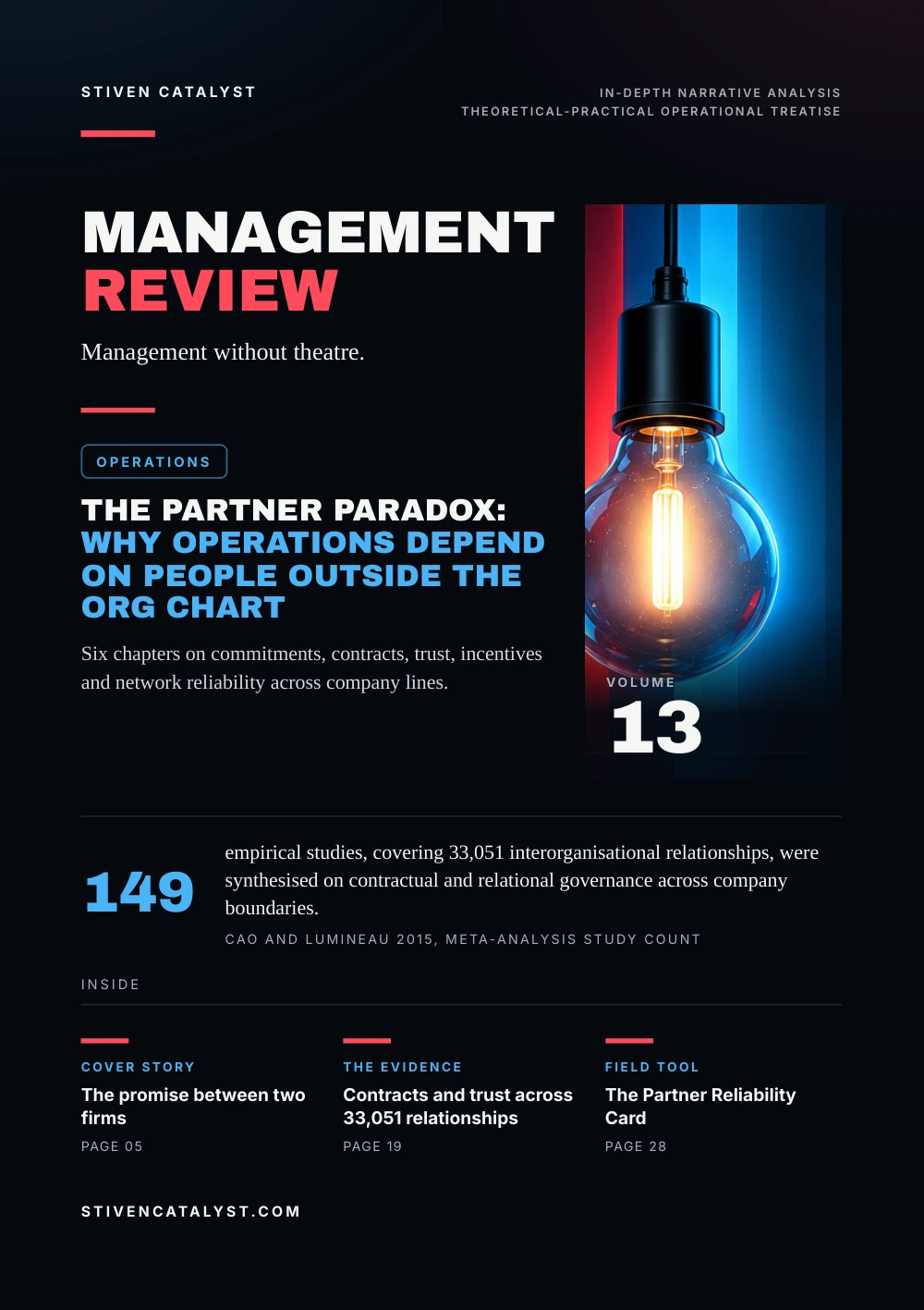
Six chapters on commitments, contracts, trust, incentives and network reliability across company lines.

Volume13
empirical studies, covering 33,051 interorganisational relationships, were synthesised on contractual and relational governance across company boundaries.Cao and Lumineau 2015, meta-analysis study count
stivencatalyst.com
Editorial · Volume 13
The work acrosscompany lines
Some of the most consequential operational work happens outside the manager's direct authority.
How every chapter is built
- 1
The living scene
A shift, a ramp, a desk at 03:00: one piece of work followed as it actually happens, with the hand-off where it breaks. Scenes are constructed from real categories of work and say so.
- 2
The conceptual and scientific breakdown
The mechanism behind the scene, named with the model that explains it, and the research that tests it: the study, its population, its year and its limits, before it is applied anywhere else.
- 3
The operating protocol for action
What a working team can try on Monday: fields, questions, a cadence and a count, each with an owner, a next step and a return of information to the people who do the work.
The reading contract
Clarit y
A shared promise, not competing assumptions.
Reciprocit y
Information that moves in both directions.
Evidence
Verify the service and the response.
Contents
The chap ters,in three layers
Chapter IThe promise across company lines05
1 SceneThe order between two firms052 BreakdownThe invisible handoff contract063 ProtocolMake the promise testable07Chapter IIThe limits of the contract08
1 SceneA clause cannot drive the route082 BreakdownGovernance beyond the signatures09When control changes the conversation10What the 99 disputes were about113 ProtocolBuild two layers that agree12Chapter IIITrust is an operating asset13
1 SceneThe call that needs no command132 BreakdownTwo different levels of trust14Four sources of shared advantage153 ProtocolFrom a trusted person to a trusted process16Chapter IVWhen incentives pull apart17
1 SceneOne delivery, two scorecards172 BreakdownCooperation has a cost structure18Contracts and norms: a qualified relationship193 ProtocolMeasure the interface, not just each party20Chapter VThe fragile partner network21
1 SceneA network can grow and become more fragile212 BreakdownWho governs the whole network?22Partnerships are maintained, not installed233 ProtocolTest the network before it is tested24Chapter VIDesigning reliable partnerships25
1 SceneThe partnership review that ends with action252 BreakdownA charter for shared execution263 ProtocolTest, learn, renegotiate27
Also in this volume
- 04Editorial methodNarrative, science, operational protocol
- 28Field toolOne card. Two organisations.
- 29Closing essayOutside the org chart, inside the outcome
- 30MethodWhere the evidence comes from
- 31SourcesSources and method
Editorial method
Narrative, science,operational prot ocol
A plausible scenario can reveal a mechanism. It cannot substitute for evidence of what happened.
Three kinds of evidence are kept apart throughout this volume. First, the author's confirmed career context includes wholesale distribution work with 61 resellers and the coordination of last-mile delivery partners. These facts establish relevant operating environments; they do not establish the frequency of disputes, contract terms or a measured causal outcome. Second, the research ranges from conceptual frameworks to surveys of relationships, a study of documented buyer-supplier disputes and a meta-analysis. Every count belongs to its published study, and cross-sector mechanisms are prompts for inquiry, not universal effect sizes: a sample of industrial buyers does not report performance for a German delivery operation. Third, every scene is a labelled hypothetical or composite, and the protocols and the Partner Reliability Card are editorial proposals that need local review, consent, contractual compatibility and protection of confidential information before any formal use. This volume is not a legal guide. It does not provide contract language, name partner organisations, evaluate actual disputes or reveal commercial terms.
Fact · career context
61 reseller relationships; last-mile partner coordination.
Research · published study
Author, year, sample and method noted where relevant.
Proposal · field design
Test locally; never present as a certified method.
The strongest claim in a field treatise is a claim whose evidence level the reader can see.
Sources: Jeffrey H. Dyer & Harbir Singh, Academy of Management Review 23(4), 1998 (via the publisher's record); Akbar Zaheer, Bill McEvily & Vincenzo Perrone, Organization Science 9(2), 1998; Laura Poppo & Todd Zenger, Strategic Management Journal 23(8), 2002; Zhi Cao & Fabrice Lumineau, Journal of Operations Management 33–34, 2015
Research orientation: Dyer and Singh (1998); Zaheer et al. (1998); Poppo and Zenger (2002); Cao and Lumineau (2015). No private partner data are used.
- 1Scene
- 2Breakdown
- 3Protocol
Chapter I · The promise across company lines
The orderbe tween two firms
A customer hears one promise. Two organisations must decide how to keep it.
Composite wholesale scene, hypothetical, not a documented incident
A reseller asks for a shipment before a local campaign. The commercial contact wants to preserve the sale. Availability looks reasonable in the sales view, but the distribution team has a separate picture of picking capacity and transport cut-off times. Someone on the supplying side gives a confident answer before both realities are reconciled. The order is accepted. The next morning another team discovers that the promised date requires an exception. Nobody in the scene needs to be dishonest. The salesperson sees a commitment to a business relationship, the warehouse sees a capacity constraint, the reseller sees a delivery promise. Each holds a different piece of the operating system and faces a different consequence if the promise fails. The interface between their information is the real problem.
This scene is constructed. The author's confirmed background includes 61 reseller relationships in Albania, but no source establishes that this particular event occurred. It illustrates a question that applies across wholesale and logistics: how much operational certainty is needed before one firm communicates a commitment another firm will plan around? The easy response is to demand more personal effort after the promise has been made. The stronger one is a joint commitment process that asks about stock, preparation, handoff and confirmation before the customer is given a date. That will not eliminate uncertainty. It will make uncertainty visible before it becomes someone else's crisis.
A promise is an interface between organisations. Treat its conditions as carefully as its wording.
Source: James C. Anderson & James A. Narus, Journal of Marketing 54(1), 1990
Constructed illustration. For distributor-manufacturer relationship context, see Anderson and Narus (1990). The essay named below follows mistakes across the points where work changes hands.
- 1Scene
- 2Breakdown
- 3Protocol
Chapter I · The promise across company lines
The invisiblehandoff contract
The handoff carries materials, information, expectations and a duty to respond.
A commercial promise is not only a date or a quantity. It is an agreement about which organisation will perform which part of a chain. The outcome is judged by one recipient, while each contributing company sees only its local part: a classic coordination challenge, not simply a communication failure. Anderson and Narus (1990) studied manufacturer-distributor working partnerships with multiple informants on both sides. Their model was supported best when cooperation was specified as an antecedent of trust rather than its consequence: a caution against assuming trust must exist before useful joint action occurs. Repeated reliable interactions can help build confidence in a partner.
Three handoffs deserve separate attention. A physical handoff transfers goods or a completed service. An informational handoff transfers verified facts about status and exceptions. An authority handoff specifies who is permitted and required to decide when the original plan is threatened. A perfect goods label cannot repair a missing authority rule; friendly communication cannot repair a systematically misleading status. For a reseller network, a joint promise might record accepted quantity, confirmed availability, dispatch commitment and the responsible point of contact; for a carrier, readiness to load might be distinguished from actual departure. These are proposed fields, not a claim about how the author's employers worked.
Physical
What must cross the boundary?
Information
Which status is verified, and at what time?
Authority
Who may change the promise, and who must be informed?
Sources: James C. Anderson & James A. Narus, Journal of Marketing 54(1), 1990; Peter Smith Ring & Andrew H. Van de Ven, Academy of Management Review 19(1), 1994 (via the publisher's record)
Anderson and Narus (1990), Journal of Marketing 54(1); Ring and Van de Ven (1994). The three handoffs and their fields are editorial.
- 1Scene
- 2Breakdown
- 3Protocol
Chapter I · The promise across company lines
Make the promisetestable
The goal is not perfect forecasting. It is reducing the gap between commitment and shared knowledge.
Partnership discipline starts before a problem becomes a dispute. A promise should be specific enough to be checked, yet flexible enough to record an authorised revision; the final customer should not have to negotiate the boundary between two suppliers or two teams. A practical test is to review a small sample of recent, non-sensitive commitments with both sides: when the commitment was made, what evidence was available, what was delivered and how any revision was communicated.
Define the output
Specify quantity, service, agreed date and acceptance criteria.
Verify the dependency
Confirm the capacity or input supplied by the other organisation.
Assign the contact
Name a role on both sides, with a lawful escalation route.
Record revisions
Keep one authorised version of a changed commitment.
Close the loop
Confirm the result with the recipient, not only the sender.
A relationship that always relies on one personal phone call may work today but remain fragile during absence or peak volume.
If the promise cannot be checked by both sides, it is not yet an operational standard.
Sources: James C. Anderson & James A. Narus, Journal of Marketing 54(1), 1990; Peter Smith Ring & Andrew H. Van de Ven, Academy of Management Review 19(1), 1994 (via the publisher's record)
Editorial protocol inspired by Anderson and Narus (1990) and Ring and Van de Ven (1994); not a company procedure.
- 1Scene
- 2Breakdown
- 3Protocol
Chapter II · The limits of the contract
A clause cannotdrive the route
A detailed contract is necessary in some settings. It does not operate the next decision for people.
Hypothetical transport scene, no actual partner or contract identified
A delivery operation has service expectations agreed with an external partner. A vehicle becomes unavailable shortly before departure. The local dispatcher needs an updated resource plan. One side asks for immediate confirmation; the other must verify what is feasible. Both know the service outcome matters, yet the operational answer cannot be produced by reading a contract aloud. A contract can establish duties, service levels, notice requirements, remedies and boundaries of authority. It cannot specify every combination of traffic, resource availability and last-minute demand, nor guarantee that the person answering the telephone knows the operational state at that moment. The missing ingredient is a repeatable coordination routine that operates inside the contractual framework.
The scenario is constructed and reveals no live route, company, vehicle or agreement. Its point is not that contracts are bad. Without clear formal obligations a partnership can depend on personal goodwill and become impossible to govern fairly. The danger is treating the written instrument as a substitute for the daily relationships through which information reaches decisions. The managerial question becomes more precise: what should the contract define, and what should the operating team maintain through routine communication? Over-specifying ordinary collaboration may make escalation mechanical; under-specifying authority can leave a critical decision with someone not permitted to make it.
A contract allocates obligations. A working partnership also needs a reliable method for coordinating uncertainty.
Sources: Oliver E. Williamson, The Journal of Law and Economics 22(2), 1979 (via the publisher's record); Laura Poppo & Todd Zenger, Strategic Management Journal 23(8), 2002
Scene hypothetical. Williamson (1979); Poppo and Zenger (2002). The essay named below is about coordinating vehicles you cannot see.
- 1Scene
- 2Breakdown
- 3Protocol
Chapter II · The limits of the contract
Governance be yondthe signatures
Transactional safeguards and relational routines solve different aspects of the same problem.
Williamson's transaction-cost approach (1979) directs attention to the uncertainty of an exchange, how often it recurs and how far it requires investments specific to one relationship. When one organisation invests in arrangements useful mainly for a particular partner, its exposure grows, and formal safeguards may matter more. That does not make relational processes irrelevant. Poppo and Zenger (2002) tested whether formal contracts and relational governance work as substitutes or complements. In a sample of information-services exchanges they found support for complementarity: managers coupled increasingly customised contracts with higher levels of relational governance, and that interdependence was associated with better exchange performance. The sample and context matter; it would be wrong to conclude that more contract pages always raise trust in a delivery operation.
The distinction is functional. The written contract clarifies expectations, liability and authorised remedies; relational governance provides cooperative norms, information sharing and practical adjustment when unforeseen events occur. Neither is naturally unlimited: excessive flexibility can make requirements uncertain, excessive control can make an adjustment needlessly adversarial. The question is not contract or trust, but whether the agreement and the working routines reinforce the same outcome.
Formal · boundaries
Clear obligations, decision rights and authorised remedies.
Relational · coordination
Timely updates, joint problem framing and fair adjustments.
Combined · reliability
Compatible rules and routines tested by actual performance.
Sources: Oliver E. Williamson, The Journal of Law and Economics 22(2), 1979 (via the publisher's record); Laura Poppo & Todd Zenger, Strategic Management Journal 23(8), 2002
Williamson (1979), Journal of Law and Economics 22(2); Poppo and Zenger (2002), Strategic Management Journal 23(8). Findings from other sectors are not universal effect estimates.
- 1Scene
- 2Breakdown
- 3Protocol
Chapter II · The limits of the contract
When control changesthe conversation
The role of a clause can matter as much as its existence.
A later study complicates the simple claim that contract and trust always reinforce each other. Lumineau and Henderson (2012) analysed buyer-supplier disputes, distinguishing contractual coordination from contractual control and cooperative from competitive relational experience. Their data were 99 two-party supply-chain disputes from the files of one French law firm. Coordination clauses reinforced the positive link between a cooperative history and a cooperative negotiation strategy. Stronger contractual control weakened that link; where the history had been competitive, more control was associated with more cooperative negotiation. The result is a contingent finding about one dispute dataset, not a global verdict against formal governance.
For a partnership review this suggests a diagnostic question: does the clause tell people how to coordinate a necessary change, or is it mainly designed to constrain unwanted behaviour? Both can be legitimate. A manager who uses a control clause as a substitute for listening may not learn what the problem requires; one who ignores a necessary safeguard in the name of trust creates another danger. A professional review examines the written rights with qualified legal input, then the everyday communication through which people use them.
The research warns against a universal slogan. The effect of governance depends on what it does and on relationship history.
Source: Fabrice Lumineau & James E. Henderson, Journal of Operations Management 30(5), 2012 (via the abstract and the authors' working paper (MPRA No. 38510))
Lumineau and Henderson (2012), Journal of Operations Management 30(5), 382–395; the sample is described in the authors' working paper.
- 1Scene
- 2Breakdown
- 3Protocol
Chapter II · The limits of the contract
What the 99disputes were about
Before borrowing a finding, look at the cases it was drawn from.
Dispute files of one French law firm, 1991–2005
Type of contract in the 99 disputes
Every figure is the authors': the files ran to some 150,000 pages, contracts fell under French law, and about 46% of the cases crossed a border. Distribution is the largest group, which makes the study relevant to a wholesale reader, but it remains a sample of disputes that reached lawyers, not of partnerships that ran smoothly. It can sharpen a question about clauses; it cannot tell how often a reseller network ends in conflict.
Source: Fabrice Lumineau & James E. Henderson, Journal of Operations Management 30(5), 2012 (via the abstract and the authors' working paper (MPRA No. 38510))
Lumineau and Henderson (2012), sample section of the working paper (MPRA No. 38510): 128 files examined, 99 kept, 96 with only European firms; contract types as reported.
- 1Scene
- 2Breakdown
- 3Protocol
Chapter II · The limits of the contract
Build two layersthat agree
Formal rights should support, not conflict with, the daily operating method.
A workable governance review distinguishes changing a task from changing an agreement. The former may be permitted within everyday responsibilities; the latter may require an authorised signatory. Treating them alike leads to needless waiting or unauthorised promises. The checklist below is for a joint review under proper contractual and data-protection controls; it is not a sample contract.
Map obligations
List outputs, verification criteria and owners without revealing confidential rates.
Name decision rights
Distinguish routine coordination from contractual variation.
Provide an exception route
Document whom to contact when normal performance cannot be achieved.
Separate control and coordination
Keep necessary safeguards while enabling timely shared information.
Test an ordinary case
Follow one non-sensitive promise from request to confirmation.
Review a disagreement
Ask whether records and roles enable an evidence-based resolution.
The best operating contract is one people can act within, while recognising what they cannot authorise.
Sources: Oliver E. Williamson, The Journal of Law and Economics 22(2), 1979 (via the publisher's record); Laura Poppo & Todd Zenger, Strategic Management Journal 23(8), 2002; Fabrice Lumineau & James E. Henderson, Journal of Operations Management 30(5), 2012 (via the abstract and the authors' working paper (MPRA No. 38510))
Editorial design informed by Williamson (1979), Poppo and Zenger (2002) and Lumineau and Henderson (2012); not legal advice.
- 1Scene
- 2Breakdown
- 3Protocol
Chapter III · Trust is an operating asset
The call thatneeds no command
Trust can make coordination easier, but should not make critical knowledge undocumented.
Composite reseller scene, not a transcript or verified incident
An established reseller calls to ask whether a planned delivery is still realistic. The commercial contact does not know every warehouse constraint, but gives an honest provisional answer and promises a confirmed update. The reseller accepts the uncertainty because similar questions have received clear responses before. The exchange is short; neither side needs a lengthy performance of confidence. A new reseller might reasonably demand more detail. The two relationships may have identical formal conditions and different histories of coordination. Trust, in this sense, is not simply liking the other person. It is a working expectation that an organisation will do what it says, acknowledge what it does not know and correct the record when circumstances change.
The scene is hypothetical. The author's experience managing a network of 61 resellers is confirmed; the specific call and its outcome are not. Trust can also be dangerously concentrated. If only one experienced contact knows how a reseller prefers updates, the shared process may break when that person leaves. A mature partnership translates useful relational knowledge into legitimate, accessible routines without exposing personal or sensitive information. Credibility grows when an honest 'not confirmed yet' is followed by a reliable confirmation, not by an unsupported promise.
Trust is operational when it changes what both sides can reasonably expect and verify, not when it removes the need to verify.
Sources: James C. Anderson & James A. Narus, Journal of Marketing 54(1), 1990; Akbar Zaheer, Bill McEvily & Vincenzo Perrone, Organization Science 9(2), 1998
Constructed illustration. Anderson and Narus (1990); Zaheer, McEvily and Perrone (1998). The essay named below is the author's own account of 61 resellers and trust.
- 1Scene
- 2Breakdown
- 3Protocol
Chapter III · Trust is an operating asset
Two differentlevels of trust
A helpful person and a dependable organisation are related but not interchangeable.
Zaheer, McEvily and Perrone (1998) investigated interorganisational and interpersonal trust using data from 107 buyer-supplier relationships in electrical-equipment manufacturing. They defined the two as distinct constructs and examined their effects on negotiation costs, conflict and performance with a structural equation model. The two levels proved related but distinct and played different roles, and the link from trust to performance received some support, though not quite in the form first proposed. An individual may trust a particular sales representative; the partner organisation must also trust that agreed information will survive a holiday, a staff change or a transfer between departments. These are different units of analysis. A team can employ a respected contact and still run an unreliable fulfilment system.
The study offers a useful question for a distributor network: if one relationship manager left today, could the reseller still obtain the same verified answer from the organisation? That cannot be answered by measuring friendliness; it requires evidence from response times, dispute resolution, handover quality and fulfilment records collected through approved channels. Nor should the evidence be pushed beyond its context: 107 industrial relationships are not 107 resellers in Albania.
A trusted representative is valuable. A trustworthy process is harder to replace and more resilient.
Source: Akbar Zaheer, Bill McEvily & Vincenzo Perrone, Organization Science 9(2), 1998
Zaheer, McEvily and Perrone (1998), Organization Science 9(2), 141–159.
- 1Scene
- 2Breakdown
- 3Protocol
Chapter III · Trust is an operating asset
Four sources ofshared advantage
The relationship between firms can hold capabilities that neither side owns alone.
Dyer and Singh (1998) proposed the relational view of competitive advantage: some valuable resources and routines live across company boundaries. They name four potential sources of relational rents: relation-specific assets, knowledge-sharing routines, complementary resources and capabilities, and effective governance. The first needs care, because an investment valuable to one trading relationship can improve performance and also create dependence. The second concerns repeated ways of exchanging useful know-how, the third capacities that work well together, the fourth the mechanisms that protect cooperation and limit unnecessary transaction costs. This is a conceptual framework, not an empirical claim that every partner network has all four, and not a promise of returns: the value of a relationship must be weighed against its cost and its exposure to risk.
For a reseller network one might ask whether the two sides share reliable stock information, understand each other's delivery constraints and keep learning from recurring problems; for last-mile partners, whether resource planning, loading readiness and exception reporting are mutually understood. These are proposed lines of inquiry, not verified practices at any named company.
Specialised assets
Useful investments that can create value and dependence.
Knowledge routines
Repeated ways to exchange verified operational information.
Complementarity
Capabilities that function better when coordinated.
The fourth source, effective governance, holds the first three together without turning cooperation into guesswork.
Source: Jeffrey H. Dyer & Harbir Singh, Academy of Management Review 23(4), 1998 (via the publisher's record)
Dyer and Singh (1998), Academy of Management Review 23(4), 660–679. Conceptual theory; the lines of inquiry are editorial.
- 1Scene
- 2Breakdown
- 3Protocol
Chapter III · Trust is an operating asset
From a trusted persont o a trusted process
A partner relationship should remain dependable when the usual contact is unavailable.
The operational test of trust is not whether two individuals believe they have a good relationship. It is whether the promised work remains understandable and correct when the relationship is under pressure. A partner that hears only optimistic statements does not necessarily have a high-trust relationship; it may have too little verified information. The design below turns trust into observable routines without pretending it can be measured by one score. Test it on non-sensitive cases, with clear agreement on what may be shared; contractual and privacy limits take priority.
Document the promise
Identify the outcome both organisations recognise as complete.
Clarify the status language
Define what 'confirmed', 'pending' and 'delivered' mean.
Create a substitute route
Provide an authorised contact for absence or escalation.
Invite correction
Make it acceptable to report uncertainty before a promise fails.
Confirm resolution
Ask the receiving side whether the action met the agreed need.
Review reliability
Use a small sample of commitments, not a popularity score.
Relationship strength is tested by the difficult update, not merely by the easy conversation.
Sources: Akbar Zaheer, Bill McEvily & Vincenzo Perrone, Organization Science 9(2), 1998; Jeffrey H. Dyer & Harbir Singh, Academy of Management Review 23(4), 1998 (via the publisher's record); Peter Smith Ring & Andrew H. Van de Ven, Academy of Management Review 19(1), 1994 (via the publisher's record)
Editorial protocol informed by Zaheer et al. (1998), Dyer and Singh (1998) and Ring and Van de Ven (1994).
- 1Scene
- 2Breakdown
- 3Protocol
Chapter IV · When incentives pull apart
One delivery,two scorecards
A good local outcome is not automatically a good result for the shared customer.
Constructed last-mile scene, not an allegation about any partner
A carrier partner is measured on a defined service commitment. The supplying operation wants vehicles to leave at the planned time. A driver reports that an item in the expected load cannot be located. The local teams face a real question: prioritise departure, investigate completeness or request a change to the plan? This is not a story about a particular employer or driver. It is an analytic scene designed to show how two scorecards can create different instincts. The problem is not automatically selfishness or negligence. Each organisation may be responding rationally to what it is asked to measure, what it can control and what its local manager will be held accountable for.
A shared customer judges the eventual service, not the elegance of each internal report. An early departure with an avoidable incomplete delivery may not be a success; delaying every route for an uncertain item can damage time-sensitive commitments. If the two firms use different definitions of a completed handoff, arguments become predictable. If they share the same exception code and responsibility, learning becomes possible. The question is not which partner should win the argument, but whether the joint performance system measures the right outcome and produces a timely decision when objectives conflict.
A partnership needs a shared definition of success, or local optimisation can become a shared failure.
Sources: Jeffrey H. Dyer & Harbir Singh, Academy of Management Review 23(4), 1998 (via the publisher's record); Jan B. Heide & George John, Journal of Marketing 56(2), 1992
Hypothetical scene; no company KPI values are used. Dyer and Singh (1998); Heide and John (1992). The essay named below is about where part of the order goes missing.
- 1Scene
- 2Breakdown
- 3Protocol
Chapter IV · When incentives pull apart
Cooperation hasa cost structure
Alignment means understanding who carries the cost when the plan changes.
Two organisations can honestly want the same customer outcome while disagreeing about the price of achieving it. A last-minute exception may require extra dispatch work on one side, waiting time on another and an explanation to a recipient who sees neither. Without an agreed way to surface the burden, the interaction can turn into repeated blame. Heide and John (1992) examined the role of relational norms in economically efficient relationships between independent firms. In a sample of manufacturer-supplier relationships they argued that where specific assets are at risk and vertical control over the other firm is not available, supportive norms matter; without them, dependent parties lose control. Their conclusion is about governing relationships under particular conditions, not a promise that goodwill erases cost.
This helps explain why a useful cross-company scorecard needs at least three views: the shared result the customer receives, the interface measures within each party's control, and the exceptions that require joint decisions. Measuring only the shared outcome can obscure where the failure arose; measuring only local tasks can reward behaviour that hurts the end-to-end service. A partner should not be held accountable for a step it cannot influence, nor excused for one it explicitly controls.
Customer outcome
Was the shared promise fulfilled at acceptable quality?
Interface performance
Which transfer or confirmation was delayed or inaccurate?
Joint exception
What decision was needed, and was the authority clear?
Sources: Jan B. Heide & George John, Journal of Marketing 56(2), 1992; Jeffrey H. Dyer & Harbir Singh, Academy of Management Review 23(4), 1998 (via the publisher's record)
Heide and John (1992), Journal of Marketing 56(2); Dyer and Singh (1998). The three-view scorecard is an editorial proposal.
- 1Scene
- 2Breakdown
- 3Protocol
Chapter IV · When incentives pull apart
Contracts and norms:a qualified relationship
Large evidence syntheses are valuable only when their reported effects are not simplified beyond recognition.
Cao and Lumineau (2015) combined a qualitative review with a meta-analysis of 149 empirical studies covering 33,051 interorganisational relationships. Contractual governance was positively related to both sides of relational governance, trust and relational norms, and contracts, trust and norms together were associated with higher satisfaction and relationship performance and lower opportunism. They also found that the link varies with the institutional environment, the type and length of the relationship and how contracts were measured. The result supports examining formal and relational governance together, not an instruction to maximise both indiscriminately. It does not measure a logistics company's completion rate or show that a particular contract raises trust by a fixed amount. The 33,051 observations are relationships across studies, not employees in one organisation, and the findings depend on how the underlying studies defined their constructs.
Operationally, the evidence challenges a false choice between trusting partners and needing strict agreements. Well-designed agreements can clarify expectations; relational norms can reduce ambiguity and improve the use of formal terms. A contract used mainly as a threat may produce a different response from a coordination rule designed for transparent adjustment. Does a notice clause help both parties react to a genuine exception, or merely help one document a penalty afterwards?
Research suggests complementarity, with variation. It does not supply an off-the-shelf trust score for one partner.
Source: Zhi Cao & Fabrice Lumineau, Journal of Operations Management 33–34, 2015
Cao and Lumineau (2015), Journal of Operations Management 33–34, 15–42.
- 1Scene
- 2Breakdown
- 3Protocol
Chapter IV · When incentives pull apart
Measure the interface,not just each par t y
Build a shared exception review with an agreed outcome and clear decision rights.
A useful scorecard conversation starts with one joint service definition: what completion means, which intermediate confirmations matter and what happens when the conditions for a normal handoff are missing. It must not become a shortcut for disclosing confidential rates, individual driver records or private commercial arrangements. The measures can often be aggregated or categorical, and the first test should be small enough for careful verification.
Agree the customer promise
Use one definition of quality, timeliness and successful completion.
Map controllable inputs
Identify which organisation owns each verified step.
Define the exception
Use clear, non-accusatory categories for shared problems.
Agree the decision route
Name the role authorised to choose among permitted alternatives.
Return the finding
Tell both parties what happened and what remains uncertain.
Verify unintended effects
Check that one improved number did not damage another outcome.
An honest cross-company scorecard records joint uncertainty rather than assigning blame to the nearest visible team.
Sources: Jan B. Heide & George John, Journal of Marketing 56(2), 1992; Zhi Cao & Fabrice Lumineau, Journal of Operations Management 33–34, 2015
Editorial protocol informed by Heide and John (1992) and Cao and Lumineau (2015); not a KPI system of any company.
- 1Scene
- 2Breakdown
- 3Protocol
Chapter V · The fragile partner network
A ne twork can growand become more fragile
More names on a partner list do not necessarily create more resilience.
Constructed network scene, no documented failure attributed
A distributor has relationships with many independent resellers. One has a strong regional position; another serves a narrow product category; a third relies on a single person for coordination. A customer request looks simple at company level but depends on a sequence of choices across local inventories, credit terms, product availability and transport. Each partner has different constraints, and counting them all as identical 'active outlets' conceals those differences. This is a constructed illustration, not an assessment of the author's historical reseller network. The confirmed network size is 61 resellers. There are no verified measures of revenue concentration, default risk, contractual dependence or the share of sales by individual partners, and such numbers must not be invented to make an analytical chart look convincing.
A partner network can be robust when capabilities are complementary and information flows through stable routines. It can be fragile when too much knowledge, volume or decision authority rests in a few narrow points. Diversity can reduce some risks, but complexity also raises coordination demands; the number of partners is a descriptor, not a resilience score. A serious review asks what could interrupt the promised service if one link became unavailable. Can another partner cover the capability? Would the same information be available? Are the commercial and legal constraints known? Has anyone tested the response? The answer is not to duplicate every relationship, but to identify material dependencies and create feasible, authorised contingencies for those that matter most.
The health of a network cannot be inferred from the count of its members.
Sources: Keith G. Provan & Patrick Kenis, Journal of Public Administration Research and Theory 18(2), 2008 (via the publisher's record); Jeffrey H. Dyer & Harbir Singh, Academy of Management Review 23(4), 1998 (via the publisher's record)
Composite illustration; confirmed background: 61 resellers. Provan and Kenis (2008); Dyer and Singh (1998). The essay named below is about what last mile taught the author.
- 1Scene
- 2Breakdown
- 3Protocol
Chapter V · The fragile partner network
Who governsthe whole ne twork?
A collection of bilateral agreements does not automatically create coordinated network governance.
Provan and Kenis (2008) developed a conceptual account of three broad modes of governing interorganisational networks: governance shared by the participants, governance through a lead organisation, and governance through a separate network administrative organisation. They explored the conditions under which each may be effective and the tensions each creates. In a small, highly aligned network, direct coordination among participants may be practical. In a larger network with asymmetric resources, a lead organisation may take more responsibility for routines. A dedicated administrative body can coordinate some networks but adds overhead and its own questions of accountability. These are analytical modes, not compulsory stages every commercial partnership must pass through.
The framework helps managers avoid an important mistake: assuming that if each individual contract is understood, the network as a whole will coordinate itself. A change in one partner's capacity can affect others even when no bilateral party has broken its own obligation. Last-mile and wholesale networks are not interchangeable, yet the question travels across both: who has the legitimate authority and information to identify a shared problem and organise a joint response? The answer may be distributed among roles, but it should not remain implicit. The most useful map may be a map of decisions and information, not a list of partner names.
Shared
Participants govern through direct joint action.
Lead
A central participant coordinates network activity.
Separate
A dedicated administrative entity coordinates.
The best network mode depends on structure and context. No one mode is universally superior.
Source: Keith G. Provan & Patrick Kenis, Journal of Public Administration Research and Theory 18(2), 2008 (via the publisher's record)
Provan and Kenis (2008), Journal of Public Administration Research and Theory 18(2), 229–252. Conceptual framework.
- 1Scene
- 2Breakdown
- 3Protocol
Chapter V · The fragile partner network
Par tnerships aremaintained, not installed
Commitment, execution and renegotiation recur when work and conditions change.
Ring and Van de Ven (1994) describe interorganisational relationships as developmental processes of negotiation, commitment and execution within both formal and social structures. Parties revise expectations through interaction rather than following a straight line from signed agreement to stable performance. The framework is conceptual and should not be presented as an experiment on annual partner retention. Gulati (1995) adds an empirical perspective on repeated alliances: in multi-industry data on alliances formed between 1970 and 1989, alliances between partners with prior ties were less likely to be organised through equity, a sign that familiarity shaped the governance chosen. Jap and Ganesan (2000), studying retailers and suppliers, found that the effect of safeguards on perceived commitment depended on the phase of the relationship. Familiarity may support trust; it may also hide assumptions never retested for current capacity.
A relationship review should therefore have more than an onboarding moment. Early commitments should be checked against actual delivery; mature relationships should be assessed for changing demand, concentration and key-person dependence; relationships in difficulty need a fair route for renegotiation or exit, not repeated informal exceptions nobody owns. If the current way of working is not what both sides believe they agreed, reconcile the gap through the authorised process.
- 01
Negotiate
Clarify need.
- 02
Commit
Define promise.
- 03
Execute
Verify work.
- 04
Review
Adapt rules.
Repetition alone is not proof of quality. A reliable partnership learns and updates its agreements.
Sources: Peter Smith Ring & Andrew H. Van de Ven, Academy of Management Review 19(1), 1994 (via the publisher's record); Ranjay Gulati, Academy of Management Journal 38(1), 1995 (via the abstract); Sandy D. Jap & Shankar Ganesan, Journal of Marketing Research 37(2), 2000
Ring and Van de Ven (1994), conceptual; Gulati (1995), empirical alliances; Jap and Ganesan (2000), Journal of Marketing Research 37(2), retailer-supplier relationships. The cycle is an editorial simplification.
- 1Scene
- 2Breakdown
- 3Protocol
Chapter V · The fragile partner network
Test the ne tworkbefore it is tested
A resilience review should identify material dependencies without inventing scenarios as measured incidents.
Begin with an authorised, high-level map of the partner network and the outcome it is meant to deliver. Identify critical capabilities, not the number of names, without collecting unnecessary personal data or publishing contract terms, then ask which dependencies have a realistic approved substitute and which would require a revised promise to the customer. The review stays qualitative: it is not a model of failure probability, which would need verified exposure data and a defensible method.
Identify the outcome
Which shared service must continue under disruption?
Map critical capabilities
Where are knowledge, capacity and decision rights concentrated?
Assess substitution
Can a permitted alternative actually cover the obligation?
Plan communication
Who informs partners and customers when the promise changes?
Exercise a hypothetical case
Test one approved scenario without real sensitive information.
Record gaps
Assign a review owner and verify any improvement later.
Resilience is the ability to keep making honest, feasible commitments when circumstances change.
Sources: Keith G. Provan & Patrick Kenis, Journal of Public Administration Research and Theory 18(2), 2008 (via the publisher's record); Peter Smith Ring & Andrew H. Van de Ven, Academy of Management Review 19(1), 1994 (via the publisher's record)
Editorial resilience protocol informed by Provan and Kenis (2008) and Ring and Van de Ven (1994); not a risk model.
- 1Scene
- 2Breakdown
- 3Protocol
Chapter VI · Designing reliable partnerships
The par tnership reviewthat ends with action
A joint meeting is useful only when it changes how work is coordinated.
Hypothetical future state, not a documented company initiative
Representatives of two organisations meet after a run of unresolved interface problems. Everyone has brought a different report. One counts departures, another counts completed customer commitments, a third lists exceptions that were reported but never clearly closed. The conversation begins with familiar explanations about pressure and the quality of other teams' data. A manager changes the question. Instead of asking who owns the failure in general, the participants choose one ordinary service promise and reconstruct it together. What did the customer expect? What was verified at the moment of commitment? When did the status change? Which party could legally decide? Who told the receiving side what had happened?
The group finds no magic answer. Several causes may have contributed, and the contract still governs rights and obligations. But the meeting produces two useful decisions: an agreed definition of a completed transfer, and an authorised way to report an exception without leaving its ownership ambiguous. Both sides assign a named role, not necessarily a named person, to review a short sample of future cases. This is a hypothetical future state; no actual intervention or result is claimed. Its point is practical: a partner review should end in an operating agreement that can be checked, not a ceremonial affirmation of collaboration.
The output of coordination is not a meeting. It is a clearer next action shared by both parties.
Sources: Laura Poppo & Todd Zenger, Strategic Management Journal 23(8), 2002; Fabrice Lumineau & James E. Henderson, Journal of Operations Management 30(5), 2012 (via the abstract and the authors' working paper (MPRA No. 38510))
Constructed scenario. Poppo and Zenger (2002); Lumineau and Henderson (2012). The essay named below is about building KPIs the team trusts.
- 1Scene
- 2Breakdown
- 3Protocol
Chapter VI · Designing reliable partnerships
A char ter forshared execution
Build a small operating structure that works inside existing contracts and approved decision rights.
An effective partnership charter need not be long, but it must be more than a list of values. It defines a shared outcome, the interface between the organisations, the role responsible for confirmation and the rules for a changing situation, and it names what each organisation is not authorised to decide for the other. What follows is an editorial structure, not binding contract language, to be checked against the actual agreement, labour, confidentiality and compliance rules; it confers no rights.
Promise
Service result, standard and clear definition of completion.
Interface
Verified information and agreed transfer point.
Ownership
Role on each side accountable for follow-through.
Exception
What changes, who decides and how updates reach others.
Evidence
Agreed, minimal data used to verify result and response.
Learning
Joint review of recurring causes, revisions and unresolved risk.
The last item matters because an organisation can formally close every individual case while keeping the same underlying problem. A disciplined monthly review might examine a small number of anonymised examples, not hundreds of reports nobody can interpret. A one-page tool cannot replace contractual advice or formal dispute procedures.
Make the interface explicit. Keep the legal agreement authoritative and the operating promise checkable.
Sources: Jeffrey H. Dyer & Harbir Singh, Academy of Management Review 23(4), 1998 (via the publisher's record); Keith G. Provan & Patrick Kenis, Journal of Public Administration Research and Theory 18(2), 2008 (via the publisher's record); Fabrice Lumineau & James E. Henderson, Journal of Operations Management 30(5), 2012 (via the abstract and the authors' working paper (MPRA No. 38510))
Editorial charter informed by Dyer and Singh (1998), Provan and Kenis (2008) and Lumineau and Henderson (2012); not contract language.
- 1Scene
- 2Breakdown
- 3Protocol
Chapter VI · Designing reliable partnerships
Test, learn,renegotiate
A proposal for a 30/60/90-day partnership review, not a research-validated universal schedule.
A partnership-improvement effort can begin with a bounded pilot. Select one agreed service interface and obtain approval from both organisations. Exchange only necessary information through a permitted channel. Establish the baseline through a small sample of cases before introducing any change; the evidence should include both timely completion and the quality of exception closure. The time points below are practical checkpoints proposed by this publication, not thresholds established by the cited studies.
Day 30
Do the partners read the same status the same way? Confirm both sides receive useful updates.
Day 60
Look for repeat exceptions and hidden dependence on specific contacts.
Day 90
Decide whether to adopt, revise or stop the pilot, or whether a contractual decision is needed.
The unit of analysis must stay clear. A claim about a reseller network requires data about that network; a claim about contracted last-mile transport requires its own records and permission. Industrial buyer-supplier studies may inform hypotheses, not prove them elsewhere. The outcome of the review is a decision, not a score alone: keep an interface that works, redesign one that creates repeated avoidable work, escalate any matter that belongs to formal governance, and if results are inconclusive, say so.
Partnership reliability improves through an evidence loop, not through enthusiasm at the launch meeting.
Sources: Peter Smith Ring & Andrew H. Van de Ven, Academy of Management Review 19(1), 1994 (via the publisher's record); Zhi Cao & Fabrice Lumineau, Journal of Operations Management 33–34, 2015
All checkpoints are proposed editorial design, not empirically validated deadlines. Informed by Ring and Van de Ven (1994) and Cao and Lumineau (2015).
Field tool
One card.Two organisations.
The Partner Reliability Card: a joint conversation aid for a single, non-sensitive operating interface. Not a validated scale, legal agreement, supplier audit or authorisation to share confidential information; use it only with the relevant parties' permission.
01Shared promisewhat is the verifiable outcome, and how will both sides define completion?
02Interfacewhat physical or information transfer must be acknowledged, and by whom?
03Authoritywhich role can resolve a routine exception, and what requires formal approval?
04Communicationhow and when will both sides learn of a changed commitment?
05Evidencewhich minimal, authorised records will verify completion and any open issue?
06Learningwho reviews recurring gaps, and when will changes be checked again?
Sources: Jeffrey H. Dyer & Harbir Singh, Academy of Management Review 23(4), 1998 (via the publisher's record); Peter Smith Ring & Andrew H. Van de Ven, Academy of Management Review 19(1), 1994 (via the publisher's record)
Decision gate: if confidentiality, safety, a regulatory duty or contractual authority is uncertain, use the authorised process and do not improvise a new data-sharing practice. This card is a testable editorial proposal; the Action Tracker on this site can hold the follow-up items, each with an owner and a review date.
Closing essay
Outside the org char t,inside the out come
A partner is not a subordinate. The shared result still needs ownership.
The first twelve volumes of this treatise dealt largely with the internal workings of operations: seeing the process, mapping flow, protecting human judgement, maintaining standards, managing capacity, designing measures, recovering service and protecting attention. The thirteenth adds a boundary that cannot be managed away. Many vital outcomes depend on organisations that remain independent. The evidence does not support the simple choice between control and trust. Contracts, relational norms, repeated experience, joint routines and network governance each address a different part of uncertainty, and their interaction depends on context. The strongest managerial insight is therefore a design question, not a slogan: what combination of clear rights and reliable cooperation lets the partners keep honest promises? The author's wholesale and last-mile experience makes the question grounded. It does not by itself establish a causal mechanism or a performance improvement, and that discipline protects both author and reader from the illusion that every plausible scene is a documented case. The applied conclusion is concrete. Define the shared result. Verify the transfer points. Respect the autonomy and contractual rights of each party. Create an exception route that works without one indispensable individual. Test whether the customer receives the promised result, not merely whether each department or firm reports a completed action. The relationship can then be examined as an operating capability, observed in routine confirmations, in difficult updates and in the fairness of resolution when the original plan no longer holds. That is a more demanding meaning of partnership than a signature, and a more useful one than a promise of effortless trust.
You can manage a department through authority. You cannot build a reliable partnership through authority alone.
Editorial essay. No dispute, failure or improvement is attributed to any named partner or employer.
Method
Where the evidencecomes from
An evidence-informed editorial synthesis, not original field research: twelve sources, four conceptual papers, seven empirical studies and one meta-analysis, each with its limits. Scenes, protocols and the card are editorial.
Conceptual
Williamson (1979), transaction costs; Ring and Van de Ven (1994), relationship processes; Dyer and Singh (1998), relational rents; Provan and Kenis (2008), network governance. They explain; they do not measure.
Empirical samples
Distributor and manufacturer firms (Anderson and Narus 1990); manufacturer-supplier relationships (Heide and John 1992); alliances 1970–1989 (Gulati 1995); 107 buyer-supplier relationships (Zaheer et al. 1998); retailers and suppliers (Jap and Ganesan 2000); information-services exchanges (Poppo and Zenger 2002); 99 disputes from one law firm (Lumineau and Henderson 2012).
Meta-analysis
149 studies, 33,051 relationships (Cao and Lumineau 2015): associations across heterogeneous research, moderated by context.
Author's background
61 resellers in Albania and last-mile partner coordination in Germany: confirmed context, not a sample; no partner data, rates or disputes are used.
The handoff types, the three-view scorecard, the charter, the six-step protocols, the 30/60/90-day checkpoints and the Partner Reliability Card are editorial proposals for local testing, not validated controls or employer-approved procedures. Publisher records were checked for every source; where only the record or an abstract was read, the source list says so.
Sources: Oliver E. Williamson, The Journal of Law and Economics 22(2), 1979 (via the publisher's record); James C. Anderson & James A. Narus, Journal of Marketing 54(1), 1990; Jan B. Heide & George John, Journal of Marketing 56(2), 1992; Peter Smith Ring & Andrew H. Van de Ven, Academy of Management Review 19(1), 1994 (via the publisher's record); Ranjay Gulati, Academy of Management Journal 38(1), 1995 (via the abstract); Jeffrey H. Dyer & Harbir Singh, Academy of Management Review 23(4), 1998 (via the publisher's record); Akbar Zaheer, Bill McEvily & Vincenzo Perrone, Organization Science 9(2), 1998; Sandy D. Jap & Shankar Ganesan, Journal of Marketing Research 37(2), 2000; Laura Poppo & Todd Zenger, Strategic Management Journal 23(8), 2002; Keith G. Provan & Patrick Kenis, Journal of Public Administration Research and Theory 18(2), 2008 (via the publisher's record); Fabrice Lumineau & James E. Henderson, Journal of Operations Management 30(5), 2012 (via the abstract and the authors' working paper (MPRA No. 38510)); Zhi Cao & Fabrice Lumineau, Journal of Operations Management 33–34, 2015
Every source is cited on the next page; the twelve records, their journals, volumes, pages and years were checked against the publishers' metadata.
Sources and method
Where the claimscome from
The figures in this volume come from the sources below, each with its year. The scenes are constructed; the protocols are proposals; what is research is named as research.
- Transaction-Cost Economics: The Governance of Contractual RelationsOliver E. Williamson, The Journal of Law and Economics 22(2), 1979 · via the publisher's recordhttps://doi.org/10.1086/466942
- A Model of Distributor Firm and Manufacturer Firm Working PartnershipsJames C. Anderson & James A. Narus, Journal of Marketing 54(1), 1990https://doi.org/10.1177/002224299005400103
- Do Norms Matter in Marketing Relationships?Jan B. Heide & George John, Journal of Marketing 56(2), 1992https://doi.org/10.1177/002224299205600203
- Developmental Processes of Cooperative Interorganizational RelationshipsPeter Smith Ring & Andrew H. Van de Ven, Academy of Management Review 19(1), 1994 · via the publisher's recordhttps://doi.org/10.5465/amr.1994.9410122009
- Does Familiarity Breed Trust? The Implications of Repeated Ties for Contractual Choice in AlliancesRanjay Gulati, Academy of Management Journal 38(1), 1995 · via the abstracthttps://doi.org/10.5465/256729
- The Relational View: Cooperative Strategy and Sources of Interorganizational Competitive AdvantageJeffrey H. Dyer & Harbir Singh, Academy of Management Review 23(4), 1998 · via the publisher's recordhttps://doi.org/10.5465/amr.1998.1255632
- Does Trust Matter? Exploring the Effects of Interorganizational and Interpersonal Trust on PerformanceAkbar Zaheer, Bill McEvily & Vincenzo Perrone, Organization Science 9(2), 1998https://doi.org/10.1287/orsc.9.2.141
- Control Mechanisms and the Relationship Life Cycle: Implications for Safeguarding Specific Investments and Developing CommitmentSandy D. Jap & Shankar Ganesan, Journal of Marketing Research 37(2), 2000https://doi.org/10.1509/jmkr.37.2.227.18735
- Do formal contracts and relational governance function as substitutes or complements?Laura Poppo & Todd Zenger, Strategic Management Journal 23(8), 2002https://doi.org/10.1002/smj.249
- Modes of Network Governance: Structure, Management, and EffectivenessKeith G. Provan & Patrick Kenis, Journal of Public Administration Research and Theory 18(2), 2008 · via the publisher's recordhttps://doi.org/10.1093/jopart/mum015
- The influence of relational experience and contractual governance on the negotiation strategy in buyer-supplier disputesFabrice Lumineau & James E. Henderson, Journal of Operations Management 30(5), 2012 · via the abstract and the authors' working paper (MPRA No. 38510)https://doi.org/10.1016/j.jom.2012.03.005
- Revisiting the interplay between contractual and relational governance: A qualitative and meta-analytic investigationZhi Cao & Fabrice Lumineau, Journal of Operations Management 33–34, 2015https://doi.org/10.1016/j.jom.2014.09.009
Management without theatre.
Every volume, one question about operations, followed from the floor to the protocol and tested against research.
All volumes
stivencatalyst.com/magazine/operational-treatise.html
Operational Treatise · Volume 13 · October 2026 · Stiven Catalyst
Edited by Stiven Janaqi, who answers for it; “the editors” in this publication means him. Its texts, translations, layout and the checking of figures against their sources are done in working sessions with Claude, an AI model by Anthropic.
stivencatalyst.com/how-this-is-made.html
 Next publication · Book
Longing for Durrës
Click or swipe a page to turn it. The arrow keys work too.
Operational Treatise · Volume 13
The figures of the volume
The charts of the printed pages, with their sources. Invented examples are marked as such.
Source: Fabrice Lumineau & James E. Henderson, Journal of Operations Management 30(5), 2012 (via the abstract and the authors' working paper (MPRA No. 38510))
Source: Fabrice Lumineau & James E. Henderson, Journal of Operations Management 30(5), 2012 (via the abstract and the authors' working paper (MPRA No. 38510))
The whole text Read the volume as text For reading on a small screen, searching or a screen reader. The same words, without the page design.
Editorial
The work across company lines
Some of the most consequential operational work happens outside the manager's direct authority.
An organisation can prepare the work, publish the target and appoint an accountable manager. Yet the final result may depend on an independent reseller, a carrier, a supplier or another business with its own resources and incentives. The operating problem is not simply how to give an instruction. It is how to make a promise reliable across a boundary neither side fully controls. The author's experience spans a wholesale distribution network of 61 resellers in Albania and last-mile coordination with delivery partners in Germany. Those are confirmed areas of work. This treatise does not assert that a named partner failed, that a particular contract caused conflict, or that a governance change produced measured savings; its scenes are constructed and labelled. Research adds a demanding counterpoint. Trust between people is not identical to trust between organisations. Formal contracts do not automatically destroy trust, nor does a contract guarantee cooperative execution. A mature partnership is not one without disagreements. It is one that knows what has been promised, how uncertainty will be signalled, how exceptions will be handled fairly, and whether corrective decisions reach both sides. The measure is not whether a partner feels agreeable, but whether two organisations can coordinate legitimate work under changing conditions without losing accountability.
Stiven Janaqi, Editor
How every chap ter is built
- The living scene. A shift, a ramp, a desk at 03:00: one piece of work followed as it actually happens, with the hand-off where it breaks. Scenes are constructed from real categories of work and say so.
- The conce
p tual and scientific breakdown. The mechanism behind the scene, named with the model that explains it, and the research that tests it: the study, its population, its year and its limits, before it is applied anywhere else. - The operating pro
t ocol for action. What a working team can try on Monday: fields, questions, a cadence and a count, each with an owner, a next step and a return of information to the people who do the work.
The reading contract
- Clari
t y. A shared promise, not competing assumptions. - Reciproci
t y. Information that moves in both directions. - Evidence. Verify the service and the response.
Editorial method
Narrative, science, operational prot ocol
A plausible scenario can reveal a mechanism. It cannot substitute for evidence of what happened.
Three kinds of evidence are kept apart throughout this volume. First, the author's confirmed career context includes wholesale distribution work with 61 resellers and the coordination of last-mile delivery partners. These facts establish relevant operating environments; they do not establish the frequency of disputes, contract terms or a measured causal outcome. Second, the research ranges from conceptual frameworks to surveys of relationships, a study of documented buyer-supplier disputes and a meta-analysis. Every count belongs to its published study, and cross-sector mechanisms are prompts for inquiry, not universal effect sizes: a sample of industrial buyers does not report performance for a German delivery operation. Third, every scene is a labelled hypothetical or composite, and the protocols and the Partner Reliability Card are editorial proposals that need local review, consent, contractual compatibility and protection of confidential information before any formal use. This volume is not a legal guide. It does not provide contract language, name partner organisations, evaluate actual disputes or reveal commercial terms.
- Fact · career context. 61 reseller relationships; last-mile partner coordination.
- Research · published study. Author, year, sample and method noted where relevant.
- Proposal · field design. Test locally; never present as a certified method.
Our reading
The strongest claim in a field treatise is a claim whose evidence level the reader can see.
Research orientation: Dyer and Singh (1998); Zaheer et al. (1998); Poppo and Zenger (2002); Cao and Lumineau (2015). No private partner data are used.
Sources: Jeffrey H. Dyer & Harbir Singh, Academy of Management Review 23(4), 1998 (via the publisher's record); Akbar Zaheer, Bill McEvily & Vincenzo Perrone, Organization Science 9(2), 1998; Laura Poppo & Todd Zenger, Strategic Management Journal 23(8), 2002; Zhi Cao & Fabrice Lumineau, Journal of Operations Management 33–34, 2015
Chap ter I: The promise across company lines
Layer 1 · The living scene
The order be tween two firms
A customer hears one promise. Two organisations must decide how to keep it.
Composite wholesale scene, hypothetical, not a documented incident
A reseller asks for a shipment before a local campaign. The commercial contact wants to preserve the sale. Availability looks reasonable in the sales view, but the distribution team has a separate picture of picking capacity and transport cut-off times. Someone on the supplying side gives a confident answer before both realities are reconciled. The order is accepted. The next morning another team discovers that the promised date requires an exception. Nobody in the scene needs to be dishonest. The salesperson sees a commitment to a business relationship, the warehouse sees a capacity constraint, the reseller sees a delivery promise. Each holds a different piece of the operating system and faces a different consequence if the promise fails. The interface between their information is the real problem.
This scene is constructed. The author's confirmed background includes 61 reseller relationships in Albania, but no source establishes that this particular event occurred. It illustrates a question that applies across wholesale and logistics: how much operational certainty is needed before one firm communicates a commitment another firm will plan around? The easy response is to demand more personal effort after the promise has been made. The stronger one is a joint commitment process that asks about stock, preparation, handoff and confirmation before the customer is given a date. That will not eliminate uncertainty. It will make uncertainty visible before it becomes someone else's crisis.
Our reading
A promise is an interface between organisations. Treat its conditions as carefully as its wording.
Constructed illustration. For distributor-manufacturer relationship context, see Anderson and Narus (1990). The essay named below follows mistakes across the points where work changes hands.
Source: James C. Anderson & James A. Narus, Journal of Marketing 54(1), 1990
More in the essay: Mistakes get lost between departments
Layer 2 · The conceptual and scientific breakdown
The invisible handoff contract
The handoff carries materials, information, expectations and a duty to respond.
A commercial promise is not only a date or a quantity. It is an agreement about which organisation will perform which part of a chain. The outcome is judged by one recipient, while each contributing company sees only its local part: a classic coordination challenge, not simply a communication failure. Anderson and Narus (1990) studied manufacturer-distributor working partnerships with multiple informants on both sides. Their model was supported best when cooperation was specified as an antecedent of trust rather than its consequence: a caution against assuming trust must exist before useful joint action occurs. Repeated reliable interactions can help build confidence in a partner.
Three handoffs deserve separate attention. A physical handoff transfers goods or a completed service. An informational handoff transfers verified facts about status and exceptions. An authority handoff specifies who is permitted and required to decide when the original plan is threatened. A perfect goods label cannot repair a missing authority rule; friendly communication cannot repair a systematically misleading status. For a reseller network, a joint promise might record accepted quantity, confirmed availability, dispatch commitment and the responsible point of contact; for a carrier, readiness to load might be distinguished from actual departure. These are proposed fields, not a claim about how the author's employers worked.
- Physical. What must cross the boundary?
- Information. Which status is verified, and at what time?
- Authori
t y. Who may change the promise, and who must be informed?
Anderson and Narus (1990), Journal of Marketing 54(1); Ring and Van de Ven (1994). The three handoffs and their fields are editorial.
Sources: James C. Anderson & James A. Narus, Journal of Marketing 54(1), 1990; Peter Smith Ring & Andrew H. Van de Ven, Academy of Management Review 19(1), 1994 (via the publisher's record)
Layer 3 · The operating protocol for action
Make the promise testable
The goal is not perfect forecasting. It is reducing the gap between commitment and shared knowledge.
Partnership discipline starts before a problem becomes a dispute. A promise should be specific enough to be checked, yet flexible enough to record an authorised revision; the final customer should not have to negotiate the boundary between two suppliers or two teams. A practical test is to review a small sample of recent, non-sensitive commitments with both sides: when the commitment was made, what evidence was available, what was delivered and how any revision was communicated.
- Define the output. Specify quantity, service, agreed date and acceptance criteria.
- Veri
f y the dependency. Confirm the capacity or input supplied by the other organisation. - Assign the contact. Name a role on both sides, with a lawful escalation route.
- Record revisions. Keep one authorised version of a changed commitment.
- Close the loop. Confirm the result with the recipient, not only the sender.
A relationship that always relies on one personal phone call may work today but remain fragile during absence or peak volume.
Our reading
If the promise cannot be checked by both sides, it is not yet an operational standard.
Editorial protocol inspired by Anderson and Narus (1990) and Ring and Van de Ven (1994); not a company procedure.
Sources: James C. Anderson & James A. Narus, Journal of Marketing 54(1), 1990; Peter Smith Ring & Andrew H. Van de Ven, Academy of Management Review 19(1), 1994 (via the publisher's record)
Chap ter II: The limits of the contract
Layer 1 · The living scene
A clause cannot drive the route
A detailed contract is necessary in some settings. It does not operate the next decision for people.
Hypothetical transport scene, no actual partner or contract identified
A delivery operation has service expectations agreed with an external partner. A vehicle becomes unavailable shortly before departure. The local dispatcher needs an updated resource plan. One side asks for immediate confirmation; the other must verify what is feasible. Both know the service outcome matters, yet the operational answer cannot be produced by reading a contract aloud. A contract can establish duties, service levels, notice requirements, remedies and boundaries of authority. It cannot specify every combination of traffic, resource availability and last-minute demand, nor guarantee that the person answering the telephone knows the operational state at that moment. The missing ingredient is a repeatable coordination routine that operates inside the contractual framework.
The scenario is constructed and reveals no live route, company, vehicle or agreement. Its point is not that contracts are bad. Without clear formal obligations a partnership can depend on personal goodwill and become impossible to govern fairly. The danger is treating the written instrument as a substitute for the daily relationships through which information reaches decisions. The managerial question becomes more precise: what should the contract define, and what should the operating team maintain through routine communication? Over-specifying ordinary collaboration may make escalation mechanical; under-specifying authority can leave a critical decision with someone not permitted to make it.
Our reading
A contract allocates obligations. A working partnership also needs a reliable method for coordinating uncertainty.
Scene hypothetical. Williamson (1979); Poppo and Zenger (2002). The essay named below is about coordinating vehicles you cannot see.
Sources: Oliver E. Williamson, The Journal of Law and Economics 22(2), 1979 (via the publisher's record); Laura Poppo & Todd Zenger, Strategic Management Journal 23(8), 2002
More in the essay: Leading 80+ vehicles you cannot see
Layer 2 · The conceptual and scientific breakdown
Governance be yond the signatures
Transactional safeguards and relational routines solve different aspects of the same problem.
Williamson's transaction-cost approach (1979) directs attention to the uncertainty of an exchange, how often it recurs and how far it requires investments specific to one relationship. When one organisation invests in arrangements useful mainly for a particular partner, its exposure grows, and formal safeguards may matter more. That does not make relational processes irrelevant. Poppo and Zenger (2002) tested whether formal contracts and relational governance work as substitutes or complements. In a sample of information-services exchanges they found support for complementarity: managers coupled increasingly customised contracts with higher levels of relational governance, and that interdependence was associated with better exchange performance. The sample and context matter; it would be wrong to conclude that more contract pages always raise trust in a delivery operation.
The distinction is functional. The written contract clarifies expectations, liability and authorised remedies; relational governance provides cooperative norms, information sharing and practical adjustment when unforeseen events occur. Neither is naturally unlimited: excessive flexibility can make requirements uncertain, excessive control can make an adjustment needlessly adversarial. The question is not contract or trust, but whether the agreement and the working routines reinforce the same outcome.
- Formal · boundaries. Clear obligations, decision rights and authorised remedies.
- Relational · coordination. Timely updates, joint problem framing and fair adjustments.
- Combined · reliabili
t y. Compatible rules and routines tested by actual performance.
Williamson (1979), Journal of Law and Economics 22(2); Poppo and Zenger (2002), Strategic Management Journal 23(8). Findings from other sectors are not universal effect estimates.
Sources: Oliver E. Williamson, The Journal of Law and Economics 22(2), 1979 (via the publisher's record); Laura Poppo & Todd Zenger, Strategic Management Journal 23(8), 2002
Layer 2 · The conceptual and scientific breakdown
When control changes the conversation
The role of a clause can matter as much as its existence.
A later study complicates the simple claim that contract and trust always reinforce each other. Lumineau and Henderson (2012) analysed buyer-supplier disputes, distinguishing contractual coordination from contractual control and cooperative from competitive relational experience. Their data were 99 two-party supply-chain disputes from the files of one French law firm. Coordination clauses reinforced the positive link between a cooperative history and a cooperative negotiation strategy. Stronger contractual control weakened that link; where the history had been competitive, more control was associated with more cooperative negotiation. The result is a contingent finding about one dispute dataset, not a global verdict against formal governance.
For a partnership review this suggests a diagnostic question: does the clause tell people how to coordinate a necessary change, or is it mainly designed to constrain unwanted behaviour? Both can be legitimate. A manager who uses a control clause as a substitute for listening may not learn what the problem requires; one who ignores a necessary safeguard in the name of trust creates another danger. A professional review examines the written rights with qualified legal input, then the everyday communication through which people use them.
99 buyer-supplier disputes in an empirical study of contractual governance and negotiation strategy (Lumineau and Henderson, 2012): a study sample, not local disputes.
Our reading
The research warns against a universal slogan. The effect of governance depends on what it does and on relationship history.
Lumineau and Henderson (2012), Journal of Operations Management 30(5), 382–395; the sample is described in the authors' working paper.
Source: Fabrice Lumineau & James E. Henderson, Journal of Operations Management 30(5), 2012 (via the abstract and the authors' working paper (MPRA No. 38510))
Layer 2 · The conceptual and scientific breakdown
What the 99 disputes were about
Before borrowing a finding, look at the cases it was drawn from.
Dispute files of one French law firm, 1991–2005: Disputes examined in detail 128, Two-party supply-chain disputes kept 99, Of those, only European firms 96.
Type of contract in the 99 disputes: Distribution 36.4%, Production supply 28.3%, IT 26.2%, Consulting and other services 9.1%.
Every figure is the authors': the files ran to some 150,000 pages, contracts fell under French law, and about 46% of the cases crossed a border. Distribution is the largest group, which makes the study relevant to a wholesale reader, but it remains a sample of disputes that reached lawyers, not of partnerships that ran smoothly. It can sharpen a question about clauses; it cannot tell how often a reseller network ends in conflict.
Lumineau and Henderson (2012), sample section of the working paper (MPRA No. 38510): 128 files examined, 99 kept, 96 with only European firms; contract types as reported.
Source: Fabrice Lumineau & James E. Henderson, Journal of Operations Management 30(5), 2012 (via the abstract and the authors' working paper (MPRA No. 38510))
Layer 3 · The operating protocol for action
Build two layers that agree
Formal rights should support, not conflict with, the daily operating method.
A workable governance review distinguishes changing a task from changing an agreement. The former may be permitted within everyday responsibilities; the latter may require an authorised signatory. Treating them alike leads to needless waiting or unauthorised promises. The checklist below is for a joint review under proper contractual and data-protection controls; it is not a sample contract.
- Map obligations. List outputs, verification criteria and owners without revealing confidential rates.
- Name decision rights. Distinguish routine coordination from contractual variation.
- Provide an exce
p tion route. Document whom to contact when normal performance cannot be achieved. - Separate control and coordination. Keep necessary safeguards while enabling timely shared information.
- Test an ordinary case. Follow one non-sensitive promise from request to confirmation.
- Review a disagreement. Ask whether records and roles enable an evidence-based resolution.
Our reading
The best operating contract is one people can act within, while recognising what they cannot authorise.
Editorial design informed by Williamson (1979), Poppo and Zenger (2002) and Lumineau and Henderson (2012); not legal advice.
Sources: Oliver E. Williamson, The Journal of Law and Economics 22(2), 1979 (via the publisher's record); Laura Poppo & Todd Zenger, Strategic Management Journal 23(8), 2002; Fabrice Lumineau & James E. Henderson, Journal of Operations Management 30(5), 2012 (via the abstract and the authors' working paper (MPRA No. 38510))
Chap ter III: Trust is an operating asse t
Layer 1 · The living scene
The call that needs no command
Trust can make coordination easier, but should not make critical knowledge undocumented.
Composite reseller scene, not a transcript or verified incident
An established reseller calls to ask whether a planned delivery is still realistic. The commercial contact does not know every warehouse constraint, but gives an honest provisional answer and promises a confirmed update. The reseller accepts the uncertainty because similar questions have received clear responses before. The exchange is short; neither side needs a lengthy performance of confidence. A new reseller might reasonably demand more detail. The two relationships may have identical formal conditions and different histories of coordination. Trust, in this sense, is not simply liking the other person. It is a working expectation that an organisation will do what it says, acknowledge what it does not know and correct the record when circumstances change.
The scene is hypothetical. The author's experience managing a network of 61 resellers is confirmed; the specific call and its outcome are not. Trust can also be dangerously concentrated. If only one experienced contact knows how a reseller prefers updates, the shared process may break when that person leaves. A mature partnership translates useful relational knowledge into legitimate, accessible routines without exposing personal or sensitive information. Credibility grows when an honest 'not confirmed yet' is followed by a reliable confirmation, not by an unsupported promise.
Our reading
Trust is operational when it changes what both sides can reasonably expect and verify, not when it removes the need to verify.
Constructed illustration. Anderson and Narus (1990); Zaheer, McEvily and Perrone (1998). The essay named below is the author's own account of 61 resellers and trust.
Sources: James C. Anderson & James A. Narus, Journal of Marketing 54(1), 1990; Akbar Zaheer, Bill McEvily & Vincenzo Perrone, Organization Science 9(2), 1998
More in the essay: 61 resellers: what wholesale taught me about trust
Layer 2 · The conceptual and scientific breakdown
Two different levels of trust
A helpful person and a dependable organisation are related but not interchangeable.
Zaheer, McEvily and Perrone (1998) investigated interorganisational and interpersonal trust using data from 107 buyer-supplier relationships in electrical-equipment manufacturing. They defined the two as distinct constructs and examined their effects on negotiation costs, conflict and performance with a structural equation model. The two levels proved related but distinct and played different roles, and the link from trust to performance received some support, though not quite in the form first proposed. An individual may trust a particular sales representative; the partner organisation must also trust that agreed information will survive a holiday, a staff change or a transfer between departments. These are different units of analysis. A team can employ a respected contact and still run an unreliable fulfilment system.
The study offers a useful question for a distributor network: if one relationship manager left today, could the reseller still obtain the same verified answer from the organisation? That cannot be answered by measuring friendliness; it requires evidence from response times, dispute resolution, handover quality and fulfilment records collected through approved channels. Nor should the evidence be pushed beyond its context: 107 industrial relationships are not 107 resellers in Albania.
107 buyer-supplier relationships analysed for interpersonal and interorganisational trust (Zaheer, McEvily and Perrone, Organization Science, 1998).
Our reading
A trusted representative is valuable. A trustworthy process is harder to replace and more resilient.
Zaheer, McEvily and Perrone (1998), Organization Science 9(2), 141–159.
Source: Akbar Zaheer, Bill McEvily & Vincenzo Perrone, Organization Science 9(2), 1998
Layer 2 · The conceptual and scientific breakdown
Four sources of shared advantage
The relationship between firms can hold capabilities that neither side owns alone.
Dyer and Singh (1998) proposed the relational view of competitive advantage: some valuable resources and routines live across company boundaries. They name four potential sources of relational rents: relation-specific assets, knowledge-sharing routines, complementary resources and capabilities, and effective governance. The first needs care, because an investment valuable to one trading relationship can improve performance and also create dependence. The second concerns repeated ways of exchanging useful know-how, the third capacities that work well together, the fourth the mechanisms that protect cooperation and limit unnecessary transaction costs. This is a conceptual framework, not an empirical claim that every partner network has all four, and not a promise of returns: the value of a relationship must be weighed against its cost and its exposure to risk.
For a reseller network one might ask whether the two sides share reliable stock information, understand each other's delivery constraints and keep learning from recurring problems; for last-mile partners, whether resource planning, loading readiness and exception reporting are mutually understood. These are proposed lines of inquiry, not verified practices at any named company.
- Specialised ass
e ts. Useful investments that can create value and dependence. - Knowledge routines. Repeated ways to exchange verified operational information.
- Complementari
t y. Capabilities that function better when coordinated.
Our reading
The fourth source, effective governance, holds the first three together without turning cooperation into guesswork.
Dyer and Singh (1998), Academy of Management Review 23(4), 660–679. Conceptual theory; the lines of inquiry are editorial.
Source: Jeffrey H. Dyer & Harbir Singh, Academy of Management Review 23(4), 1998 (via the publisher's record)
Layer 3 · The operating protocol for action
From a trusted person t o a trusted process
A partner relationship should remain dependable when the usual contact is unavailable.
The operational test of trust is not whether two individuals believe they have a good relationship. It is whether the promised work remains understandable and correct when the relationship is under pressure. A partner that hears only optimistic statements does not necessarily have a high-trust relationship; it may have too little verified information. The design below turns trust into observable routines without pretending it can be measured by one score. Test it on non-sensitive cases, with clear agreement on what may be shared; contractual and privacy limits take priority.
- Document the promise. Identify the outcome both organisations recognise as complete.
- Clari
f y the status language. Define what 'confirmed', 'pending' and 'delivered' mean. - Create a substitute route. Provide an authorised contact for absence or escalation.
- Invite correction. Make it acceptable to report uncertainty before a promise fails.
- Confirm resolution. Ask the receiving side whether the action met the agreed need.
- Review reliabili
t y. Use a small sample of commitments, not a popularity score.
Our reading
Relationship strength is tested by the difficult update, not merely by the easy conversation.
Editorial protocol informed by Zaheer et al. (1998), Dyer and Singh (1998) and Ring and Van de Ven (1994).
Sources: Akbar Zaheer, Bill McEvily & Vincenzo Perrone, Organization Science 9(2), 1998; Jeffrey H. Dyer & Harbir Singh, Academy of Management Review 23(4), 1998 (via the publisher's record); Peter Smith Ring & Andrew H. Van de Ven, Academy of Management Review 19(1), 1994 (via the publisher's record)
Chap ter IV: When incentives pull apar t
Layer 1 · The living scene
One delivery, two scorecards
A good local outcome is not automatically a good result for the shared customer.
Constructed last-mile scene, not an allegation about any partner
A carrier partner is measured on a defined service commitment. The supplying operation wants vehicles to leave at the planned time. A driver reports that an item in the expected load cannot be located. The local teams face a real question: prioritise departure, investigate completeness or request a change to the plan? This is not a story about a particular employer or driver. It is an analytic scene designed to show how two scorecards can create different instincts. The problem is not automatically selfishness or negligence. Each organisation may be responding rationally to what it is asked to measure, what it can control and what its local manager will be held accountable for.
A shared customer judges the eventual service, not the elegance of each internal report. An early departure with an avoidable incomplete delivery may not be a success; delaying every route for an uncertain item can damage time-sensitive commitments. If the two firms use different definitions of a completed handoff, arguments become predictable. If they share the same exception code and responsibility, learning becomes possible. The question is not which partner should win the argument, but whether the joint performance system measures the right outcome and produces a timely decision when objectives conflict.
Our reading
A partnership needs a shared definition of success, or local optimisation can become a shared failure.
Hypothetical scene; no company KPI values are used. Dyer and Singh (1998); Heide and John (1992). The essay named below is about where part of the order goes missing.
Sources: Jeffrey H. Dyer & Harbir Singh, Academy of Management Review 23(4), 1998 (via the publisher's record); Jan B. Heide & George John, Journal of Marketing 56(2), 1992
More in the essay: Where part of the order goes missing
Layer 2 · The conceptual and scientific breakdown
Cooperation has a cost structure
Alignment means understanding who carries the cost when the plan changes.
Two organisations can honestly want the same customer outcome while disagreeing about the price of achieving it. A last-minute exception may require extra dispatch work on one side, waiting time on another and an explanation to a recipient who sees neither. Without an agreed way to surface the burden, the interaction can turn into repeated blame. Heide and John (1992) examined the role of relational norms in economically efficient relationships between independent firms. In a sample of manufacturer-supplier relationships they argued that where specific assets are at risk and vertical control over the other firm is not available, supportive norms matter; without them, dependent parties lose control. Their conclusion is about governing relationships under particular conditions, not a promise that goodwill erases cost.
This helps explain why a useful cross-company scorecard needs at least three views: the shared result the customer receives, the interface measures within each party's control, and the exceptions that require joint decisions. Measuring only the shared outcome can obscure where the failure arose; measuring only local tasks can reward behaviour that hurts the end-to-end service. A partner should not be held accountable for a step it cannot influence, nor excused for one it explicitly controls.
- Cus
t omer out come. Was the shared promise fulfilled at acceptable quality? - Interface performance. Which transfer or confirmation was delayed or inaccurate?
- Joint exce
p tion. What decision was needed, and was the authority clear?
Heide and John (1992), Journal of Marketing 56(2); Dyer and Singh (1998). The three-view scorecard is an editorial proposal.
Sources: Jan B. Heide & George John, Journal of Marketing 56(2), 1992; Jeffrey H. Dyer & Harbir Singh, Academy of Management Review 23(4), 1998 (via the publisher's record)
Layer 2 · The conceptual and scientific breakdown
Contracts and norms: a qualified relationship
Large evidence syntheses are valuable only when their reported effects are not simplified beyond recognition.
Cao and Lumineau (2015) combined a qualitative review with a meta-analysis of 149 empirical studies covering 33,051 interorganisational relationships. Contractual governance was positively related to both sides of relational governance, trust and relational norms, and contracts, trust and norms together were associated with higher satisfaction and relationship performance and lower opportunism. They also found that the link varies with the institutional environment, the type and length of the relationship and how contracts were measured. The result supports examining formal and relational governance together, not an instruction to maximise both indiscriminately. It does not measure a logistics company's completion rate or show that a particular contract raises trust by a fixed amount. The 33,051 observations are relationships across studies, not employees in one organisation, and the findings depend on how the underlying studies defined their constructs.
Operationally, the evidence challenges a false choice between trusting partners and needing strict agreements. Well-designed agreements can clarify expectations; relational norms can reduce ambiguity and improve the use of formal terms. A contract used mainly as a threat may produce a different response from a coordination rule designed for transparent adjustment. Does a notice clause help both parties react to a genuine exception, or merely help one document a penalty afterwards?
149 empirical studies covering 33,051 interorganisational relationships in a governance meta-analysis (Cao and Lumineau, Journal of Operations Management, 2015).
Our reading
Research suggests complementarity, with variation. It does not supply an off-the-shelf trust score for one partner.
Cao and Lumineau (2015), Journal of Operations Management 33–34, 15–42.
Source: Zhi Cao & Fabrice Lumineau, Journal of Operations Management 33–34, 2015
Layer 3 · The operating protocol for action
Measure the interface, not just each par t y
Build a shared exception review with an agreed outcome and clear decision rights.
A useful scorecard conversation starts with one joint service definition: what completion means, which intermediate confirmations matter and what happens when the conditions for a normal handoff are missing. It must not become a shortcut for disclosing confidential rates, individual driver records or private commercial arrangements. The measures can often be aggregated or categorical, and the first test should be small enough for careful verification.
- Agree the cus
t omer promise. Use one definition of quality, timeliness and successful completion. - Map controllable inputs. Identify which organisation owns each verified step.
- Define the exce
p tion. Use clear, non-accusatory categories for shared problems. - Agree the decision route. Name the role authorised to choose among permitted alternatives.
- R
e turn the finding. Tell both parties what happened and what remains uncertain. - Veri
f y unintended effects. Check that one improved number did not damage another outcome.
Our reading
An honest cross-company scorecard records joint uncertainty rather than assigning blame to the nearest visible team.
Editorial protocol informed by Heide and John (1992) and Cao and Lumineau (2015); not a KPI system of any company.
Sources: Jan B. Heide & George John, Journal of Marketing 56(2), 1992; Zhi Cao & Fabrice Lumineau, Journal of Operations Management 33–34, 2015
Chap ter V: The fragile par tner ne twork
Layer 1 · The living scene
A ne twork can grow and become more fragile
More names on a partner list do not necessarily create more resilience.
Constructed network scene, no documented failure attributed
A distributor has relationships with many independent resellers. One has a strong regional position; another serves a narrow product category; a third relies on a single person for coordination. A customer request looks simple at company level but depends on a sequence of choices across local inventories, credit terms, product availability and transport. Each partner has different constraints, and counting them all as identical 'active outlets' conceals those differences. This is a constructed illustration, not an assessment of the author's historical reseller network. The confirmed network size is 61 resellers. There are no verified measures of revenue concentration, default risk, contractual dependence or the share of sales by individual partners, and such numbers must not be invented to make an analytical chart look convincing.
A partner network can be robust when capabilities are complementary and information flows through stable routines. It can be fragile when too much knowledge, volume or decision authority rests in a few narrow points. Diversity can reduce some risks, but complexity also raises coordination demands; the number of partners is a descriptor, not a resilience score. A serious review asks what could interrupt the promised service if one link became unavailable. Can another partner cover the capability? Would the same information be available? Are the commercial and legal constraints known? Has anyone tested the response? The answer is not to duplicate every relationship, but to identify material dependencies and create feasible, authorised contingencies for those that matter most.
Our reading
The health of a network cannot be inferred from the count of its members.
Composite illustration; confirmed background: 61 resellers. Provan and Kenis (2008); Dyer and Singh (1998). The essay named below is about what last mile taught the author.
Sources: Keith G. Provan & Patrick Kenis, Journal of Public Administration Research and Theory 18(2), 2008 (via the publisher's record); Jeffrey H. Dyer & Harbir Singh, Academy of Management Review 23(4), 1998 (via the publisher's record)
More in the essay: What last mile taught me about running real operations
Layer 2 · The conceptual and scientific breakdown
Who governs the whole ne twork?
A collection of bilateral agreements does not automatically create coordinated network governance.
Provan and Kenis (2008) developed a conceptual account of three broad modes of governing interorganisational networks: governance shared by the participants, governance through a lead organisation, and governance through a separate network administrative organisation. They explored the conditions under which each may be effective and the tensions each creates. In a small, highly aligned network, direct coordination among participants may be practical. In a larger network with asymmetric resources, a lead organisation may take more responsibility for routines. A dedicated administrative body can coordinate some networks but adds overhead and its own questions of accountability. These are analytical modes, not compulsory stages every commercial partnership must pass through.
The framework helps managers avoid an important mistake: assuming that if each individual contract is understood, the network as a whole will coordinate itself. A change in one partner's capacity can affect others even when no bilateral party has broken its own obligation. Last-mile and wholesale networks are not interchangeable, yet the question travels across both: who has the legitimate authority and information to identify a shared problem and organise a joint response? The answer may be distributed among roles, but it should not remain implicit. The most useful map may be a map of decisions and information, not a list of partner names.
- Shared. Participants govern through direct joint action.
- Lead. A central participant coordinates network activity.
- Separate. A dedicated administrative entity coordinates.
Our reading
The best network mode depends on structure and context. No one mode is universally superior.
Provan and Kenis (2008), Journal of Public Administration Research and Theory 18(2), 229–252. Conceptual framework.
Source: Keith G. Provan & Patrick Kenis, Journal of Public Administration Research and Theory 18(2), 2008 (via the publisher's record)
Layer 2 · The conceptual and scientific breakdown
Par tnerships are maintained, not installed
Commitment, execution and renegotiation recur when work and conditions change.
Ring and Van de Ven (1994) describe interorganisational relationships as developmental processes of negotiation, commitment and execution within both formal and social structures. Parties revise expectations through interaction rather than following a straight line from signed agreement to stable performance. The framework is conceptual and should not be presented as an experiment on annual partner retention. Gulati (1995) adds an empirical perspective on repeated alliances: in multi-industry data on alliances formed between 1970 and 1989, alliances between partners with prior ties were less likely to be organised through equity, a sign that familiarity shaped the governance chosen. Jap and Ganesan (2000), studying retailers and suppliers, found that the effect of safeguards on perceived commitment depended on the phase of the relationship. Familiarity may support trust; it may also hide assumptions never retested for current capacity.
A relationship review should therefore have more than an onboarding moment. Early commitments should be checked against actual delivery; mature relationships should be assessed for changing demand, concentration and key-person dependence; relationships in difficulty need a fair route for renegotiation or exit, not repeated informal exceptions nobody owns. If the current way of working is not what both sides believe they agreed, reconcile the gap through the authorised process.
- Negotiate. Clarify need.
- Commit. Define promise.
- Execute. Verify work.
- Review. Adapt rules.
Our reading
Repetition alone is not proof of quality. A reliable partnership learns and updates its agreements.
Ring and Van de Ven (1994), conceptual; Gulati (1995), empirical alliances; Jap and Ganesan (2000), Journal of Marketing Research 37(2), retailer-supplier relationships. The cycle is an editorial simplification.
Sources: Peter Smith Ring & Andrew H. Van de Ven, Academy of Management Review 19(1), 1994 (via the publisher's record); Ranjay Gulati, Academy of Management Journal 38(1), 1995 (via the abstract); Sandy D. Jap & Shankar Ganesan, Journal of Marketing Research 37(2), 2000
Layer 3 · The operating protocol for action
Test the ne twork before it is tested
A resilience review should identify material dependencies without inventing scenarios as measured incidents.
Begin with an authorised, high-level map of the partner network and the outcome it is meant to deliver. Identify critical capabilities, not the number of names, without collecting unnecessary personal data or publishing contract terms, then ask which dependencies have a realistic approved substitute and which would require a revised promise to the customer. The review stays qualitative: it is not a model of failure probability, which would need verified exposure data and a defensible method.
- Identi
f y the out come. Which shared service must continue under disruption? - Map critical capabilities. Where are knowledge, capacity and decision rights concentrated?
- Assess substitution. Can a permitted alternative actually cover the obligation?
- Plan communication. Who informs partners and customers when the promise changes?
- Exercise a hypoth
e tical case. Test one approved scenario without real sensitive information. - Record gaps. Assign a review owner and verify any improvement later.
Our reading
Resilience is the ability to keep making honest, feasible commitments when circumstances change.
Editorial resilience protocol informed by Provan and Kenis (2008) and Ring and Van de Ven (1994); not a risk model.
Sources: Keith G. Provan & Patrick Kenis, Journal of Public Administration Research and Theory 18(2), 2008 (via the publisher's record); Peter Smith Ring & Andrew H. Van de Ven, Academy of Management Review 19(1), 1994 (via the publisher's record)
Chap ter VI: Designing reliable par tnerships
Layer 1 · The living scene
The par tnership review that ends with action
A joint meeting is useful only when it changes how work is coordinated.
Hypothetical future state, not a documented company initiative
Representatives of two organisations meet after a run of unresolved interface problems. Everyone has brought a different report. One counts departures, another counts completed customer commitments, a third lists exceptions that were reported but never clearly closed. The conversation begins with familiar explanations about pressure and the quality of other teams' data. A manager changes the question. Instead of asking who owns the failure in general, the participants choose one ordinary service promise and reconstruct it together. What did the customer expect? What was verified at the moment of commitment? When did the status change? Which party could legally decide? Who told the receiving side what had happened?
The group finds no magic answer. Several causes may have contributed, and the contract still governs rights and obligations. But the meeting produces two useful decisions: an agreed definition of a completed transfer, and an authorised way to report an exception without leaving its ownership ambiguous. Both sides assign a named role, not necessarily a named person, to review a short sample of future cases. This is a hypothetical future state; no actual intervention or result is claimed. Its point is practical: a partner review should end in an operating agreement that can be checked, not a ceremonial affirmation of collaboration.
Our reading
The output of coordination is not a meeting. It is a clearer next action shared by both parties.
Constructed scenario. Poppo and Zenger (2002); Lumineau and Henderson (2012). The essay named below is about building KPIs the team trusts.
Sources: Laura Poppo & Todd Zenger, Strategic Management Journal 23(8), 2002; Fabrice Lumineau & James E. Henderson, Journal of Operations Management 30(5), 2012 (via the abstract and the authors' working paper (MPRA No. 38510))
More in the essay: KPIs the team trusts
Layer 2 · The conceptual and scientific breakdown
A char ter for shared execution
Build a small operating structure that works inside existing contracts and approved decision rights.
An effective partnership charter need not be long, but it must be more than a list of values. It defines a shared outcome, the interface between the organisations, the role responsible for confirmation and the rules for a changing situation, and it names what each organisation is not authorised to decide for the other. What follows is an editorial structure, not binding contract language, to be checked against the actual agreement, labour, confidentiality and compliance rules; it confers no rights.
- Promise. Service result, standard and clear definition of completion.
- Interface. Verified information and agreed transfer point.
- Ownership. Role on each side accountable for follow-through.
- Exce
p tion. What changes, who decides and how updates reach others. - Evidence. Agreed, minimal data used to verify result and response.
- Learning. Joint review of recurring causes, revisions and unresolved risk.
The last item matters because an organisation can formally close every individual case while keeping the same underlying problem. A disciplined monthly review might examine a small number of anonymised examples, not hundreds of reports nobody can interpret. A one-page tool cannot replace contractual advice or formal dispute procedures.
Our reading
Make the interface explicit. Keep the legal agreement authoritative and the operating promise checkable.
Editorial charter informed by Dyer and Singh (1998), Provan and Kenis (2008) and Lumineau and Henderson (2012); not contract language.
Sources: Jeffrey H. Dyer & Harbir Singh, Academy of Management Review 23(4), 1998 (via the publisher's record); Keith G. Provan & Patrick Kenis, Journal of Public Administration Research and Theory 18(2), 2008 (via the publisher's record); Fabrice Lumineau & James E. Henderson, Journal of Operations Management 30(5), 2012 (via the abstract and the authors' working paper (MPRA No. 38510))
Layer 3 · The operating protocol for action
Test, learn, renegotiate
A proposal for a 30/60/90-day partnership review, not a research-validated universal schedule.
A partnership-improvement effort can begin with a bounded pilot. Select one agreed service interface and obtain approval from both organisations. Exchange only necessary information through a permitted channel. Establish the baseline through a small sample of cases before introducing any change; the evidence should include both timely completion and the quality of exception closure. The time points below are practical checkpoints proposed by this publication, not thresholds established by the cited studies.
- Day 30. Do the partners read the same status the same way? Confirm both sides receive useful updates.
- Day 60. Look for repeat exceptions and hidden dependence on specific contacts.
- Day 90. Decide whether to adopt, revise or stop the pilot, or whether a contractual decision is needed.
The unit of analysis must stay clear. A claim about a reseller network requires data about that network; a claim about contracted last-mile transport requires its own records and permission. Industrial buyer-supplier studies may inform hypotheses, not prove them elsewhere. The outcome of the review is a decision, not a score alone: keep an interface that works, redesign one that creates repeated avoidable work, escalate any matter that belongs to formal governance, and if results are inconclusive, say so.
Our reading
Partnership reliability improves through an evidence loop, not through enthusiasm at the launch meeting.
All checkpoints are proposed editorial design, not empirically validated deadlines. Informed by Ring and Van de Ven (1994) and Cao and Lumineau (2015).
Sources: Peter Smith Ring & Andrew H. Van de Ven, Academy of Management Review 19(1), 1994 (via the publisher's record); Zhi Cao & Fabrice Lumineau, Journal of Operations Management 33–34, 2015
Field tool
One card. Two organisations.
The Partner Reliability Card: a joint conversation aid for a single, non-sensitive operating interface. Not a validated scale, legal agreement, supplier audit or authorisation to share confidential information; use it only with the relevant parties' permission.
- Shared promise what is the verifiable outcome, and how will both sides define completion?
- Interface what physical or information transfer must be acknowledged, and by whom?
- Authori
t y which role can resolve a routine exception, and what requires formal approval? - Communication how and when will both sides learn of a changed commitment?
- Evidence which minimal, authorised records will verify completion and any open issue?
- Learning who reviews recurring gaps, and when will changes be checked again?
Decision gate: if confidentiality, safety, a regulatory duty or contractual authority is uncertain, use the authorised process and do not improvise a new data-sharing practice. This card is a testable editorial proposal; the Action Tracker on this site can hold the follow-up items, each with an owner and a review date.
Sources: Jeffrey H. Dyer & Harbir Singh, Academy of Management Review 23(4), 1998 (via the publisher's record); Peter Smith Ring & Andrew H. Van de Ven, Academy of Management Review 19(1), 1994 (via the publisher's record)
Open the tool: Action Tracker
Closing essay
Outside the org char t, inside the out come
A partner is not a subordinate. The shared result still needs ownership.
The first twelve volumes of this treatise dealt largely with the internal workings of operations: seeing the process, mapping flow, protecting human judgement, maintaining standards, managing capacity, designing measures, recovering service and protecting attention. The thirteenth adds a boundary that cannot be managed away. Many vital outcomes depend on organisations that remain independent. The evidence does not support the simple choice between control and trust. Contracts, relational norms, repeated experience, joint routines and network governance each address a different part of uncertainty, and their interaction depends on context. The strongest managerial insight is therefore a design question, not a slogan: what combination of clear rights and reliable cooperation lets the partners keep honest promises? The author's wholesale and last-mile experience makes the question grounded. It does not by itself establish a causal mechanism or a performance improvement, and that discipline protects both author and reader from the illusion that every plausible scene is a documented case. The applied conclusion is concrete. Define the shared result. Verify the transfer points. Respect the autonomy and contractual rights of each party. Create an exception route that works without one indispensable individual. Test whether the customer receives the promised result, not merely whether each department or firm reports a completed action. The relationship can then be examined as an operating capability, observed in routine confirmations, in difficult updates and in the fairness of resolution when the original plan no longer holds. That is a more demanding meaning of partnership than a signature, and a more useful one than a promise of effortless trust.
Our reading
You can manage a department through authority. You cannot build a reliable partnership through authority alone.
Editorial essay. No dispute, failure or improvement is attributed to any named partner or employer.
Method
Where the evidence comes from
An evidence-informed editorial synthesis, not original field research: twelve sources, four conceptual papers, seven empirical studies and one meta-analysis, each with its limits. Scenes, protocols and the card are editorial.
- Conce
p tual. Williamson (1979), transaction costs; Ring and Van de Ven (1994), relationship processes; Dyer and Singh (1998), relational rents; Provan and Kenis (2008), network governance. They explain; they do not measure. - Empirical samples. Distributor and manufacturer firms (Anderson and Narus 1990); manufacturer-supplier relationships (Heide and John 1992); alliances 1970–1989 (Gulati 1995); 107 buyer-supplier relationships (Zaheer et al. 1998); retailers and suppliers (Jap and Ganesan 2000); information-services exchanges (Poppo and Zenger 2002); 99 disputes from one law firm (Lumineau and Henderson 2012).
- M
e ta-analysis. 149 studies, 33,051 relationships (Cao and Lumineau 2015): associations across heterogeneous research, moderated by context. - Author's background. 61 resellers in Albania and last-mile partner coordination in Germany: confirmed context, not a sample; no partner data, rates or disputes are used.
The handoff types, the three-view scorecard, the charter, the six-step protocols, the 30/60/90-day checkpoints and the Partner Reliability Card are editorial proposals for local testing, not validated controls or employer-approved procedures. Publisher records were checked for every source; where only the record or an abstract was read, the source list says so.
Every source is cited on the next page; the twelve records, their journals, volumes, pages and years were checked against the publishers' metadata.
Sources: Oliver E. Williamson, The Journal of Law and Economics 22(2), 1979 (via the publisher's record); James C. Anderson & James A. Narus, Journal of Marketing 54(1), 1990; Jan B. Heide & George John, Journal of Marketing 56(2), 1992; Peter Smith Ring & Andrew H. Van de Ven, Academy of Management Review 19(1), 1994 (via the publisher's record); Ranjay Gulati, Academy of Management Journal 38(1), 1995 (via the abstract); Jeffrey H. Dyer & Harbir Singh, Academy of Management Review 23(4), 1998 (via the publisher's record); Akbar Zaheer, Bill McEvily & Vincenzo Perrone, Organization Science 9(2), 1998; Sandy D. Jap & Shankar Ganesan, Journal of Marketing Research 37(2), 2000; Laura Poppo & Todd Zenger, Strategic Management Journal 23(8), 2002; Keith G. Provan & Patrick Kenis, Journal of Public Administration Research and Theory 18(2), 2008 (via the publisher's record); Fabrice Lumineau & James E. Henderson, Journal of Operations Management 30(5), 2012 (via the abstract and the authors' working paper (MPRA No. 38510)); Zhi Cao & Fabrice Lumineau, Journal of Operations Management 33–34, 2015
Sources and method
Where the claims come from
The figures in this volume come from the sources below, each with its year. The scenes are constructed; the protocols are proposals; what is research is named as research.
- Oliver E. Williamson, The Journal of Law and Economics 22(2), “Transaction-Cost Economics: The Governance of Contractual Relations”, 1979 (via the publisher's record). https://doi.org/10.1086/466942
- James C. Anderson & James A. Narus, Journal of Marketing 54(1), “A Model of Distributor Firm and Manufacturer Firm Working Partnerships”, 1990. https://doi.org/10.1177/002224299005400103
- Jan B. Heide & George John, Journal of Marketing 56(2), “Do Norms Matter in Marketing Relationships?”, 1992. https://doi.org/10.1177/002224299205600203
- Peter Smith Ring & Andrew H. Van de Ven, Academy of Management Review 19(1), “Developmental Processes of Cooperative Interorganizational Relationships”, 1994 (via the publisher's record). https://doi.org/10.5465/amr.1994.9410122009
- Ranjay Gulati, Academy of Management Journal 38(1), “Does Familiarity Breed Trust? The Implications of Repeated Ties for Contractual Choice in Alliances”, 1995 (via the abstract). https://doi.org/10.5465/256729
- Jeffrey H. Dyer & Harbir Singh, Academy of Management Review 23(4), “The Relational View: Cooperative Strategy and Sources of Interorganizational Competitive Advantage”, 1998 (via the publisher's record). https://doi.org/10.5465/amr.1998.1255632
- Akbar Zaheer, Bill McEvily & Vincenzo Perrone, Organization Science 9(2), “Does Trust Matter? Exploring the Effects of Interorganizational and Interpersonal Trust on Performance”, 1998. https://doi.org/10.1287/orsc.9.2.141
- Sandy D. Jap & Shankar Ganesan, Journal of Marketing Research 37(2), “Control Mechanisms and the Relationship Life Cycle: Implications for Safeguarding Specific Investments and Developing Commitment”, 2000. https://doi.org/10.1509/jmkr.37.2.227.18735
- Laura Poppo & Todd Zenger, Strategic Management Journal 23(8), “Do formal contracts and relational governance function as substitutes or complements?”, 2002. https://doi.org/10.1002/smj.249
- Keith G. Provan & Patrick Kenis, Journal of Public Administration Research and Theory 18(2), “Modes of Network Governance: Structure, Management, and Effectiveness”, 2008 (via the publisher's record). https://doi.org/10.1093/jopart/mum015
- Fabrice Lumineau & James E. Henderson, Journal of Operations Management 30(5), “The influence of relational experience and contractual governance on the negotiation strategy in buyer-supplier disputes”, 2012 (via the abstract and the authors' working paper (MPRA No. 38510)). https://doi.org/10.1016/j.jom.2012.03.005
- Zhi Cao & Fabrice Lumineau, Journal of Operations Management 33–34, “Revisiting the interplay between contractual and relational governance: A qualitative and meta-analytic investigation”, 2015. https://doi.org/10.1016/j.jom.2014.09.009
Edit orial me thod
Each figure was checked for its year, its publisher and what exactly it measures, at the full text where it could be opened. Where the publisher's page could not be opened, the figure was checked against independent summaries and is marked “via”. The editor's interpretation is marked “Our reading”. No figure of the author's own workplaces is claimed.
Edited by Stiven Janaqi, who answers for it; “the editors” in this publication means him. Its texts, translations, layout and the checking of figures against their sources are done in working sessions with Claude, an AI model by Anthropic. How this is made
Operational Treatise · Operational treatise