There is a difference between seeing a problem and having the power to change its course. A dashboard may identify an exception. A colleague may explain it accurately. A supervisor may have every reason to believe the report. Yet the work stays still because the next decision belongs to a role that has not been reached, is missing a necessary fact or has not accepted the decision as its own. This is the tenth volume of the operational treatise. The earlier volumes considered observation, value streams, automation, sustaining standards, capacity, metrics, silence, training and service recovery. The question here is what happens when those systems have made a problem visible but have not yet made action possible. The background crosses last-mile dispatch, warehouse loading, wholesale sales and hotel night shifts. It is real occupational context; the individual scenes, exchanges, durations and outcomes are deliberately constructed, because the author has no verified case file demonstrating a specific decision bottleneck in a named workplace. The research is equally bounded. Studies of fire commanders, trauma teams, technology firms and decision processes do not establish a universal deadline for dispatch or hotel operations. They illuminate mechanisms: recognition, limited information, expert judgement, authority and coordination. We translate those mechanisms into questions a manager can test, not into promises of measured improvement. A decision clock does not simply demand speed. It asks where the clock starts, what useful work occurs while it runs, when escalation is warranted and who must account for the outcome.
In-depth narrative analysis and theoretical-practical operational treatise · Volume 10 · October 2026
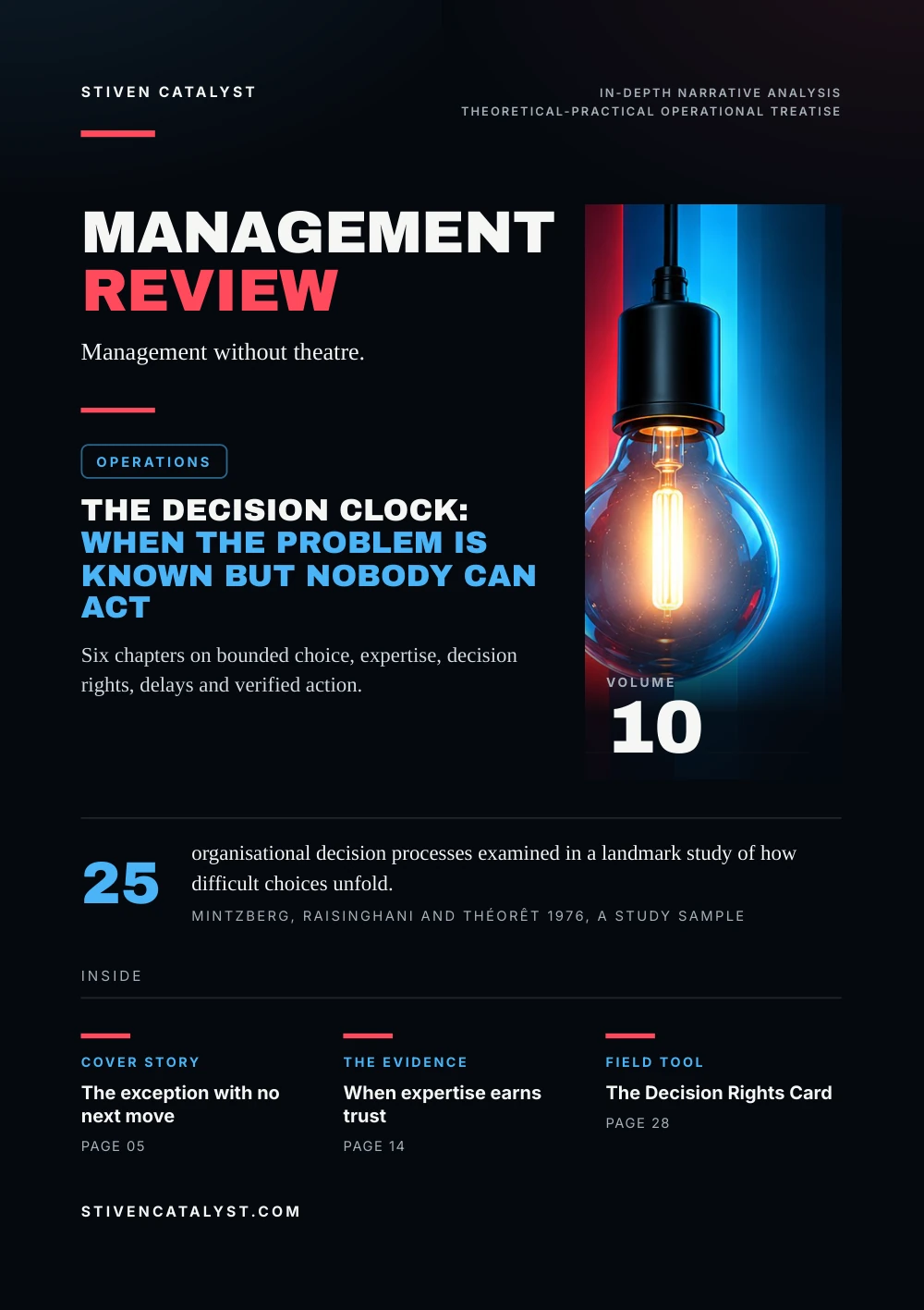
The decision clock: when the problem is known but nobody can act
Six chapters on bounded choice, expertise, decision rights, delays and verified action.
- Volume
- 10
- Chapters
- 6
- Pages
- 32
- Sources
- 11
- Online since
- 23 October 2026
How every chapter is built
- 1The living scene
A shift, a ramp, a desk at 03:00: one piece of work followed as it actually happens, with the hand-off where it breaks. Scenes are constructed from real categories of work and say so.
- 2The conce
p tual and scientific breakdownThe mechanism behind the scene, named with the model that explains it, and the research that tests it: the study, its population, its year and its limits, before it is applied anywhere else.
- 3The operating pro
t ocol for actionWhat a working team can try on Monday: fields, questions, a cadence and a count, each with an owner, a next step and a return of information to the people who do the work.
Theoretical-practical operational treatise
Management without theatre.
Operations
Six chapters on bounded choice, expertise, decision rights, delays and verified action.

Volume10
organisational decision processes examined in a landmark study of how difficult choices unfold.Mintzberg, Raisinghani and Théorêt 1976, a study sample
stivencatalyst.com
Editorial · Volume 10
The momentaf ter recognition
A problem can be known, verified and discussed while the next authorised decision remains absent.
How every chapter is built
- 1
The living scene
A shift, a ramp, a desk at 03:00: one piece of work followed as it actually happens, with the hand-off where it breaks. Scenes are constructed from real categories of work and say so.
- 2
The conceptual and scientific breakdown
The mechanism behind the scene, named with the model that explains it, and the research that tests it: the study, its population, its year and its limits, before it is applied anywhere else.
- 3
The operating protocol for action
What a working team can try on Monday: fields, questions, a cadence and a count, each with an owner, a next step and a return of information to the people who do the work.
The reading contract
Field
Real categories of operational work, no invented personal incidents.
Evidence
Each study is evidence for its own setting and a hypothesis elsewhere.
Action
Escalated is a transfer. Decided is a choice. Resolved is a verified outcome.
Contents
The chap ters,in three layers
Chapter IThe problem everyone could see05
1 SceneAn exception with no next move052 BreakdownThree clocks, one blocked flow063 ProtocolTrace the decision, not just the delay07Chapter IIThe limits of rational decisions08
1 SceneThe information that never ends082 BreakdownBounded rationality is not carelessness09Unstructured does not mean random103 ProtocolThe minimum sufficient brief11Chapter IIIThe expert under pressure12
1 SceneThe signal that feels familiar122 BreakdownRecognition before comparison13When intuition has earned trust143 ProtocolRespect the expert, test the premise15Chapter IVWho has the authority to act?16
1 SceneFour people know four pieces162 BreakdownExpertise coordination meets live dialogue17Three conditions for joined-up work183 ProtocolAuthority is a map, not a job title19Chapter VThe cost of waiting for permission20
1 SceneThe queue that has no vehicle202 BreakdownTwelve open items, counted by state21Fast decisions can use more evidence22Rules that make flexibility possible233 ProtocolMeasure the wait with honest denominators24Chapter VIDesigning the decision system25
1 SceneThe next turn without the expert252 BreakdownAct, interpret, revise the diagnosis263 ProtocolThe six-step decision discipline27
Also in this volume
- 04Research noteEvidence has a decision boundary
- 28Field toolThe Decision Rights Card
- 29Closing essayTen volumes, one operating question
- 30MethodWhere the claims come from
- 31SourcesSources and method
Research note
Evidence hasa decision boundary
Different research designs answer different questions. They cannot be combined into a universal countdown.
Herbert Simon (1955) challenged idealised rational choice by addressing the limits that shape real decisions. Mintzberg, Raisinghani and Théorêt (1976) examined 25 organisational decision processes, building a descriptive account of how unstructured choices unfold. Neither paper prescribes a response-time threshold for a warehouse. Klein, Calderwood and Clinton-Cirocco (1986) studied proficient fire-ground commanders under time pressure. Eisenhardt (1989) drew inductive propositions from eight microcomputer firms. Faraj and Xiao (2006) investigated coordination in a medical trauma centre, where consequences and expertise differ sharply from hotel or dispatch work. Kahneman and Klein (2009) identified conditions under which intuition may be trustworthy. Okhuysen and Bechky (2009) synthesised coordination theory, proposing accountability, predictability and common understanding as integrative conditions. Weick and Sutcliffe (2015) examine deference to expertise in high-reliability organising. These are complementary lenses, not eleven independent replications of one causal claim.
The protocols and indicators in this volume are original editorial proposals; no local before-and-after result has been measured. A hypothetical clock illustrates definitions, not a scientific estimate of how quickly a named business should decide.
A source is evidence for its own study and a hypothesis generator elsewhere.
Sources: Henry Mintzberg, Duru Raisinghani & André Théorêt, Administrative Science Quarterly 21(2), 1976; Kathleen M. Eisenhardt, Academy of Management Journal 32(3), 1989; Gerardo A. Okhuysen & Beth A. Bechky, Academy of Management Annals 3(1), 2009
Mintzberg et al. (1976); Eisenhardt (1989); Okhuysen and Bechky (2009). The counts are sample descriptors, not outcomes or local KPIs.
- 1Scene
- 2Breakdown
- 3Protocol
Chapter I · The problem everyone could see
An excep tionwith no next move
A delayed departure may be visible before anyone has decided what that visibility permits.
Constructed last-mile scene, not a documented incident
A route is scheduled to leave the loading area. A missing bag is reported. The driver is waiting; a supervisor knows about the exception; the team is trying to verify whether the load is complete. The departure clock continues to move. To an observer reading only the late-departure status, this may look like a problem of the driver being slow. But the physical work is not simply waiting for a faster person. It is waiting for a decision grounded in the right facts: what has been checked, whether the missing item is physically available and who is authorised to decide the next safe, permitted step. Repeating the instruction to hurry cannot supply that authority. Suppose the supervisor reports the issue again but nobody can confirm who will decide. Reporting has succeeded. Understanding may even have succeeded. Yet the next necessary move has not been accepted. The situation is not invisible. It is undecided.
The author has worked with missing bags, mixed trolleys, loading discipline, driver coordination and KPI discussion; those categories are documented. The particular route, people, sequence and outcome here are fictional. The scene illustrates the boundary between operational visibility and managerial action; it does not establish that a particular employer had an unclear escalation rule.
The position at which delay becomes visible is not necessarily the position that can resolve it.
Constructed scene based on documented work categories only; no person, site, timestamp or employer-specific decision process is claimed. The essay named below reads a red number as a signal to check, not a diagnosis.
- 1Scene
- 2Breakdown
- 3Protocol
Chapter I · The problem everyone could see
Three clocks,one blocked flow
Detection, authorisation and execution are different activities; a single delay number cannot separate them.
An operational event becomes actionable through several transitions. Someone first notices an exception. The team then verifies enough of the condition to describe a legitimate choice. A person or role with authority accepts responsibility for that choice. Only after the decision can the work move into execution and outcome verification. Calling all of this “decision time” conceals the mechanism. A long fact-check can protect safety and quality. A long wait caused by an absent owner is a different kind of delay. And a decision recorded quickly may still produce no benefit if implementation never begins. No timestamp by itself tells us which interval should have been shorter; an organisation should define the start and end of each interval before comparing cases.
Detection lag
Event to first reliable signal.
Verification interval
Signal to sufficient fact base.
Decision wait
Verified case to authorised decision.
Execution interval
Decision to action and checked outcome.
- 01
Detect
Exception seen.
- 02
Verify
Condition checked.
- 03
Decide
Authorised choice.
- 04
Act
Change executed.
Shortening the wrong interval can degrade the result. Verify the whole chain.
Sources: Herbert A. Simon, The Quarterly Journal of Economics 69(1), 1955; Gerardo A. Okhuysen & Beth A. Bechky, Academy of Management Annals 3(1), 2009
Editorial process segmentation informed by Simon (1955) and Okhuysen and Bechky (2009); no empirical effect of the four clocks is asserted. Chapter V counts a wholly invented example.
- 1Scene
- 2Breakdown
- 3Protocol
Chapter I · The problem everyone could see
Trace the decision,not just the delay
A short event trace can expose missing authority without identifying or blaming individual workers.
Define the event
The exception and what makes it relevant to the customer or the work standard.
Record what is known
Observed facts apart from reported claims and unknown conditions.
Identify the first choice
Which decision must be made before the work can safely move?
Name the authorised role
The actual delegation and escalation rule; never invent authority.
Record the handover
When sufficient information reached that role, and whether it was accepted.
Follow through
Execution, downstream effect and the next update if the case stays open.
The first experiment needs no complex dashboard. Review a small, anonymised sample of permitted events and look for decisions waiting without an owner; separate urgent hazards from ordinary exceptions. A note that a case was “escalated” is not evidence that someone decided: the receiver should be able to act on the information transferred, know the permitted alternatives and say what will happen next.
A signal becomes useful only when an authorised person can turn it into a checked next action.
Sources: Gerardo A. Okhuysen & Beth A. Bechky, Academy of Management Annals 3(1), 2009; Samer Faraj & Yan Xiao, Management Science 52(8), 2006
Proposed audit trail, not a workplace-certified procedure; inspired by Okhuysen and Bechky (2009) and Faraj and Xiao (2006).
- 1Scene
- 2Breakdown
- 3Protocol
Chapter II · The limits of rational decisions
The informationthat never ends
A manager can continue asking for certainty until the window for a useful choice has passed.
Constructed wholesale scene, not a claimed commercial incident
An independent reseller wants an answer about an urgent order. Sales knows the request. The warehouse has to confirm available stock and preparation capacity. A manager wants a reliable promise, so another update is requested, then another clarification. No one wants to mislead the partner, but the customer still cannot plan. There are legitimate reasons to pause: physical availability, order terms and capacity may be uncertain. There are also limits to the value of additional information. If the next update cannot materially change the permitted choices, waiting for complete certainty may simply postpone a necessary explanation to the customer. What should the manager do with a choice that cannot be made perfectly? Not guess. Identify the minimum sufficient evidence for a safe, authorised decision, record what remains uncertain and communicate the actual commitment rather than an attractive one. Sometimes the correct decision is that no promise can yet be confirmed; that decision still has an owner and a next update.
The author previously managed a wholesale network of 61 active resellers and coordinated commercial, warehouse and financial work. That experience supports the categories, not this fabricated order: there is no documented conversation, delivery failure or specific delay behind the scene.
Not every unanswered question is necessary to the next decision.
Source: Herbert A. Simon, The Quarterly Journal of Economics 69(1), 1955
Constructed wholesale illustration; Simon (1955) provides the conceptual lens, and no observed behaviour is attributed to a named business. The essay named below is about those 61 resellers and trust.
- 1Scene
- 2Breakdown
- 3Protocol
Chapter II · The limits of rational decisions
Bounded rationalit yis not carelessness
Herbert Simon questioned the model of an actor who can know and compare every relevant option.
Simon's 1955 behavioural model of rational choice examines decisions under realistic limitations. Attention, information and the ability to evaluate alternatives are finite. A person may seek an option that satisfies the relevant requirements without calculating the theoretical best of all possible futures. That is not permission to disregard evidence; it is a way to recognise the conditions under which choices are made. A real operational decision should therefore begin with its constraints. Which action is prohibited? What is irreversible? What information is essential to prevent a harmful mistake? What may be learned after an authorised, reversible trial? A routine allocation with clear limits may justify a defined delegation and quick review; a security, safety or sensitive financial exception may require a pause, a different level of authority and an explicit audit trail. Treating both as equivalent in an average “decision time” metric would reward the wrong behaviour.
Constraint
What must never be traded away?
Sufficiency
Which evidence changes the choice?
Reversibility
What can be tested and undone?
A useful manager's rule is neither “get more information” nor “decide immediately” in isolation. It is: learn what fact would alter the set of permissible actions, obtain that fact when possible, then decide at the proper authority level. If a fact is unobtainable, make the uncertainty visible.
Fast enough means fast enough for the risk, not simply fast.
Source: Herbert A. Simon, The Quarterly Journal of Economics 69(1), 1955
Conceptual interpretation of Simon (1955), Quarterly Journal of Economics 69(1). The three-card managerial test is an editorial proposal, not Simon's own taxonomy.
- 1Scene
- 2Breakdown
- 3Protocol
Chapter II · The limits of rational decisions
Unstructureddoes not mean random
Mintzberg and colleagues described recurring patterns in decisions that had no simple ready-made answer.
Their model identified major phases of identification, development and selection, as well as supporting routines and dynamic factors. Its contribution was descriptive: difficult decisions have structure, even when the process is not linear. This matters because the familiar instruction to “just decide” can hide two different deficits. The organisation may not have identified the problem accurately. Or it may have identified the problem but failed to develop a permissible response. In either case, selection is not yet a genuine choice; a signature does not repair what the earlier work failed to establish. The phases below are translated into operational questions. They are not a reproduction of the authors' diagram, and they do not claim that a five-minute shift decision behaves like a corporate investment decision: the research studied organisational decisions, not hotel night-audit exceptions or dispatch routes. A decision can revisit an earlier phase when new evidence arrives; that return should be deliberate and recorded, not disguised as endless committee discussion.
- 01
Identify
What is the actual issue?
- 02
Develop
What feasible actions exist?
- 03
Select
Who chooses, and on what basis?
Selection without an identified problem and workable alternatives is merely motion.
Source: Henry Mintzberg, Duru Raisinghani & André Théorêt, Administrative Science Quarterly 21(2), 1976
Mintzberg, Raisinghani and Théorêt (1976), Administrative Science Quarterly 21(2). The phases are abbreviated for the editorial diagram.
- 1Scene
- 2Breakdown
- 3Protocol
Chapter II · The limits of rational decisions
The minimumsufficient brief
Give an authorised decision maker what changes the choice, and label what is still unknown.
State the decision question
An action to choose, not a vague request for guidance.
Define the hard limits
The non-negotiable safety, privacy, legal and operational rules.
Separate facts from assumptions
Observations, known constraints and explicit unknowns.
Offer permissible alternatives
Including the safe default when a decision cannot be supported.
Name reversibility
What can be undone, monitored or checked after the choice.
Set the next information point
Who updates the decision maker when the uncertainty changes.
A good brief may lead to the conclusion “do not proceed yet”, a legitimate decision when the conditions for safe action are unmet. The format is small because a brief exists to make judgement possible, not to recreate the whole history of the case. Before adopting it, a workplace should check how it fits existing authority, data-protection rules and incident reporting: a two-line decision log is no alternative to a mandatory formal record.
Enough information is the information required for an authorised, defensible choice.
Sources: Herbert A. Simon, The Quarterly Journal of Economics 69(1), 1955; Henry Mintzberg, Duru Raisinghani & André Théorêt, Administrative Science Quarterly 21(2), 1976
Original editorial protocol informed by Simon (1955) and Mintzberg et al. (1976), not a validated decision aid.
- 1Scene
- 2Breakdown
- 3Protocol
Chapter III · The expert under pressure
The signalthat feels familiar
Experience can accelerate recognition. It can also make an unfamiliar situation look deceptively familiar.
Constructed dispatch scene, not a recorded escalation
A dispatcher receives a message that a scheduled route is falling behind. The visible status resembles problems encountered before. The temptation is to move straight to the familiar explanation: a loading delay, a late start or a route obstacle. An experienced colleague may recognise a pattern quickly, and that recognition could save time, provided the pattern actually fits. The message alone does not show every condition. A reported delay might already have been corrected; another stage might be responsible; the data may have been refreshed at a different interval. Acting on the first plausible story can waste the same minutes that slow deliberation wastes. A more defensible response begins with the expert's hypothesis and asks what observation could falsify it. If the signal is urgent, the authorised escalation begins promptly; the dispatcher can still distinguish the apparent pattern from the facts checked.
The author's background includes coordinating drivers and vehicles in last-mile work, including remote dispatch. The precise software, route, telephone exchange and outcome here are fictional; no documented event is claimed in which a particular dispatcher made a mistaken intuitive choice. Experience is powerful when it narrows attention to the right questions rather than exempting the decision from verification.
Expertise should accelerate the search for relevant evidence, not remove the need for evidence.
Sources: Gary A. Klein, Roberta Calderwood & Anne Clinton-Cirocco, Proceedings of the Human Factors Society Annual Meeting 30(6), 1986; Daniel Kahneman & Gary Klein, American Psychologist 64(6), 2009
Constructed dispatch scenario; relevant research: Klein, Calderwood and Clinton-Cirocco (1986); Kahneman and Klein (2009). The essay named below follows a tour the driver does not understand.
- 1Scene
- 2Breakdown
- 3Protocol
Chapter III · The expert under pressure
Recognitionbefore comparison
A classic fire-ground study described experienced decision makers working differently from textbook option lists.
Gary Klein, Roberta Calderwood and Anne Clinton-Cirocco (1986) used critical-incident protocol analysis with proficient fire-ground commanders. At fewer than 12% of the reported decision points did the researchers find evidence of simultaneously comparing two or more options. In that setting, commanders most commonly recognised a familiar pattern and identified a plausible action; the work contributed to the recognition-primed decision perspective. The result is sometimes retold as evidence that experts never compare alternatives. That would be too strong: the figure concerns this study's observed decision points, not all experts or all decisions, and it is no evidence that a hotel receptionist or dispatcher should operate like a fire commander. Consequences, training, repetition and available feedback differ. The transferable insight is narrower. Expert recognition can produce a workable first option without exhaustive comparison; the next safeguard is to ask whether that option fits the observed constraints, and mental rehearsal, where feasible, can reveal a reason it will not work before the action is launched. In unfamiliar, high-stakes or weakly patterned situations, fast recognition may be less reliable, and teams should know how to stop a false pattern from becoming an instruction.
Recognition is a description of expert practice, not permission to skip required controls.
Source: Gary A. Klein, Roberta Calderwood & Anne Clinton-Cirocco, Proceedings of the Human Factors Society Annual Meeting 30(6), 1986
Klein, Calderwood and Clinton-Cirocco (1986), Proceedings of the Human Factors Society Annual Meeting 30(6). A descriptive finding only.
- 1Scene
- 2Breakdown
- 3Protocol
Chapter III · The expert under pressure
When intuitionhas earned trust
Kahneman and Klein agreed that confidence feels persuasive but does not validate the underlying judgement.
In 2009, Daniel Kahneman and Gary Klein compared two research traditions often presented as rivals: studies of heuristics and biases, and studies of naturalistic decision making. Their shared conclusion was conditional. The likely quality of intuitive judgement depends on whether the environment has learnable regularities and whether the practitioner has had an adequate chance to learn them through feedback. This is a more demanding standard than years of service. A worker may have spent years responding to repeated situations without reliable information about which early judgements were correct. Familiarity with a dashboard's colour is not the same as knowing the causal mechanism behind it, and rapid action becomes overconfidence when the task has changed but the person has not noticed. A manager weighing expert advice can ask two questions: is this a situation with patterns that can realistically be learned, and has the expert had clear and timely outcome feedback in similar situations? The answer may differ between a familiar process exception and the cause of a rare system failure.
Regularity
Is the environment learnable?
Feedback
Did prior outcomes correct judgement?
Boundary
Is this problem inside real expertise?
None of this supports ignoring qualified colleagues or demanding unrealistic statistical proof for every routine decision. It supports matching reliance on intuition to the validity of the task and keeping a clear path to further verification.
Confidence is a feeling. Reliability is a property to be checked.
Source: Daniel Kahneman & Gary Klein, American Psychologist 64(6), 2009
Kahneman and Klein (2009), American Psychologist 64(6), 515–526. The three-card questions are an editorial translation.
- 1Scene
- 2Breakdown
- 3Protocol
Chapter III · The expert under pressure
Respect the exper t,test the premise
Fast expert input becomes more useful when the manager knows which assumption the proposed action depends on.
Ask what pattern was recognised
The expert's working hypothesis, not presented as confirmed fact.
Check the key distinguishing fact
An observation that could make the diagnosis wrong.
Locate the expertise boundary
Does the adviser have relevant experience in this class of situation?
Respect the authorised decision role
Expertise is an input; rules of delegation or approval are not bypassed.
Make the next action explicit
The chosen permitted response and the condition that would trigger review.
Return outcome feedback
Whether the premise held and what changed, without turning every error into blame.
A quick review is useful only when it tests a consequential premise; it must not become a ritual of six questions while an immediate hazard continues. In urgent cases, authorised safety measures take precedence and learning follows containment. A small practice test could review anonymised decisions and ask how often a key assumption was identified in advance and revisited after the outcome: that measures discipline of thought, not the probability that intuition will succeed.
The best use of expertise is a faster route to a better question and a lawful next action.
Sources: Gary A. Klein, Roberta Calderwood & Anne Clinton-Cirocco, Proceedings of the Human Factors Society Annual Meeting 30(6), 1986; Daniel Kahneman & Gary Klein, American Psychologist 64(6), 2009
Original operating protocol informed by Klein et al. (1986) and Kahneman and Klein (2009).
- 1Scene
- 2Breakdown
- 3Protocol
Chapter IV · Who has the authority to act?
Four peopleknow four pieces
A problem may cross roles that understand different parts of it, none of whom owns the complete decision.
Constructed cross-shift hotel scene, no real guest or incident
A room concern has been recorded during an earlier hotel shift. The night colleague knows what the guest reported and what was handed over. A specialist team understands the technical condition. Another role knows what customer-facing commitment can be made. Each person may have accurate information, but an unresolved case still requires a choice about the next permissible step. The handover might say “follow up” without identifying who is to make that decision. One person assumes the specialist will decide; the specialist assumes reception will communicate; reception assumes management will authorise a commitment. The problem is not necessarily incompetence or unwillingness. It can be the design of the boundaries between knowledgeable people and authorised people. The next person should not need to reconstruct every previous call simply to learn who can decide: the case should carry a verified condition, a responsible receiving role and the next approved communication commitment.
The author's Night Audit experience includes documented categories of room problems and shift handovers. No evidence is available for the precise conversation, room, timing, customer reaction or chain of responsibility described here; the scene is a composite meant to expose a general coordination mechanism, without revealing any hotel's internal security, payment or escalation procedures.
Knowing a problem, owning the next step and being authorised to decide are different roles.
Sources: Samer Faraj & Yan Xiao, Management Science 52(8), 2006; Gerardo A. Okhuysen & Beth A. Bechky, Academy of Management Annals 3(1), 2009
Constructed hotel illustration; the applicable scholarship is Faraj and Xiao (2006) and Okhuysen and Bechky (2009). The essay named below says what the driver, the dispatcher and the manager each see.
- 1Scene
- 2Breakdown
- 3Protocol
Chapter IV · Who has the authority to act?
Exper tise coordinationmee ts live dialogue
Fast-response work relies on knowledge distributed across people who cannot all hold the same view.
Samer Faraj and Yan Xiao (2006) examined coordination in a medical trauma centre. They distinguished expertise-coordination practices, including protocols, knowledge sharing and flexible teaming, from dialogic practices used when novel events demanded joint sensemaking and cross-boundary intervention. The study shows how specialised actors coordinate without reducing every difficult choice to a fixed handoff. Its setting matters: a trauma centre has professional roles, urgency and potential harm that are not interchangeable with dispatch, wholesale sales or hotel operations, and its discussion of protocol breaking is not advice to bypass procedures in another industry. The relevant transfer is the distinction between prepared coordination and the conversation needed to make sense of an unexpected condition. An operation needs stable pathways for common situations; when the situation does not fit them, it needs a way to bring the relevant experts together quickly and identify who has decision authority. Escalation that only forwards a message may increase activity and still leave the case stalled.
- 01
Routine
Known rules and roles.
- 02
Novel event
Joint sensemaking.
- 03
Authority
Permitted decision.
- 04
Outcome
Feedback to each role.
Prepared coordination and real-time dialogue are complements, not substitutes.
Source: Samer Faraj & Yan Xiao, Management Science 52(8), 2006
Faraj and Xiao (2006), Management Science 52(8), 1155–1169. Expertise without a clear decision right can be ignored; a decision right without access to expertise can be exercised badly. Cross-sector implications are editorial.
- 1Scene
- 2Breakdown
- 3Protocol
Chapter IV · Who has the authority to act?
Three conditionsfor joined-up work
Coordination is not the number of messages exchanged. It is the condition of being able to act together.
Okhuysen and Bechky (2009) synthesised research on coordination across organisational settings. Their framework argues that mechanisms such as routines, schedules, meetings and plans help create three integrative conditions: accountability, predictability and common understanding. The categories are useful for diagnosing why information can travel while action stalls. Accountability asks which person or role is answerable for the next decision and outcome. Predictability asks whether the other parties can anticipate what that role will do and when it will respond. Common understanding asks whether the parties share enough of the situation to coordinate without repeatedly rebuilding the story. The conditions are distinct: a named owner without adequate facts may decide poorly; a detailed report with no owner may be filed indefinitely; a schedule nobody trusts coordinates nothing. The article is an integrative conceptual review, not a randomised test of a checklist; it provides a lens for a local pilot that still needs definitions and measurement.
Accountability
Who accepts the decision and outcome?
Predictability
When and how will that role respond?
Common view
What facts and limits are shared?
A message has travelled successfully only when the receiver understands what they can do next.
Source: Gerardo A. Okhuysen & Beth A. Bechky, Academy of Management Annals 3(1), 2009
Okhuysen and Bechky (2009), Academy of Management Annals 3(1), 463–502. The questions are an editorial adaptation.
- 1Scene
- 2Breakdown
- 3Protocol
Chapter IV · Who has the authority to act?
Authorit y is a map,not a job title
Before an exception occurs, define the role of the observer, the expert, the decision owner and the communicator.
List recurring decision classes
One narrow class of operating exception, not “all incidents”.
Identify the authorised owner
Existing delegation, policy and legal requirements.
Define the fact threshold
What must be known before that person can decide?
Name a safe holding state
The permitted containment or pause while the decision is pending.
Set an escalation trigger
When, and to which authorised role, the issue moves if no decision occurs.
Confirm the communication duty
Who tells affected workers or customers what the decision means.
A generalised chart may contain four functions: notice, advise, decide and communicate. One person may perform several, but that must be intentional rather than assumed. A chart for a particular hotel or logistics employer is made and approved by the responsible organisation; this publication cannot assign real privileges, and for sensitive or hazardous work no editorial map substitutes for authorised policy. The map is a test of clarity: can the team explain the next permitted move without inventing a new chain of command?
Deference to expertise is not abdication of accountability; both must be designed.
Sources: Gerardo A. Okhuysen & Beth A. Bechky, Academy of Management Annals 3(1), 2009; Samer Faraj & Yan Xiao, Management Science 52(8), 2006
Editorial role design inspired by Okhuysen and Bechky (2009) and Faraj and Xiao (2006); not an authorised chart.
- 1Scene
- 2Breakdown
- 3Protocol
Chapter V · The cost of waiting for permission
The queuethat has no vehicle
An operation can develop a queue of unresolved choices even when no physical material is accumulating.
Hypothetical loading-ramp illustration; times and people invented
Imagine a morning when a loading exception has been checked. The items are not where the team expected, but the physical condition is now clear. The driver cannot change the approved process; the supervisor has reported the case; a person with the required authority is considering the next permissible step. Work is not moving, although the missing information is no longer the main cause of delay. This is a decision queue. Unlike a trolley line, it has no obvious physical length: it may exist across messages, approval requests, follow-up calls and separate screens. To a manager looking at one department's task list, each person may appear busy and compliant. To the customer, the outcome remains late. Not all waiting is waste. Permission may protect money, safety, contractual commitments or the integrity of the process. The managerial question is what the waiting accomplishes: a genuine verification interval buys evidence; an unowned request simply makes the next commitment harder to keep.
The categories of loading exceptions and communication are grounded in the author's last-mile background, but the timing, escalation and resolution described here are not documented and must not be assigned to an actual employer. The case serves only to clarify what an analyst would need to record before making an operational claim.
The absence of movement may mean a necessary hold, a missing fact or an ownerless decision.
Constructed illustration; the categorisation of waiting as a decision queue is editorial, not a measured characteristic of any company. The essay named below is about the limit of one's own decision.
- 1Scene
- 2Breakdown
- 3Protocol
Chapter V · The cost of waiting for permission
Twelve open items,counted by state
A fully synthetic snapshot shows how a decision queue can be made visible by naming the state of each open case.
Synthetic example, authored for this volume; not employer data
Invented snapshot at 10:00, twelve open exceptions
Every count is invented so the states can be compared, not measured at any station. On a single task list these twelve items would all read “open”. Named by state, the largest group is the one nobody can shorten by working harder: four cases are verified and still have no owner who has accepted the decision. Three are legitimately waiting for facts, one is waiting for execution, two were executed without anyone checking the result. A real operation has its own states and its own authorised owners; the chart shows only that a queue of decisions becomes manageable once each case says which clock it is waiting on.
An “open” count hides the ownerless cases. A count by state puts them first.
Source: Gerardo A. Okhuysen & Beth A. Bechky, Academy of Management Annals 3(1), 2009
Every value on this page is synthetic, authored for this volume; the states follow the four clocks of Chapter I. The author's PDF describes the decision queue without counting it.
- 1Scene
- 2Breakdown
- 3Protocol
Chapter V · The cost of waiting for permission
Fast decisionscan use more evidence
An inductive study of fast-moving technology firms challenged the claim that rapid decisions require less information.
Kathleen Eisenhardt (1989) investigated strategic decision making in eight firms from the high-velocity microcomputer industry. In that context, faster decision makers used more real-time information, developed more alternatives and used a two-tiered advice process; conflict resolution and the integration of strategy with tactical plans also mattered. This is not a randomised experiment, and it concerns executives making strategic choices, not a dispatcher clearing a route. The practical lesson is not “collect everything”. It is to distinguish real-time, decision-relevant evidence from information gathered because nobody knows when to stop. A brief that shows the current condition, alternatives and their consequences supports a timely decision better than an escalating pile of status emails. A disciplined team prepares the facts before the decision maker becomes available and identifies which disputes must be resolved rather than allowed to travel silently into execution. The fastest wrong decision is not a good outcome; neither is the slowest risk-free conversation.
Timeliness can depend on preparing a better information flow, not merely pressuring people to reply.
Source: Kathleen M. Eisenhardt, Academy of Management Journal 32(3), 1989
Eisenhardt (1989), Academy of Management Journal 32(3), 543–576. The study offers propositions for a specific industry; applicability to frontline service operations is proposed, not tested.
- 1Scene
- 2Breakdown
- 3Protocol
Chapter V · The cost of waiting for permission
Rules thatmake flexibilit y possible
Strong decision structures can enable adaptation rather than merely slow it.
Bigley and Roberts (2001) investigated the Incident Command System as used by a fire department. Their inductive research examined how a formal structure could support flexible and reliable action in complex and volatile settings. The study counters an easy caricature: not every hierarchy is bureaucratic delay, and not every decentralised action is adaptive. The design challenge is a balance of boundaries and access. The organisation must say what cannot be decided locally; it must also make the route to an authorised decision understandable and workable. When an unexpected condition emerges, workers need a way to bring specialised evidence into the decision without rewriting the authority structure from scratch. Weick and Sutcliffe (2015) discuss “deference to expertise” in high-reliability organising: a principle about mobilising relevant knowledge, not about handing decision rights to whoever speaks with the most confidence. Nothing in these studies authorises an operations manager to copy emergency command procedures into hospitality or last-mile logistics; local law, training, safety and policy control the real design. The transferable question is whether the approved hierarchy makes informed, lawful action possible at the pace the situation demands.
Structure
Know who may decide what.
Expertise
Know whose evidence to consult.
Escalation
Know how the two are connected.
Good authority design can reduce uncertainty without weakening necessary safeguards.
Sources: Gregory A. Bigley & Karlene H. Roberts, Academy of Management Journal 44(6), 2001; Karl E. Weick & Kathleen M. Sutcliffe, Wiley, 2015
Bigley and Roberts (2001), Academy of Management Journal 44(6); Weick and Sutcliffe (2015), Managing the Unexpected, 3rd edition, chapter 7.
- 1Scene
- 2Breakdown
- 3Protocol
Chapter V · The cost of waiting for permission
Measure the waitwith honest denominat ors
Timing data can locate a bottleneck, but it cannot establish fault or justified urgency by itself.
Synthetic example, authored for this volume; not employer data
One invented decision, 36 minutes in all
In this fully hypothetical case, 11 minutes confirm the condition, 17 pass from verified brief to authorised choice and 8 from decision to checked execution: 36 minutes in all, of which the decision wait is 17/36, about 47.2%. None of these numbers was collected from the author's employers, and 17 minutes is an illustration, not an acceptable benchmark. A local pilot records four timestamps only where a reliable and lawful source exists: first signal, verified brief, authorised decision and confirmed action. Missing times are marked “not measured”, never zero. Justified holds are logged apart from unowned waiting, and the class of problem is recorded so a routine exception is not compared with a safety-critical decision. The sample includes unresolved cases, not only decisions that reached completion; otherwise an organisation reports an attractive response time by excluding its longest waits.
Measure time to a useful decision together with time to a verified result.
Source: Kathleen M. Eisenhardt, Academy of Management Journal 32(3), 1989
All times and ratios are invented for a reproducible arithmetic example, as in the author's PDF; the indicator design is editorial and unvalidated. Review how often the owner was known and whether the outcome was verified.
- 1Scene
- 2Breakdown
- 3Protocol
Chapter VI · Designing the decision system
The next turnwithout the exper t
A decision routine is most valuable when it still works after the person who invented it has left the shift.
Constructed cross-shift scene, no claimed personal result
A recurring operational exception appears near a shift change. The experienced colleague can usually tell the team whom to contact and which fact to check first. Today that colleague is leaving. The next shift receives a short note: the condition is verified, a decision is still pending and the receiving role has been named. The work is not magically solved, but it has not been reset to the beginning. Contrast that with a second version. The outgoing colleague writes “still investigating”. No one records what was verified, which decision remains or who has accepted the case. The next team spends time discovering the same facts. The failure is not simply poor memory; it is a lack of continuity in the decision process. Tucker and Edmondson (2003) studied nurses' responses to failures in nine hospitals and examined why local fixes do not always become system learning: a comparison, not proof about this shift. An effective handover need not record every conversation. It must preserve what enables the next authorised choice.
Neither version describes a documented incident from the author's hotel or logistics work. That is the significance of Volume 10 within this series: observation identifies conditions, a map locates the stalled flow, metrics signal exceptions, training equips people, speaking up supplies evidence, recovery protects the customer. Unless the chain carries a legitimate decision into a checked action, the system can remain busy without making progress.
A good decision system survives the shift boundary without erasing what has already been learned.
Sources: Anita L. Tucker & Amy C. Edmondson, California Management Review, 2003; Gerardo A. Okhuysen & Beth A. Bechky, Academy of Management Annals 3(1), 2009
Constructed comparison; editorial synthesis informed by Tucker and Edmondson (2003) and Okhuysen and Bechky (2009). The essay named below says the industry changes and the management problems do not.
- 1Scene
- 2Breakdown
- 3Protocol
Chapter VI · Designing the decision system
Act, interpre t,revise the diagnosis
Decision making does not end when a choice is recorded; the outcome can change what the team knows.
Rudolph, Morrison and Carroll (2009) developed a theory of action-oriented problem solving using an iterative, simulation-based modelling approach. Their model links acting, interpreting and cultivating diagnoses, showing how feedback affects opportunities for adaptive problem solving. This is a conceptual and modelling contribution, not a controlled trial of a particular decision card. A practical decision system therefore requires two commitments: to make a permitted choice when the conditions for it are met, and to watch what follows and be willing to revise the interpretation. A decision accepted by a manager may be well documented and still fail to change the original constraint; that failure is information, not evidence that the record should be closed. The improvement question is not merely whether the escalation was answered, but whether the action addressed the right mechanism and whether any unexpected downstream cost appeared. Repeated safe failures can identify a defect in a decision rule, a missing source of expertise or an unrealistic standard. There is no single perfect decision time: the appropriate period depends on risk, irreversibility, authority and the opportunity to verify, and an urgent hazard and a routine supplier clarification should not share one arbitrary countdown.
- 01
Observe
The condition.
- 02
Choose
An authorised action.
- 03
Check
The actual effect.
- 04
Learn
Revise the rule if needed.
The decision is a hypothesis about what action will help. The outcome supplies its test.
Source: Jenny W. Rudolph, J. Bradley Morrison & John S. Carroll, Academy of Management Review 34(4), 2009
Rudolph, Morrison and Carroll (2009), Academy of Management Review 34(4), 733–756. The operating ribbon is editorial.
- 1Scene
- 2Breakdown
- 3Protocol
Chapter VI · Designing the decision system
The six-stepdecision discipline
A compact protocol for ordinary operating decisions, bounded by the real authority and safety rules of the workplace.
Identify
The verified problem and why a choice is needed now; fact apart from hypothesis.
Assess
The risk of acting, the risk of waiting, what is reversible and what evidence is essential.
Authorise
The role legally and operationally permitted to decide, through existing escalation.
Decide
The selected permissible action, owner, reason and review condition, recorded.
Verify
Whether implementation happened and the intended result was achieved.
Learn
The finding returned to the team; the standard changed only through the approved process.
This discipline is no licence to override financial controls, security or safety rules or confidential hotel procedures. When a hazard is immediate, the authorised emergency pathway applies; when uncertainty makes action unsafe, “hold and escalate” may be the right outcome. To test the protocol, take one permitted class of recurring problem and document a few anonymised cases, tracking time and quality together: was the owner clear, was the decision authorised, did the action help, was the outcome communicated? The framework has not been validated in the author's workplaces.
A decision is only finished when someone can account for what happened next.
Sources: Herbert A. Simon, The Quarterly Journal of Economics 69(1), 1955; Jenny W. Rudolph, J. Bradley Morrison & John S. Carroll, Academy of Management Review 34(4), 2009
Six-stage editorial synthesis after Simon (1955) and Rudolph et al. (2009); not a validated procedure.
Field tool
The DecisionRights Card
One issue. One authorised decision. One checked outcome. Use only with non-sensitive sample data or inside approved systems; if the decision is pending, write “pending”, assign the approved owner and keep the next review commitment.
01The problem and its evidencewhat was directly verified? what is only reported or assumed?
02Risk and consequence of waitingwhat deteriorates while no decision is made? what requires immediate escalation?
03Decision question and permitted alternativeswhich action is needed, and which options are actually authorised?
04Decision owner and checkpointwhich role accepts the choice? by when is the next update required?
05Action, status and outcomewhat was decided, done and observed? what is still open?
06Learning returned to the teamwhat did this case teach about the rule, training or information flow?
Sources: Gerardo A. Okhuysen & Beth A. Bechky, Academy of Management Annals 3(1), 2009; Herbert A. Simon, The Quarterly Journal of Economics 69(1), 1955
A proposed management aid, not a legal delegation document or a substitute for an incident system. Do not publish employee, guest, payment, route-security or confidential operational details. Escalated is a transfer; decided is a choice; resolved is a verified outcome.
Closing essay
Ten volumes,one operating question
Can an organisation turn what it knows into a responsible result that survives the next shift?
The first nine volumes asked different questions of the same world of operations. Go to the work. Follow the flow. Challenge the machine's apparent certainty. Make standards survive. Understand capacity. Resist misleading targets. Hear the people. Verify training. Recover the promise to the customer. The tenth volume asks what happens when those disciplines have succeeded. A problem is visible, the process mapped, the metric understood, the staff member heard. The customer still needs an answer. Who can act, and who will check whether that action helped? Speed is not automatically a virtue. A deliberate pause may protect people or a process, while an unowned delay hides a lack of accountability. The remedy is neither heroic improvisation nor another form for every exception. It is clarity about facts, risk, expertise, authority and outcome. A manager's legacy is not the number of decisions personally signed. It is whether successors can recognise a problem, reach the right expertise, act within their rights and learn from the result. That is how responsible judgement outlives the shift.
Volumes 1 to 5
- Gemba: see the real work.
- Value stream mapping: trace the whole flow.
- The human override: question automated certainty.
- When improvement fades: protect the standard.
- The capacity trap: understand pressure and queues.
Volumes 6 to 10
- The KPI trap: measure the real outcome.
- The cost of silence: hear what staff know.
- The training illusion: prove readiness to act.
- The recovery gap: close the customer consequence.
- The decision clock: turn evidence into owned action.
A problem does not become smaller while everyone waits for someone else to decide.
Editorial conclusion to the first cycle of ten volumes. No decision bottleneck, delayed case or stalled escalation is attributed to any named employer.
Method
Where the claimscome from
An evidence-informed editorial synthesis, not original field research: eleven reference works, conceptual theory, qualitative studies, an inductive firm study and research on expert judgement, each with its limits. Scenes, the time example and the field tool are editorial, not local measurements.
Theory
Simon (1955), Okhuysen and Bechky (2009), Rudolph et al. (2009) and Weick and Sutcliffe (2015) describe mechanisms and conditions, not measured rates.
Field studies
25 decision processes (Mintzberg et al. 1976); fire-ground commanders, fewer than 12% of decision points with option comparison (Klein et al. 1986); 8 firms (Eisenhardt 1989); an incident command system (Bigley and Roberts 2001); 9 hospitals (Tucker and Edmondson 2003); a trauma centre (Faraj and Xiao 2006).
Expert judgement
Kahneman and Klein (2009): intuition deserves trust where the environment is regular and feedback was adequate; a condition, not a licence.
Invented counts
Twelve open items by state (3, 2, 4, 1, 2) and the 36-minute decision (11, 17, 8; 17/36 ≈ 47.2%) are illustrations flagged on their pages; no proportion is a benchmark.
The Decision Rights Card, the minimum sufficient brief, the authority map and the six-step discipline are editorial proposals for local testing, not validated decision aids or employer-approved delegation. Publisher records were checked for every source; paywalled papers were not represented as read in full. Editorial standard: a theory, a field study, an expert-judgement finding and a proposal are named as such, and the sentence stops claiming where the evidence stops.
Sources: Herbert A. Simon, The Quarterly Journal of Economics 69(1), 1955; Henry Mintzberg, Duru Raisinghani & André Théorêt, Administrative Science Quarterly 21(2), 1976; Gary A. Klein, Roberta Calderwood & Anne Clinton-Cirocco, Proceedings of the Human Factors Society Annual Meeting 30(6), 1986; Kathleen M. Eisenhardt, Academy of Management Journal 32(3), 1989; Gregory A. Bigley & Karlene H. Roberts, Academy of Management Journal 44(6), 2001; Anita L. Tucker & Amy C. Edmondson, California Management Review, 2003; Samer Faraj & Yan Xiao, Management Science 52(8), 2006; Daniel Kahneman & Gary Klein, American Psychologist 64(6), 2009; Gerardo A. Okhuysen & Beth A. Bechky, Academy of Management Annals 3(1), 2009; Jenny W. Rudolph, J. Bradley Morrison & John S. Carroll, Academy of Management Review 34(4), 2009; Karl E. Weick & Kathleen M. Sutcliffe, Wiley, 2015
Every source is cited at its DOI on the next page; the eleven records, their journals, volumes and years were checked against the publishers' metadata and abstracts.
Sources and method
Where the claimscome from
The figures in this volume come from the sources below, each with its year. The scenes are constructed; the protocols are proposals; what is research is named as research.
- A Behavioral Model of Rational ChoiceHerbert A. Simon, The Quarterly Journal of Economics 69(1), 1955https://doi.org/10.2307/1884852
- The Structure of "Unstructured" Decision ProcessesHenry Mintzberg, Duru Raisinghani & André Théorêt, Administrative Science Quarterly 21(2), 1976https://doi.org/10.2307/2392045
- Rapid Decision Making on the Fire GroundGary A. Klein, Roberta Calderwood & Anne Clinton-Cirocco, Proceedings of the Human Factors Society Annual Meeting 30(6), 1986https://doi.org/10.1177/154193128603000616
- Making Fast Strategic Decisions in High-Velocity EnvironmentsKathleen M. Eisenhardt, Academy of Management Journal 32(3), 1989https://doi.org/10.5465/256434
- The Incident Command System: High-Reliability Organizing for Complex and Volatile Task EnvironmentsGregory A. Bigley & Karlene H. Roberts, Academy of Management Journal 44(6), 2001https://doi.org/10.5465/3069401
- Why Hospitals Don't Learn from FailuresAnita L. Tucker & Amy C. Edmondson, California Management Review, 2003https://cmr.berkeley.edu/2003/02/45-2-why-hospitals-dont-learn-from-failures-organizational-and-psychological-dynamics-that-inhibit-system-change
- Coordination in Fast-Response OrganizationsSamer Faraj & Yan Xiao, Management Science 52(8), 2006https://doi.org/10.1287/mnsc.1060.0526
- Conditions for intuitive expertise: A failure to disagreeDaniel Kahneman & Gary Klein, American Psychologist 64(6), 2009https://doi.org/10.1037/a0016755
- Coordination in Organizations: An Integrative PerspectiveGerardo A. Okhuysen & Beth A. Bechky, Academy of Management Annals 3(1), 2009https://doi.org/10.1080/19416520903047533
- The Dynamics of Action-Oriented Problem Solving: Linking Interpretation and ChoiceJenny W. Rudolph, J. Bradley Morrison & John S. Carroll, Academy of Management Review 34(4), 2009https://doi.org/10.5465/amr.34.4.zok733
- Managing the Unexpected, 3rd edition, chapter 7: Principle 5, Deference to ExpertiseKarl E. Weick & Kathleen M. Sutcliffe, Wiley, 2015https://doi.org/10.1002/9781119175834.ch07
Management without theatre.
Every volume, one question about operations, followed from the floor to the protocol and tested against research.
All volumes
stivencatalyst.com/magazine/operational-treatise.html
Operational Treatise · Volume 10 · October 2026 · Stiven Catalyst
Click or swipe a page to turn it. The arrow keys work too.
Operational Treatise · Volume 10
The figures of the volume
The charts of the printed pages, with their sources. Invented examples are marked as such.
Source: Invented example by the editors, so the arithmetic can be checked; not a measurement
Source: Invented example by the editors, so the arithmetic can be checked; not a measurement
The whole text Read the volume as text For reading on a small screen, searching or a screen reader. The same words, without the page design.
Editorial
The moment af ter recognition
A problem can be known, verified and discussed while the next authorised decision remains absent.
There is a difference between seeing a problem and having the power to change its course. A dashboard may identify an exception. A colleague may explain it accurately. A supervisor may have every reason to believe the report. Yet the work stays still because the next decision belongs to a role that has not been reached, is missing a necessary fact or has not accepted the decision as its own. This is the tenth volume of the operational treatise. The earlier volumes considered observation, value streams, automation, sustaining standards, capacity, metrics, silence, training and service recovery. The question here is what happens when those systems have made a problem visible but have not yet made action possible. The background crosses last-mile dispatch, warehouse loading, wholesale sales and hotel night shifts. It is real occupational context; the individual scenes, exchanges, durations and outcomes are deliberately constructed, because the author has no verified case file demonstrating a specific decision bottleneck in a named workplace. The research is equally bounded. Studies of fire commanders, trauma teams, technology firms and decision processes do not establish a universal deadline for dispatch or hotel operations. They illuminate mechanisms: recognition, limited information, expert judgement, authority and coordination. We translate those mechanisms into questions a manager can test, not into promises of measured improvement. A decision clock does not simply demand speed. It asks where the clock starts, what useful work occurs while it runs, when escalation is warranted and who must account for the outcome.
Stiven Janaqi, Editor
How every chap ter is built
- The living scene. A shift, a ramp, a desk at 03:00: one piece of work followed as it actually happens, with the hand-off where it breaks. Scenes are constructed from real categories of work and say so.
- The conce
p tual and scientific breakdown. The mechanism behind the scene, named with the model that explains it, and the research that tests it: the study, its population, its year and its limits, before it is applied anywhere else. - The operating pro
t ocol for action. What a working team can try on Monday: fields, questions, a cadence and a count, each with an owner, a next step and a return of information to the people who do the work.
The reading contract
- Field. Real categories of operational work, no invented personal incidents.
- Evidence. Each study is evidence for its own setting and a hypothesis elsewhere.
- Action. Escalated is a transfer. Decided is a choice. Resolved is a verified outcome.
Research note
Evidence has a decision boundary
Different research designs answer different questions. They cannot be combined into a universal countdown.
Herbert Simon (1955) challenged idealised rational choice by addressing the limits that shape real decisions. Mintzberg, Raisinghani and Théorêt (1976) examined 25 organisational decision processes, building a descriptive account of how unstructured choices unfold. Neither paper prescribes a response-time threshold for a warehouse. Klein, Calderwood and Clinton-Cirocco (1986) studied proficient fire-ground commanders under time pressure. Eisenhardt (1989) drew inductive propositions from eight microcomputer firms. Faraj and Xiao (2006) investigated coordination in a medical trauma centre, where consequences and expertise differ sharply from hotel or dispatch work. Kahneman and Klein (2009) identified conditions under which intuition may be trustworthy. Okhuysen and Bechky (2009) synthesised coordination theory, proposing accountability, predictability and common understanding as integrative conditions. Weick and Sutcliffe (2015) examine deference to expertise in high-reliability organising. These are complementary lenses, not eleven independent replications of one causal claim.
- 25 processes described in the 1976 organisational decision study
- 8 firms in Eisenhardt's 1989 inductive research
- 3 conditions: accountability, predictability, common understanding
The protocols and indicators in this volume are original editorial proposals; no local before-and-after result has been measured. A hypothetical clock illustrates definitions, not a scientific estimate of how quickly a named business should decide.
Our reading
A source is evidence for its own study and a hypothesis generator elsewhere.
Mintzberg et al. (1976); Eisenhardt (1989); Okhuysen and Bechky (2009). The counts are sample descriptors, not outcomes or local KPIs.
Sources: Henry Mintzberg, Duru Raisinghani & André Théorêt, Administrative Science Quarterly 21(2), 1976; Kathleen M. Eisenhardt, Academy of Management Journal 32(3), 1989; Gerardo A. Okhuysen & Beth A. Bechky, Academy of Management Annals 3(1), 2009
Chap ter I: The problem everyone could see
Layer 1 · The living scene
An excep tion with no next move
A delayed departure may be visible before anyone has decided what that visibility permits.
Constructed last-mile scene, not a documented incident
A route is scheduled to leave the loading area. A missing bag is reported. The driver is waiting; a supervisor knows about the exception; the team is trying to verify whether the load is complete. The departure clock continues to move. To an observer reading only the late-departure status, this may look like a problem of the driver being slow. But the physical work is not simply waiting for a faster person. It is waiting for a decision grounded in the right facts: what has been checked, whether the missing item is physically available and who is authorised to decide the next safe, permitted step. Repeating the instruction to hurry cannot supply that authority. Suppose the supervisor reports the issue again but nobody can confirm who will decide. Reporting has succeeded. Understanding may even have succeeded. Yet the next necessary move has not been accepted. The situation is not invisible. It is undecided.
The author has worked with missing bags, mixed trolleys, loading discipline, driver coordination and KPI discussion; those categories are documented. The particular route, people, sequence and outcome here are fictional. The scene illustrates the boundary between operational visibility and managerial action; it does not establish that a particular employer had an unclear escalation rule.
Our reading
The position at which delay becomes visible is not necessarily the position that can resolve it.
Constructed scene based on documented work categories only; no person, site, timestamp or employer-specific decision process is claimed. The essay named below reads a red number as a signal to check, not a diagnosis.
More in the essay: When the dashboard turns red before you
Layer 2 · The conceptual and scientific breakdown
Three clocks, one blocked flow
Detection, authorisation and execution are different activities; a single delay number cannot separate them.
An operational event becomes actionable through several transitions. Someone first notices an exception. The team then verifies enough of the condition to describe a legitimate choice. A person or role with authority accepts responsibility for that choice. Only after the decision can the work move into execution and outcome verification. Calling all of this “decision time” conceals the mechanism. A long fact-check can protect safety and quality. A long wait caused by an absent owner is a different kind of delay. And a decision recorded quickly may still produce no benefit if implementation never begins. No timestamp by itself tells us which interval should have been shorter; an organisation should define the start and end of each interval before comparing cases.
- D
e tection lag. Event to first reliable signal. - Verification interval. Signal to sufficient fact base.
- Decision wait. Verified case to authorised decision.
- Execution interval. Decision to action and checked outcome.
- D
e tect. Exception seen. - Veri
f y. Condition checked. - Decide. Authorised choice.
- Act. Change executed.
Our reading
Shortening the wrong interval can degrade the result. Verify the whole chain.
Editorial process segmentation informed by Simon (1955) and Okhuysen and Bechky (2009); no empirical effect of the four clocks is asserted. Chapter V counts a wholly invented example.
Sources: Herbert A. Simon, The Quarterly Journal of Economics 69(1), 1955; Gerardo A. Okhuysen & Beth A. Bechky, Academy of Management Annals 3(1), 2009
Layer 3 · The operating protocol for action
Trace the decision, not just the delay
A short event trace can expose missing authority without identifying or blaming individual workers.
- Define the event. The exception and what makes it relevant to the customer or the work standard.
- Record what is known. Observed facts apart from reported claims and unknown conditions.
- Identi
f y the first choice. Which decision must be made before the work can safely move? - Name the authorised role. The actual delegation and escalation rule; never invent authority.
- Record the handover. When sufficient information reached that role, and whether it was accepted.
- Follow through. Execution, downstream effect and the next update if the case stays open.
The first experiment needs no complex dashboard. Review a small, anonymised sample of permitted events and look for decisions waiting without an owner; separate urgent hazards from ordinary exceptions. A note that a case was “escalated” is not evidence that someone decided: the receiver should be able to act on the information transferred, know the permitted alternatives and say what will happen next.
Our reading
A signal becomes useful only when an authorised person can turn it into a checked next action.
Proposed audit trail, not a workplace-certified procedure; inspired by Okhuysen and Bechky (2009) and Faraj and Xiao (2006).
Sources: Gerardo A. Okhuysen & Beth A. Bechky, Academy of Management Annals 3(1), 2009; Samer Faraj & Yan Xiao, Management Science 52(8), 2006
Chap ter II: The limits of rational decisions
Layer 1 · The living scene
The information that never ends
A manager can continue asking for certainty until the window for a useful choice has passed.
Constructed wholesale scene, not a claimed commercial incident
An independent reseller wants an answer about an urgent order. Sales knows the request. The warehouse has to confirm available stock and preparation capacity. A manager wants a reliable promise, so another update is requested, then another clarification. No one wants to mislead the partner, but the customer still cannot plan. There are legitimate reasons to pause: physical availability, order terms and capacity may be uncertain. There are also limits to the value of additional information. If the next update cannot materially change the permitted choices, waiting for complete certainty may simply postpone a necessary explanation to the customer. What should the manager do with a choice that cannot be made perfectly? Not guess. Identify the minimum sufficient evidence for a safe, authorised decision, record what remains uncertain and communicate the actual commitment rather than an attractive one. Sometimes the correct decision is that no promise can yet be confirmed; that decision still has an owner and a next update.
The author previously managed a wholesale network of 61 active resellers and coordinated commercial, warehouse and financial work. That experience supports the categories, not this fabricated order: there is no documented conversation, delivery failure or specific delay behind the scene.
Our reading
Not every unanswered question is necessary to the next decision.
Constructed wholesale illustration; Simon (1955) provides the conceptual lens, and no observed behaviour is attributed to a named business. The essay named below is about those 61 resellers and trust.
Source: Herbert A. Simon, The Quarterly Journal of Economics 69(1), 1955
More in the essay: 61 resellers: what wholesale taught me about trust
Layer 2 · The conceptual and scientific breakdown
Bounded rationalit y is not carelessness
Herbert Simon questioned the model of an actor who can know and compare every relevant option.
Simon's 1955 behavioural model of rational choice examines decisions under realistic limitations. Attention, information and the ability to evaluate alternatives are finite. A person may seek an option that satisfies the relevant requirements without calculating the theoretical best of all possible futures. That is not permission to disregard evidence; it is a way to recognise the conditions under which choices are made. A real operational decision should therefore begin with its constraints. Which action is prohibited? What is irreversible? What information is essential to prevent a harmful mistake? What may be learned after an authorised, reversible trial? A routine allocation with clear limits may justify a defined delegation and quick review; a security, safety or sensitive financial exception may require a pause, a different level of authority and an explicit audit trail. Treating both as equivalent in an average “decision time” metric would reward the wrong behaviour.
- Constraint. What must never be traded away?
- Sufficiency. Which evidence changes the choice?
- Reversibili
t y. What can be tested and undone?
A useful manager's rule is neither “get more information” nor “decide immediately” in isolation. It is: learn what fact would alter the set of permissible actions, obtain that fact when possible, then decide at the proper authority level. If a fact is unobtainable, make the uncertainty visible.
Our reading
Fast enough means fast enough for the risk, not simply fast.
Conceptual interpretation of Simon (1955), Quarterly Journal of Economics 69(1). The three-card managerial test is an editorial proposal, not Simon's own taxonomy.
Source: Herbert A. Simon, The Quarterly Journal of Economics 69(1), 1955
Layer 2 · The conceptual and scientific breakdown
Unstructured does not mean random
Mintzberg and colleagues described recurring patterns in decisions that had no simple ready-made answer.
25 strategic decision processes examined in Mintzberg, Raisinghani and Théorêt's 1976 study: a descriptive sample, not a benchmark
Their model identified major phases of identification, development and selection, as well as supporting routines and dynamic factors. Its contribution was descriptive: difficult decisions have structure, even when the process is not linear. This matters because the familiar instruction to “just decide” can hide two different deficits. The organisation may not have identified the problem accurately. Or it may have identified the problem but failed to develop a permissible response. In either case, selection is not yet a genuine choice; a signature does not repair what the earlier work failed to establish. The phases below are translated into operational questions. They are not a reproduction of the authors' diagram, and they do not claim that a five-minute shift decision behaves like a corporate investment decision: the research studied organisational decisions, not hotel night-audit exceptions or dispatch routes. A decision can revisit an earlier phase when new evidence arrives; that return should be deliberate and recorded, not disguised as endless committee discussion.
- Identi
f y. What is the actual issue? - Develop. What feasible actions exist?
- Select. Who chooses, and on what basis?
Our reading
Selection without an identified problem and workable alternatives is merely motion.
Mintzberg, Raisinghani and Théorêt (1976), Administrative Science Quarterly 21(2). The phases are abbreviated for the editorial diagram.
Source: Henry Mintzberg, Duru Raisinghani & André Théorêt, Administrative Science Quarterly 21(2), 1976
Layer 3 · The operating protocol for action
The minimum sufficient brief
Give an authorised decision maker what changes the choice, and label what is still unknown.
- State the decision question. An action to choose, not a vague request for guidance.
- Define the hard limits. The non-negotiable safety, privacy, legal and operational rules.
- Separate facts from assum
p tions. Observations, known constraints and explicit unknowns. - Offer permissible alternatives. Including the safe default when a decision cannot be supported.
- Name reversibili
t y. What can be undone, monitored or checked after the choice. - S
e t the next information point. Who updates the decision maker when the uncertainty changes.
A good brief may lead to the conclusion “do not proceed yet”, a legitimate decision when the conditions for safe action are unmet. The format is small because a brief exists to make judgement possible, not to recreate the whole history of the case. Before adopting it, a workplace should check how it fits existing authority, data-protection rules and incident reporting: a two-line decision log is no alternative to a mandatory formal record.
Our reading
Enough information is the information required for an authorised, defensible choice.
Original editorial protocol informed by Simon (1955) and Mintzberg et al. (1976), not a validated decision aid.
Sources: Herbert A. Simon, The Quarterly Journal of Economics 69(1), 1955; Henry Mintzberg, Duru Raisinghani & André Théorêt, Administrative Science Quarterly 21(2), 1976
Chap ter III: The exper t under pressure
Layer 1 · The living scene
The signal that feels familiar
Experience can accelerate recognition. It can also make an unfamiliar situation look deceptively familiar.
Constructed dispatch scene, not a recorded escalation
A dispatcher receives a message that a scheduled route is falling behind. The visible status resembles problems encountered before. The temptation is to move straight to the familiar explanation: a loading delay, a late start or a route obstacle. An experienced colleague may recognise a pattern quickly, and that recognition could save time, provided the pattern actually fits. The message alone does not show every condition. A reported delay might already have been corrected; another stage might be responsible; the data may have been refreshed at a different interval. Acting on the first plausible story can waste the same minutes that slow deliberation wastes. A more defensible response begins with the expert's hypothesis and asks what observation could falsify it. If the signal is urgent, the authorised escalation begins promptly; the dispatcher can still distinguish the apparent pattern from the facts checked.
The author's background includes coordinating drivers and vehicles in last-mile work, including remote dispatch. The precise software, route, telephone exchange and outcome here are fictional; no documented event is claimed in which a particular dispatcher made a mistaken intuitive choice. Experience is powerful when it narrows attention to the right questions rather than exempting the decision from verification.
Our reading
Expertise should accelerate the search for relevant evidence, not remove the need for evidence.
Constructed dispatch scenario; relevant research: Klein, Calderwood and Clinton-Cirocco (1986); Kahneman and Klein (2009). The essay named below follows a tour the driver does not understand.
Sources: Gary A. Klein, Roberta Calderwood & Anne Clinton-Cirocco, Proceedings of the Human Factors Society Annual Meeting 30(6), 1986; Daniel Kahneman & Gary Klein, American Psychologist 64(6), 2009
More in the essay: The tour the driver does not understand
Layer 2 · The conceptual and scientific breakdown
Recognition before comparison
A classic fire-ground study described experienced decision makers working differently from textbook option lists.
<12% of the decision points in the 1986 fire-ground study showed simultaneous comparison of two or more options: a specific observed sample, not a rule for all experts
Gary Klein, Roberta Calderwood and Anne Clinton-Cirocco (1986) used critical-incident protocol analysis with proficient fire-ground commanders. At fewer than 12% of the reported decision points did the researchers find evidence of simultaneously comparing two or more options. In that setting, commanders most commonly recognised a familiar pattern and identified a plausible action; the work contributed to the recognition-primed decision perspective. The result is sometimes retold as evidence that experts never compare alternatives. That would be too strong: the figure concerns this study's observed decision points, not all experts or all decisions, and it is no evidence that a hotel receptionist or dispatcher should operate like a fire commander. Consequences, training, repetition and available feedback differ. The transferable insight is narrower. Expert recognition can produce a workable first option without exhaustive comparison; the next safeguard is to ask whether that option fits the observed constraints, and mental rehearsal, where feasible, can reveal a reason it will not work before the action is launched. In unfamiliar, high-stakes or weakly patterned situations, fast recognition may be less reliable, and teams should know how to stop a false pattern from becoming an instruction.
Our reading
Recognition is a description of expert practice, not permission to skip required controls.
Klein, Calderwood and Clinton-Cirocco (1986), Proceedings of the Human Factors Society Annual Meeting 30(6). A descriptive finding only.
Source: Gary A. Klein, Roberta Calderwood & Anne Clinton-Cirocco, Proceedings of the Human Factors Society Annual Meeting 30(6), 1986
Layer 2 · The conceptual and scientific breakdown
When intuition has earned trust
Kahneman and Klein agreed that confidence feels persuasive but does not validate the underlying judgement.
In 2009, Daniel Kahneman and Gary Klein compared two research traditions often presented as rivals: studies of heuristics and biases, and studies of naturalistic decision making. Their shared conclusion was conditional. The likely quality of intuitive judgement depends on whether the environment has learnable regularities and whether the practitioner has had an adequate chance to learn them through feedback. This is a more demanding standard than years of service. A worker may have spent years responding to repeated situations without reliable information about which early judgements were correct. Familiarity with a dashboard's colour is not the same as knowing the causal mechanism behind it, and rapid action becomes overconfidence when the task has changed but the person has not noticed. A manager weighing expert advice can ask two questions: is this a situation with patterns that can realistically be learned, and has the expert had clear and timely outcome feedback in similar situations? The answer may differ between a familiar process exception and the cause of a rare system failure.
- Regulari
t y. Is the environment learnable? - Feedback. Did prior outcomes correct judgement?
- Boundary. Is this problem inside real expertise?
None of this supports ignoring qualified colleagues or demanding unrealistic statistical proof for every routine decision. It supports matching reliance on intuition to the validity of the task and keeping a clear path to further verification.
Our reading
Confidence is a feeling. Reliability is a property to be checked.
Kahneman and Klein (2009), American Psychologist 64(6), 515–526. The three-card questions are an editorial translation.
Source: Daniel Kahneman & Gary Klein, American Psychologist 64(6), 2009
Layer 3 · The operating protocol for action
Respect the exper t, test the premise
Fast expert input becomes more useful when the manager knows which assumption the proposed action depends on.
- Ask what pa
t tern was recognised. The expert's working hypothesis, not presented as confirmed fact. - Check the k
e y distinguishing fact. An observation that could make the diagnosis wrong. - Locate the expe
r tise boundary. Does the adviser have relevant experience in this class of situation? - Respect the authorised decision role. Expertise is an input; rules of delegation or approval are not bypassed.
- Make the next action explicit. The chosen permitted response and the condition that would trigger review.
- R
e turn out come feedback. Whether the premise held and what changed, without turning every error into blame.
A quick review is useful only when it tests a consequential premise; it must not become a ritual of six questions while an immediate hazard continues. In urgent cases, authorised safety measures take precedence and learning follows containment. A small practice test could review anonymised decisions and ask how often a key assumption was identified in advance and revisited after the outcome: that measures discipline of thought, not the probability that intuition will succeed.
Our reading
The best use of expertise is a faster route to a better question and a lawful next action.
Original operating protocol informed by Klein et al. (1986) and Kahneman and Klein (2009).
Sources: Gary A. Klein, Roberta Calderwood & Anne Clinton-Cirocco, Proceedings of the Human Factors Society Annual Meeting 30(6), 1986; Daniel Kahneman & Gary Klein, American Psychologist 64(6), 2009
Chap ter IV: Who has the authorit y t o act?
Layer 1 · The living scene
Four people know four pieces
A problem may cross roles that understand different parts of it, none of whom owns the complete decision.
Constructed cross-shift hotel scene, no real guest or incident
A room concern has been recorded during an earlier hotel shift. The night colleague knows what the guest reported and what was handed over. A specialist team understands the technical condition. Another role knows what customer-facing commitment can be made. Each person may have accurate information, but an unresolved case still requires a choice about the next permissible step. The handover might say “follow up” without identifying who is to make that decision. One person assumes the specialist will decide; the specialist assumes reception will communicate; reception assumes management will authorise a commitment. The problem is not necessarily incompetence or unwillingness. It can be the design of the boundaries between knowledgeable people and authorised people. The next person should not need to reconstruct every previous call simply to learn who can decide: the case should carry a verified condition, a responsible receiving role and the next approved communication commitment.
The author's Night Audit experience includes documented categories of room problems and shift handovers. No evidence is available for the precise conversation, room, timing, customer reaction or chain of responsibility described here; the scene is a composite meant to expose a general coordination mechanism, without revealing any hotel's internal security, payment or escalation procedures.
Our reading
Knowing a problem, owning the next step and being authorised to decide are different roles.
Constructed hotel illustration; the applicable scholarship is Faraj and Xiao (2006) and Okhuysen and Bechky (2009). The essay named below says what the driver, the dispatcher and the manager each see.
Sources: Samer Faraj & Yan Xiao, Management Science 52(8), 2006; Gerardo A. Okhuysen & Beth A. Bechky, Academy of Management Annals 3(1), 2009
More in the essay: What last mile taught me about running real operations
Layer 2 · The conceptual and scientific breakdown
Exper tise coordination mee ts live dialogue
Fast-response work relies on knowledge distributed across people who cannot all hold the same view.
Samer Faraj and Yan Xiao (2006) examined coordination in a medical trauma centre. They distinguished expertise-coordination practices, including protocols, knowledge sharing and flexible teaming, from dialogic practices used when novel events demanded joint sensemaking and cross-boundary intervention. The study shows how specialised actors coordinate without reducing every difficult choice to a fixed handoff. Its setting matters: a trauma centre has professional roles, urgency and potential harm that are not interchangeable with dispatch, wholesale sales or hotel operations, and its discussion of protocol breaking is not advice to bypass procedures in another industry. The relevant transfer is the distinction between prepared coordination and the conversation needed to make sense of an unexpected condition. An operation needs stable pathways for common situations; when the situation does not fit them, it needs a way to bring the relevant experts together quickly and identify who has decision authority. Escalation that only forwards a message may increase activity and still leave the case stalled.
- Routine. Known rules and roles.
- Novel event. Joint sensemaking.
- Authori
t y. Permitted decision. - Ou
t come. Feedback to each role.
Our reading
Prepared coordination and real-time dialogue are complements, not substitutes.
Faraj and Xiao (2006), Management Science 52(8), 1155–1169. Expertise without a clear decision right can be ignored; a decision right without access to expertise can be exercised badly. Cross-sector implications are editorial.
Source: Samer Faraj & Yan Xiao, Management Science 52(8), 2006
Layer 2 · The conceptual and scientific breakdown
Three conditions for joined-up work
Coordination is not the number of messages exchanged. It is the condition of being able to act together.
Okhuysen and Bechky (2009) synthesised research on coordination across organisational settings. Their framework argues that mechanisms such as routines, schedules, meetings and plans help create three integrative conditions: accountability, predictability and common understanding. The categories are useful for diagnosing why information can travel while action stalls. Accountability asks which person or role is answerable for the next decision and outcome. Predictability asks whether the other parties can anticipate what that role will do and when it will respond. Common understanding asks whether the parties share enough of the situation to coordinate without repeatedly rebuilding the story. The conditions are distinct: a named owner without adequate facts may decide poorly; a detailed report with no owner may be filed indefinitely; a schedule nobody trusts coordinates nothing. The article is an integrative conceptual review, not a randomised test of a checklist; it provides a lens for a local pilot that still needs definitions and measurement.
- Accountabili
t y. Who accepts the decision and outcome? - Predictabili
t y. When and how will that role respond? - Common view. What facts and limits are shared?
Our reading
A message has travelled successfully only when the receiver understands what they can do next.
Okhuysen and Bechky (2009), Academy of Management Annals 3(1), 463–502. The questions are an editorial adaptation.
Source: Gerardo A. Okhuysen & Beth A. Bechky, Academy of Management Annals 3(1), 2009
Layer 3 · The operating protocol for action
Authorit y is a map, not a job title
Before an exception occurs, define the role of the observer, the expert, the decision owner and the communicator.
- List recurring decision classes. One narrow class of operating exception, not “all incidents”.
- Identi
f y the authorised owner. Existing delegation, policy and legal requirements. - Define the fact threshold. What must be known before that person can decide?
- Name a safe holding state. The permitted containment or pause while the decision is pending.
- S
e t an escalation trigger. When, and to which authorised role, the issue moves if no decision occurs. - Confirm the communication du
t y. Who tells affected workers or customers what the decision means.
A generalised chart may contain four functions: notice, advise, decide and communicate. One person may perform several, but that must be intentional rather than assumed. A chart for a particular hotel or logistics employer is made and approved by the responsible organisation; this publication cannot assign real privileges, and for sensitive or hazardous work no editorial map substitutes for authorised policy. The map is a test of clarity: can the team explain the next permitted move without inventing a new chain of command?
Our reading
Deference to expertise is not abdication of accountability; both must be designed.
Editorial role design inspired by Okhuysen and Bechky (2009) and Faraj and Xiao (2006); not an authorised chart.
Sources: Gerardo A. Okhuysen & Beth A. Bechky, Academy of Management Annals 3(1), 2009; Samer Faraj & Yan Xiao, Management Science 52(8), 2006
Chap ter V: The cost of waiting for permission
Layer 1 · The living scene
The queue that has no vehicle
An operation can develop a queue of unresolved choices even when no physical material is accumulating.
Hypothetical loading-ramp illustration; times and people invented
Imagine a morning when a loading exception has been checked. The items are not where the team expected, but the physical condition is now clear. The driver cannot change the approved process; the supervisor has reported the case; a person with the required authority is considering the next permissible step. Work is not moving, although the missing information is no longer the main cause of delay. This is a decision queue. Unlike a trolley line, it has no obvious physical length: it may exist across messages, approval requests, follow-up calls and separate screens. To a manager looking at one department's task list, each person may appear busy and compliant. To the customer, the outcome remains late. Not all waiting is waste. Permission may protect money, safety, contractual commitments or the integrity of the process. The managerial question is what the waiting accomplishes: a genuine verification interval buys evidence; an unowned request simply makes the next commitment harder to keep.
The categories of loading exceptions and communication are grounded in the author's last-mile background, but the timing, escalation and resolution described here are not documented and must not be assigned to an actual employer. The case serves only to clarify what an analyst would need to record before making an operational claim.
Our reading
The absence of movement may mean a necessary hold, a missing fact or an ownerless decision.
Constructed illustration; the categorisation of waiting as a decision queue is editorial, not a measured characteristic of any company. The essay named below is about the limit of one's own decision.
More in the essay: When to solve it yourself and when to take it higher
Layer 2 · The conceptual and scientific breakdown
Twelve open items, counted by state
A fully synthetic snapshot shows how a decision queue can be made visible by naming the state of each open case.
Synthetic example, authored for this volume; not employer data
Invented snapshot at 10:00, twelve open exceptions: Noticed, not yet verified 3, Verified, owner accepted 2, Verified, no accepted owner 4, Decided, not yet executed 1, Executed, outcome unchecked 2.
Every count is invented so the states can be compared, not measured at any station. On a single task list these twelve items would all read “open”. Named by state, the largest group is the one nobody can shorten by working harder: four cases are verified and still have no owner who has accepted the decision. Three are legitimately waiting for facts, one is waiting for execution, two were executed without anyone checking the result. A real operation has its own states and its own authorised owners; the chart shows only that a queue of decisions becomes manageable once each case says which clock it is waiting on.
Our reading
An “open” count hides the ownerless cases. A count by state puts them first.
Every value on this page is synthetic, authored for this volume; the states follow the four clocks of Chapter I. The author's PDF describes the decision queue without counting it.
Source: Gerardo A. Okhuysen & Beth A. Bechky, Academy of Management Annals 3(1), 2009
Layer 2 · The conceptual and scientific breakdown
Fast decisions can use more evidence
An inductive study of fast-moving technology firms challenged the claim that rapid decisions require less information.
8 microcomputer firms in Eisenhardt's inductive 1989 study of strategic decision making: a sample size, not a decision speed
Kathleen Eisenhardt (1989) investigated strategic decision making in eight firms from the high-velocity microcomputer industry. In that context, faster decision makers used more real-time information, developed more alternatives and used a two-tiered advice process; conflict resolution and the integration of strategy with tactical plans also mattered. This is not a randomised experiment, and it concerns executives making strategic choices, not a dispatcher clearing a route. The practical lesson is not “collect everything”. It is to distinguish real-time, decision-relevant evidence from information gathered because nobody knows when to stop. A brief that shows the current condition, alternatives and their consequences supports a timely decision better than an escalating pile of status emails. A disciplined team prepares the facts before the decision maker becomes available and identifies which disputes must be resolved rather than allowed to travel silently into execution. The fastest wrong decision is not a good outcome; neither is the slowest risk-free conversation.
Our reading
Timeliness can depend on preparing a better information flow, not merely pressuring people to reply.
Eisenhardt (1989), Academy of Management Journal 32(3), 543–576. The study offers propositions for a specific industry; applicability to frontline service operations is proposed, not tested.
Source: Kathleen M. Eisenhardt, Academy of Management Journal 32(3), 1989
Layer 2 · The conceptual and scientific breakdown
Rules that make flexibilit y possible
Strong decision structures can enable adaptation rather than merely slow it.
Bigley and Roberts (2001) investigated the Incident Command System as used by a fire department. Their inductive research examined how a formal structure could support flexible and reliable action in complex and volatile settings. The study counters an easy caricature: not every hierarchy is bureaucratic delay, and not every decentralised action is adaptive. The design challenge is a balance of boundaries and access. The organisation must say what cannot be decided locally; it must also make the route to an authorised decision understandable and workable. When an unexpected condition emerges, workers need a way to bring specialised evidence into the decision without rewriting the authority structure from scratch. Weick and Sutcliffe (2015) discuss “deference to expertise” in high-reliability organising: a principle about mobilising relevant knowledge, not about handing decision rights to whoever speaks with the most confidence. Nothing in these studies authorises an operations manager to copy emergency command procedures into hospitality or last-mile logistics; local law, training, safety and policy control the real design. The transferable question is whether the approved hierarchy makes informed, lawful action possible at the pace the situation demands.
- Structure. Know who may decide what.
- Expe
r tise. Know whose evidence to consult. - Escalation. Know how the two are connected.
Our reading
Good authority design can reduce uncertainty without weakening necessary safeguards.
Bigley and Roberts (2001), Academy of Management Journal 44(6); Weick and Sutcliffe (2015), Managing the Unexpected, 3rd edition, chapter 7.
Sources: Gregory A. Bigley & Karlene H. Roberts, Academy of Management Journal 44(6), 2001; Karl E. Weick & Kathleen M. Sutcliffe, Wiley, 2015
Layer 3 · The operating protocol for action
Measure the wait with honest denominat ors
Timing data can locate a bottleneck, but it cannot establish fault or justified urgency by itself.
Synthetic example, authored for this volume; not employer data
One invented decision, 36 minutes in all: Verify the condition 11 min, Decision wait 17 min, Execute and check 8 min.
In this fully hypothetical case, 11 minutes confirm the condition, 17 pass from verified brief to authorised choice and 8 from decision to checked execution: 36 minutes in all, of which the decision wait is 17/36, about 47.2%. None of these numbers was collected from the author's employers, and 17 minutes is an illustration, not an acceptable benchmark. A local pilot records four timestamps only where a reliable and lawful source exists: first signal, verified brief, authorised decision and confirmed action. Missing times are marked “not measured”, never zero. Justified holds are logged apart from unowned waiting, and the class of problem is recorded so a routine exception is not compared with a safety-critical decision. The sample includes unresolved cases, not only decisions that reached completion; otherwise an organisation reports an attractive response time by excluding its longest waits.
Our reading
Measure time to a useful decision together with time to a verified result.
All times and ratios are invented for a reproducible arithmetic example, as in the author's PDF; the indicator design is editorial and unvalidated. Review how often the owner was known and whether the outcome was verified.
Source: Kathleen M. Eisenhardt, Academy of Management Journal 32(3), 1989
Chap ter VI: Designing the decision system
Layer 1 · The living scene
The next turn without the exper t
A decision routine is most valuable when it still works after the person who invented it has left the shift.
Constructed cross-shift scene, no claimed personal result
A recurring operational exception appears near a shift change. The experienced colleague can usually tell the team whom to contact and which fact to check first. Today that colleague is leaving. The next shift receives a short note: the condition is verified, a decision is still pending and the receiving role has been named. The work is not magically solved, but it has not been reset to the beginning. Contrast that with a second version. The outgoing colleague writes “still investigating”. No one records what was verified, which decision remains or who has accepted the case. The next team spends time discovering the same facts. The failure is not simply poor memory; it is a lack of continuity in the decision process. Tucker and Edmondson (2003) studied nurses' responses to failures in nine hospitals and examined why local fixes do not always become system learning: a comparison, not proof about this shift. An effective handover need not record every conversation. It must preserve what enables the next authorised choice.
Neither version describes a documented incident from the author's hotel or logistics work. That is the significance of Volume 10 within this series: observation identifies conditions, a map locates the stalled flow, metrics signal exceptions, training equips people, speaking up supplies evidence, recovery protects the customer. Unless the chain carries a legitimate decision into a checked action, the system can remain busy without making progress.
Our reading
A good decision system survives the shift boundary without erasing what has already been learned.
Constructed comparison; editorial synthesis informed by Tucker and Edmondson (2003) and Okhuysen and Bechky (2009). The essay named below says the industry changes and the management problems do not.
Sources: Anita L. Tucker & Amy C. Edmondson, California Management Review, 2003; Gerardo A. Okhuysen & Beth A. Bechky, Academy of Management Annals 3(1), 2009
More in the essay: From retail to logistics and hospitality: the industry changes, the management problems do not
Layer 2 · The conceptual and scientific breakdown
Act, interpre t, revise the diagnosis
Decision making does not end when a choice is recorded; the outcome can change what the team knows.
Rudolph, Morrison and Carroll (2009) developed a theory of action-oriented problem solving using an iterative, simulation-based modelling approach. Their model links acting, interpreting and cultivating diagnoses, showing how feedback affects opportunities for adaptive problem solving. This is a conceptual and modelling contribution, not a controlled trial of a particular decision card. A practical decision system therefore requires two commitments: to make a permitted choice when the conditions for it are met, and to watch what follows and be willing to revise the interpretation. A decision accepted by a manager may be well documented and still fail to change the original constraint; that failure is information, not evidence that the record should be closed. The improvement question is not merely whether the escalation was answered, but whether the action addressed the right mechanism and whether any unexpected downstream cost appeared. Repeated safe failures can identify a defect in a decision rule, a missing source of expertise or an unrealistic standard. There is no single perfect decision time: the appropriate period depends on risk, irreversibility, authority and the opportunity to verify, and an urgent hazard and a routine supplier clarification should not share one arbitrary countdown.
- Observe. The condition.
- Choose. An authorised action.
- Check. The actual effect.
- Learn. Revise the rule if needed.
Our reading
The decision is a hypothesis about what action will help. The outcome supplies its test.
Rudolph, Morrison and Carroll (2009), Academy of Management Review 34(4), 733–756. The operating ribbon is editorial.
Source: Jenny W. Rudolph, J. Bradley Morrison & John S. Carroll, Academy of Management Review 34(4), 2009
Layer 3 · The operating protocol for action
The six-step decision discipline
A compact protocol for ordinary operating decisions, bounded by the real authority and safety rules of the workplace.
- Identi
f y. The verified problem and why a choice is needed now; fact apart from hypothesis. - Assess. The risk of acting, the risk of waiting, what is reversible and what evidence is essential.
- Authorise. The role legally and operationally permitted to decide, through existing escalation.
- Decide. The selected permissible action, owner, reason and review condition, recorded.
- Veri
f y. Whether implementation happened and the intended result was achieved. - Learn. The finding returned to the team; the standard changed only through the approved process.
This discipline is no licence to override financial controls, security or safety rules or confidential hotel procedures. When a hazard is immediate, the authorised emergency pathway applies; when uncertainty makes action unsafe, “hold and escalate” may be the right outcome. To test the protocol, take one permitted class of recurring problem and document a few anonymised cases, tracking time and quality together: was the owner clear, was the decision authorised, did the action help, was the outcome communicated? The framework has not been validated in the author's workplaces.
Our reading
A decision is only finished when someone can account for what happened next.
Six-stage editorial synthesis after Simon (1955) and Rudolph et al. (2009); not a validated procedure.
Sources: Herbert A. Simon, The Quarterly Journal of Economics 69(1), 1955; Jenny W. Rudolph, J. Bradley Morrison & John S. Carroll, Academy of Management Review 34(4), 2009
Field tool
The Decision Rights Card
One issue. One authorised decision. One checked outcome. Use only with non-sensitive sample data or inside approved systems; if the decision is pending, write “pending”, assign the approved owner and keep the next review commitment.
- The problem and its evidence what was directly verified? what is only reported or assumed?
- Risk and consequence of waiting what deteriorates while no decision is made? what requires immediate escalation?
- Decision question and permi
t ted alternatives which action is needed, and which options are actually authorised? - Decision owner and checkpoint which role accepts the choice? by when is the next update required?
- Action, status and ou
t come what was decided, done and observed? what is still open? - Learning r
e turnedt o the team what did this case teach about the rule, training or information flow?
A proposed management aid, not a legal delegation document or a substitute for an incident system. Do not publish employee, guest, payment, route-security or confidential operational details. Escalated is a transfer; decided is a choice; resolved is a verified outcome.
Sources: Gerardo A. Okhuysen & Beth A. Bechky, Academy of Management Annals 3(1), 2009; Herbert A. Simon, The Quarterly Journal of Economics 69(1), 1955
Open the tool: Delay Analyzer
Closing essay
Ten volumes, one operating question
Can an organisation turn what it knows into a responsible result that survives the next shift?
The first nine volumes asked different questions of the same world of operations. Go to the work. Follow the flow. Challenge the machine's apparent certainty. Make standards survive. Understand capacity. Resist misleading targets. Hear the people. Verify training. Recover the promise to the customer. The tenth volume asks what happens when those disciplines have succeeded. A problem is visible, the process mapped, the metric understood, the staff member heard. The customer still needs an answer. Who can act, and who will check whether that action helped? Speed is not automatically a virtue. A deliberate pause may protect people or a process, while an unowned delay hides a lack of accountability. The remedy is neither heroic improvisation nor another form for every exception. It is clarity about facts, risk, expertise, authority and outcome. A manager's legacy is not the number of decisions personally signed. It is whether successors can recognise a problem, reach the right expertise, act within their rights and learn from the result. That is how responsible judgement outlives the shift.
Volumes 1 t o 5
- Gemba: see the real work.
- Value stream mapping: trace the whole flow.
- The human override: question automated certainty.
- When improvement fades: protect the standard.
- The capacity trap: understand pressure and queues.
Volumes 6 t o 10
- The KPI trap: measure the real outcome.
- The cost of silence: hear what staff know.
- The training illusion: prove readiness to act.
- The recovery gap: close the customer consequence.
- The decision clock: turn evidence into owned action.
Our reading
A problem does not become smaller while everyone waits for someone else to decide.
Editorial conclusion to the first cycle of ten volumes. No decision bottleneck, delayed case or stalled escalation is attributed to any named employer.
Method
Where the claims come from
An evidence-informed editorial synthesis, not original field research: eleven reference works, conceptual theory, qualitative studies, an inductive firm study and research on expert judgement, each with its limits. Scenes, the time example and the field tool are editorial, not local measurements.
- Theory. Simon (1955), Okhuysen and Bechky (2009), Rudolph et al. (2009) and Weick and Sutcliffe (2015) describe mechanisms and conditions, not measured rates.
- Field studies. 25 decision processes (Mintzberg et al. 1976); fire-ground commanders, fewer than 12% of decision points with option comparison (Klein et al. 1986); 8 firms (Eisenhardt 1989); an incident command system (Bigley and Roberts 2001); 9 hospitals (Tucker and Edmondson 2003); a trauma centre (Faraj and Xiao 2006).
- Expe
r t judgement. Kahneman and Klein (2009): intuition deserves trust where the environment is regular and feedback was adequate; a condition, not a licence. - Invented counts. Twelve open items by state (3, 2, 4, 1, 2) and the 36-minute decision (11, 17, 8; 17/36 ≈ 47.2%) are illustrations flagged on their pages; no proportion is a benchmark.
The Decision Rights Card, the minimum sufficient brief, the authority map and the six-step discipline are editorial proposals for local testing, not validated decision aids or employer-approved delegation. Publisher records were checked for every source; paywalled papers were not represented as read in full. Editorial standard: a theory, a field study, an expert-judgement finding and a proposal are named as such, and the sentence stops claiming where the evidence stops.
Every source is cited at its DOI on the next page; the eleven records, their journals, volumes and years were checked against the publishers' metadata and abstracts.
Sources: Herbert A. Simon, The Quarterly Journal of Economics 69(1), 1955; Henry Mintzberg, Duru Raisinghani & André Théorêt, Administrative Science Quarterly 21(2), 1976; Gary A. Klein, Roberta Calderwood & Anne Clinton-Cirocco, Proceedings of the Human Factors Society Annual Meeting 30(6), 1986; Kathleen M. Eisenhardt, Academy of Management Journal 32(3), 1989; Gregory A. Bigley & Karlene H. Roberts, Academy of Management Journal 44(6), 2001; Anita L. Tucker & Amy C. Edmondson, California Management Review, 2003; Samer Faraj & Yan Xiao, Management Science 52(8), 2006; Daniel Kahneman & Gary Klein, American Psychologist 64(6), 2009; Gerardo A. Okhuysen & Beth A. Bechky, Academy of Management Annals 3(1), 2009; Jenny W. Rudolph, J. Bradley Morrison & John S. Carroll, Academy of Management Review 34(4), 2009; Karl E. Weick & Kathleen M. Sutcliffe, Wiley, 2015
Sources and method
Where the claims come from
The figures in this volume come from the sources below, each with its year. The scenes are constructed; the protocols are proposals; what is research is named as research.
- Herbert A. Simon, The Quarterly Journal of Economics 69(1), “A Behavioral Model of Rational Choice”, 1955. https://doi.org/10.2307/1884852
- Henry Mintzberg, Duru Raisinghani & André Théorêt, Administrative Science Quarterly 21(2), “The Structure of "Unstructured" Decision Processes”, 1976. https://doi.org/10.2307/2392045
- Gary A. Klein, Roberta Calderwood & Anne Clinton-Cirocco, Proceedings of the Human Factors Society Annual Meeting 30(6), “Rapid Decision Making on the Fire Ground”, 1986. https://doi.org/10.1177/154193128603000616
- Kathleen M. Eisenhardt, Academy of Management Journal 32(3), “Making Fast Strategic Decisions in High-Velocity Environments”, 1989. https://doi.org/10.5465/256434
- Gregory A. Bigley & Karlene H. Roberts, Academy of Management Journal 44(6), “The Incident Command System: High-Reliability Organizing for Complex and Volatile Task Environments”, 2001. https://doi.org/10.5465/3069401
- Anita L. Tucker & Amy C. Edmondson, California Management Review, “Why Hospitals Don't Learn from Failures”, 2003. https://cmr.berkeley.edu/2003/02/45-2-why-hospitals-dont-learn-from-failures-organizational-and-psychological-dynamics-that-inhibit-system-change
- Samer Faraj & Yan Xiao, Management Science 52(8), “Coordination in Fast-Response Organizations”, 2006. https://doi.org/10.1287/mnsc.1060.0526
- Daniel Kahneman & Gary Klein, American Psychologist 64(6), “Conditions for intuitive expertise: A failure to disagree”, 2009. https://doi.org/10.1037/a0016755
- Gerardo A. Okhuysen & Beth A. Bechky, Academy of Management Annals 3(1), “Coordination in Organizations: An Integrative Perspective”, 2009. https://doi.org/10.1080/19416520903047533
- Jenny W. Rudolph, J. Bradley Morrison & John S. Carroll, Academy of Management Review 34(4), “The Dynamics of Action-Oriented Problem Solving: Linking Interpretation and Choice”, 2009. https://doi.org/10.5465/amr.34.4.zok733
- Karl E. Weick & Kathleen M. Sutcliffe, Wiley, “Managing the Unexpected, 3rd edition, chapter 7: Principle 5, Deference to Expertise”, 2015. https://doi.org/10.1002/9781119175834.ch07
Edit orial me thod
Each figure was checked for its year, its publisher and what exactly it measures, at the full text where it could be opened. Where the publisher's page could not be opened, the figure was checked against independent summaries and is marked “via”. The editors' interpretation is marked “Our reading”. No figure of the author's own workplaces is claimed.
Operational Treatise · Operational treatise