Operations often celebrate the moment a backlog clears, a check becomes faster or a handover becomes cleaner. There is a meeting, a new instruction and the relief of a measurable improvement. A week later the manager is occupied with something else. New people arrive, demand changes and the old conditions quietly return. If the benefit was real, why did it not last? This fourth volume follows the distinction between winning the improvement and keeping the capability. Its settings are recognisable from the author's experience: last-mile loading and driver ramp-up, shift work in hotels, and organising operational instructions. These are documented categories of work, not proof that a specific initiative later failed; the scenes are constructed and labelled as such. The argument brings together four kinds of knowledge: operational design from Spear and Bowen, learning failures studied by Tucker and Edmondson, Normalization Process Theory from May and colleagues, and research on sustaining interventions. It ends with an editable, low-risk operational test. It does not claim that one universal checklist or a 90-day calendar guarantees lasting change.
In-depth narrative analysis and theoretical-practical operational treatise · Volume 4 · October 2026
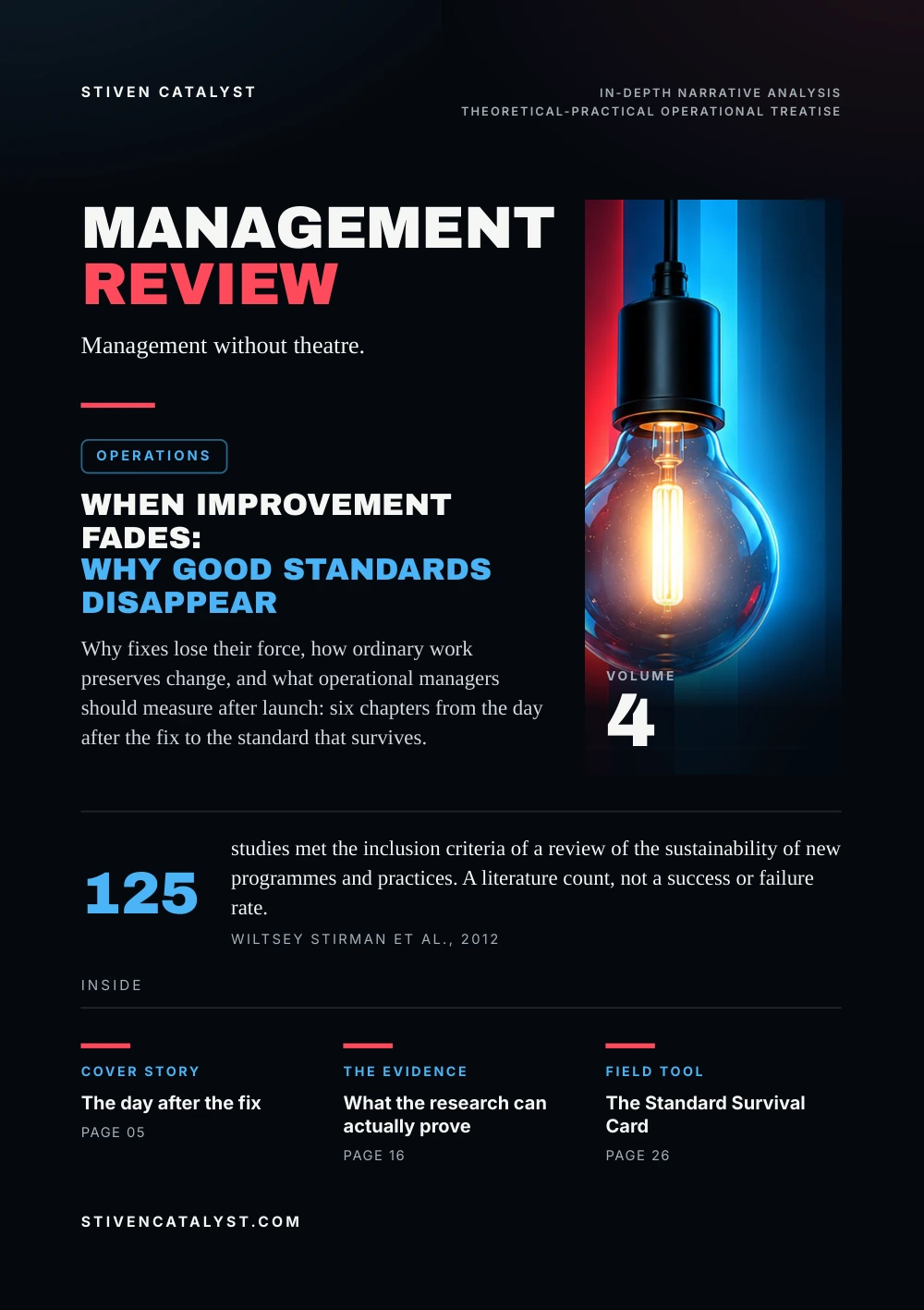
When improvement fades: why good standards disappear
Why fixes lose their force, how ordinary work preserves change, and what operational managers should measure after launch: six chapters from the day after the fix to the standard that survives.
- Volume
- 4
- Chapters
- 6
- Pages
- 30
- Sources
- 8
- Online since
- 21 October 2026
How every chapter is built
- 1The living scene
A shift, a ramp, a desk at 03:00: one piece of work followed as it actually happens, with the hand-off where it breaks. Scenes are constructed from real categories of work and say so.
- 2The conce
p tual and scientific breakdownThe mechanism behind the scene, named with the model that explains it, and the research that tests it: the study, its population, its year and its limits, before it is applied anywhere else.
- 3The operating pro
t ocol for actionWhat a working team can try on Monday: fields, questions, a cadence and a count, each with an owner, a next step and a return of information to the people who do the work.
Theoretical-practical operational treatise
Management without theatre.
Operations
Why fixes lose their force, how ordinary work preserves change, and what operational managers should measure after launch: six chapters from the day after the fix to the standard that survives.

Volume4
studies met the inclusion criteria of a review of the sustainability of new programmes and practices. A literature count, not a success or failure rate.Wiltsey Stirman et al., 2012
stivencatalyst.com
Editorial · Volume 4
The day af terthe fix
A better number is encouraging. A better system is one that can keep producing the result when attention moves elsewhere.
How every chapter is built
- 1
The living scene
A shift, a ramp, a desk at 03:00: one piece of work followed as it actually happens, with the hand-off where it breaks. Scenes are constructed from real categories of work and say so.
- 2
The conceptual and scientific breakdown
The mechanism behind the scene, named with the model that explains it, and the research that tests it: the study, its population, its year and its limits, before it is applied anywhere else.
- 3
The operating protocol for action
What a working team can try on Monday: fields, questions, a cadence and a count, each with an owner, a next step and a return of information to the people who do the work.
The reading contract
Field
Real work domains, never invented first-person cases.
Evidence
Study designs, limits and populations remain attached to findings.
Practice
Proposals must be tested; a template is not an achieved result.
Contents
The chap ters,in three layers
Chapter IThe day after the fix05
1 SceneThe day after the fix052 BreakdownThree ways a fix can disappear063 ProtocolDefine the benefit before defending it07Chapter IIA standard is not a poster08
1 SceneA standard is not a poster082 BreakdownThe Toyota rules behind the standard093 ProtocolMake the standard demonstrable10Chapter IIIThe person who holds it together11
1 SceneThe person who holds it together112 BreakdownTacit knowledge needs a route123 ProtocolTest the process without its champion13Chapter IVThe return of old habits14
1 SceneThe return of old habits142 BreakdownFirst-order fixes, second-order learning15What the research can actually prove163 ProtocolTreat the workaround as evidence17Chapter VHow change becomes routine18
1 SceneHow change becomes routine182 BreakdownThe four forms of implementation work19Ten factors, not a magic score203 ProtocolMake adoption visible and revisable21Chapter VIThe standard that survives22
1 SceneThe standard that survives222 BreakdownImprove, control, improve again23Measure persistence, not enthusiasm243 ProtocolA 30 / 60 / 90 day field test25
Also in this volume
- 04Research noteWhat counts as sustainment?
- 26Field toolThe Standard Survival Card
- 27Closing essayBuild the capability, not the hero
- 28MethodEvidence, adaptation, and limits
- 29SourcesSources and method
Research note
What countsas sustainment?
The question is not whether a change once worked. It is whether the useful result, not merely the ritual, continues.
Sustainability has several meanings in the research. A practice may exist on paper while actual use declines; staff may follow the steps while the customer benefit disappears; or a team may responsibly adapt the method, preserving the outcome without copying every original gesture. These are different results and should be measured separately.
Wiltsey Stirman and colleagues reviewed 125 studies of programme sustainment. Most designs were retrospective, about half relied on self-reports, and not all studies defined the term. The review does not produce one transferable failure percentage for warehouses or hotels. It shows why a claim such as “most changes fade” needs a population, a definition and a period of observation before it can be treated as evidence.
Result
Has the intended outcome persisted?
Practice
Is the approved method in use at the point of work?
Capability
Can a new person perform and improve it without the original champion?
A standard can remain on a wall while its operational effect has already vanished.
Sources: Shannon Wiltsey Stirman et al., Implementation Science 7:17, 2012; Carl May & Tracy Finch, Sociology 43(3), 2009
“Two coders identified 125 studies on sustainability that met eligibility criteria” (Implementation Science 7:17, 2012). The three questions are editorial, after Normalization Process Theory.
- 1Scene
- 2Breakdown
- 3Protocol
Chapter I · The day after the fix
The day af terthe fix
A loading point is orderly after a focused improvement week. What happens when the focus goes elsewhere?
Constructed scene, not a reported personal incident
Consider a loading team that has recently reorganised its trolley checks. A visible reminder has been added, the handover is tidier and fewer questions interrupt departures. Then the person who introduced the change moves to another priority. Two new colleagues arrive. On a busy morning one part of the check is abbreviated to save time, and nobody can agree whether that exception is allowed. By the third week, different shifts believe they are following the same rule while actually doing different things.
This is not an account of a measured decline in the author's workplace. Missing bags, mixed trolleys, loading discipline and the difficulties of ramp-up were real areas of operational attention. The sequence, timing, improvement programme and resulting erosion here are invented to expose a mechanism. One manager may see a flattering chart and assume that the new standard has been adopted. One worker may see a procedure that needs a certain colleague standing nearby to function. Neither view is enough. To understand whether the change will survive, we need to know whether it has become routine work, whether failures are visible and whether the team knows what to do when the conditions of the original trial are absent.
The day of implementation is the beginning of the sustainability test, not the end of it.
Constructed from the author's last-mile categories; the essay named below tells the same shape from the dispatch desk.
- 1Scene
- 2Breakdown
- 3Protocol
Chapter I · The day after the fix
Three ways afix can disappear
A lost outcome, a lost practice and a lost capability are not interchangeable. The first failure is performance decay: the measure drifts back towards the former level. The second is practice decay: the written process remains, but daily steps are shortened, misunderstood or skipped. The third is capability decay: the process works only when a particularly experienced employee is present to correct exceptions.
Outcome
The customer or downstream team still gets the intended result.
Fidelity
The agreed critical steps are being performed, or an approved adaptation is documented.
Transfer
A trained substitute can do the work and find authorised help when it fails.
An attractive performance chart cannot show these three conditions by itself. Conversely, an audit that checks only whether every box was ticked may penalise a safe and necessary adaptation. Sustainment research treats continued delivery and the evolution of a practice as more complicated than permanent repetition of the original script, and warns that apparently positive reports may rely on staff recollection rather than direct observation. For an operational manager the practical distinction is simple: verify what the process produces, verify what people actually do, and verify whether the result depends on one individual. Those checks must use the same definition across shifts and over time, or comparison becomes cosmetic.
Keep the purpose stable; inspect whether the method still serves it.
Sources: Shannon Wiltsey Stirman et al., Implementation Science 7:17, 2012; Steven Spear & H. Kent Bowen, Harvard Business Review, 1999
The three decays and the three rows are editorial; the warnings about definitions and self-reports are Wiltsey Stirman et al. (2012), the work design Spear and Bowen (1999).
- 1Scene
- 2Breakdown
- 3Protocol
Chapter I · The day after the fix
Define the benefitbefore defending it
The first sustainability control is a clear statement of what should remain true.
Name the customer result
The specific downstream outcome, not “people followed the new process” as the sole result.
State the critical condition
The few requirements that protect quality, service or safety.
Record the baseline
The previous state and how it was measured, including exclusions.
Separate success measures
Outcome, adherence and handover quality rather than one green status.
Check substitution
A trained person who did not design the change explains and performs the method.
Choose a review owner
A role, a review date and a route to revise the process when evidence changes.
A workplace follows its authorised procedures: this template is a proposal for process review, not permission to bypass a scan, a quality control or a compliance rule. An immediate risk takes the approved safety path before any scheduled review.
If no one can say what success means after the launch meeting, the organisation has not defined what it wants to sustain.
Sources: Richard Scoville, Kevin Little, Jeff Rakover, Kathy Luther & Kedar Mate, Institute for Healthcare Improvement, 2016; Shannon Wiltsey Stirman et al., Implementation Science 7:17, 2012
Editorial protocol after the IHI's Sustaining Improvement (2016) and Wiltsey Stirman et al. (2012); not a procedure certified for a named employer.
- 1Scene
- 2Breakdown
- 3Protocol
Chapter II · A standard is not a poster
A standard isnot a poster
The same rule can be displayed in three places and still be interpreted differently at the work point.
Hypothetical scene, documented types of work
A new driver reaches the loading area during a demanding shift. The wall shows a short checklist. A colleague offers one explanation, another demonstrates a faster variation, and the supervisor is occupied with a departure. The new person follows the last instruction heard. The checklist has been distributed, but the method has not truly been transferred. The author's last-mile experience included clear expectations for trolley order, loading discipline, temperature-controlled handling and reporting missing items, and the challenge of bringing new drivers into the work. The particular conversation and behaviour in this scene were not documented and must not be read as a personal incident.
A poster is an information surface. A standard is a working agreement on what result should be achieved, under which conditions and how the team can detect a departure from the agreed method. It must be understandable at the moment of execution and usable by someone who is not already an expert. Otherwise the posted instruction and the working instruction become separate systems, leaving the employee to guess which one management will judge later.
The instruction on the wall is the start of a standard. The observable work is the test.
Constructed scene; the essay named below makes the same argument for the SOP.
- 1Scene
- 2Breakdown
- 3Protocol
Chapter II · A standard is not a poster
The T oyota rulesbehind the standard
In Spear and Bowen's account, precise work design and learning through experiments are not opposites. They described Toyota's operating system in terms of four design and improvement rules, from observation rather than a randomised trial showing that a checklist mechanically improves any company. The idea is more demanding than “write a procedure”: activities, connections and pathways should be specified clearly enough that departures become detectable, and improvements should be tested with scientific discipline.
- 01
Specify the work
Content, sequence, timing, outcome.
- 02
Clear connections
Who asks whom, for what, by when.
- 03
Direct pathways
One simple route for each product or service.
- 04
Test changes
Improve by experiment, under guidance.
Consider a shift handover. “Inform the next shift” is too vague to test. A usable standard names which open issue must be passed, which facts were verified, who accepts the next action and how the receiver knows the transfer is complete. Specificity makes the gap visible without requiring the manager to read minds. But standardisation must not become rigid theatre. When the environment changes, staff need a legitimate way to expose the mismatch and propose a controlled revision. Otherwise the paper remains stable while the real work quietly adapts. The valuable unit is not the poster; it is the repeating loop between a clear expectation, the evidence from work and a response to the mismatch.
A good standard helps reveal that the process has changed; it does not pretend the change never happened.
Sources: Steven Spear & H. Kent Bowen, Harvard Business Review, 1999; Anita L. Tucker & Amy C. Edmondson, California Management Review, 2003
Spear and Bowen, Harvard Business Review, September–October 1999, an observational study of Toyota and its suppliers; the four short labels are editorial. The learning failures that follow are Tucker and Edmondson (2003).
- 1Scene
- 2Breakdown
- 3Protocol
Chapter II · A standard is not a poster
Make the standarddemonstrable
Test whether the next person can use it, not whether the document looks complete.
Watch an ordinary cycle
A trained worker shows the real sequence; the observer does not lead.
Compare the reference
What the approved SOP requires, and where the work differs.
Ask about exceptions
What the worker does when an item, fact or approval is missing.
Test comprehension
A newly trained colleague explains the purpose and the stopping rule.
Record the mismatch
Unclear wording, inadequate training or an impossible condition: three different findings.
Correct through authority
Update only through the approval path; communicate the active version.
A standard succeeds when a normally trained person can follow it and recognise when it no longer applies. A manager who silently does every hard step for the team shows expertise, not transferability. Use brief samples across roles and shifts, never secret personal performance files.
If the work cannot be taught, observed and safely questioned, the standard has not yet become a system.
Sources: Steven Spear & H. Kent Bowen, Harvard Business Review, 1999; Richard Scoville, Kevin Little, Jeff Rakover, Kathy Luther & Kedar Mate, Institute for Healthcare Improvement, 2016
Editorial protocol after Spear and Bowen (1999) and the IHI's standard work guidance (2016); not an audit procedure of any employer.
- 1Scene
- 2Breakdown
- 3Protocol
Chapter III · The person who holds it together
The person whoholds it t oge ther
An operation can appear stable because one experienced colleague is supplying the missing process.
Constructed illustration, not a claim about a named hotel
Picture a night-shift colleague who knows where every instruction is buried, which report is relevant and which open task requires a different team the next day. Questions arrive, and the colleague answers them instantly. The shift goes smoothly. Later a replacement joins and discovers that many decisions live in conversations rather than an accessible, approved guide. In the author's documented hotel work, training material did come from several sources, including SOP documents, explanations and visual references. That experience contributed to Front Desk Control, an information-organising project. There is no verified evidence that a particular hotel lost performance because one expert departed, or that the project was formally adopted by colleagues.
The fictional scene illustrates a common organisational dependency: a helpful person becomes the unofficial connection between procedures, systems and teams. The operation appears resilient while that person is present. The fragility becomes visible only when somebody else must perform the same task. This is why the ability to substitute and train is not an administrative afterthought; it is part of the quality of a process.
If one person is the only bridge, the bridge is a risk even when it works perfectly today.
Constructed scene; the author's Front Desk Control project is on the site's Projects page, and the essay named below tells how it was built.
- 1Scene
- 2Breakdown
- 3Protocol
Chapter III · The person who holds it together
Tacit knowledgeneeds a route
Transfer should preserve judgment and boundaries, not turn experience into a pile of screenshots. Some knowledge is written: the official sequence, definitions, escalation conditions and a checklist. Other knowledge is tacit: the cues that experienced staff notice, the questions they ask and the way they recognise an unusual situation. A process loses resilience when its written part is too thin to let a trained substitute act, or when every exception requires the original designer.
Person dependence
“Ask Alex; Alex knows.” Work continues, but the next person cannot reconstruct the decision.
Process capability
“Use the approved guide; here is the owner when the guide no longer fits.”
A useful guide therefore has to separate an instruction from an interpretation. Record the source and version of the authorised SOP. Explain the expected input and output. Keep examples generic and anonymised. Put exceptional cases behind appropriate authority, rather than teaching colleagues an unofficial bypass. The guide should help a new user find the next responsible role, not pretend that a public web page can replace an employer's operational system. Normalization Process Theory later helps explain this transition: sustained work requires people to understand the practice, engage with it, do it and examine its results. A personal tool can support some of that work, but does not itself demonstrate institutional adoption.
Document enough to transfer the decision boundary; train enough to preserve judgment.
Sources: Carl R. May et al., Implementation Science 4:29, 2009; Carl May & Tracy Finch, Sociology 43(3), 2009
Written and tacit knowledge is an editorial distinction; the four kinds of implementation work are May et al. (2009) and May and Finch (2009).
- 1Scene
- 2Breakdown
- 3Protocol
Chapter III · The person who holds it together
Test the processwithout its champion
A respectful handover rehearsal reveals single-person dependencies before they become incidents.
Select a low-risk workflow
A permitted task with an authorised reference and no sensitive personal examples.
Ask for a substitute
A trained colleague other than the creator performs the task using available instructions.
Observe the interruptions
Where they must ask for undocumented information or personal permission.
Check the authorised source
Conflicting versions, and the role allowed to resolve them.
Improve the transfer
Clarify one missing decision, example or escalation boundary.
Re-test after an interval
Another trained person, and only process-level learning documented.
No informal webpage replaces a hotel PMS, a security procedure or an employer-approved record, and the rehearsal is agreed with management where required. Success means the team works safely within its authority and finds help quickly when it cannot, not that every expert judgment has become a formula.
A truly reliable process is teachable without requiring the person who invented it to remain in the room.
Sources: Richard Scoville, Kevin Little, Jeff Rakover, Kathy Luther & Kedar Mate, Institute for Healthcare Improvement, 2016; Carl R. May et al., Implementation Science 4:29, 2009
Editorial rehearsal after the IHI's standard work (2016) and May et al. (2009); not a procedure of any hotel.
- 1Scene
- 2Breakdown
- 3Protocol
Chapter IV · The return of old habits
The re turn ofold habits
A shortcut can become normal because it works once under pressure, not because anyone approved it.
Hypothetical scene, no employer incident attributed
Imagine a shift in which an item is delayed, the work queue is growing and a more experienced colleague offers an improvised route around a difficult verification step. The team completes the urgent task. No one notes why the approved process failed to serve the situation. When the same pressure returns, the shortcut feels familiar and practical. Soon it is taught to new colleagues as the way the job is done. This account is deliberately constructed. The author has dealt with operational pressure, missing bags, incomplete orders and training issues, but no documented case proves that a particular unauthorised workaround became normal in those workplaces.
The general risk is nevertheless worth examining: a quick local solution may spare the current shift while making the underlying obstacle invisible to the organisation. The corrective question is not automatically “who broke the rule?” It is “what condition made the approved work hard to complete, and did someone knowingly cross a clear boundary?” Process design and individual accountability both matter. Necessary safety and compliance controls are not optional, however much pressure a team feels.
A shortcut can remove the pain of a problem while preserving the cause that created it.
Constructed scene; the essay named below draws the line between solving and escalating.
- 1Scene
- 2Breakdown
- 3Protocol
Chapter IV · The return of old habits
First-order fixes,second-order learning
Tucker and Edmondson help explain why competent, hardworking people keep a defective system running. They observed 26 nurses for 239 hours at nine hospitals. Staff were not careless: the work environment rewarded immediate recovery from a problem and discouraged the harder work of removing its cause.
How the observed nurses responded to process failures
First-order response
Get the task done now; bridge a missing resource, seek an answer or absorb extra effort.
Second-order response
Preserve the recovery, but investigate what made that recovery necessary and change the system.
Managers need both modes. A frontline colleague cannot suspend service until an improvement project is complete. But when a team repeatedly clears the same obstacle by unofficial personal effort, management may mistake adaptability for process health. A system that depends on hidden heroics is vulnerable to fatigue and staffing changes. The study does not measure last-mile loading or hotel night audits.
The organisation learns only when today's workaround becomes evidence for tomorrow's redesign.
Source: Anita L. Tucker & Amy C. Edmondson, California Management Review, 2003
Tucker and Edmondson, California Management Review 45(2), 2003, pp. 55–72: 239 hours, 26 nurses, nine hospitals; 93% first-order and 7% second-order responses, read at the full text for Management Review No. 15.
- 1Scene
- 2Breakdown
- 3Protocol
Chapter IV · The return of old habits
What the researchcan actually prove
A literature review is evidence about published studies, not a universal percentage of improvement projects that collapse.
Wiltsey Stirman and colleagues (2012) examined a varied set of interventions and programmes after their initial implementation. They found substantial variation in definitions and study design. Most studies were retrospective; about half used self-reported measures. Few assessed both continued use and the quality with which a practice was delivered. As a result, the review could not produce a reliable single rate of sustainment transferable across all organisations.
What the evidence supports: sustainment is shaped by interacting factors such as organisational context, capacity, implementation processes and features of the intervention. It is also dynamic: some changes are adapted productively; others erode. The fact that an original step is no longer performed is not, by itself, proof that the customer outcome worsened. What it does not support: claims that a fixed share of logistics initiatives disappear after ninety days; that one standard automatically prevents burnout; or that this author's employers experienced measurable decline. Each would need local records and an agreed outcome measure. The 125 studies are not 125 success cases or 125 failures.
The most dangerous sustainability metric is a confident number with no agreed meaning.
Source: Shannon Wiltsey Stirman et al., Implementation Science 7:17, 2012
Implementation Science 7:17, 2012; the design and self-report findings are from the abstract and the results section.
- 1Scene
- 2Breakdown
- 3Protocol
Chapter IV · The return of old habits
Treat theworkaround as evidence
The responsible manager separates a safety breach from a signal that the process is hard to use.
Protect the immediate outcome
Approved safety and service controls first; contain any urgent risk without delay.
Describe the deviation
What differed from the agreed method, without inventing motives.
Understand the constraint
What time, resource, training or information was missing.
Sort accountability fairly
An unclear system condition is not a conscious violation of a clear rule.
Test one approved change
Remove an obstacle within the proper authority and monitor the downstream result.
Return the decision
What changed, what remains prohibited and who owns the open issue.
Some deviation warns that the process design is obsolete; some is a serious violation. A useful review finds out which, instead of treating every deviation as innovation or as misconduct, and makes the difference explicit in training and escalation.
An exception becomes useful learning only when the organisation records the cause, not just the rescue.
Sources: Anita L. Tucker & Amy C. Edmondson, California Management Review, 2003; Richard Scoville, Kevin Little, Jeff Rakover, Kathy Luther & Kedar Mate, Institute for Healthcare Improvement, 2016
Editorial protocol after Tucker and Edmondson (2003) and the IHI (2016); the site's 5 Whys tool carries the cause question.
- 1Scene
- 2Breakdown
- 3Protocol
Chapter V · How change becomes routine
How changebecomes routine
The hard part of a new process is not announcing it. It is getting the next shift to make sense of it.
Constructed scene, inspired by a verified training context
A new team member receives a revised instruction. It is clear to the person who wrote it. The new employee is uncertain which old steps still apply, where to find an example and when a different department must approve the next move. The trainer demonstrates the procedure once, then the operation becomes busy. By the end of the week the new colleague knows where the file is but still asks the same question before acting. The author's hotel training involved multiple SOPs, visual materials and help from colleagues. That is documented. The conversation, revised rule and sequence above are hypothetical, not a claim about a particular hotel's practice or training outcome.
The failure mode is more subtle than resistance. A colleague can want to learn, read the document and still have no reliable opportunity to integrate the new method into daily work. When managers judge only whether a document was sent or acknowledged, they confuse dissemination with adoption. The real question is whether staff can make sense of the change, do the work and assess whether it helps.
A procedure becomes routine through repeated, supported work, not because its publication date has arrived.
Constructed scene; the essay named below says why a demonstration is not training.
- 1Scene
- 2Breakdown
- 3Protocol
Chapter V · How change becomes routine
The four forms ofimplementation work
Normalization Process Theory describes the effort it takes to make a new practice part of everyday life. May and colleagues built it to explain implementation and integration: a conceptual framework, not a guarantee that a rollout will succeed. Four interacting constructs show why a procedure can be distributed yet never become habitual.
Coherence
Do people understand what is changing and why?
Participation
Who commits to the work, and who is left outside it?
Collective action
Can people carry out the method with available roles and resources?
Reflexive monitoring
Do users examine whether the new practice is worthwhile and adapt it responsibly?
These are not a linear certification test: understanding does not produce willingness, willingness does not supply missing equipment, and doing a step once is not valuing it after repeated use. Ask the four questions together, with the people who do the work on a hard shift. The practical transfer: a new SOP should be understandable, accepted, workable at the point of use and reviewable from results. An editorial application, not a test of the theory.
The best written procedure can still fail if the work required to use it has not been designed.
Sources: Carl May & Tracy Finch, Sociology 43(3), 2009; Carl R. May et al., Implementation Science 4:29, 2009
May and Finch, Sociology 43(3), 2009; May et al., Implementation Science 4:29, 2009. The four names are the theory's; the questions beside them are editorial.
- 1Scene
- 2Breakdown
- 3Protocol
Chapter V · How change becomes routine
Ten fact ors,not a magic score
The NHS Sustainability Model is a structured conversation about what helps a new practice last: a self-assessment around ten factors in three domains. Doyle and colleagues (2013) evaluated it with 19 project teams in north-west London. A health-service tool, not a validated prediction of success in a warehouse or a hotel.
19 project teams and the Sustainability Model, north-west London
Process · 4
Benefits beyond the first recipient; credibility; adaptability; monitoring.
Staff · 4
Involvement and training; attitudes; senior leadership; clinical or local leadership.
Organisation · 2
Fit with strategy and culture; infrastructure and resources.
The model asks uncomfortable questions before a rollout is declared complete: are benefits visible to the people doing the work, can the process adapt when its champion leaves, do leaders keep paying attention? These are conditions, not an effect size. “Clinical leadership” must be translated cautiously into a local role structure; an NHS score does not predict logistics performance.
Source: Cathal Doyle et al., Implementation Science 8:127, 2013
Doyle et al., Implementation Science 8:127, 2013: a formative evaluation of 19 teams, “six engaged, six partially engaged, seven non-engaged”, from the abstract. The ten factors are the NHS Institute's model.
- 1Scene
- 2Breakdown
- 3Protocol
Chapter V · How change becomes routine
Make adop tionvisible and revisable
One training record is not enough. Test whether a normal shift can carry the approved method.
Explain the difference
Staff describe, in their own words, what changes and why.
Include the next shift
Check the workflow with the people who receive the output or inherit open work.
Provide an authorised reference
One identifiable version, owner and review date; no sensitive case files.
Make practice possible
Access, staffing, equipment, training and time, before demanding adherence.
Observe ordinary use
Sample the method during routine work, including periods of pressure.
Review and adapt deliberately
Did outcomes improve? Revise only through the relevant owner and approval.
Do not reward only the number of people who clicked “read”; the stronger signal is whether trained users can run the process and spot exceptions safely. A change may need to stop, evolve or be withdrawn if it does not bring the intended benefit.
Adoption is not obedience to the announcement. It is the ability to make a new way of working function responsibly.
Sources: Carl R. May et al., Implementation Science 4:29, 2009; Cathal Doyle et al., Implementation Science 8:127, 2013
Editorial protocol after May et al. (2009) and Doyle et al. (2013); proposed, not tested in the author's workplaces.
- 1Scene
- 2Breakdown
- 3Protocol
Chapter VI · The standard that survives
The standardthat survives
A handover still works even after the person who designed it is no longer on the shift.
Hypothetical test, no measured result attributed
Consider a team that has redesigned its shift handover. The first month looks promising. Instead of ending with a congratulatory message, the manager arranges a small test: a trained replacement receives an ordinary open issue, finds the current approved instruction and knows where the next decision belongs. If the receiver still needs to telephone the previous shift for basic facts, the handover has not yet passed the test. This scene is constructed. In the author's night-audit experience, handover and clear SOPs mattered, but no before-and-after evaluation of a personally introduced handover redesign has been documented.
The decisive observation is ordinary. No expert hero is called in, no temporary rescue is hidden in the figures and no one confuses an issue marked “reported” with an issue solved. The work is still allowed to be complex. What has improved is the organisation's capacity to carry that complexity between people and shifts.
The durable improvement is a capability that stays available when the original designer is absent.
Constructed scene; the essay named below and the Shift Handover tool carry the same fields.
- 1Scene
- 2Breakdown
- 3Protocol
Chapter VI · The standard that survives
Improve, control,improve again
A lasting standard needs both a working daily management system and the freedom to discover a better method. The Institute for Healthcare Improvement's 2016 white paper Sustaining Improvement describes management standard work for maintaining gains, informed by Juran's distinction between planning, quality control and quality improvement. Its recommendations come from healthcare practice and selected literature: guidance, not a controlled comparison proving a universal effect in other sectors.
- 01
Plan
Define the customer need.
- 02
Improve
Test a better condition.
- 03
Control
Monitor the new level.
- 04
Learn
Revise when facts change.
Quality control is not surveillance of individuals. It is the regular management work needed to notice when the process no longer behaves as designed, protect the result and distinguish immediate recovery from deeper redesign. If the outcome deteriorates, the manager should investigate whether the operating conditions changed or the original improvement never became part of routine work. The difficult balance is between consistency and evolution. An approved standard should protect essential quality and safety requirements. But staff must also have a trustworthy route to report why it no longer fits reality. Without control, improvements fade unnoticed. Without learning, control becomes ceremonial compliance.
Improvement changes the process. Daily management makes the change observable and correctable.
Sources: Richard Scoville, Kevin Little, Jeff Rakover, Kathy Luther & Kedar Mate, Institute for Healthcare Improvement, 2016; Steven Spear & H. Kent Bowen, Harvard Business Review, 1999
Scoville, Little, Rakover, Luther and Mate, IHI white paper, 2016; the four-step chain is an editorial compression; the work design is Spear and Bowen (1999).
- 1Scene
- 2Breakdown
- 3Protocol
Chapter VI · The standard that survives
Measure persistence,not enthusiasm
A launch presentation is an event. Sustained performance is a time series: does an agreed result persist across repeated opportunities, shifts and people, with a defined numerator, denominator and process boundary? A handful of good days may be ordinary variation; the IHI recommends run charts and properly built control charts to tell common-cause variation from real change.
Result
Acceptable completed outputs / relevant opportunities, over time.
Standard use
Cases following the approved critical steps / cases reviewed.
Transferability
Substitutes completing the workflow without undocumented rescue / substitute trials.
Exception learning
Recurring constraints assigned and reviewed / verified constraints found.
These are editorial suggestions, not validated benchmarks or outcomes from the author's workplaces. Beware a flattering success rate: exclude unresolved cases and almost any percentage looks good. Stratify where the work differs, protect employee and guest information, and with few observations start with a dated run chart rather than an invented baseline or sigma. Test the measurement itself before judging the team from it.
One good day is news. A reliable sequence of days is evidence worth investigating.
Sources: David Williams, Institute for Healthcare Improvement, 2018; Richard Scoville, Kevin Little, Jeff Rakover, Kathy Luther & Kedar Mate, Institute for Healthcare Improvement, 2016
Run and Shewhart charts after Williams (IHI, 2018) and the IHI white paper (2016); the four ratios are editorial. The site's Sigma & Control Chart tool draws such a chart.
- 1Scene
- 2Breakdown
- 3Protocol
Chapter VI · The standard that survives
A 30 / 60 / 90day field test
Three review points for a non-urgent change; the cadence is proposed, not established by the cited studies.
- Day 0Define result and owner.
- Day 30Observe live use.
- Day 60Test transfer.
- Day 90Judge continuation.
Before launch
Baseline, customer result, authorised SOP.
At day 30
Ordinary use, exceptions, downstream quality.
At day 60
Can a newly trained or substitute colleague use the method?
At day 90
Outcomes against baseline, adaptations noted; retain, revise or withdraw.
At every checkpoint
An accountable owner, the decision shared with the team, unresolved problems recorded.
A safety, legal, privacy or serious service issue is never deferred to day 30: use the approved immediate procedure. Structural changes may need far longer than 90 days; the timetable is modest on purpose, a start to learning, not proof of long-term sustainability.
The calendar is a reminder to ask. Only the observed work and outcomes can answer.
Sources: Shannon Wiltsey Stirman et al., Implementation Science 7:17, 2012; Richard Scoville, Kevin Little, Jeff Rakover, Kathy Luther & Kedar Mate, Institute for Healthcare Improvement, 2016; Cathal Doyle et al., Implementation Science 8:127, 2013
Editorial cadence after Wiltsey Stirman et al. (2012), the IHI (2016) and Doyle et al. (2013); no study establishes 30, 60 and 90 days as the right interval.
Field tool
The StandardSurvival Card
One standard, one outcome, one safe and reviewable test. Print a blank copy; keep internal records in authorised locations. If there is no reliable result measure, write “not measured”.
01Purpose and resultwhat specific customer or downstream outcome must continue?
02Current standardwhich approved version, critical steps and stopping rule apply?
03People and substitutewho owns it? can another trained person do the work?
04Work at the pointwhat was observed, not simply reported or ticked?
05Measurement and changebaseline, repeat sample, exceptions, approved adaptations
06Decision / tell backkeep, revise or stop? owner, next date, and feedback to staff
Sources: Steven Spear & H. Kent Bowen, Harvard Business Review, 1999; Carl R. May et al., Implementation Science 4:29, 2009; Shannon Wiltsey Stirman et al., Implementation Science 7:17, 2012; Richard Scoville, Kevin Little, Jeff Rakover, Kathy Luther & Kedar Mate, Institute for Healthcare Improvement, 2016
Original editorial tool, synthesising Spear and Bowen, May et al., Wiltsey Stirman et al. and the IHI. Review horizon proposed by the editors: days 30, 60 and 90. If a case is sensitive, record only a sanitised description in any public example.
Closing essay
Build the capabilit y,not the hero
What survives after the manager, trainer or project owner has moved on?
A manager can have a genuinely good week. An overdue task gets completed; the trolley area is clearer; the incoming shift finally receives the information it needs. These achievements matter. The danger is turning them into a story about the remarkable individual who “made it happen”, while leaving the next team with no reliable way to repeat the result. Operational improvement does not belong to a trophy cabinet. It belongs to the work. A standard has to fit the conditions under which it will be used, withstand an ordinary busy day and remain intelligible when a new person arrives. Those conditions do not eliminate the need for leadership. They change its purpose. Instead of being the permanent rescuer, the manager helps build the capability to see, report, correct and learn.
The research in this volume does not offer a magic number for the lifespan of a good idea. Spear and Bowen remind us that specification and experimentation must work together. Tucker and Edmondson show why repeated first-order recovery can obstruct organisational learning. May and colleagues give language to the work of normalising a practice. Sustainment reviews reveal how incomplete the evidence often is. The IHI guidance asks management to make ongoing quality control part of its own standard work. These ideas travel from hospitals and manufacturing into last-mile and hospitality only as questions to test, never as measured findings about the author's former employers. The most useful legacy a manager can leave is therefore neither a perfect report nor a set of instructions bearing their name. It is a way of working where the next person can understand the purpose, notice when reality differs, find the owner of the decision and improve the process without pretending the old method was flawless.
The test of an improvement is not the applause on launch day. It is the quality of work that remains when the launch team has gone.
Editorial conclusion. Whether any personal improvement lasted after a role change is not known from verified follow-up data.
Method
Evidence, adap tation,and limits
An evidence-informed editorial treatise. Not a new field experiment, management audit or verified intervention outcome.
Verified field
Work categories from last-mile loading, driver ramp-up, hotel training, shift handovers and the author's documentation project.
Published research
Peer-reviewed research, a systematic review, a model application study and IHI guidance, each named by design and setting.
Constructed scenes
Every invented driver, colleague, timetable and handover is labelled hypothetical. No result is attributed to an employer.
Operational tools
The Standard Survival Card and the 30/60/90 review are proposed, not validated instruments or approved procedures.
Evidence boundaries. Spear and Bowen (1999) describe organisational design from Toyota research, not a trial in logistics. Tucker and Edmondson (2003) observed nurses in nine hospitals. The NPT papers of 2009 are explanatory theory. Wiltsey Stirman et al. (2012) reviewed 125 studies, many with limited sustainment measures. The NHS model application and the IHI papers are health-care guidance; their factors predict nothing for the author's workplaces. Measurement boundaries. No benefit, decay rate or training effect is invented; 125, 93% and 19 teams belong to the cited studies, not to company performance. The review interval is not claimed as optimal. Actions are subject to authorised SOPs. Editorial standard: source, interpretation and proposal stay distinguishable, and a conclusion stops claiming when the evidence stops.
Sources: Steven Spear & H. Kent Bowen, Harvard Business Review, 1999; Anita L. Tucker & Amy C. Edmondson, California Management Review, 2003; Carl R. May et al., Implementation Science 4:29, 2009; Carl May & Tracy Finch, Sociology 43(3), 2009; Shannon Wiltsey Stirman et al., Implementation Science 7:17, 2012; Richard Scoville, Kevin Little, Jeff Rakover, Kathy Luther & Kedar Mate, Institute for Healthcare Improvement, 2016; Cathal Doyle et al., Implementation Science 8:127, 2013; David Williams, Institute for Healthcare Improvement, 2018
Every source is cited on the next page; the three counts (125 studies, 93% first-order responses, 19 teams) were read in the abstracts or, for Tucker and Edmondson, in the full text.
Sources and method
Where the claimscome from
The figures in this volume come from the sources below, each with its year. The scenes are constructed; the protocols are proposals; what is research is named as research.
- Decoding the DNA of the Toyota Production SystemSteven Spear & H. Kent Bowen, Harvard Business Review, 1999https://hbr.org/1999/09/decoding-the-dna-of-the-toyota-production-system
- Why Hospitals Don't Learn from FailuresAnita L. Tucker & Amy C. Edmondson, California Management Review, 2003https://cmr.berkeley.edu/2003/02/45-2-why-hospitals-dont-learn-from-failures-organizational-and-psychological-dynamics-that-inhibit-system-change
- Development of a theory of implementation and integration: Normalization Process TheoryCarl R. May et al., Implementation Science 4:29, 2009https://doi.org/10.1186/1748-5908-4-29
- Implementing, Embedding, and Integrating Practices: An Outline of Normalization Process TheoryCarl May & Tracy Finch, Sociology 43(3), 2009https://doi.org/10.1177/0038038509103208
- The sustainability of new programs and innovations: a review of the empirical literature and recommendations for future researchShannon Wiltsey Stirman et al., Implementation Science 7:17, 2012https://doi.org/10.1186/1748-5908-7-17
- Sustaining Improvement (IHI White Paper)Richard Scoville, Kevin Little, Jeff Rakover, Kathy Luther & Kedar Mate, Institute for Healthcare Improvement, 2016https://www.ihi.org/library/white-papers/sustaining-improvement
- Making change last: applying the NHS Institute for Innovation and Improvement sustainability model to healthcare improvementCathal Doyle et al., Implementation Science 8:127, 2013https://doi.org/10.1186/1748-5908-8-127
- Avoid Two Common Mistakes with a Shewhart ChartDavid Williams, Institute for Healthcare Improvement, 2018https://www.ihi.org/library/blog/avoid-two-common-mistakes-shewhart-chart
Each figure was checked for its year, its publisher and what exactly it measures, at the full text where it could be opened. Where the publisher's page could not be opened, the figure was checked against independent summaries and is marked “via”. The editors' interpretation is marked “Our reading”. No figure of the author's own workplaces is claimed.
Management without theatre.
Every volume, one question about operations, followed from the floor to the protocol and tested against research.
All volumes
stivencatalyst.com/magazine/operational-treatise.html
Operational Treatise · Volume 4 · October 2026 · Stiven Catalyst
Click or swipe a page to turn it. The arrow keys work too.
Operational Treatise · Volume 4
The figures of the volume
The charts of the printed pages, with their sources. Invented examples are marked as such.
Source: Anita L. Tucker & Amy C. Edmondson, California Management Review, 2003
Source: Cathal Doyle et al., Implementation Science 8:127, 2013
The whole text Read the volume as text For reading on a small screen, searching or a screen reader. The same words, without the page design.
Editorial
The day af ter the fix
A better number is encouraging. A better system is one that can keep producing the result when attention moves elsewhere.
Operations often celebrate the moment a backlog clears, a check becomes faster or a handover becomes cleaner. There is a meeting, a new instruction and the relief of a measurable improvement. A week later the manager is occupied with something else. New people arrive, demand changes and the old conditions quietly return. If the benefit was real, why did it not last? This fourth volume follows the distinction between winning the improvement and keeping the capability. Its settings are recognisable from the author's experience: last-mile loading and driver ramp-up, shift work in hotels, and organising operational instructions. These are documented categories of work, not proof that a specific initiative later failed; the scenes are constructed and labelled as such. The argument brings together four kinds of knowledge: operational design from Spear and Bowen, learning failures studied by Tucker and Edmondson, Normalization Process Theory from May and colleagues, and research on sustaining interventions. It ends with an editable, low-risk operational test. It does not claim that one universal checklist or a 90-day calendar guarantees lasting change.
Stiven Janaqi, Editor
How every chap ter is built
- The living scene. A shift, a ramp, a desk at 03:00: one piece of work followed as it actually happens, with the hand-off where it breaks. Scenes are constructed from real categories of work and say so.
- The conce
p tual and scientific breakdown. The mechanism behind the scene, named with the model that explains it, and the research that tests it: the study, its population, its year and its limits, before it is applied anywhere else. - The operating pro
t ocol for action. What a working team can try on Monday: fields, questions, a cadence and a count, each with an owner, a next step and a return of information to the people who do the work.
The reading contract
- Field. Real work domains, never invented first-person cases.
- Evidence. Study designs, limits and populations remain attached to findings.
- Practice. Proposals must be tested; a template is not an achieved result.
Research note
What counts as sustainment?
The question is not whether a change once worked. It is whether the useful result, not merely the ritual, continues.
Sustainability has several meanings in the research. A practice may exist on paper while actual use declines; staff may follow the steps while the customer benefit disappears; or a team may responsibly adapt the method, preserving the outcome without copying every original gesture. These are different results and should be measured separately.
- 125 studies included in a 2012 review
- N/A local decay rates measured in the author's workplaces
Wiltsey Stirman and colleagues reviewed 125 studies of programme sustainment. Most designs were retrospective, about half relied on self-reports, and not all studies defined the term. The review does not produce one transferable failure percentage for warehouses or hotels. It shows why a claim such as “most changes fade” needs a population, a definition and a period of observation before it can be treated as evidence.
- Result. Has the intended outcome persisted?
- Practice. Is the approved method in use at the point of work?
- Capabili
t y. Can a new person perform and improve it without the original champion?
Our reading
A standard can remain on a wall while its operational effect has already vanished.
“Two coders identified 125 studies on sustainability that met eligibility criteria” (Implementation Science 7:17, 2012). The three questions are editorial, after Normalization Process Theory.
Sources: Shannon Wiltsey Stirman et al., Implementation Science 7:17, 2012; Carl May & Tracy Finch, Sociology 43(3), 2009
Chap ter I: The day af ter the fix
Layer 1 · The living scene
The day af ter the fix
A loading point is orderly after a focused improvement week. What happens when the focus goes elsewhere?
Constructed scene, not a reported personal incident
Consider a loading team that has recently reorganised its trolley checks. A visible reminder has been added, the handover is tidier and fewer questions interrupt departures. Then the person who introduced the change moves to another priority. Two new colleagues arrive. On a busy morning one part of the check is abbreviated to save time, and nobody can agree whether that exception is allowed. By the third week, different shifts believe they are following the same rule while actually doing different things.
This is not an account of a measured decline in the author's workplace. Missing bags, mixed trolleys, loading discipline and the difficulties of ramp-up were real areas of operational attention. The sequence, timing, improvement programme and resulting erosion here are invented to expose a mechanism. One manager may see a flattering chart and assume that the new standard has been adopted. One worker may see a procedure that needs a certain colleague standing nearby to function. Neither view is enough. To understand whether the change will survive, we need to know whether it has become routine work, whether failures are visible and whether the team knows what to do when the conditions of the original trial are absent.
Our reading
The day of implementation is the beginning of the sustainability test, not the end of it.
Constructed from the author's last-mile categories; the essay named below tells the same shape from the dispatch desk.
More in the essay: When improvement fades
Layer 2 · The conceptual and scientific breakdown
Three ways a fix can disappear
A lost outcome, a lost practice and a lost capability are not interchangeable. The first failure is performance decay: the measure drifts back towards the former level. The second is practice decay: the written process remains, but daily steps are shortened, misunderstood or skipped. The third is capability decay: the process works only when a particularly experienced employee is present to correct exceptions.
- Ou
t come. The customer or downstream team still gets the intended result. - Fideli
t y. The agreed critical steps are being performed, or an approved adaptation is documented. - Transfer. A trained substitute can do the work and find authorised help when it fails.
An attractive performance chart cannot show these three conditions by itself. Conversely, an audit that checks only whether every box was ticked may penalise a safe and necessary adaptation. Sustainment research treats continued delivery and the evolution of a practice as more complicated than permanent repetition of the original script, and warns that apparently positive reports may rely on staff recollection rather than direct observation. For an operational manager the practical distinction is simple: verify what the process produces, verify what people actually do, and verify whether the result depends on one individual. Those checks must use the same definition across shifts and over time, or comparison becomes cosmetic.
Our reading
Keep the purpose stable; inspect whether the method still serves it.
The three decays and the three rows are editorial; the warnings about definitions and self-reports are Wiltsey Stirman et al. (2012), the work design Spear and Bowen (1999).
Sources: Shannon Wiltsey Stirman et al., Implementation Science 7:17, 2012; Steven Spear & H. Kent Bowen, Harvard Business Review, 1999
Layer 3 · The operating protocol for action
Define the benefit before defending it
The first sustainability control is a clear statement of what should remain true.
- Name the cus
t omer result. The specific downstream outcome, not “people followed the new process” as the sole result. - State the critical condition. The few requirements that protect quality, service or safety.
- Record the baseline. The previous state and how it was measured, including exclusions.
- Separate success measures. Outcome, adherence and handover quality rather than one green status.
- Check substitution. A trained person who did not design the change explains and performs the method.
- Choose a review owner. A role, a review date and a route to revise the process when evidence changes.
A workplace follows its authorised procedures: this template is a proposal for process review, not permission to bypass a scan, a quality control or a compliance rule. An immediate risk takes the approved safety path before any scheduled review.
Our reading
If no one can say what success means after the launch meeting, the organisation has not defined what it wants to sustain.
Editorial protocol after the IHI's Sustaining Improvement (2016) and Wiltsey Stirman et al. (2012); not a procedure certified for a named employer.
Sources: Richard Scoville, Kevin Little, Jeff Rakover, Kathy Luther & Kedar Mate, Institute for Healthcare Improvement, 2016; Shannon Wiltsey Stirman et al., Implementation Science 7:17, 2012
Chap ter II: A standard is not a poster
Layer 1 · The living scene
A standard is not a poster
The same rule can be displayed in three places and still be interpreted differently at the work point.
Hypothetical scene, documented types of work
A new driver reaches the loading area during a demanding shift. The wall shows a short checklist. A colleague offers one explanation, another demonstrates a faster variation, and the supervisor is occupied with a departure. The new person follows the last instruction heard. The checklist has been distributed, but the method has not truly been transferred. The author's last-mile experience included clear expectations for trolley order, loading discipline, temperature-controlled handling and reporting missing items, and the challenge of bringing new drivers into the work. The particular conversation and behaviour in this scene were not documented and must not be read as a personal incident.
A poster is an information surface. A standard is a working agreement on what result should be achieved, under which conditions and how the team can detect a departure from the agreed method. It must be understandable at the moment of execution and usable by someone who is not already an expert. Otherwise the posted instruction and the working instruction become separate systems, leaving the employee to guess which one management will judge later.
Our reading
The instruction on the wall is the start of a standard. The observable work is the test.
Constructed scene; the essay named below makes the same argument for the SOP.
More in the essay: A good SOP is not a document
Layer 2 · The conceptual and scientific breakdown
The T oyota rules behind the standard
In Spear and Bowen's account, precise work design and learning through experiments are not opposites. They described Toyota's operating system in terms of four design and improvement rules, from observation rather than a randomised trial showing that a checklist mechanically improves any company. The idea is more demanding than “write a procedure”: activities, connections and pathways should be specified clearly enough that departures become detectable, and improvements should be tested with scientific discipline.
- Speci
f y the work. Content, sequence, timing, outcome. - Clear connections. Who asks whom, for what, by when.
- Direct pathways. One simple route for each product or service.
- Test changes. Improve by experiment, under guidance.
Consider a shift handover. “Inform the next shift” is too vague to test. A usable standard names which open issue must be passed, which facts were verified, who accepts the next action and how the receiver knows the transfer is complete. Specificity makes the gap visible without requiring the manager to read minds. But standardisation must not become rigid theatre. When the environment changes, staff need a legitimate way to expose the mismatch and propose a controlled revision. Otherwise the paper remains stable while the real work quietly adapts. The valuable unit is not the poster; it is the repeating loop between a clear expectation, the evidence from work and a response to the mismatch.
Our reading
A good standard helps reveal that the process has changed; it does not pretend the change never happened.
Spear and Bowen, Harvard Business Review, September–October 1999, an observational study of Toyota and its suppliers; the four short labels are editorial. The learning failures that follow are Tucker and Edmondson (2003).
Sources: Steven Spear & H. Kent Bowen, Harvard Business Review, 1999; Anita L. Tucker & Amy C. Edmondson, California Management Review, 2003
Layer 3 · The operating protocol for action
Make the standard demonstrable
Test whether the next person can use it, not whether the document looks complete.
- Wa
t ch an ordinary cycle. A trained worker shows the real sequence; the observer does not lead. - Compare the reference. What the approved SOP requires, and where the work differs.
- Ask about exce
p tions. What the worker does when an item, fact or approval is missing. - Test comprehension. A newly trained colleague explains the purpose and the stopping rule.
- Record the misma
t ch. Unclear wording, inadequate training or an impossible condition: three different findings. - Correct through authori
t y. Update only through the approval path; communicate the active version.
A standard succeeds when a normally trained person can follow it and recognise when it no longer applies. A manager who silently does every hard step for the team shows expertise, not transferability. Use brief samples across roles and shifts, never secret personal performance files.
Our reading
If the work cannot be taught, observed and safely questioned, the standard has not yet become a system.
Editorial protocol after Spear and Bowen (1999) and the IHI's standard work guidance (2016); not an audit procedure of any employer.
Sources: Steven Spear & H. Kent Bowen, Harvard Business Review, 1999; Richard Scoville, Kevin Little, Jeff Rakover, Kathy Luther & Kedar Mate, Institute for Healthcare Improvement, 2016
Chap ter III: The person who holds it t oge ther
Layer 1 · The living scene
The person who holds it t oge ther
An operation can appear stable because one experienced colleague is supplying the missing process.
Constructed illustration, not a claim about a named hotel
Picture a night-shift colleague who knows where every instruction is buried, which report is relevant and which open task requires a different team the next day. Questions arrive, and the colleague answers them instantly. The shift goes smoothly. Later a replacement joins and discovers that many decisions live in conversations rather than an accessible, approved guide. In the author's documented hotel work, training material did come from several sources, including SOP documents, explanations and visual references. That experience contributed to Front Desk Control, an information-organising project. There is no verified evidence that a particular hotel lost performance because one expert departed, or that the project was formally adopted by colleagues.
The fictional scene illustrates a common organisational dependency: a helpful person becomes the unofficial connection between procedures, systems and teams. The operation appears resilient while that person is present. The fragility becomes visible only when somebody else must perform the same task. This is why the ability to substitute and train is not an administrative afterthought; it is part of the quality of a process.
Our reading
If one person is the only bridge, the bridge is a risk even when it works perfectly today.
Constructed scene; the author's Front Desk Control project is on the site's Projects page, and the essay named below tells how it was built.
More in the essay: How I built Front Desk Control
Layer 2 · The conceptual and scientific breakdown
Tacit knowledge needs a route
Transfer should preserve judgment and boundaries, not turn experience into a pile of screenshots. Some knowledge is written: the official sequence, definitions, escalation conditions and a checklist. Other knowledge is tacit: the cues that experienced staff notice, the questions they ask and the way they recognise an unusual situation. A process loses resilience when its written part is too thin to let a trained substitute act, or when every exception requires the original designer.
- Person dependence. “Ask Alex; Alex knows.” Work continues, but the next person cannot reconstruct the decision.
- Process capabili
t y. “Use the approved guide; here is the owner when the guide no longer fits.”
A useful guide therefore has to separate an instruction from an interpretation. Record the source and version of the authorised SOP. Explain the expected input and output. Keep examples generic and anonymised. Put exceptional cases behind appropriate authority, rather than teaching colleagues an unofficial bypass. The guide should help a new user find the next responsible role, not pretend that a public web page can replace an employer's operational system. Normalization Process Theory later helps explain this transition: sustained work requires people to understand the practice, engage with it, do it and examine its results. A personal tool can support some of that work, but does not itself demonstrate institutional adoption.
Our reading
Document enough to transfer the decision boundary; train enough to preserve judgment.
Written and tacit knowledge is an editorial distinction; the four kinds of implementation work are May et al. (2009) and May and Finch (2009).
Sources: Carl R. May et al., Implementation Science 4:29, 2009; Carl May & Tracy Finch, Sociology 43(3), 2009
Layer 3 · The operating protocol for action
Test the process without its champion
A respectful handover rehearsal reveals single-person dependencies before they become incidents.
- Select a low-risk workflow. A permitted task with an authorised reference and no sensitive personal examples.
- Ask for a substitute. A trained colleague other than the creator performs the task using available instructions.
- Observe the interru
p tions. Where they must ask for undocumented information or personal permission. - Check the authorised source. Conflicting versions, and the role allowed to resolve them.
- Improve the transfer. Clarify one missing decision, example or escalation boundary.
- Re-test a
f ter an interval. Another trained person, and only process-level learning documented.
No informal webpage replaces a hotel PMS, a security procedure or an employer-approved record, and the rehearsal is agreed with management where required. Success means the team works safely within its authority and finds help quickly when it cannot, not that every expert judgment has become a formula.
Our reading
A truly reliable process is teachable without requiring the person who invented it to remain in the room.
Editorial rehearsal after the IHI's standard work (2016) and May et al. (2009); not a procedure of any hotel.
Sources: Richard Scoville, Kevin Little, Jeff Rakover, Kathy Luther & Kedar Mate, Institute for Healthcare Improvement, 2016; Carl R. May et al., Implementation Science 4:29, 2009
Chap ter IV: The re turn of old habits
Layer 1 · The living scene
The re turn of old habits
A shortcut can become normal because it works once under pressure, not because anyone approved it.
Hypothetical scene, no employer incident attributed
Imagine a shift in which an item is delayed, the work queue is growing and a more experienced colleague offers an improvised route around a difficult verification step. The team completes the urgent task. No one notes why the approved process failed to serve the situation. When the same pressure returns, the shortcut feels familiar and practical. Soon it is taught to new colleagues as the way the job is done. This account is deliberately constructed. The author has dealt with operational pressure, missing bags, incomplete orders and training issues, but no documented case proves that a particular unauthorised workaround became normal in those workplaces.
The general risk is nevertheless worth examining: a quick local solution may spare the current shift while making the underlying obstacle invisible to the organisation. The corrective question is not automatically “who broke the rule?” It is “what condition made the approved work hard to complete, and did someone knowingly cross a clear boundary?” Process design and individual accountability both matter. Necessary safety and compliance controls are not optional, however much pressure a team feels.
Our reading
A shortcut can remove the pain of a problem while preserving the cause that created it.
Constructed scene; the essay named below draws the line between solving and escalating.
More in the essay: When to solve it yourself and when to take it higher
Layer 2 · The conceptual and scientific breakdown
First-order fixes, second-order learning
Tucker and Edmondson help explain why competent, hardworking people keep a defective system running. They observed 26 nurses for 239 hours at nine hospitals. Staff were not careless: the work environment rewarded immediate recovery from a problem and discouraged the harder work of removing its cause.
How the observed nurses responded to process failures: First-order: work around it, carry on 93%, Second-order: also report or address the cause 7%.
- First-order response. Get the task done now; bridge a missing resource, seek an answer or absorb extra effort.
- Second-order response. Preserve the recovery, but investigate what made that recovery necessary and change the system.
Managers need both modes. A frontline colleague cannot suspend service until an improvement project is complete. But when a team repeatedly clears the same obstacle by unofficial personal effort, management may mistake adaptability for process health. A system that depends on hidden heroics is vulnerable to fatigue and staffing changes. The study does not measure last-mile loading or hotel night audits.
Our reading
The organisation learns only when today's workaround becomes evidence for tomorrow's redesign.
Tucker and Edmondson, California Management Review 45(2), 2003, pp. 55–72: 239 hours, 26 nurses, nine hospitals; 93% first-order and 7% second-order responses, read at the full text for Management Review No. 15.
Source: Anita L. Tucker & Amy C. Edmondson, California Management Review, 2003
Layer 2 · The conceptual and scientific breakdown
What the research can actually prove
A literature review is evidence about published studies, not a universal percentage of improvement projects that collapse.
- 125 studies included in a systematic review
- 2012 publication year of the review
Wiltsey Stirman and colleagues (2012) examined a varied set of interventions and programmes after their initial implementation. They found substantial variation in definitions and study design. Most studies were retrospective; about half used self-reported measures. Few assessed both continued use and the quality with which a practice was delivered. As a result, the review could not produce a reliable single rate of sustainment transferable across all organisations.
What the evidence supports: sustainment is shaped by interacting factors such as organisational context, capacity, implementation processes and features of the intervention. It is also dynamic: some changes are adapted productively; others erode. The fact that an original step is no longer performed is not, by itself, proof that the customer outcome worsened. What it does not support: claims that a fixed share of logistics initiatives disappear after ninety days; that one standard automatically prevents burnout; or that this author's employers experienced measurable decline. Each would need local records and an agreed outcome measure. The 125 studies are not 125 success cases or 125 failures.
Our reading
The most dangerous sustainability metric is a confident number with no agreed meaning.
Implementation Science 7:17, 2012; the design and self-report findings are from the abstract and the results section.
Source: Shannon Wiltsey Stirman et al., Implementation Science 7:17, 2012
Layer 3 · The operating protocol for action
Treat the workaround as evidence
The responsible manager separates a safety breach from a signal that the process is hard to use.
- Protect the immediate ou
t come. Approved safety and service controls first; contain any urgent risk without delay. - Describe the deviation. What differed from the agreed method, without inventing motives.
- Understand the constraint. What time, resource, training or information was missing.
- So
r t accountabilit y fairly. An unclear system condition is not a conscious violation of a clear rule. - Test one approved change. Remove an obstacle within the proper authority and monitor the downstream result.
- R
e turn the decision. What changed, what remains prohibited and who owns the open issue.
Some deviation warns that the process design is obsolete; some is a serious violation. A useful review finds out which, instead of treating every deviation as innovation or as misconduct, and makes the difference explicit in training and escalation.
Our reading
An exception becomes useful learning only when the organisation records the cause, not just the rescue.
Editorial protocol after Tucker and Edmondson (2003) and the IHI (2016); the site's 5 Whys tool carries the cause question.
Sources: Anita L. Tucker & Amy C. Edmondson, California Management Review, 2003; Richard Scoville, Kevin Little, Jeff Rakover, Kathy Luther & Kedar Mate, Institute for Healthcare Improvement, 2016
Chap ter V: How change becomes routine
Layer 1 · The living scene
How change becomes routine
The hard part of a new process is not announcing it. It is getting the next shift to make sense of it.
Constructed scene, inspired by a verified training context
A new team member receives a revised instruction. It is clear to the person who wrote it. The new employee is uncertain which old steps still apply, where to find an example and when a different department must approve the next move. The trainer demonstrates the procedure once, then the operation becomes busy. By the end of the week the new colleague knows where the file is but still asks the same question before acting. The author's hotel training involved multiple SOPs, visual materials and help from colleagues. That is documented. The conversation, revised rule and sequence above are hypothetical, not a claim about a particular hotel's practice or training outcome.
The failure mode is more subtle than resistance. A colleague can want to learn, read the document and still have no reliable opportunity to integrate the new method into daily work. When managers judge only whether a document was sent or acknowledged, they confuse dissemination with adoption. The real question is whether staff can make sense of the change, do the work and assess whether it helps.
Our reading
A procedure becomes routine through repeated, supported work, not because its publication date has arrived.
Constructed scene; the essay named below says why a demonstration is not training.
More in the essay: “Watch how I do it” is not training
Layer 2 · The conceptual and scientific breakdown
The four forms of implementation work
Normalization Process Theory describes the effort it takes to make a new practice part of everyday life. May and colleagues built it to explain implementation and integration: a conceptual framework, not a guarantee that a rollout will succeed. Four interacting constructs show why a procedure can be distributed yet never become habitual.
- Coherence. Do people understand what is changing and why?
- Pa
r ticipation. Who commits to the work, and who is left outside it? - Collective action. Can people carry out the method with available roles and resources?
- Reflexive moni
t oring. Do users examine whether the new practice is worthwhile and adapt it responsibly?
These are not a linear certification test: understanding does not produce willingness, willingness does not supply missing equipment, and doing a step once is not valuing it after repeated use. Ask the four questions together, with the people who do the work on a hard shift. The practical transfer: a new SOP should be understandable, accepted, workable at the point of use and reviewable from results. An editorial application, not a test of the theory.
Our reading
The best written procedure can still fail if the work required to use it has not been designed.
May and Finch, Sociology 43(3), 2009; May et al., Implementation Science 4:29, 2009. The four names are the theory's; the questions beside them are editorial.
Sources: Carl May & Tracy Finch, Sociology 43(3), 2009; Carl R. May et al., Implementation Science 4:29, 2009
Layer 2 · The conceptual and scientific breakdown
Ten fact ors, not a magic score
The NHS Sustainability Model is a structured conversation about what helps a new practice last: a self-assessment around ten factors in three domains. Doyle and colleagues (2013) evaluated it with 19 project teams in north-west London. A health-service tool, not a validated prediction of success in a warehouse or a hotel.
19 project teams and the Sustainability Model, north-west London: Engaged 6, Partially engaged 6, Non-engaged 7.
- Process · 4. Benefits beyond the first recipient; credibility; adaptability; monitoring.
- Staff · 4. Involvement and training; attitudes; senior leadership; clinical or local leadership.
- Organisation · 2. Fit with strategy and culture; infrastructure and resources.
The model asks uncomfortable questions before a rollout is declared complete: are benefits visible to the people doing the work, can the process adapt when its champion leaves, do leaders keep paying attention? These are conditions, not an effect size. “Clinical leadership” must be translated cautiously into a local role structure; an NHS score does not predict logistics performance.
Doyle et al., Implementation Science 8:127, 2013: a formative evaluation of 19 teams, “six engaged, six partially engaged, seven non-engaged”, from the abstract. The ten factors are the NHS Institute's model.
Source: Cathal Doyle et al., Implementation Science 8:127, 2013
Layer 3 · The operating protocol for action
Make adop tion visible and revisable
One training record is not enough. Test whether a normal shift can carry the approved method.
- Explain the difference. Staff describe, in their own words, what changes and why.
- Include the next shi
f t. Check the workflow with the people who receive the output or inherit open work. - Provide an authorised reference. One identifiable version, owner and review date; no sensitive case files.
- Make practice possible. Access, staffing, equipment, training and time, before demanding adherence.
- Observe ordinary use. Sample the method during routine work, including periods of pressure.
- Review and ada
p t deliberately. Did outcomes improve? Revise only through the relevant owner and approval.
Do not reward only the number of people who clicked “read”; the stronger signal is whether trained users can run the process and spot exceptions safely. A change may need to stop, evolve or be withdrawn if it does not bring the intended benefit.
Our reading
Adoption is not obedience to the announcement. It is the ability to make a new way of working function responsibly.
Editorial protocol after May et al. (2009) and Doyle et al. (2013); proposed, not tested in the author's workplaces.
Sources: Carl R. May et al., Implementation Science 4:29, 2009; Cathal Doyle et al., Implementation Science 8:127, 2013
Chap ter VI: The standard that survives
Layer 1 · The living scene
The standard that survives
A handover still works even after the person who designed it is no longer on the shift.
Hypothetical test, no measured result attributed
Consider a team that has redesigned its shift handover. The first month looks promising. Instead of ending with a congratulatory message, the manager arranges a small test: a trained replacement receives an ordinary open issue, finds the current approved instruction and knows where the next decision belongs. If the receiver still needs to telephone the previous shift for basic facts, the handover has not yet passed the test. This scene is constructed. In the author's night-audit experience, handover and clear SOPs mattered, but no before-and-after evaluation of a personally introduced handover redesign has been documented.
The decisive observation is ordinary. No expert hero is called in, no temporary rescue is hidden in the figures and no one confuses an issue marked “reported” with an issue solved. The work is still allowed to be complex. What has improved is the organisation's capacity to carry that complexity between people and shifts.
Our reading
The durable improvement is a capability that stays available when the original designer is absent.
Constructed scene; the essay named below and the Shift Handover tool carry the same fields.
More in the essay: Why the shift handover is one of the most underrated processes
Layer 2 · The conceptual and scientific breakdown
Improve, control, improve again
A lasting standard needs both a working daily management system and the freedom to discover a better method. The Institute for Healthcare Improvement's 2016 white paper Sustaining Improvement describes management standard work for maintaining gains, informed by Juran's distinction between planning, quality control and quality improvement. Its recommendations come from healthcare practice and selected literature: guidance, not a controlled comparison proving a universal effect in other sectors.
- Plan. Define the customer need.
- Improve. Test a better condition.
- Control. Monitor the new level.
- Learn. Revise when facts change.
Quality control is not surveillance of individuals. It is the regular management work needed to notice when the process no longer behaves as designed, protect the result and distinguish immediate recovery from deeper redesign. If the outcome deteriorates, the manager should investigate whether the operating conditions changed or the original improvement never became part of routine work. The difficult balance is between consistency and evolution. An approved standard should protect essential quality and safety requirements. But staff must also have a trustworthy route to report why it no longer fits reality. Without control, improvements fade unnoticed. Without learning, control becomes ceremonial compliance.
Our reading
Improvement changes the process. Daily management makes the change observable and correctable.
Scoville, Little, Rakover, Luther and Mate, IHI white paper, 2016; the four-step chain is an editorial compression; the work design is Spear and Bowen (1999).
Sources: Richard Scoville, Kevin Little, Jeff Rakover, Kathy Luther & Kedar Mate, Institute for Healthcare Improvement, 2016; Steven Spear & H. Kent Bowen, Harvard Business Review, 1999
Layer 2 · The conceptual and scientific breakdown
Measure persistence, not enthusiasm
A launch presentation is an event. Sustained performance is a time series: does an agreed result persist across repeated opportunities, shifts and people, with a defined numerator, denominator and process boundary? A handful of good days may be ordinary variation; the IHI recommends run charts and properly built control charts to tell common-cause variation from real change.
- Result. Acceptable completed outputs / relevant opportunities, over time.
- Standard use. Cases following the approved critical steps / cases reviewed.
- Transferabili
t y. Substitutes completing the workflow without undocumented rescue / substitute trials. - Exce
p tion learning. Recurring constraints assigned and reviewed / verified constraints found.
These are editorial suggestions, not validated benchmarks or outcomes from the author's workplaces. Beware a flattering success rate: exclude unresolved cases and almost any percentage looks good. Stratify where the work differs, protect employee and guest information, and with few observations start with a dated run chart rather than an invented baseline or sigma. Test the measurement itself before judging the team from it.
Our reading
One good day is news. A reliable sequence of days is evidence worth investigating.
Run and Shewhart charts after Williams (IHI, 2018) and the IHI white paper (2016); the four ratios are editorial. The site's Sigma & Control Chart tool draws such a chart.
Sources: David Williams, Institute for Healthcare Improvement, 2018; Richard Scoville, Kevin Little, Jeff Rakover, Kathy Luther & Kedar Mate, Institute for Healthcare Improvement, 2016
Layer 3 · The operating protocol for action
A 30 / 60 / 90 day field test
Three review points for a non-urgent change; the cadence is proposed, not established by the cited studies.
- Day 0 Define result and owner.
- Day 30 Observe live use.
- Day 60 Test transfer.
- Day 90 Judge continuation.
- Before launch. Baseline, customer result, authorised SOP.
- At day 30. Ordinary use, exceptions, downstream quality.
- At day 60. Can a newly trained or substitute colleague use the method?
- At day 90. Outcomes against baseline, adaptations noted; retain, revise or withdraw.
- At every checkpoint. An accountable owner, the decision shared with the team, unresolved problems recorded.
A safety, legal, privacy or serious service issue is never deferred to day 30: use the approved immediate procedure. Structural changes may need far longer than 90 days; the timetable is modest on purpose, a start to learning, not proof of long-term sustainability.
Our reading
The calendar is a reminder to ask. Only the observed work and outcomes can answer.
Editorial cadence after Wiltsey Stirman et al. (2012), the IHI (2016) and Doyle et al. (2013); no study establishes 30, 60 and 90 days as the right interval.
Sources: Shannon Wiltsey Stirman et al., Implementation Science 7:17, 2012; Richard Scoville, Kevin Little, Jeff Rakover, Kathy Luther & Kedar Mate, Institute for Healthcare Improvement, 2016; Cathal Doyle et al., Implementation Science 8:127, 2013
Field tool
The Standard Survival Card
One standard, one outcome, one safe and reviewable test. Print a blank copy; keep internal records in authorised locations. If there is no reliable result measure, write “not measured”.
- Purpose and result what specific customer or downstream outcome must continue?
- Current standard which approved version, critical steps and stopping rule apply?
- People and substitute who owns it? can another trained person do the work?
- Work at the point what was observed, not simply reported or ticked?
- Measurement and change baseline, repeat sample, exceptions, approved adaptations
- Decision / tell back keep, revise or stop? owner, next date, and feedback to staff
Original editorial tool, synthesising Spear and Bowen, May et al., Wiltsey Stirman et al. and the IHI. Review horizon proposed by the editors: days 30, 60 and 90. If a case is sensitive, record only a sanitised description in any public example.
Sources: Steven Spear & H. Kent Bowen, Harvard Business Review, 1999; Carl R. May et al., Implementation Science 4:29, 2009; Shannon Wiltsey Stirman et al., Implementation Science 7:17, 2012; Richard Scoville, Kevin Little, Jeff Rakover, Kathy Luther & Kedar Mate, Institute for Healthcare Improvement, 2016
Open the tool: Sigma & Control Chart
Closing essay
Build the capabilit y, not the hero
What survives after the manager, trainer or project owner has moved on?
A manager can have a genuinely good week. An overdue task gets completed; the trolley area is clearer; the incoming shift finally receives the information it needs. These achievements matter. The danger is turning them into a story about the remarkable individual who “made it happen”, while leaving the next team with no reliable way to repeat the result. Operational improvement does not belong to a trophy cabinet. It belongs to the work. A standard has to fit the conditions under which it will be used, withstand an ordinary busy day and remain intelligible when a new person arrives. Those conditions do not eliminate the need for leadership. They change its purpose. Instead of being the permanent rescuer, the manager helps build the capability to see, report, correct and learn.
The research in this volume does not offer a magic number for the lifespan of a good idea. Spear and Bowen remind us that specification and experimentation must work together. Tucker and Edmondson show why repeated first-order recovery can obstruct organisational learning. May and colleagues give language to the work of normalising a practice. Sustainment reviews reveal how incomplete the evidence often is. The IHI guidance asks management to make ongoing quality control part of its own standard work. These ideas travel from hospitals and manufacturing into last-mile and hospitality only as questions to test, never as measured findings about the author's former employers. The most useful legacy a manager can leave is therefore neither a perfect report nor a set of instructions bearing their name. It is a way of working where the next person can understand the purpose, notice when reality differs, find the owner of the decision and improve the process without pretending the old method was flawless.
Our reading
The test of an improvement is not the applause on launch day. It is the quality of work that remains when the launch team has gone.
Editorial conclusion. Whether any personal improvement lasted after a role change is not known from verified follow-up data.
Method
Evidence, adap tation, and limits
An evidence-informed editorial treatise. Not a new field experiment, management audit or verified intervention outcome.
- Verified field. Work categories from last-mile loading, driver ramp-up, hotel training, shift handovers and the author's documentation project.
- Published research. Peer-reviewed research, a systematic review, a model application study and IHI guidance, each named by design and setting.
- Constructed scenes. Every invented driver, colleague, timetable and handover is labelled hypothetical. No result is attributed to an employer.
- Operational
t ools. The Standard Survival Card and the 30/60/90 review are proposed, not validated instruments or approved procedures.
Evidence boundaries. Spear and Bowen (1999) describe organisational design from Toyota research, not a trial in logistics. Tucker and Edmondson (2003) observed nurses in nine hospitals. The NPT papers of 2009 are explanatory theory. Wiltsey Stirman et al. (2012) reviewed 125 studies, many with limited sustainment measures. The NHS model application and the IHI papers are health-care guidance; their factors predict nothing for the author's workplaces. Measurement boundaries. No benefit, decay rate or training effect is invented; 125, 93% and 19 teams belong to the cited studies, not to company performance. The review interval is not claimed as optimal. Actions are subject to authorised SOPs. Editorial standard: source, interpretation and proposal stay distinguishable, and a conclusion stops claiming when the evidence stops.
Every source is cited on the next page; the three counts (125 studies, 93% first-order responses, 19 teams) were read in the abstracts or, for Tucker and Edmondson, in the full text.
Sources: Steven Spear & H. Kent Bowen, Harvard Business Review, 1999; Anita L. Tucker & Amy C. Edmondson, California Management Review, 2003; Carl R. May et al., Implementation Science 4:29, 2009; Carl May & Tracy Finch, Sociology 43(3), 2009; Shannon Wiltsey Stirman et al., Implementation Science 7:17, 2012; Richard Scoville, Kevin Little, Jeff Rakover, Kathy Luther & Kedar Mate, Institute for Healthcare Improvement, 2016; Cathal Doyle et al., Implementation Science 8:127, 2013; David Williams, Institute for Healthcare Improvement, 2018
Sources and method
Where the claims come from
The figures in this volume come from the sources below, each with its year. The scenes are constructed; the protocols are proposals; what is research is named as research.
- Steven Spear & H. Kent Bowen, Harvard Business Review, “Decoding the DNA of the Toyota Production System”, 1999. https://hbr.org/1999/09/decoding-the-dna-of-the-toyota-production-system
- Anita L. Tucker & Amy C. Edmondson, California Management Review, “Why Hospitals Don't Learn from Failures”, 2003. https://cmr.berkeley.edu/2003/02/45-2-why-hospitals-dont-learn-from-failures-organizational-and-psychological-dynamics-that-inhibit-system-change
- Carl R. May et al., Implementation Science 4:29, “Development of a theory of implementation and integration: Normalization Process Theory”, 2009. https://doi.org/10.1186/1748-5908-4-29
- Carl May & Tracy Finch, Sociology 43(3), “Implementing, Embedding, and Integrating Practices: An Outline of Normalization Process Theory”, 2009. https://doi.org/10.1177/0038038509103208
- Shannon Wiltsey Stirman et al., Implementation Science 7:17, “The sustainability of new programs and innovations: a review of the empirical literature and recommendations for future research”, 2012. https://doi.org/10.1186/1748-5908-7-17
- Richard Scoville, Kevin Little, Jeff Rakover, Kathy Luther & Kedar Mate, Institute for Healthcare Improvement, “Sustaining Improvement (IHI White Paper)”, 2016. https://www.ihi.org/library/white-papers/sustaining-improvement
- Cathal Doyle et al., Implementation Science 8:127, “Making change last: applying the NHS Institute for Innovation and Improvement sustainability model to healthcare improvement”, 2013. https://doi.org/10.1186/1748-5908-8-127
- David Williams, Institute for Healthcare Improvement, “Avoid Two Common Mistakes with a Shewhart Chart”, 2018. https://www.ihi.org/library/blog/avoid-two-common-mistakes-shewhart-chart
Edit orial me thod
Each figure was checked for its year, its publisher and what exactly it measures, at the full text where it could be opened. Where the publisher's page could not be opened, the figure was checked against independent summaries and is marked “via”. The editors' interpretation is marked “Our reading”. No figure of the author's own workplaces is claimed.
Operational Treatise · Operational treatise