This volume follows one question through warehouses, last-mile transport and the hotel night shift: what changes when a manager leaves the comfort of the report, sees the actual process, and then has to act on what was found? The lens comes from Taiichi Ohno, Jim Womack and David Mann. Two studies of hospital walkrounds test the comforting assumption that visible leadership is useful in itself. They do not confirm it: observation pays only inside a credible chain of finding, owning, resolving and reporting back.
In-depth narrative analysis and theoretical-practical operational treatise · Volume 1 · October 2026
Gemba: management where the work happens
A hotel desk at 03:00, Ohno's circle, one order followed to the customer, Womack's purpose, process and people, a randomised study in which walking around made things worse, the staff who never heard back, and a card for your own walk.
- Volume
- 1
- Chapters
- 3
- Pages
- 18
- Sources
- 8
How every chapter is built
- 1The living scene
A shift, a ramp, a desk at 03:00: one piece of work followed as it actually happens, with the hand-off where it breaks. Scenes are constructed from real categories of work and say so.
- 2The conce
p tual and scientific breakdownThe mechanism behind the scene, named with the model that explains it, and the research that tests it: the study, its population, its year and its limits, before it is applied anywhere else.
- 3The operating pro
t ocol for actionWhat a working team can try on Monday: fields, questions, a cadence and a count, each with an owner, a next step and a return of information to the people who do the work.
Stiven CatalystIn-depth narrative analysis
Theoretical-practical operational treatise
Theoretical-practical operational treatise
ManagementReview
Management without theatre.
Operations
Gemba:management where the work happens
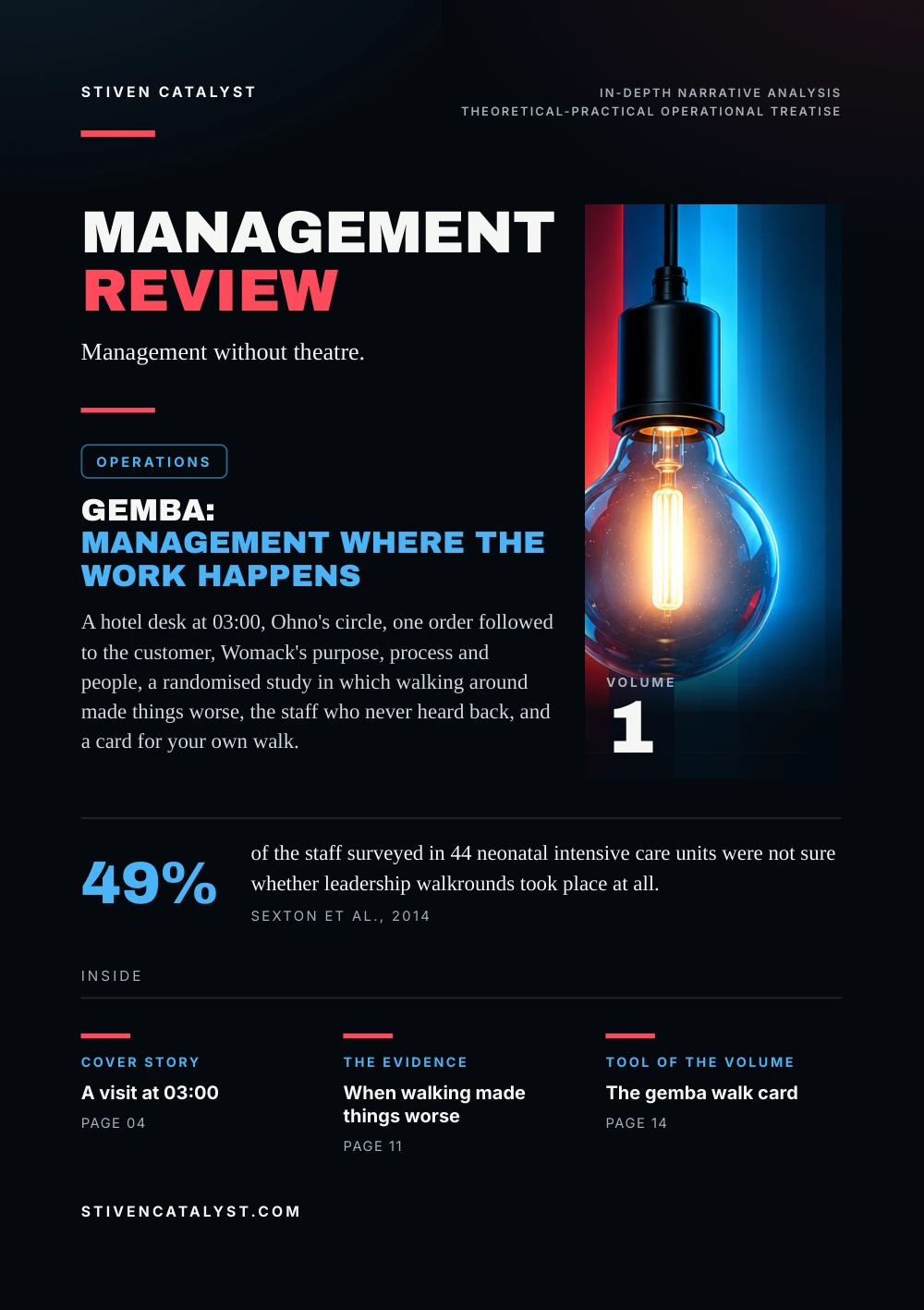
A hotel desk at 03:00, Ohno's circle, one order followed to the customer, Womack's purpose, process and people, a randomised study in which walking around made things worse, the staff who never heard back, and a card for your own walk.

Volume1
49%
of the staff surveyed in 44 neonatal intensive care units were not sure whether leadership walkrounds took place at all.Sexton et al., 2014
stivencatalyst.com
Editorial · Volume 1
The workbehind the number
A report can say a shift missed its target. It cannot, by itself, explain how the failure was made. To understand that, a manager has to cross the distance between the number and the place where people do the work.
How every chapter is built
- 1
The living scene
A shift, a ramp, a desk at 03:00: one piece of work followed as it actually happens, with the hand-off where it breaks. Scenes are constructed from real categories of work and say so.
- 2
The conceptual and scientific breakdown
The mechanism behind the scene, named with the model that explains it, and the research that tests it: the study, its population, its year and its limits, before it is applied anywhere else.
- 3
The operating protocol for action
What a working team can try on Monday: fields, questions, a cadence and a count, each with an owner, a next step and a return of information to the people who do the work.
The reading contract
Fact
The research is attributed, dated and bounded.
Field
Operational examples are anonymised or clearly hypothetical.
Judgment
Editorial readings are not presented as measured effects.
Contents
The chap ters,in three layers
Chapter IA visit at 03:0004
1 SceneA visit at 03:00042 BreakdownThe number is not the process053 ProtocolSee before you diagnose06Chapter IIFollow one piece of work07
1 SceneFollow one piece of work072 BreakdownPurpose, process, people083 ProtocolThe handover that survives the morning09Chapter IIIThe visit that changes nothing10
1 SceneThe visit that changes nothing102 BreakdownWhen walking made things worse11When nobody hears back123 ProtocolCount the follow-through13
Also in this volume
- 14Tool of the volumeThe gemba walk card
- 15Closing essayThe manager after the walk
- 16Editorial methodWhat we can and cannot claim
- 17SourcesSources and method
- 1Scene
- 2Breakdown
- 3Protocol
Chapter I · A visit at 03:00
A visitat 03:00
It is 03:00 in a hotel. The dashboard is quiet. A technical issue has been logged, a guest has been told the morning team will follow up, and the night shift moves on to its next task.
Constructed scene, not a reported incident
On the screen the case looks handled. In reality three things stay open: whether another department accepted it, whether the guest knows when to expect an answer, and whether the incoming shift has enough context to finish it. There is no scandal here. There is a hand-off, exactly the kind of ordinary gap that vanishes inside departmental reports: reception has recorded the issue, another team has work to do, and no single screen guarantees that the chain has closed.
The same shape appears in transport. A late departure is visible on a dashboard while its reason sits elsewhere: an item not ready, a mixed trolley, a late vehicle, an unclear decision at the loading point. The metric is correct about the delay and silent about its origin.
Our reading
A completed entry is not always a completed piece of work.
The examples reflect common categories of hotel and last-mile work; they do not describe an identifiable guest, vehicle, shift or recorded investigation.
- 1Scene
- 2Breakdown
- 3Protocol
Chapter I · A visit at 03:00
The numberis not the process
A last-mile scorecard compresses many events into a few numbers: delays, damaged goods, incomplete deliveries, loading time. The compression is necessary. It also throws information away.
01
What the report sees
A timestamp, a status change, an exception, a rate.
02
What the walk seeks
The actual sequence, the constraint and the decision that shaped the result.
The tempting shortcut is to assign ownership where the error becomes visible: the driver is late, so the driver is the cause; the night auditor carries the open item, so the night auditor failed. These are propositions to test, not conclusions. Taiichi Ohno taught the opposite order. According to Teruyuki Minoura, Ohno took his students to a problem area, drew a circle on the floor and had them watch and ask why, over and over, before explaining anything. In lean language the gemba is the actual place of work; genchi genbutsu means going there to examine the real thing.
Our reading
The first task is not to be seen. It is to see accurately: the report tells us where to look, the observed process tells us what to ask next.
Sources: John Teresko, IndustryWeek, 2004; Lean Enterprise Institute, 2014
The circle is known from the accounts of Ohno's students; how long they stood in it varies from one telling to another, so we give no figure. The terms follow the Lean Enterprise Institute's lexicon.
- 1Scene
- 2Breakdown
- 3Protocol
Chapter I · A visit at 03:00
See beforeyou diagnose
The walk begins by resisting immediate judgment. Presence is a location; inquiry is a discipline. Four questions keep the two apart, in this order.
What was meant to happen?
The standard, as it is written or as the team describes it.
What happened instead?
The observed sequence, with times and places, not motives.
What condition made the deviation possible?
A missing item, an unclear rule, a tool that was not there, a decision nobody owned.
Which parts of the explanation can be checked?
Against the log, the scan, the note, the next department.
The answers may confirm the standard, reveal a broken hand-off, or show that the standard itself no longer fits the work. A manager can stand beside a process and learn nothing, especially when everyone nearby is performing the correct answer for the visitor. The questions are what turn presence into evidence.
Our reading
Ask for the work to be shown, not described from memory. Separate the fact from the first theory about its cause.
Sources: Lean Enterprise Institute, 2014; John Teresko, IndustryWeek, 2004
A practice proposed by the editors, after Ohno's circle and the Lean Enterprise Institute's definition of the gemba walk: grasping the situation by observation and inquiry before taking action.
More in the essayGemba: what you see on the floor that the report does not show
- 1Scene
- 2Breakdown
- 3Protocol
Chapter II · Follow one piece of work
Follow onepiece of work
Imagine following a single order from the warehouse preparation stage to the loading point, through the vehicle and on to the customer. At each transfer the content changes hands, and so do the assumptions.
Conceptual route, not a reconstruction of a particular company's run
- 01
Prepare
Is it the correct, complete item?
- 02
Hand over
Did the status travel with it?
- 03
Load
Is the sequence right?
- 04
Deliver
Did the customer get the result?
The item is complete, the labels are legible, the temperature rules were respected, the loading sequence is correct, the next person has received the right status. The useful finding is sometimes not a mistake but an informal repair: one experienced worker knows which label to check twice, which teammate to call, which exception will break the sequence. The organisation counts the final delivery as a success while the real process depends on a person quietly compensating for a weak rule. If that person is absent tomorrow, the performance may disappear with them.
Our reading
A department can look efficient while sending friction downstream. The walk has to reveal both the formal process and the hidden labour that makes it work.
A conventional departmental review asks whether each team met its own target. A value-stream walk asks whether the whole customer outcome was protected as the work crossed teams. The two questions are not interchangeable.
- 1Scene
- 2Breakdown
- 3Protocol
Chapter II · Follow one piece of work
Purpose, process,people
Jim Womack describes a recurring contradiction: value flows horizontally towards customers, while authority, budgets and scorecards are arranged vertically by function. A manager who looks only inside one department can miss the boundary where a problem takes shape.
01
Purpose
What problem does this stream solve for the customer?
02
Process
How does value actually travel, step by step?
03
People
Can the people doing the work sustain and improve it?
This reframes a walk. It is not an unannounced visit to check whether the team is behaving; it is an investigation of a value stream, walked with everyone who touches it. David Mann adds the distinction between compliance theatre and a repeatable routine: the leader does not come to hear the standard recited, but asks what the process is, how the team knows it works, what happens when it fails, and what is being improved. A workaround found this way is a clue, not misconduct: an obsolete instruction, a capacity gap or an exception the procedure never anticipated.
Our reading
Walking alone shows a department. Walking the stream together shows the hand-offs, where problems usually wait.
Sources: James P. Womack, Lean Enterprise Institute, 2006; Lean Enterprise Institute, 2014; James P. Womack, Lean Enterprise Institute, 2011 (via Lean Enterprise Institute, press release and excerpt); David Mann, Productivity Press, 2005 (via Routledge contents, 3rd ed., 2015; Lean Blog interview, 2014); Mark Graban, Lean Blog Podcast #212, 2014
Womack's three questions follow his column of 2006 and the Lean Enterprise Institute's lexicon; Mann's four questions are from a 2014 interview, his book was not seen. The reading is the editors'.
- 1Scene
- 2Breakdown
- 3Protocol
Chapter II · Follow one piece of work
The handover thatsurvives the morning
A hotel adds a dimension to the stream: work changes hands not only between departments but between hours. A note must carry not just facts but enough context to preserve the decision already made.
- 01
Issue received
What, where, when, in the reporter's words.
- 02
Action taken
Only what was really done, not what was hoped.
- 03
Status confirmed
Open or closed, checked by whom.
- 04
Next owner informed
Who continues, through which channel, and when the guest hears.
The same logic holds at a warehouse shift change. A task described as passed on stays fragile until the receiver knows the status, accepts responsibility and understands the exception. The test is simple: can the next person continue without asking the guest, or the previous shift, to repeat the whole history?
Our reading
The handover is complete when the next person can work, not when the first person presses Send.
Sources: James P. Womack, Lean Enterprise Institute, 2006; Mark Graban, Lean Blog Podcast #212, 2014
A practice proposed by the editors, after Womack's value-stream lens and Mann's four questions; the author's own night-audit experience is in the essay named below, not claimed as data here.
More in the essayWhy the shift handover is one of the most underrated processes
- 1Scene
- 2Breakdown
- 3Protocol
Chapter III · The visit that changes nothing
The visit thatchanges nothing
A senior manager makes a late visit. Colleagues explain a recurring obstacle that makes their shift harder. The manager writes it down, thanks them and leaves. Days pass.
Constructed scene, not an account of a named leader
On the next visit the staff are asked to explain the same obstacle. They cannot point to a decision, an owner or a deadline from the first time. At the first visit the team may have felt heard; at the second, the invitation to speak begins to look like more work. The visit has created a task for the employees, describing a known problem again, while their capacity to solve it has not changed.
Workers can tell whether a visit is an inquiry or an inspection. When a leader arrives with a verdict, the safest response is to show the leader what the leader expects to see. That is a poor way to learn what happens on an ordinary shift, and a worse way to earn the next honest answer.
Our reading
If listening creates expectations, silence after listening is part of the intervention.
A constructed illustration of a general risk, not an account of a named leader or workplace. Its weight rests on the two studies that follow.
- 1Scene
- 2Breakdown
- 3Protocol
Chapter III · The visit that changes nothing
When walkingmade things worse
Anita Tucker and Sara Singer tested management by walking around in US hospitals chosen at random. For 18 months senior managers observed frontline work, asked for ideas and worked with staff on the problems. 56 work areas took part; 138 in control hospitals did not.
Problems per work area, on average (2013)
On average the programme lowered the staff's rating of improvement compared with the control areas. It worked better where teams took on problems they could solve within about 30 days, and where a senior manager was made responsible for seeing a problem through. The implication is uncomfortable: asking frontline staff to reveal barriers can make leadership look less credible if the barriers remain.
Our reading
Being seen on the floor is not the point. A walk pays only when what it finds gets fixed; and the thirty days were a research classification, not a universal deadline.
Source: Anita L. Tucker & Sara J. Singer, Production and Operations Management, 2015 (via Harvard Business School, Working Paper 12-113, 2013)
Improvement was rated by nurses on a 1–5 scale, before (2004) and after (2006); the counts per work area come from the 2013 working paper, the published article (2015) reports the same design. Hospital findings are not a measure of warehouse or hotel performance.
- 1Scene
- 2Breakdown
- 3Protocol
Chapter III · The visit that changes nothing
When nobodyhears back
J. Bryan Sexton and colleagues surveyed staff in 44 US neonatal intensive care units about leadership walkrounds; 2,073 of 3,294 answered (62.9%). The question was not only whether leaders visited, but whether staff knew of the visits and heard what changed.
Staff in 44 neonatal intensive care units, 2011
Units where more staff heard back about the actions taken rated their safety culture better and tended to report less burnout. The study is cross-sectional: it shows an association, not a cause. Put beside the first study it suggests a mechanism worth testing. Observation can reveal constraints; the finding must then be interpreted, owned, acted on and reported back to the people who live with it. Each transition can fail even when the walk itself was sincere.
- 01
Observe
the real sequence
- 02
Verify
the cause, not the first theory
- 03
Assign
a named owner
- 04
Act
change a condition
- 05
Tell back
return the answer
Sources: J. Bryan Sexton et al., BMJ Quality & Safety, 2014; Anita L. Tucker & Sara J. Singer, Production and Operations Management, 2015 (via Harvard Business School, Working Paper 12-113, 2013)
Participation and feedback are averages of the units; 49.1% is the share of all who answered. The chain is an editorial hypothesis built on these two studies, Womack and Mann, not a published multivariable estimate.
- 1Scene
- 2Breakdown
- 3Protocol
Chapter III · The visit that changes nothing
Count thefollow-through
A raw count of walks is easy to produce and easy to game. A more useful scorecard measures what happened after the visit, and keeps the feedback share apart from the resolution share.
Walks held
Completed of scheduled.
Issues verified
Specific problems checked on the floor.
Owner assigned
Issues with a named role.
Action completed
Verified completions of those due.
Told back
Staff informed of those resolved.
- Day 0Observe; record facts and immediate risk.
- Day 3Verify the cause; name the owner and the next action.
- Day 10Check progress; remove cross-team barriers.
- Day 30Verify the result; disclose what changed or why it stays open.
Our reading
Not a promise that every issue is resolved in 30 days, but an owner, a realistic next action and a visible feedback date.
Sources: Anita L. Tucker & Sara J. Singer, Production and Operations Management, 2015 (via Harvard Business School, Working Paper 12-113, 2013); J. Bryan Sexton et al., BMJ Quality & Safety, 2014
Each measure needs a definition, a window and a denominator. The dates are illustrative: an editorial proposal after Tucker & Singer and Sexton et al., not a timetable either study requires. Solve what is safe and soluble now; contain urgent risks without waiting.
More in the essayMistakes get lost between departments
Tool of the volume
The gembawalk card
One process. One clear next action. Fill it in with the people who do the work, and set the date you will come back with an answer before you leave.
01Process and placewhich value stream or hand-off are we following?
02Purposewhat result must the customer receive?
03Observed factwhat actually happened? sight apart from interpretation
04Exception pathwhat do workers do when the standard does not fit?
05Next action and ownerwhat will be checked or changed, and by whom?
06Told backhow and when will the frontline team hear the result?
Sources: Lean Enterprise Institute, 2014; Mark Graban, Lean Blog Podcast #212, 2014; Anita L. Tucker & Sara J. Singer, Production and Operations Management, 2015 (via Harvard Business School, Working Paper 12-113, 2013); J. Bryan Sexton et al., BMJ Quality & Safety, 2014
A practice proposed by the editors, after Womack's three questions, Mann's four and the findings of Tucker & Singer and Sexton et al. The tool named below helps with the cause once the fact is written down.
Open the tool: 5 Whysstivencatalyst.com/tools/five-whys/
Closing essay
The manageraf ter the walk
A manager leaves the office because something important cannot be learned there. The numbers point to a problem; the process explains what the number is made of. But walking to the place where the work happens is only the beginning of an obligation.
Once a driver, a warehouse worker or a night-shift colleague explains a recurring obstacle, management can no longer say it never knew. That knowledge creates a choice. It can become an item on a list, a reason to blame or an excuse for another meeting. Or it can become a verified problem with an owner, an action and a response that reaches the person who raised it.
01
The learning test
Can the manager now describe the real flow, the deviation and the limits of the evidence?
02
The action test
Can the team name what changed, who owns the remainder and when they will hear back?
Where the first answer is no, the visit was a tour. Where the first is yes and the second no, it produced insight without credibility. Repeated often enough, that gap teaches staff that explaining problems makes little difference. The alternative is neither heroism nor another ritual: follow the work, ask what is happening, check the facts, respect the people who know the exceptions, act within the right authority, and return with an answer.
Our reading
Go and see. Then make sure the people who showed you the problem can see what happened next.
Editorial conclusion. No change in a hotel, warehouse or transport KPI is attributed to gemba walks without direct supporting data.
Editorial method
What we canand cannot claim
A narrative investigation, not a causal replication. This volume keeps the evidence of the ten-page issue on gemba, Management Review No. 40, and explains its limits.
Tucker and Singer ran a randomised programme in hospitals; its outcome was a staff survey measure of perceived improvement, not hotel complaints or last-mile damage rates. Sexton and colleagues surveyed staff at one point in time; feedback was associated with safety-culture ratings and burnout, but the design cannot establish that feedback caused the difference. The 30-day horizon belongs to the classification of easy-to-solve problems in the hospital study; we use a similar period as an optional review cycle, clearly labelled as an editorial choice.
01
Documented
Author names, study designs, methods and published figures.
02
Interpreted
What the research may mean for shift operations.
03
Hypothetical
The 03:00 scene, the transport case and the example response cycle.
Nothing here identifies guests, employees, companies, login systems or private operational records. The purpose is to examine how management learns and acts, not to turn routine workplace issues into personal stories without permission or evidence.
Sources: Anita L. Tucker & Sara J. Singer, Production and Operations Management, 2015 (via Harvard Business School, Working Paper 12-113, 2013); J. Bryan Sexton et al., BMJ Quality & Safety, 2014
Research checks completed against the listed primary sources; where a book or article could not be opened, the source carries “via” on the next page.
Sources and method
Where the claimscome from
The figures in this volume come from the sources below, each with its year. The scenes are constructed; the protocols are proposals; what is research is named as research.
- Step Inside the CircleJohn Teresko, IndustryWeek, 2004https://www.industryweek.com/leadership/companies-executives/article/21942244/step-inside-the-circle
- Lean Lexicon: gemba; gemba walkLean Enterprise Institute, 2014https://www.lean.org/lexicon-terms/gemba-walk/
- Purpose, Process, PeopleJames P. Womack, Lean Enterprise Institute, 2006https://www.lean.org/the-lean-post/articles/purpose-process-people/
- Gemba WalksJames P. Womack, Lean Enterprise Institute, 2011 · via Lean Enterprise Institute, press release and excerpthttps://www.lean.org/about-lei/press-releases/lean-management-book-gemba-walks-by-james-womack-challenges-the-prevailing-management-system/
- Creating a Lean Culture: Tools to Sustain Lean ConversionsDavid Mann, Productivity Press, 2005 · via Routledge contents, 3rd ed., 2015; Lean Blog interview, 2014
- Creating a Lean Culture: David Mann on Leader Standard Work and Lean Management SystemsMark Graban, Lean Blog Podcast #212, 2014https://www.leanblog.org/2014/12/podcast-212-david-mann-creating-a-lean-culture-3rd-ed/
- The Effectiveness of Management-By-Walking-Around: A Randomized Field StudyAnita L. Tucker & Sara J. Singer, Production and Operations Management, 2015 · via Harvard Business School, Working Paper 12-113, 2013https://doi.org/10.1111/poms.12226
- Exposure to Leadership WalkRounds in neonatal intensive care units is associated with a better patient safety culture and less caregiver burnoutJ. Bryan Sexton et al., BMJ Quality & Safety, 2014https://pmc.ncbi.nlm.nih.gov/articles/PMC4167964/
Editorial method
Each figure was checked for its year, its publisher and what exactly it measures, at the full text where it could be opened. Where the publisher's page could not be opened, the figure was checked against independent summaries and is marked “via”. The editors' interpretation is marked “Our reading”. No figure of the author's own workplaces is claimed.
ManagementReview
Management without theatre.
Every volume, one question about operations, followed from the floor to the protocol and tested against research.
All volumes
stivencatalyst.com/magazine/operational-treatise.html
Operational Treatise · Volume 1 · October 2026 · Stiven Catalyst
Click or swipe a page to turn it. The arrow keys work too.
Operational Treatise · Volume 1
The figures of the volume
The charts of the printed pages, with their sources. Invented examples are marked as such.
Source: Anita L. Tucker & Sara J. Singer, Production and Operations Management, 2015 (via Harvard Business School, Working Paper 12-113, 2013)
Source: J. Bryan Sexton et al., BMJ Quality & Safety, 2014
The whole text Read the volume as text For reading on a small screen, searching or a screen reader. The same words, without the page design.
Editorial
The work behind the number
A report can say a shift missed its target. It cannot, by itself, explain how the failure was made. To understand that, a manager has to cross the distance between the number and the place where people do the work.
This volume follows one question through warehouses, last-mile transport and the hotel night shift: what changes when a manager leaves the comfort of the report, sees the actual process, and then has to act on what was found? The lens comes from Taiichi Ohno, Jim Womack and David Mann. Two studies of hospital walkrounds test the comforting assumption that visible leadership is useful in itself. They do not confirm it: observation pays only inside a credible chain of finding, owning, resolving and reporting back.
Stiven Janaqi, Editor
How every chap ter is built
- The living scene. A shift, a ramp, a desk at 03:00: one piece of work followed as it actually happens, with the hand-off where it breaks. Scenes are constructed from real categories of work and say so.
- The conce
p tual and scientific breakdown. The mechanism behind the scene, named with the model that explains it, and the research that tests it: the study, its population, its year and its limits, before it is applied anywhere else. - The operating pro
t ocol for action. What a working team can try on Monday: fields, questions, a cadence and a count, each with an owner, a next step and a return of information to the people who do the work.
The reading contract
- Fact. The research is attributed, dated and bounded.
- Field. Operational examples are anonymised or clearly hypothetical.
- Judgment. Editorial readings are not presented as measured effects.
Chap ter I: A visit at 03:00
Layer 1 · The living scene
A visit at 03:00
It is 03:00 in a hotel. The dashboard is quiet. A technical issue has been logged, a guest has been told the morning team will follow up, and the night shift moves on to its next task.
Constructed scene, not a reported incident
On the screen the case looks handled. In reality three things stay open: whether another department accepted it, whether the guest knows when to expect an answer, and whether the incoming shift has enough context to finish it. There is no scandal here. There is a hand-off, exactly the kind of ordinary gap that vanishes inside departmental reports: reception has recorded the issue, another team has work to do, and no single screen guarantees that the chain has closed.
The same shape appears in transport. A late departure is visible on a dashboard while its reason sits elsewhere: an item not ready, a mixed trolley, a late vehicle, an unclear decision at the loading point. The metric is correct about the delay and silent about its origin.
Our reading
A completed entry is not always a completed piece of work.
The examples reflect common categories of hotel and last-mile work; they do not describe an identifiable guest, vehicle, shift or recorded investigation.
Layer 2 · The conceptual and scientific breakdown
The number is not the process
A last-mile scorecard compresses many events into a few numbers: delays, damaged goods, incomplete deliveries, loading time. The compression is necessary. It also throws information away.
- What the repo
r t sees. A timestamp, a status change, an exception, a rate. - What the walk seeks. The actual sequence, the constraint and the decision that shaped the result.
The tempting shortcut is to assign ownership where the error becomes visible: the driver is late, so the driver is the cause; the night auditor carries the open item, so the night auditor failed. These are propositions to test, not conclusions. Taiichi Ohno taught the opposite order. According to Teruyuki Minoura, Ohno took his students to a problem area, drew a circle on the floor and had them watch and ask why, over and over, before explaining anything. In lean language the gemba is the actual place of work; genchi genbutsu means going there to examine the real thing.
Our reading
The first task is not to be seen. It is to see accurately: the report tells us where to look, the observed process tells us what to ask next.
The circle is known from the accounts of Ohno's students; how long they stood in it varies from one telling to another, so we give no figure. The terms follow the Lean Enterprise Institute's lexicon.
Sources: John Teresko, IndustryWeek, 2004; Lean Enterprise Institute, 2014
Layer 3 · The operating protocol for action
See before you diagnose
The walk begins by resisting immediate judgment. Presence is a location; inquiry is a discipline. Four questions keep the two apart, in this order.
- What was meant
t o happen?. The standard, as it is written or as the team describes it. - What happened instead?. The observed sequence, with times and places, not motives.
- What condition made the deviation possible?. A missing item, an unclear rule, a tool that was not there, a decision nobody owned.
- Which pa
r ts of the explanation can be checked?. Against the log, the scan, the note, the next department.
The answers may confirm the standard, reveal a broken hand-off, or show that the standard itself no longer fits the work. A manager can stand beside a process and learn nothing, especially when everyone nearby is performing the correct answer for the visitor. The questions are what turn presence into evidence.
Our reading
Ask for the work to be shown, not described from memory. Separate the fact from the first theory about its cause.
A practice proposed by the editors, after Ohno's circle and the Lean Enterprise Institute's definition of the gemba walk: grasping the situation by observation and inquiry before taking action.
Sources: Lean Enterprise Institute, 2014; John Teresko, IndustryWeek, 2004
More in the essay: Gemba: what you see on the floor that the report does not show
Chap ter II: Follow one piece of work
Layer 1 · The living scene
Follow one piece of work
Imagine following a single order from the warehouse preparation stage to the loading point, through the vehicle and on to the customer. At each transfer the content changes hands, and so do the assumptions.
Conceptual route, not a reconstruction of a particular company's run
- Prepare. Is it the correct, complete item?
- Hand over. Did the status travel with it?
- Load. Is the sequence right?
- Deliver. Did the customer get the result?
The item is complete, the labels are legible, the temperature rules were respected, the loading sequence is correct, the next person has received the right status. The useful finding is sometimes not a mistake but an informal repair: one experienced worker knows which label to check twice, which teammate to call, which exception will break the sequence. The organisation counts the final delivery as a success while the real process depends on a person quietly compensating for a weak rule. If that person is absent tomorrow, the performance may disappear with them.
Our reading
A department can look efficient while sending friction downstream. The walk has to reveal both the formal process and the hidden labour that makes it work.
A conventional departmental review asks whether each team met its own target. A value-stream walk asks whether the whole customer outcome was protected as the work crossed teams. The two questions are not interchangeable.
Layer 2 · The conceptual and scientific breakdown
Purpose, process, people
Jim Womack describes a recurring contradiction: value flows horizontally towards customers, while authority, budgets and scorecards are arranged vertically by function. A manager who looks only inside one department can miss the boundary where a problem takes shape.
- Purpose. What problem does this stream solve for the customer?
- Process. How does value actually travel, step by step?
- People. Can the people doing the work sustain and improve it?
This reframes a walk. It is not an unannounced visit to check whether the team is behaving; it is an investigation of a value stream, walked with everyone who touches it. David Mann adds the distinction between compliance theatre and a repeatable routine: the leader does not come to hear the standard recited, but asks what the process is, how the team knows it works, what happens when it fails, and what is being improved. A workaround found this way is a clue, not misconduct: an obsolete instruction, a capacity gap or an exception the procedure never anticipated.
Our reading
Walking alone shows a department. Walking the stream together shows the hand-offs, where problems usually wait.
Womack's three questions follow his column of 2006 and the Lean Enterprise Institute's lexicon; Mann's four questions are from a 2014 interview, his book was not seen. The reading is the editors'.
Sources: James P. Womack, Lean Enterprise Institute, 2006; Lean Enterprise Institute, 2014; James P. Womack, Lean Enterprise Institute, 2011 (via Lean Enterprise Institute, press release and excerpt); David Mann, Productivity Press, 2005 (via Routledge contents, 3rd ed., 2015; Lean Blog interview, 2014); Mark Graban, Lean Blog Podcast #212, 2014
Layer 3 · The operating protocol for action
The handover that survives the morning
A hotel adds a dimension to the stream: work changes hands not only between departments but between hours. A note must carry not just facts but enough context to preserve the decision already made.
- Issue received. What, where, when, in the reporter's words.
- Action taken. Only what was really done, not what was hoped.
- Status confirmed. Open or closed, checked by whom.
- Next owner informed. Who continues, through which channel, and when the guest hears.
The same logic holds at a warehouse shift change. A task described as passed on stays fragile until the receiver knows the status, accepts responsibility and understands the exception. The test is simple: can the next person continue without asking the guest, or the previous shift, to repeat the whole history?
Our reading
The handover is complete when the next person can work, not when the first person presses Send.
A practice proposed by the editors, after Womack's value-stream lens and Mann's four questions; the author's own night-audit experience is in the essay named below, not claimed as data here.
Sources: James P. Womack, Lean Enterprise Institute, 2006; Mark Graban, Lean Blog Podcast #212, 2014
More in the essay: Why the shift handover is one of the most underrated processes
Chap ter III: The visit that changes nothing
Layer 1 · The living scene
The visit that changes nothing
A senior manager makes a late visit. Colleagues explain a recurring obstacle that makes their shift harder. The manager writes it down, thanks them and leaves. Days pass.
Constructed scene, not an account of a named leader
On the next visit the staff are asked to explain the same obstacle. They cannot point to a decision, an owner or a deadline from the first time. At the first visit the team may have felt heard; at the second, the invitation to speak begins to look like more work. The visit has created a task for the employees, describing a known problem again, while their capacity to solve it has not changed.
Workers can tell whether a visit is an inquiry or an inspection. When a leader arrives with a verdict, the safest response is to show the leader what the leader expects to see. That is a poor way to learn what happens on an ordinary shift, and a worse way to earn the next honest answer.
Our reading
If listening creates expectations, silence after listening is part of the intervention.
A constructed illustration of a general risk, not an account of a named leader or workplace. Its weight rests on the two studies that follow.
Layer 2 · The conceptual and scientific breakdown
When walking made things worse
Anita Tucker and Sara Singer tested management by walking around in US hospitals chosen at random. For 18 months senior managers observed frontline work, asked for ideas and worked with staff on the problems. 56 work areas took part; 138 in control hospitals did not.
Problems per work area, on average (2013): Found 19, Acted on 11.
On average the programme lowered the staff's rating of improvement compared with the control areas. It worked better where teams took on problems they could solve within about 30 days, and where a senior manager was made responsible for seeing a problem through. The implication is uncomfortable: asking frontline staff to reveal barriers can make leadership look less credible if the barriers remain.
Our reading
Being seen on the floor is not the point. A walk pays only when what it finds gets fixed; and the thirty days were a research classification, not a universal deadline.
Improvement was rated by nurses on a 1–5 scale, before (2004) and after (2006); the counts per work area come from the 2013 working paper, the published article (2015) reports the same design. Hospital findings are not a measure of warehouse or hotel performance.
Source: Anita L. Tucker & Sara J. Singer, Production and Operations Management, 2015 (via Harvard Business School, Working Paper 12-113, 2013)
Layer 2 · The conceptual and scientific breakdown
When nobody hears back
J. Bryan Sexton and colleagues surveyed staff in 44 US neonatal intensive care units about leadership walkrounds; 2,073 of 3,294 answered (62.9%). The question was not only whether leaders visited, but whether staff knew of the visits and heard what changed.
Staff in 44 neonatal intensive care units, 2011: Took part in a walkround 20.9%, Heard back about actions taken 18.4%, Not sure walkrounds took place 49.1%.
Units where more staff heard back about the actions taken rated their safety culture better and tended to report less burnout. The study is cross-sectional: it shows an association, not a cause. Put beside the first study it suggests a mechanism worth testing. Observation can reveal constraints; the finding must then be interpreted, owned, acted on and reported back to the people who live with it. Each transition can fail even when the walk itself was sincere.
- Observe. the real sequence
- Veri
f y. the cause, not the first theory - Assign. a named owner
- Act. change a condition
- Tell back. return the answer
Participation and feedback are averages of the units; 49.1% is the share of all who answered. The chain is an editorial hypothesis built on these two studies, Womack and Mann, not a published multivariable estimate.
Sources: J. Bryan Sexton et al., BMJ Quality & Safety, 2014; Anita L. Tucker & Sara J. Singer, Production and Operations Management, 2015 (via Harvard Business School, Working Paper 12-113, 2013)
Layer 3 · The operating protocol for action
Count the follow-through
A raw count of walks is easy to produce and easy to game. A more useful scorecard measures what happened after the visit, and keeps the feedback share apart from the resolution share.
- Walks held. Completed of scheduled.
- Issues verified. Specific problems checked on the floor.
- Owner assigned. Issues with a named role.
- Action compl
e ted. Verified completions of those due. T old back. Staff informed of those resolved.
- Day 0 Observe; record facts and immediate risk.
- Day 3 Verify the cause; name the owner and the next action.
- Day 10 Check progress; remove cross-team barriers.
- Day 30 Verify the result; disclose what changed or why it stays open.
Our reading
Not a promise that every issue is resolved in 30 days, but an owner, a realistic next action and a visible feedback date.
Each measure needs a definition, a window and a denominator. The dates are illustrative: an editorial proposal after Tucker & Singer and Sexton et al., not a timetable either study requires. Solve what is safe and soluble now; contain urgent risks without waiting.
Sources: Anita L. Tucker & Sara J. Singer, Production and Operations Management, 2015 (via Harvard Business School, Working Paper 12-113, 2013); J. Bryan Sexton et al., BMJ Quality & Safety, 2014
More in the essay: Mistakes get lost between departments
Tool of the volume
The gemba walk card
One process. One clear next action. Fill it in with the people who do the work, and set the date you will come back with an answer before you leave.
- Process and place which value stream or hand-off are we following?
- Purpose what result must the customer receive?
- Observed fact what actually happened? sight apart from interpretation
- Exce
p tion path what do workers do when the standard does not fit? - Next action and owner what will be checked or changed, and by whom?
T old back how and when will the frontline team hear the result?
A practice proposed by the editors, after Womack's three questions, Mann's four and the findings of Tucker & Singer and Sexton et al. The tool named below helps with the cause once the fact is written down.
Sources: Lean Enterprise Institute, 2014; Mark Graban, Lean Blog Podcast #212, 2014; Anita L. Tucker & Sara J. Singer, Production and Operations Management, 2015 (via Harvard Business School, Working Paper 12-113, 2013); J. Bryan Sexton et al., BMJ Quality & Safety, 2014
Open the tool: 5 Whys
Closing essay
The manager af ter the walk
A manager leaves the office because something important cannot be learned there. The numbers point to a problem; the process explains what the number is made of. But walking to the place where the work happens is only the beginning of an obligation.
Once a driver, a warehouse worker or a night-shift colleague explains a recurring obstacle, management can no longer say it never knew. That knowledge creates a choice. It can become an item on a list, a reason to blame or an excuse for another meeting. Or it can become a verified problem with an owner, an action and a response that reaches the person who raised it.
- The learning test. Can the manager now describe the real flow, the deviation and the limits of the evidence?
- The action test. Can the team name what changed, who owns the remainder and when they will hear back?
Where the first answer is no, the visit was a tour. Where the first is yes and the second no, it produced insight without credibility. Repeated often enough, that gap teaches staff that explaining problems makes little difference. The alternative is neither heroism nor another ritual: follow the work, ask what is happening, check the facts, respect the people who know the exceptions, act within the right authority, and return with an answer.
Our reading
Go and see. Then make sure the people who showed you the problem can see what happened next.
Editorial conclusion. No change in a hotel, warehouse or transport KPI is attributed to gemba walks without direct supporting data.
Editorial method
What we can and cannot claim
A narrative investigation, not a causal replication. This volume keeps the evidence of the ten-page issue on gemba, Management Review No. 40, and explains its limits.
Tucker and Singer ran a randomised programme in hospitals; its outcome was a staff survey measure of perceived improvement, not hotel complaints or last-mile damage rates. Sexton and colleagues surveyed staff at one point in time; feedback was associated with safety-culture ratings and burnout, but the design cannot establish that feedback caused the difference. The 30-day horizon belongs to the classification of easy-to-solve problems in the hospital study; we use a similar period as an optional review cycle, clearly labelled as an editorial choice.
- Documented. Author names, study designs, methods and published figures.
- Interpr
e ted. What the research may mean for shift operations. - Hypoth
e tical. The 03:00 scene, the transport case and the example response cycle.
Nothing here identifies guests, employees, companies, login systems or private operational records. The purpose is to examine how management learns and acts, not to turn routine workplace issues into personal stories without permission or evidence.
Research checks completed against the listed primary sources; where a book or article could not be opened, the source carries “via” on the next page.
Sources: Anita L. Tucker & Sara J. Singer, Production and Operations Management, 2015 (via Harvard Business School, Working Paper 12-113, 2013); J. Bryan Sexton et al., BMJ Quality & Safety, 2014
Sources and method
Where the claims come from
The figures in this volume come from the sources below, each with its year. The scenes are constructed; the protocols are proposals; what is research is named as research.
- John Teresko, IndustryWeek, “Step Inside the Circle”, 2004. https://www.industryweek.com/leadership/companies-executives/article/21942244/step-inside-the-circle
- Lean Enterprise Institute, “Lean Lexicon: gemba; gemba walk”, 2014. https://www.lean.org/lexicon-terms/gemba-walk/
- James P. Womack, Lean Enterprise Institute, “Purpose, Process, People”, 2006. https://www.lean.org/the-lean-post/articles/purpose-process-people/
- James P. Womack, Lean Enterprise Institute, “Gemba Walks”, 2011 (via Lean Enterprise Institute, press release and excerpt). https://www.lean.org/about-lei/press-releases/lean-management-book-gemba-walks-by-james-womack-challenges-the-prevailing-management-system/
- David Mann, Productivity Press, “Creating a Lean Culture: Tools to Sustain Lean Conversions”, 2005 (via Routledge contents, 3rd ed., 2015; Lean Blog interview, 2014).
- Mark Graban, Lean Blog Podcast #212, “Creating a Lean Culture: David Mann on Leader Standard Work and Lean Management Systems”, 2014. https://www.leanblog.org/2014/12/podcast-212-david-mann-creating-a-lean-culture-3rd-ed/
- Anita L. Tucker & Sara J. Singer, Production and Operations Management, “The Effectiveness of Management-By-Walking-Around: A Randomized Field Study”, 2015 (via Harvard Business School, Working Paper 12-113, 2013). https://doi.org/10.1111/poms.12226
- J. Bryan Sexton et al., BMJ Quality & Safety, “Exposure to Leadership WalkRounds in neonatal intensive care units is associated with a better patient safety culture and less caregiver burnout”, 2014. https://pmc.ncbi.nlm.nih.gov/articles/PMC4167964/
Edit orial me thod
Each figure was checked for its year, its publisher and what exactly it measures, at the full text where it could be opened. Where the publisher's page could not be opened, the figure was checked against independent summaries and is marked “via”. The editors' interpretation is marked “Our reading”. No figure of the author's own workplaces is claimed.
Operational Treatise · Operational treatise