
Trend of the month
Peak season
November opens the busiest season in logistics. For many teams it means more volume, less time and more new people, all at once.
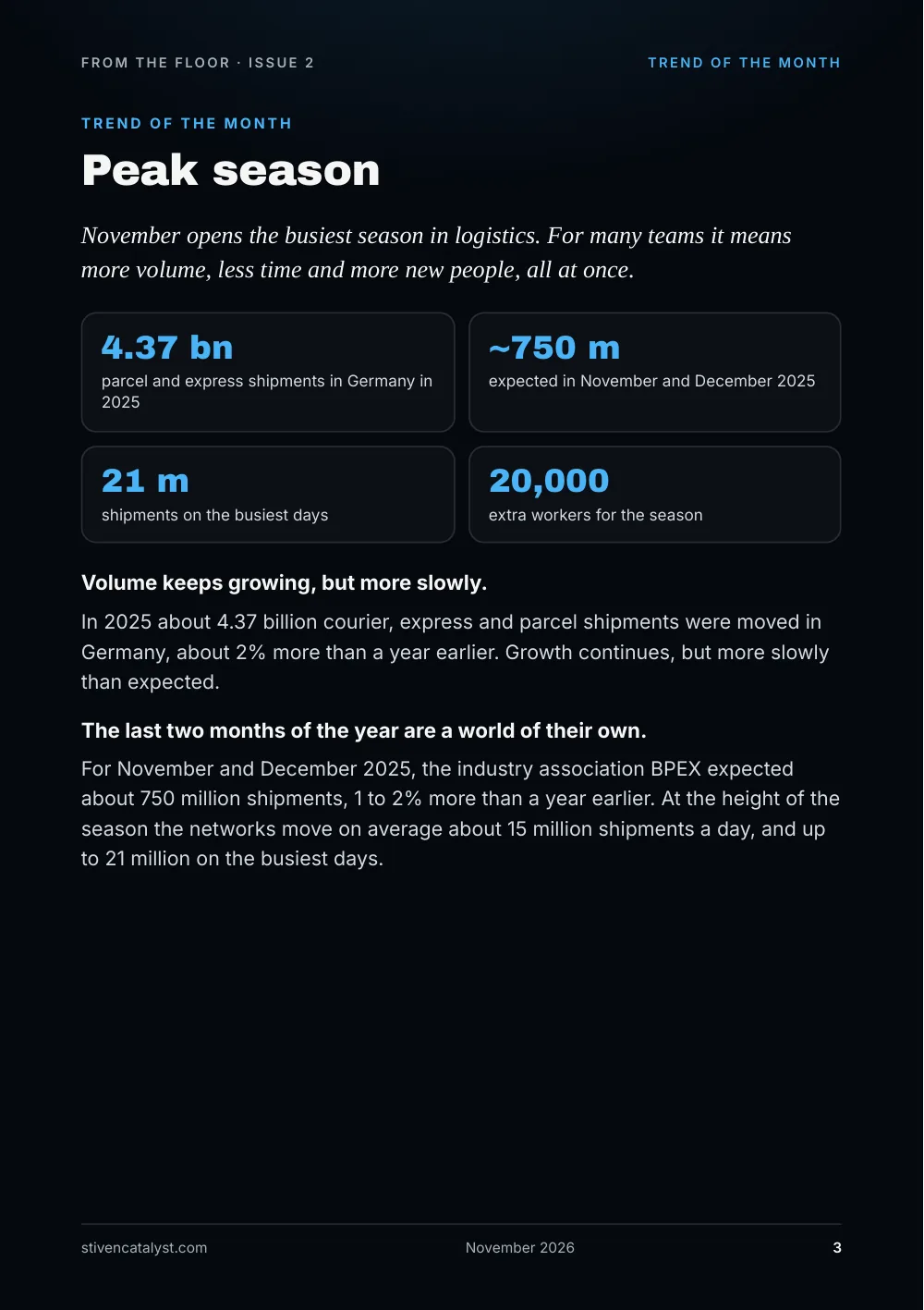
- 4.37 bn parcel and express shipments in Germany in 2025
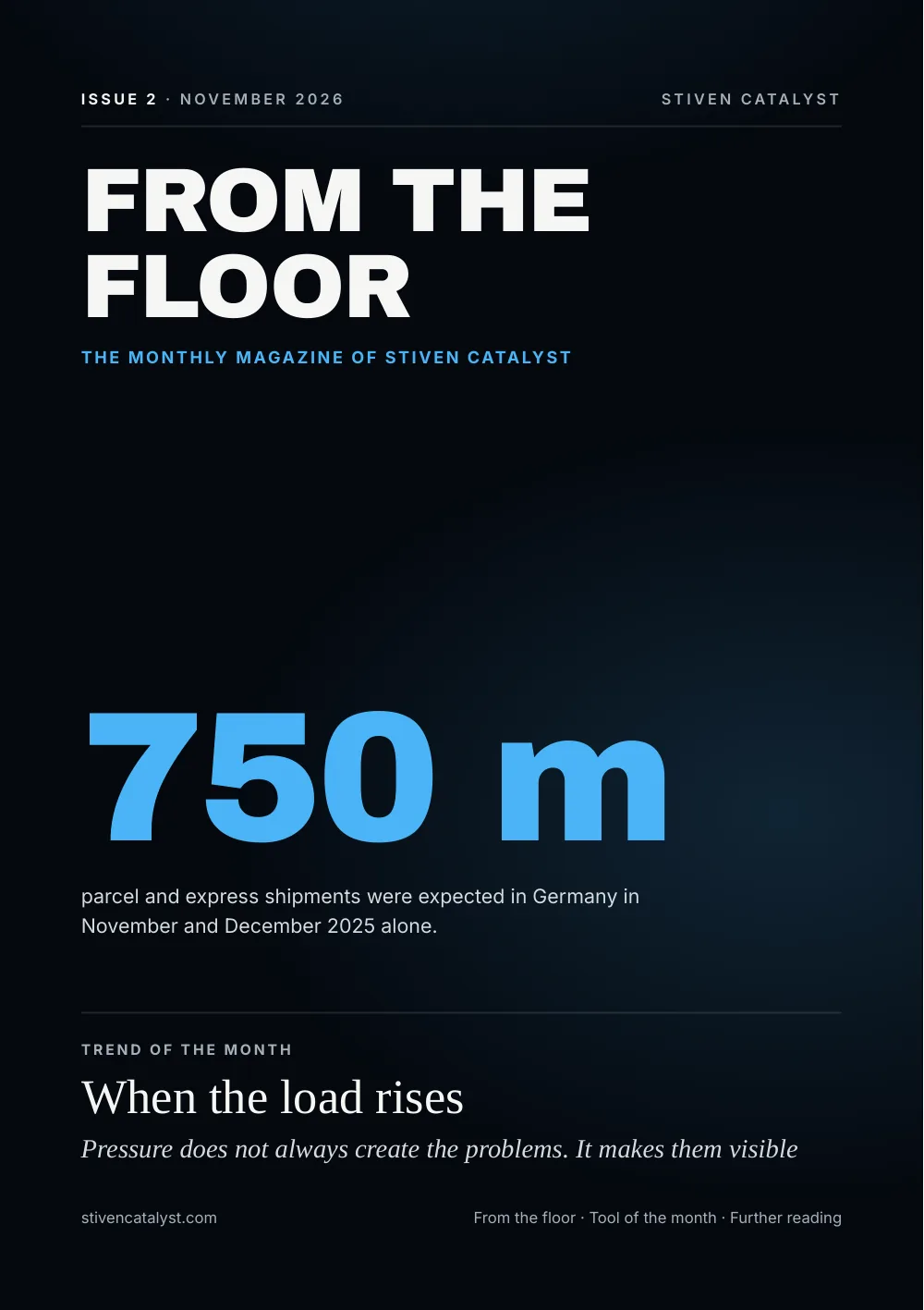
- ~750 m expected in November and December 2025
- 21 m shipments on the busiest days
- 20,000 extra workers for the season
Volume keeps growing, but more slowly.
In 2025 about 4.37 billion courier, express and parcel shipments were moved in Germany, about 2% more than a year earlier. Growth continues, but more slowly than expected.
The last two months of the year are a world of their own.
For November and December 2025, the industry association BPEX expected about 750 million shipments, 1 to 2% more than a year earlier. At the height of the season the networks move on average about 15 million shipments a day, and up to 21 million on the busiest days.
Extra capacity is mostly new people.
To handle the season, companies in the industry were adding up to 20,000 workers and 17,000 vehicles.
And people are hard to find.
According to the Federal Employment Agency's analysis for 2025, Germany had a shortage of skilled workers in 157 occupations, and professional drivers are among the occupations where demand remains high.
Onboarding is the weak point.
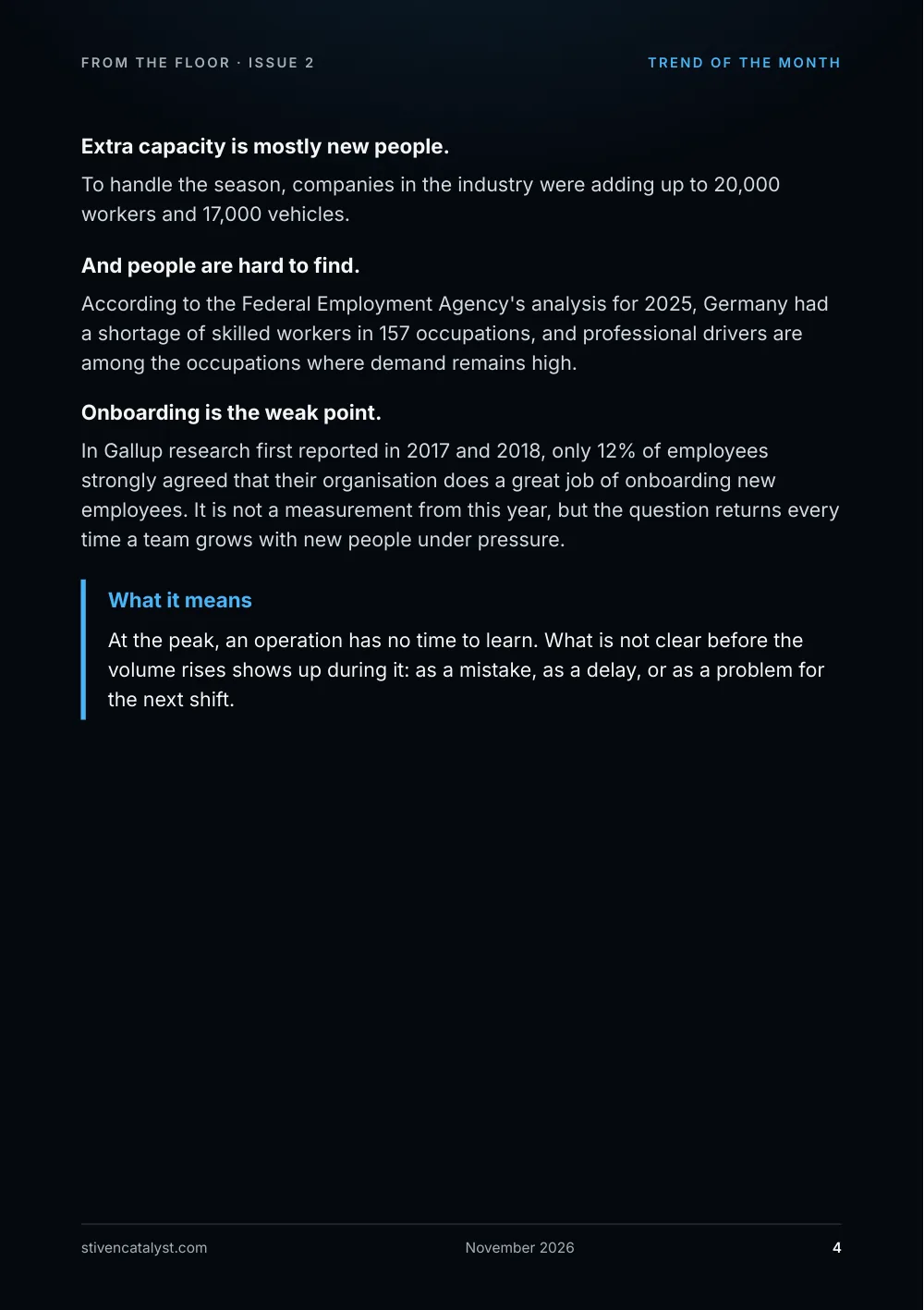
In Gallup research first reported in 2017 and 2018, only 12% of employees strongly agreed that their organisation does a great job of onboarding new employees. It is not a measurement from this year, but the question returns every time a team grows with new people under pressure.
What it means
At the peak, an operation has no time to learn. What is not clear before the volume rises shows up during it: as a mistake, as a delay, or as a problem for the next shift.
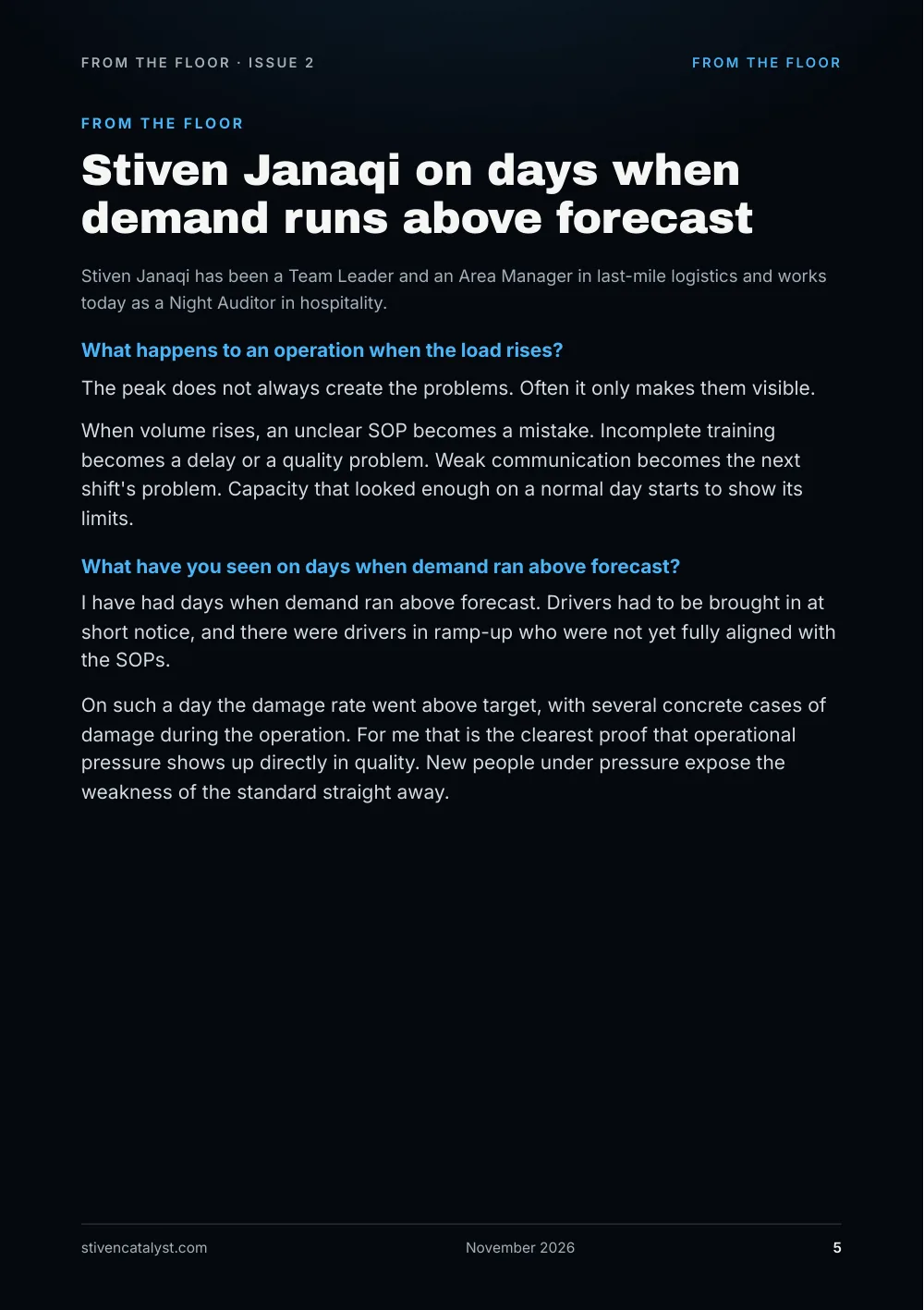
From the floor
Stiven Janaqi on days when demand runs above forecast
Stiven Janaqi has been a Team Leader and an Area Manager in last-mile logistics and works today as a Night Auditor in hospitality.
What happens to an operation when the load rises?
The peak does not always create the problems. Often it only makes them visible.
When volume rises, an unclear SOP becomes a mistake. Incomplete training becomes a delay or a quality problem. Weak communication becomes the next shift's problem. Capacity that looked enough on a normal day starts to show its limits.
What have you seen on days when demand ran above forecast?
I have had days when demand ran above forecast. Drivers had to be brought in at short notice, and there were drivers in ramp-up who were not yet fully aligned with the SOPs.
On such a day the damage rate went above target, with several concrete cases of damage during the operation. For me that is the clearest proof that operational pressure shows up directly in quality. New people under pressure expose the weakness of the standard straight away.
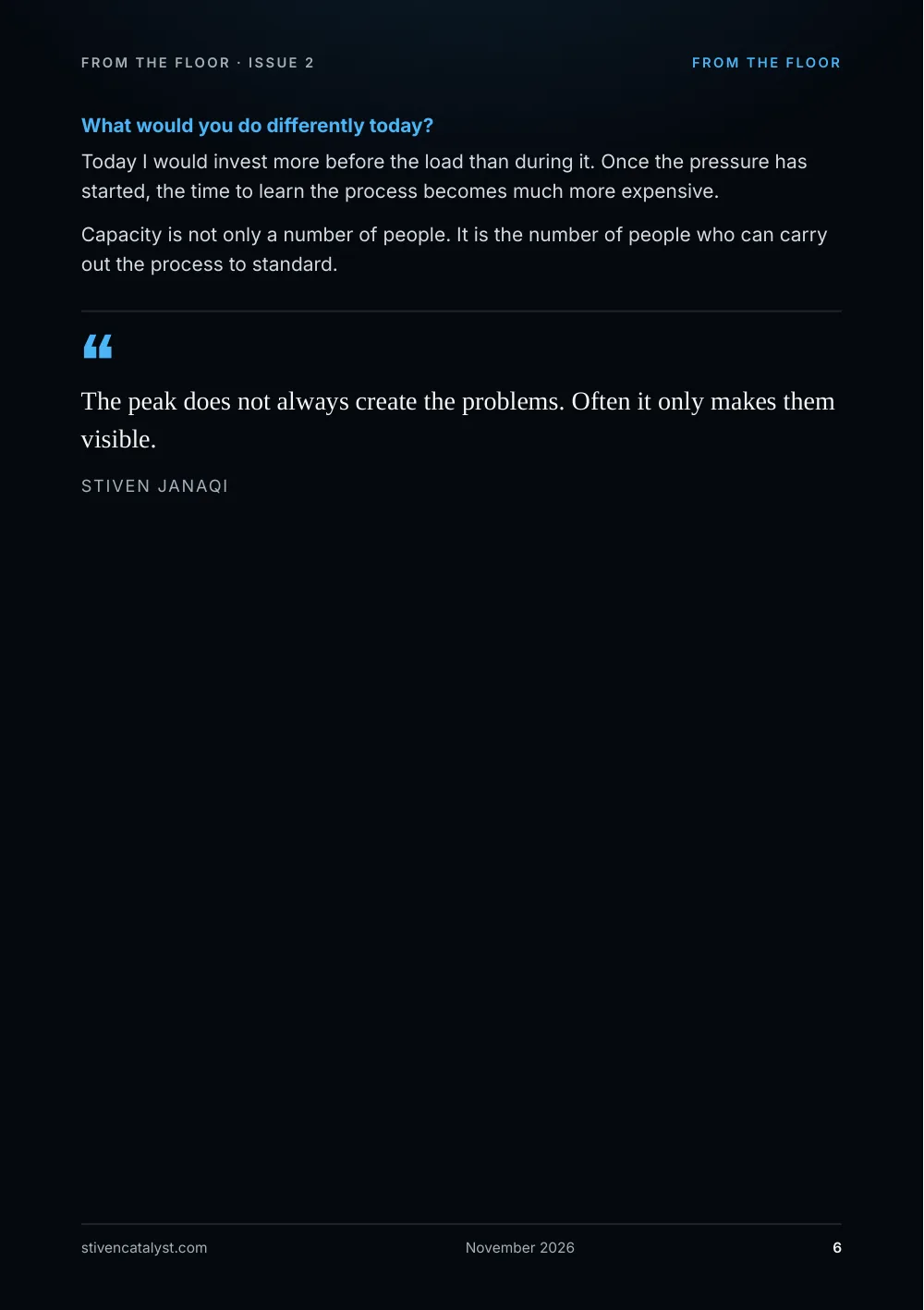
What would you do differently today?
Today I would invest more before the load than during it. Once the pressure has started, the time to learn the process becomes much more expensive.
Capacity is not only a number of people. It is the number of people who can carry out the process to standard.
The peak does not always create the problems. Often it only makes them visible.
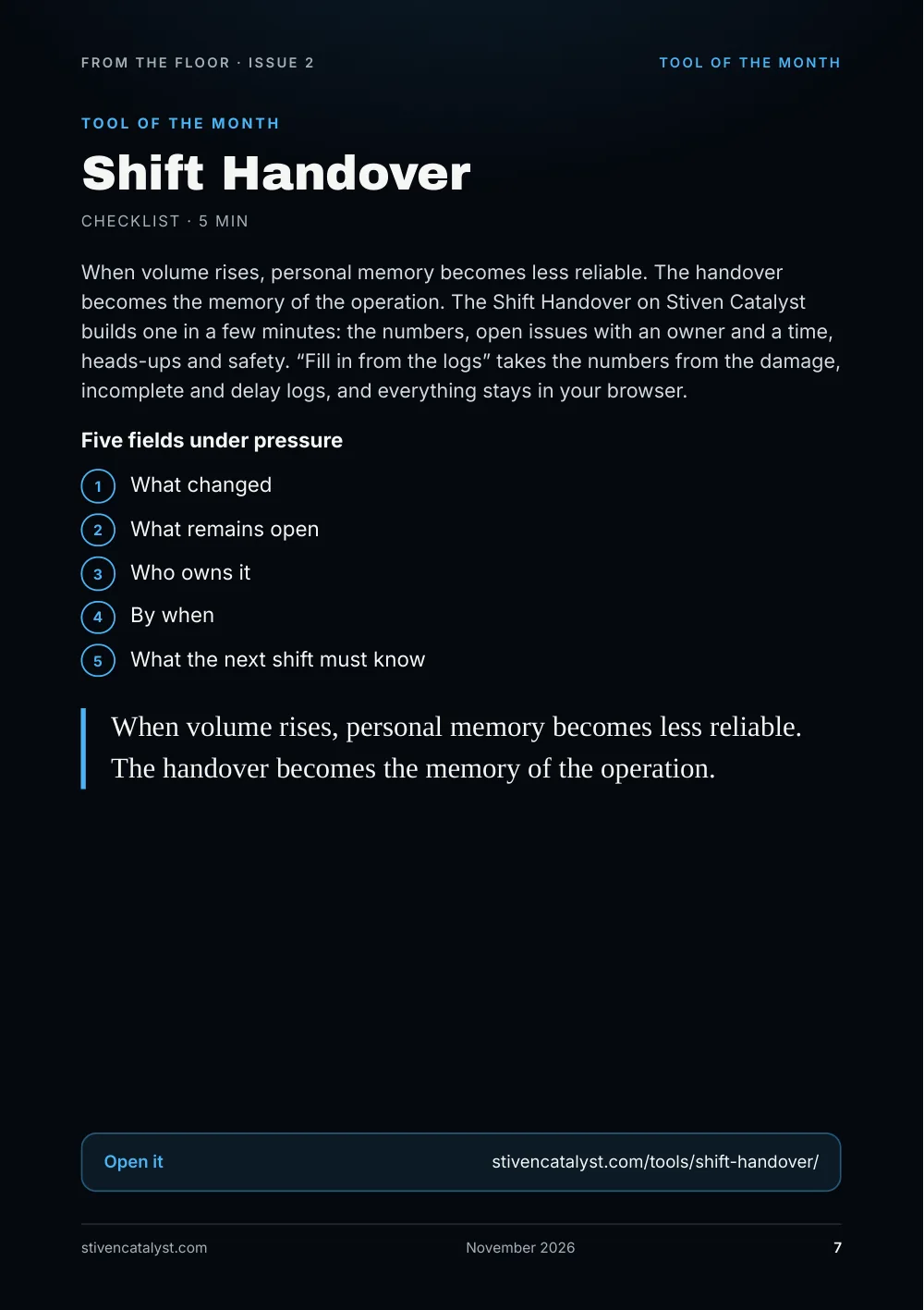
Tool of the month
Shift Handover
When volume rises, personal memory becomes less reliable. The handover becomes the memory of the operation. The Shift Handover on Stiven Catalyst builds one in a few minutes: the numbers, open issues with an owner and a time, heads-ups and safety. “Fill in from the logs” takes the numbers from the damage, incomplete and delay logs, and everything stays in your browser.
Five fields under pressure: What changed → What remains open → Who owns it → By when → What the next shift must know
When volume rises, personal memory becomes less reliable. The handover becomes the memory of the operation.
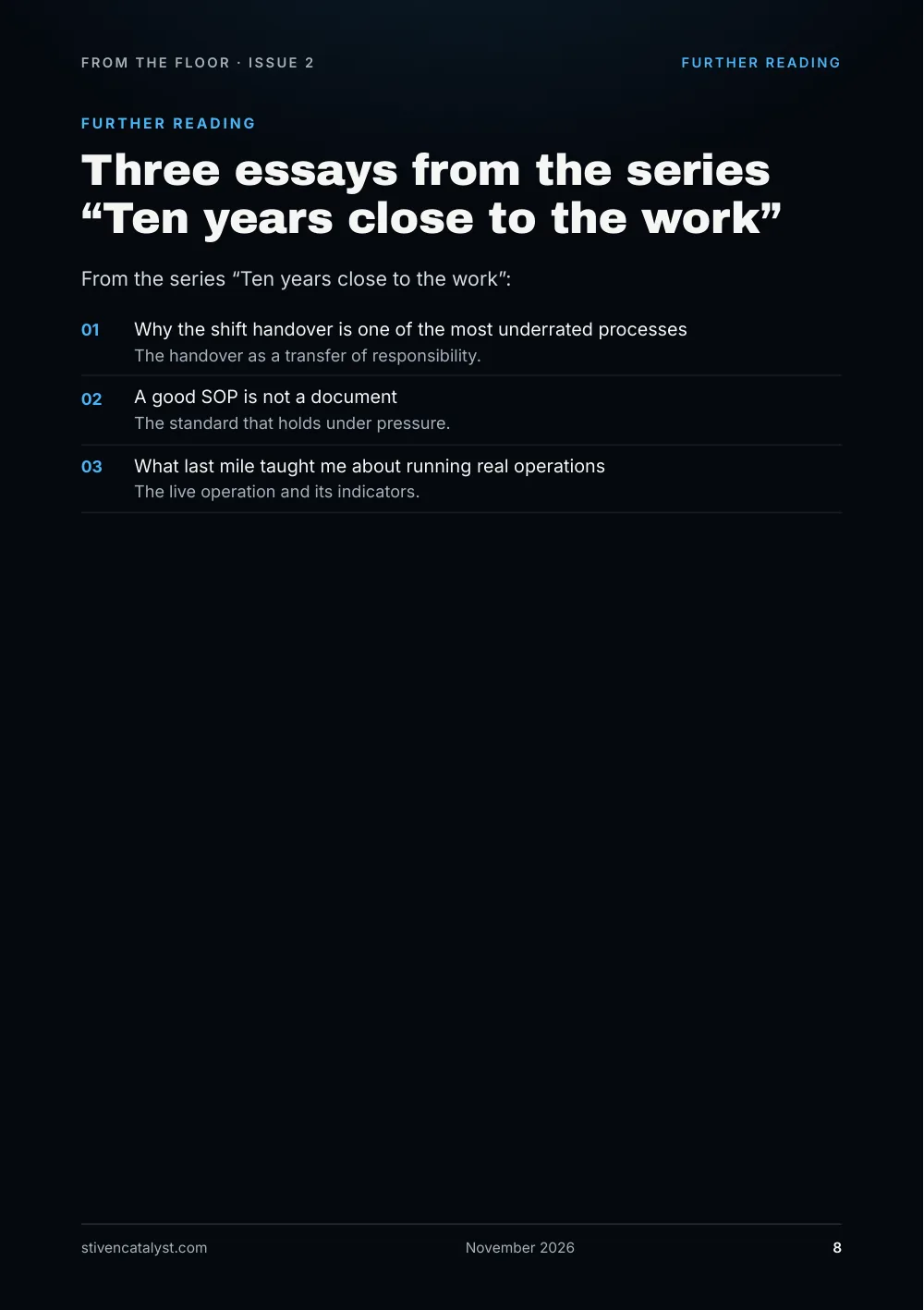
Further reading
Three essays from the series “Ten years close to the work”
From the series “Ten years close to the work”:
- Why the shift handover is one of the most underrated processes
The handover as a transfer of responsibility. - A good SOP is not a document
The standard that holds under pressure. - What last mile taught me about running real operations
The live operation and its indicators.
A question for you
If your volume rose by a third tomorrow, which standard would break first?
Sources
- BPEX (the German parcel and express association, formerly BIEK), facts and figures: shipments in Germany in 2025. https://bpex-ev.de/kep-branche/zahlen-und-fakten.html
- BPEX, “Ausblick Weihnachtsgeschäft 2025”, November 2025: shipments in November and December, peak days, extra staff and vehicles. https://www.bpex-ev.de/presse/meldung/ausblick-weihnachtsgeschaeft-2025.html
- Bundesagentur für Arbeit, Fachkräfteengpassanalyse 2025: occupations with a shortage of skilled workers. https://statistik.arbeitsagentur.de/DE/Statischer-Content/Statistiken/Themen-im-Fokus/Fachkraeftebedarf/Fachkraefteengpassanalyse/Fachkraefteengpassanalyse.html
- Gallup, “Why the Onboarding Experience Is Key for Retention”, 2018, research first reported in State of the American Workplace (2017). https://www.gallup.com/workplace/235121/why-onboarding-experience-key-retention.aspx