Trend of the month
The manager in the middle
The latest data show something many people in operations have felt for a long time: the pressure gathers at the manager.
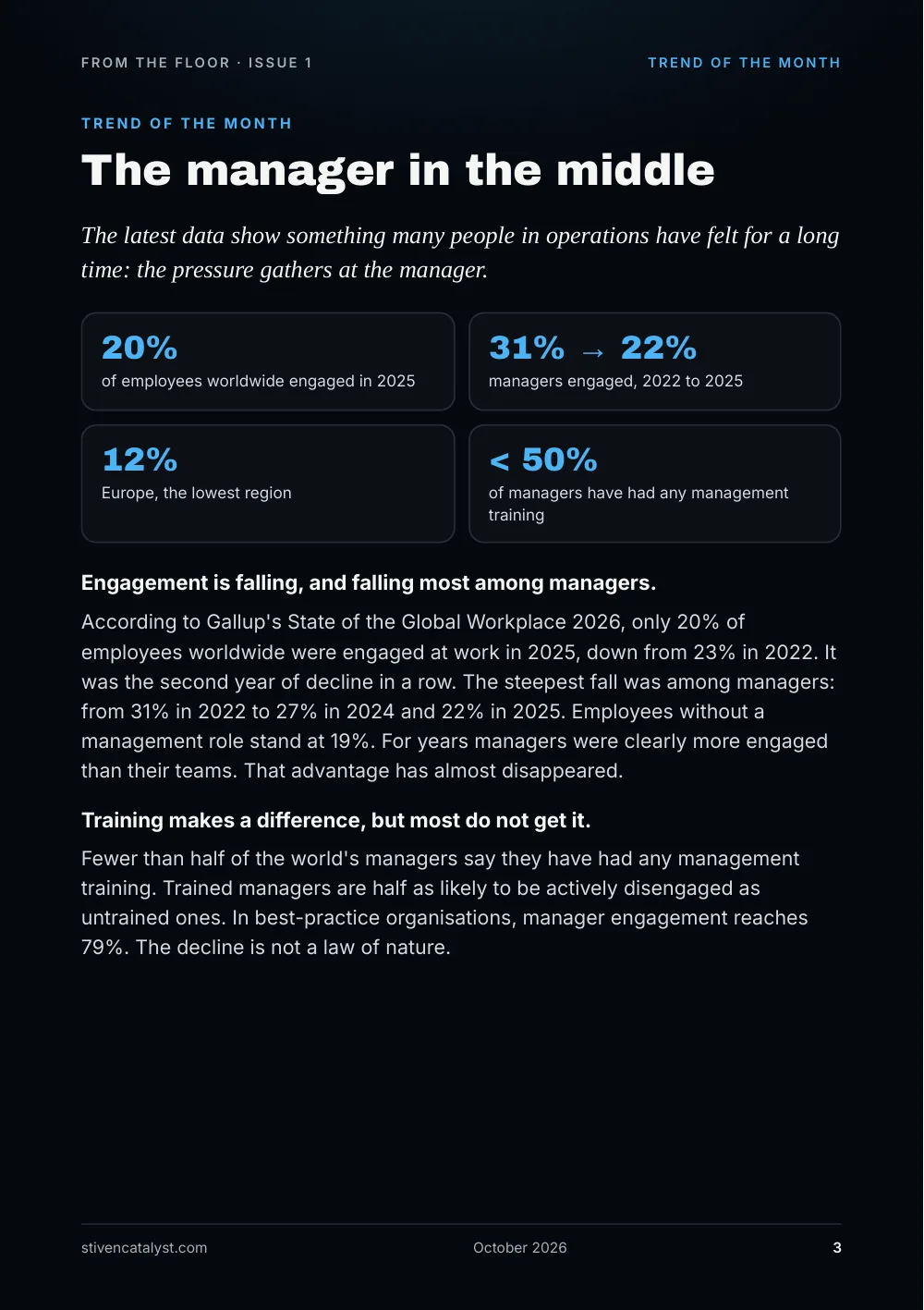
- 20% of employees worldwide engaged in 2025
- 31% → 22% managers engaged, 2022 to 2025
- 12% Europe, the lowest region
- < 50% of managers have had any management training
Engagement is falling, and falling most among managers.
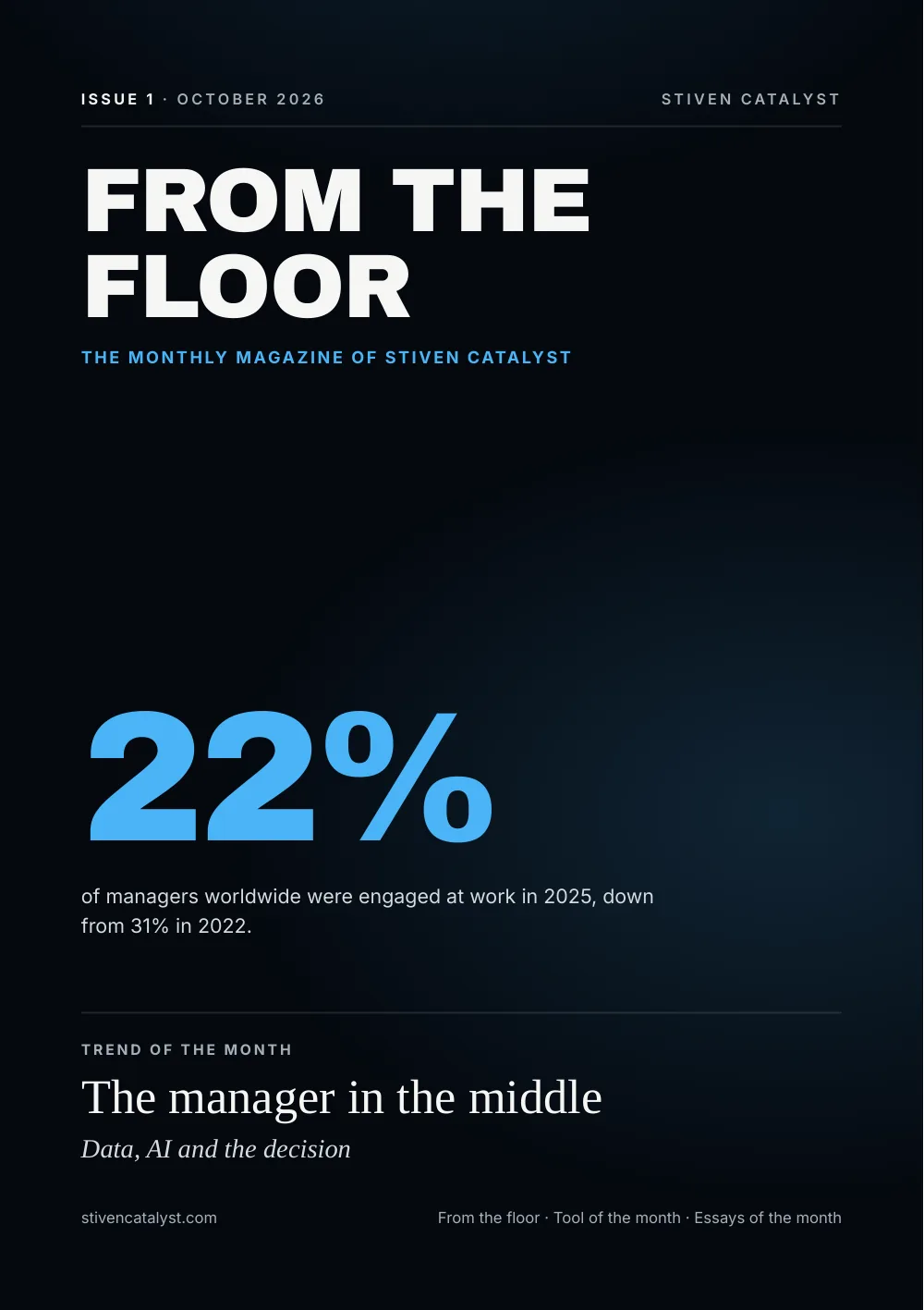
According to Gallup's State of the Global Workplace 2026, only 20% of employees worldwide were engaged at work in 2025, down from 23% in 2022. It was the second year of decline in a row. The steepest fall was among managers: from 31% in 2022 to 27% in 2024 and 22% in 2025. Employees without a management role stand at 19%. For years managers were clearly more engaged than their teams. That advantage has almost disappeared.
Training makes a difference, but most do not get it.
Fewer than half of the world's managers say they have had any management training. Trained managers are half as likely to be actively disengaged as untrained ones. In best-practice organisations, manager engagement reaches 79%. The decline is not a law of nature.
The manager sets most of a team's climate.
Gallup estimates that about 70% of the variance in a team's engagement is linked to its manager.
Teams are growing, but not everywhere alike.
In the US, the average number of direct reports per manager rose from 8.2 in 2013 to 12.1 in 2025. The median stays around 6. The average rises because some teams have become very large, not because every manager has more people.
And now AI arrives, through the manager.
In the second quarter of 2026, according to Gallup, 51% of US leaders used AI a few times a week or more, up from 17% in 2023. Among managers the figure is 36%, up from 15%; among employees without a management role, 26%, up from 9%. Employees whose manager actively supports the team's use of AI use it 2.1 times as often, and their engagement is 48%, against 30% for the others. With frequent use, a clear plan and a supportive manager together, engagement reaches 53%.
A prediction, not a measurement.
In October 2024 Gartner predicted that through 2026, one in five organisations would use AI to flatten their structure, eliminating more than half of current middle management positions.
What it means
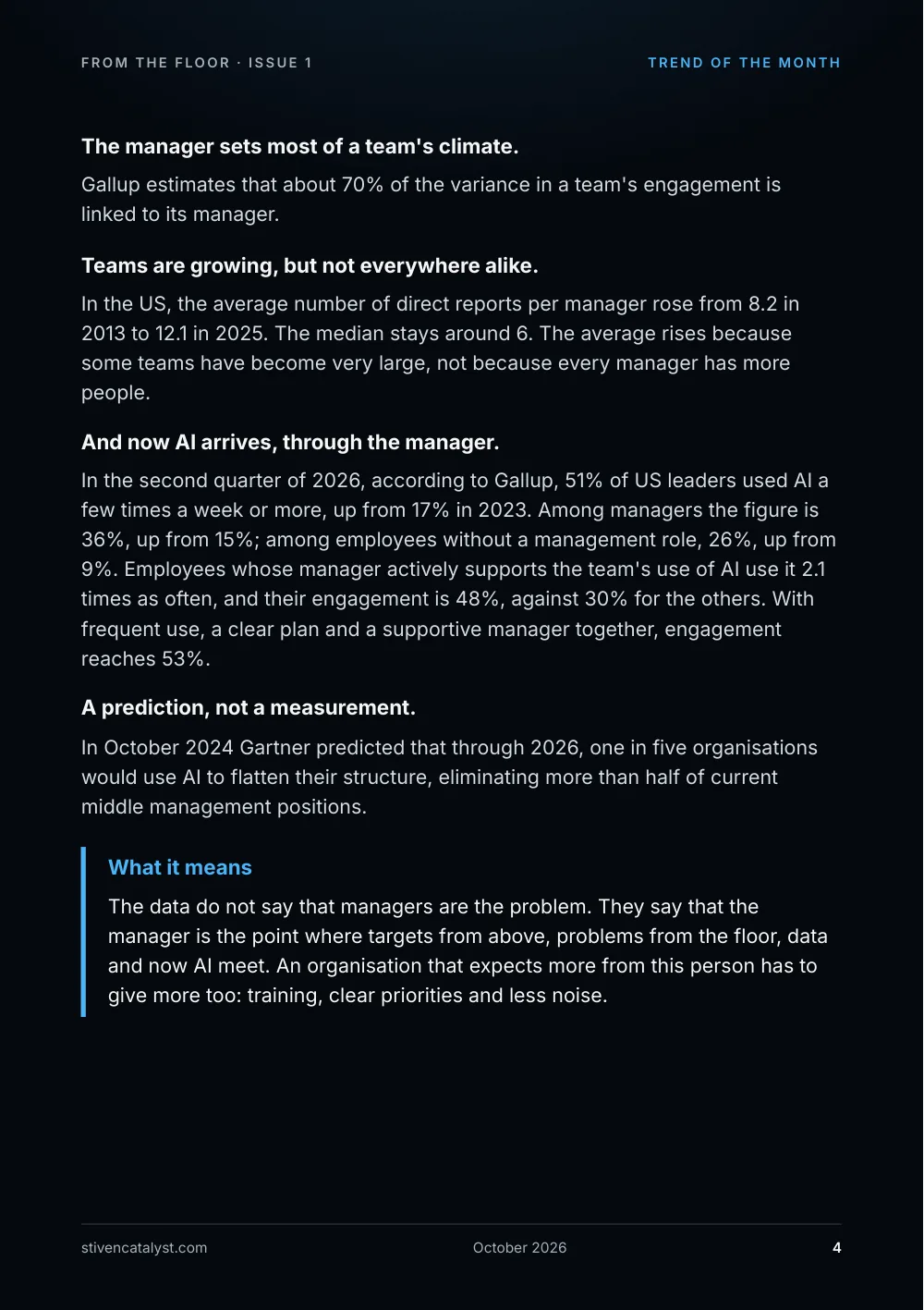
The data do not say that managers are the problem. They say that the manager is the point where targets from above, problems from the floor, data and now AI meet. An organisation that expects more from this person has to give more too: training, clear priorities and less noise.
From the floor
Stiven Janaqi on energy, training, large teams and noise
Stiven Janaqi has been a Team Leader and an Area Manager in last-mile logistics and works today as a Night Auditor in hospitality.
When you were promoted, what took most of your energy?
When I moved from a role closer to the operation to Area Manager, after about five months, the challenge was no longer only solving the problems of the moment. I had 4 Shift Leaders and 8 Dispatchers reporting to me directly, while the operation included around 250 drivers indirectly. Most of my energy went into moving constantly from one problem to the next: KPIs, delays, quality, damage, loading, safety, and people who needed decisions or support.
What wears you out is not always the size of a problem. It is the number of small problems that need attention at the same time.
Did you get management training?
I do not have certain information that would let me say I received a formal management training programme at that moment, so I would not present it as a fact. What would have helped me a lot is an onboarding made for the move from operator to manager: how to prioritise, how to delegate, how to give feedback, how to develop people, and how to tell a problem that needs you from a problem the team should solve itself.
Many people are promoted because they are good at the operational work. But the manager's job needs a different set of skills.
Does it ring true that managers can be as disengaged as their teams?
Yes, it seems credible from what I have seen. Not because managers do not want to do their job, but because they are often the point where all the pressures gather. From above come the targets, the KPIs and the deadlines. From below come people's problems, absences, conflicts and the reality of the operation. In between are the reports, the meetings and the admin.
When this goes on for long, a manager can slide from leading the team to reacting to problems. At that point the energy for coaching, development and improvement is gone.
How many direct reports are too many in operations?
I do not believe in a universal number. It depends on how complex the work is and how autonomous the people are. But from my experience, 12 direct reports in a fast-paced operation is already a serious span. If each of them needs feedback, coaching, problem-solving and escalation, the quality of management can drop very quickly.
The problem is not only how many people you have on the org chart. The question is: how many of them can you really give the attention your role demands?
One thing an organisation could do tomorrow for its first-line managers?
Give them clarity on priorities and take away part of the administrative noise. A first-line manager should not spend most of the day producing reports about the work they should be managing.
I would set up a simple rhythm: a few KPIs that matter, open problems with a clear owner, a short moment for the people, and a defined channel for escalation. If everything is a priority, in the end the manager only reacts.
When I started leading larger operations, I thought my job was to have as many answers as possible. Over time I understood that the most valuable part of the role was knowing which problems really needed my attention. A manager who reacts to everything quickly becomes part of the problem. A manager who tells the signal from the noise can start building a system.
Tool of the month
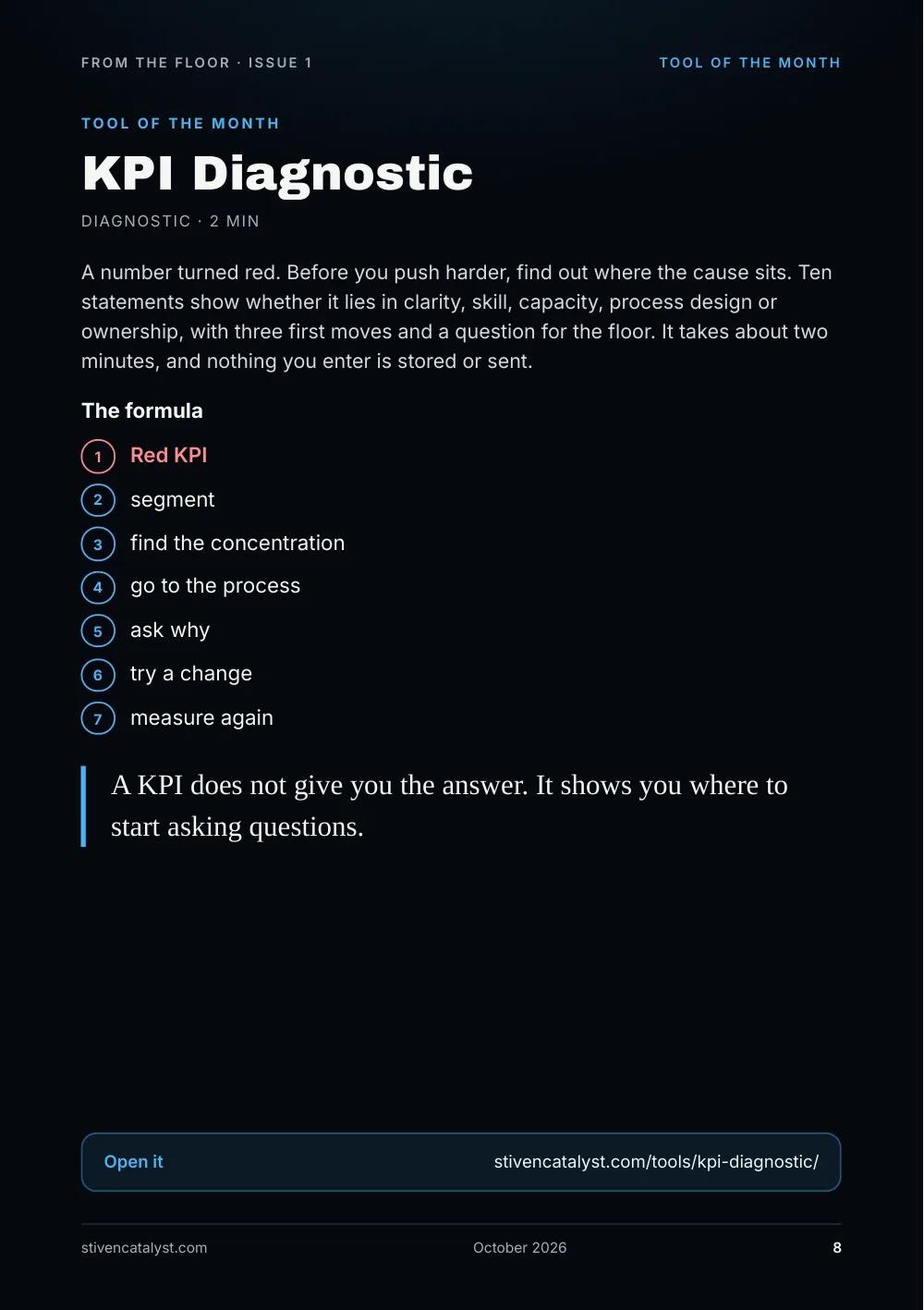
KPI Diagnostic
A number turned red. Before you push harder, find out where the cause sits. Ten statements show whether it lies in clarity, skill, capacity, process design or ownership, with three first moves and a question for the floor. It takes about two minutes, and nothing you enter is stored or sent.
The formula: Red KPI → segment → find the concentration → go to the process → ask why → try a change → measure again
A KPI does not give you the answer. It shows you where to start asking questions.
Essays of the month
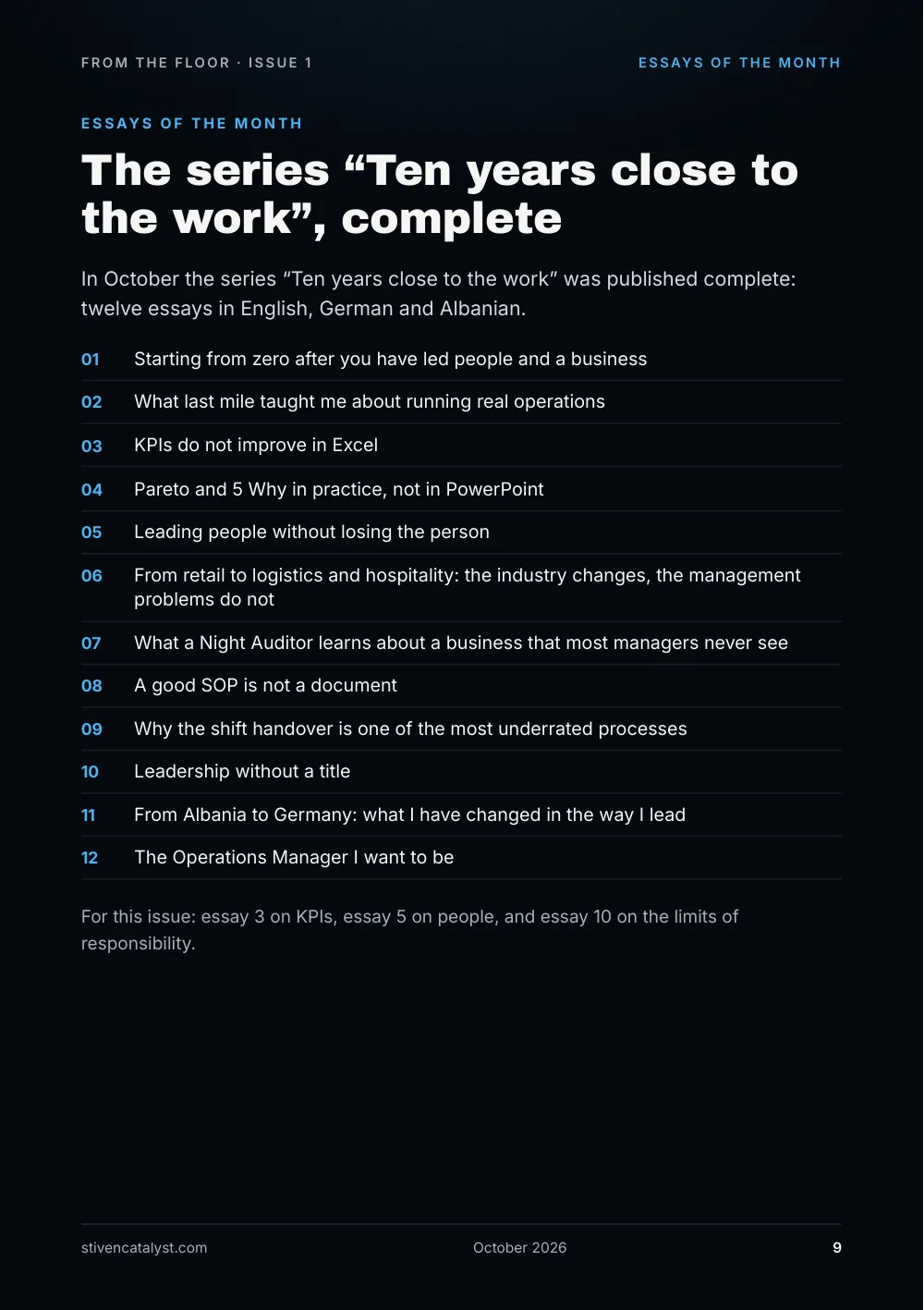
The series “Ten years close to the work”, complete
In October the series “Ten years close to the work” was published complete: twelve essays in English, German and Albanian.
- Starting from zero after you have led people and a business
- What last mile taught me about running real operations
- KPIs do not improve in Excel
- Pareto and 5 Why in practice, not in PowerPoint
- Leading people without losing the person
- From retail to logistics and hospitality: the industry changes, the management problems do not
- What a Night Auditor learns about a business that most managers never see
- A good SOP is not a document
- Why the shift handover is one of the most underrated processes
- Leadership without a title
- From Albania to Germany: what I have changed in the way I lead
- The Operations Manager I want to be
For this issue: essay 3 on KPIs, essay 5 on people, and essay 10 on the limits of responsibility.
A question for you
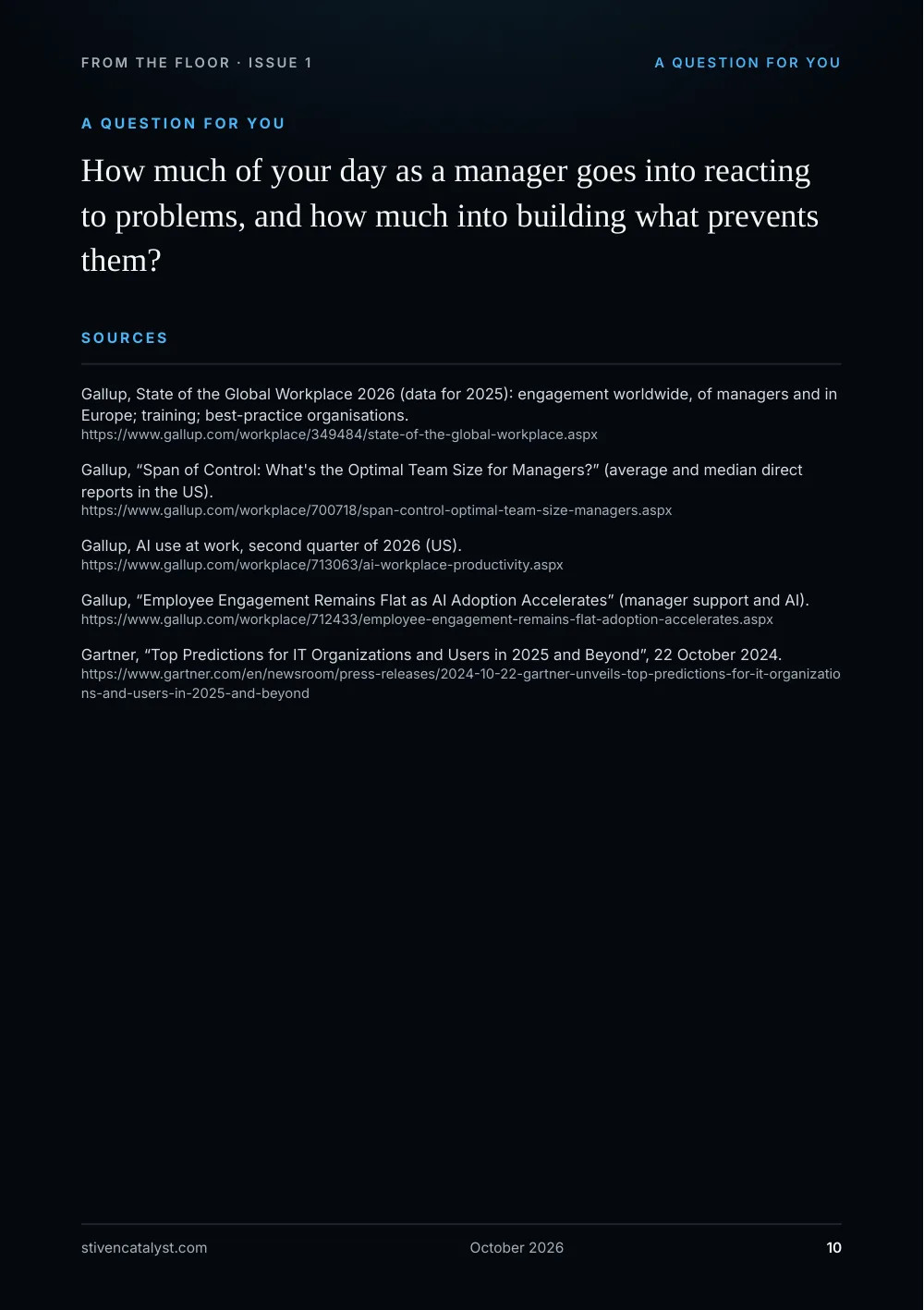
How much of your day as a manager goes into reacting to problems, and how much into building what prevents them?
Sources
- Gallup, State of the Global Workplace 2026 (data for 2025): engagement worldwide, of managers and in Europe; training; best-practice organisations. https://www.gallup.com/workplace/349484/state-of-the-global-workplace.aspx
- Gallup, “Span of Control: What's the Optimal Team Size for Managers?” (average and median direct reports in the US). https://www.gallup.com/workplace/700718/span-control-optimal-team-size-managers.aspx
- Gallup, AI use at work, second quarter of 2026 (US). https://www.gallup.com/workplace/713063/ai-workplace-productivity.aspx
- Gallup, “Employee Engagement Remains Flat as AI Adoption Accelerates” (manager support and AI). https://www.gallup.com/workplace/712433/employee-engagement-remains-flat-adoption-accelerates.aspx
- Gartner, “Top Predictions for IT Organizations and Users in 2025 and Beyond”, 22 October 2024. https://www.gartner.com/en/newsroom/press-releases/2024-10-22-gartner-unveils-top-predictions-for-it-organizations-and-users-in-2025-and-beyond